1990s-05
E-FINANCE
Online banking, wealth, governance, credit unions and digital customers.
Industries · Financial Services
Financial innovation is a question of trust as much as technology. The keynote connects AI and changing customer relationships to accountability, control and new value.

Begin with your audience
Banking leaders, financial-services executives and advisory organizations.
Financial innovation is a question of trust as much as technology. The keynote connects AI and changing customer relationships to accountability, control and new value. The final emphasis depends on who is attending, what they already understand, and the strategic choices your event is intended to support.
The shift
Banks and financial institutions are becoming more digital, more interconnected and more exposed to fast-moving risk. Their differentiator is not software alone: it is the ability to make dependable, explainable decisions at the speed customers now expect.
The 12 forces ↓Financial Services · 12 forces
What this means for leaders: The following twelve shifts connect technology and market change to practical choices for organizations in financial services. They are analysis, not claims that every development is universally deployed or inevitable.
These are the trends Jim is talking about with financial services leaders right now.
The research lens
These themes provide a direction for research, rather than a fixed set of slides. A leadership session can examine assumptions and investment priorities in depth. An industry conference can build a shared view of the changes affecting its members. A customer event can explore the future of the markets your customers serve.
Banking is increasingly experienced through software, embedded payments and continuous digital service rather than a visit to a branch. That changes where customer relationships begin and who controls the interface. Financial institutions need to invest in reliable core capabilities and human help for exceptions instead of assuming that a new app is a complete digital strategy.
Trust remains a competitive asset when customers can move money, compare products and encounter convincing fraudulent content instantly. Clear communication, secure recovery processes and transparent decision-making are part of the product. Institutions should measure the customer's ability to get help when something goes wrong—not just the elegance of the onboarding journey.
AI may expand the ability to assess risk and automate parts of lending, but historical data can carry bias and unstable assumptions. Models require explainability, monitoring, validation and accountable people who can challenge outcomes. The issue is not whether an algorithm scores faster; it is whether a financial institution can defend the decision it made.
Synthetic identities, voice imitation and sophisticated social engineering can make familiar authentication signals less dependable. Fraud programs need layered verification, behavioral evidence and effective customer support rather than a single 'AI detector.' Institutions should plan for a world in which convincing appearance is no longer reliable proof of authenticity.
Payments are increasingly integrated into retail, mobility, software and other experiences. That creates convenience and new partnerships but can blur responsibility for disputes, consumer protection and data use. Banks and payment providers need to decide where they add distinctive trust and infrastructure value when the customer may barely notice the financial transaction.
Real-time financial information can improve treasury visibility and risk responses, but it also changes the pace of decisions and expectations. Faster data without limits or controls can amplify mistakes. Financial leaders must connect analytics to clear authority, exception handling and scenario planning so speed supports judgment instead of bypassing it.
Automated advice can widen access to financial guidance, yet customers still need clarity about assumptions, suitability and who is accountable for recommendations. The most useful model may combine convenient technology with human expertise for complex or consequential decisions. Institutions should separate personalization that helps clients from engagement mechanics designed mainly to sell more products.
Open interfaces and specialized technology providers can unbundle functions once controlled by a single institution. New platform relationships introduce operational, contractual and security dependencies. Banks need an explicit architecture for how data and services move among parties, with customer permission and resilience designed in rather than bolted on later.
Digital finance can extend service to underserved communities, but access depends on connectivity, identity, literacy, product design and cost. An account or app does not create inclusion if a customer cannot use it confidently. Financial institutions should assess barriers from the customer's actual situation rather than treating a download count as evidence of progress.
The bank branch can evolve from a place for routine transactions into a center for advice, complex service and trust-building. The right format varies by community and customer need. Executives should redesign networks using behavior and service outcomes, not a simplistic assumption that every physical location is obsolete.
Financial compliance must adapt to faster products, more data and new forms of risk while preserving due process and professional skepticism. Automation can support triage and documentation, but accountability cannot disappear behind a model. Leaders need governance that updates as quickly as the systems it oversees without losing the ability to explain decisions.
Outages, vendor failure, cybersecurity events and payment interruptions directly shape confidence in a financial brand. Resilience must therefore be visible in architecture, recovery planning and customer communications. A good digital financial product is not merely convenient when everything works; it is dependable and understandable when something fails.
From forecast to decision
This is not a fixed slide deck. The right keynote starts with the audience, the current evidence, the genuine opportunities and the choices leaders must make. These forces are research directions; the specific examples and action framework are customized for the organization at the event.
Every financial services keynote pairs these forces with what the sector’s fastest innovators are doing about them. What world-class innovators do ↗
From the industry brief
The sample guide develops five connected movements. The emphasis and examples are refined around the actual audience and event objectives.
Customer expectations, AI assistants and contextual financial services.
Agents, platforms, embedded finance and shifting distribution economics.
Synthetic evidence, identity confidence, cybersecurity and verification.
What transparency, privacy, judgement and governance mean in the AI era.
Where to start, which outcomes to measure, and how to learn safely.
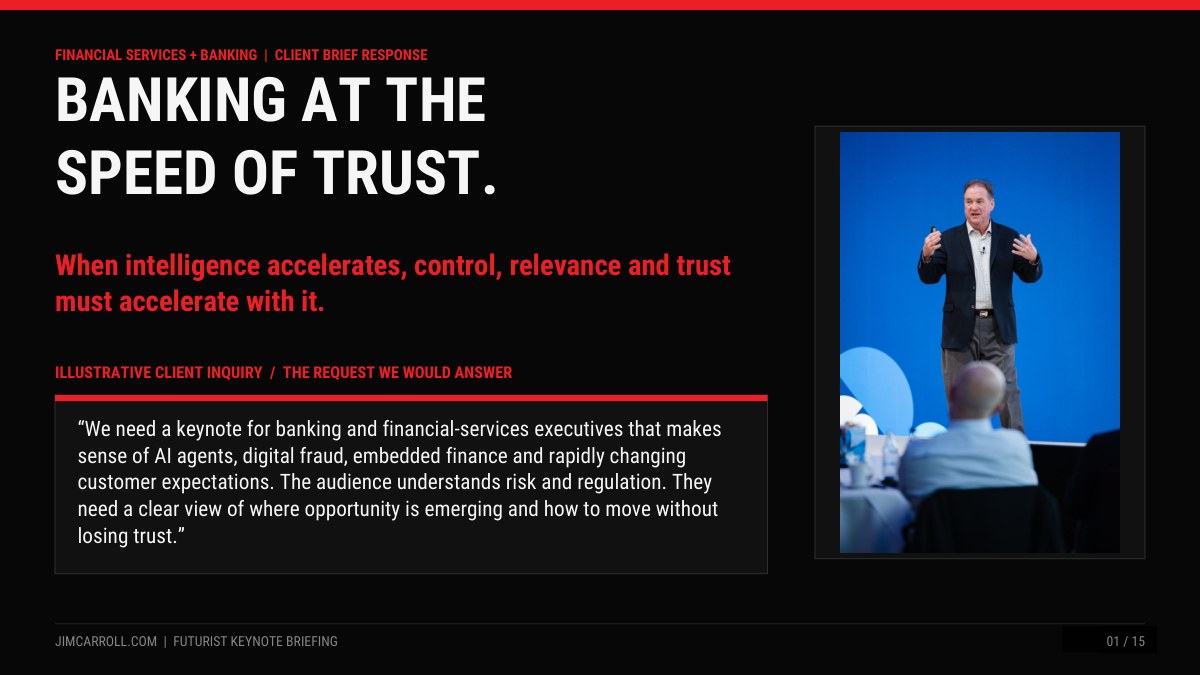
Illustrative industry brief · 15 pages
The complete guide develops the client challenge, relevant forces of change, keynote direction and industry experience. It is an illustrative briefing scenario, not a quotation from an actual client inquiry; the live proposal is shaped around your audience, priorities and objectives.
Read the financial services brief (PDF) ↗All 21 briefs ↗Documented financial services engagements




 iA Financial Group2026 · Case study ↗
 Jenius Bank2024 · Case study ↗
 Northwest Farm Credit Cooperative2019 · Case study ↗
 Deltec Bank2019 · Case study ↗
 Eversheds2018 · Case study ↗
 CPA Canada2018 · Case study ↗
 Canadian Finance & Leasing Association2018 · Case study ↗
 Finastra2017 · Case study ↗
 CUDirect2017 · Case study ↗
 Scotiabank2017 · Case study ↗
 Corcentric2016 · Case study ↗
 Wells Fargo2014 · Case study ↗
 EY Tax2010 · Case study ↗
Also worked with
DeloitteNew York LifeAmerican FidelityElavonBerkshire PartnersBaker TillyAllegacyYPO
The published record
Relevant published engagements from JimCarroll.com. Cross-industry examples show adjacent markets and questions; the specific scope of each assignment is described in its original story.
The deep dive
The branch was never the point. The future of finance is code.
Finance is moving from branch-and-vault to mobile, embedded, API-driven, AI-enabled and real-time. The institutions that win are learning to think like technology companies.
Download the financial services keynote brochure (PDF, 4.7 MB) ↗
The sector story
Finance is moving from branch-and-vault to mobile, embedded, API-driven, AI-enabled and real-time. The institutions that win are learning to think like technology companies.
The bank branch was never the point. The future of finance is code - and it's being written by everyone but the banks.

Experience
Pre-2006 work included RBC, TD, CIBC, BMO, Canada Trust, Hudson Valley Federal Credit Union, credit-union leagues across North America, Yorkton Securities, ScotiaMcLeod, GBC Asset Management, KPMG and professional finance organizations.
1990s-05
Online banking, wealth, governance, credit unions and digital customers.
2006-12
Mobile banking, just-in-time business banking and post-crisis innovation.
2013-18
Smartphones become wallets; fintechs and platforms invade banking.
2019-24
Open banking, data, automation, digital wealth and platform finance.
2025+
AI agents, quantum risk, embedded finance and machine-speed decisions.
Potential keynote directions
These are directions, not canned speeches. Each keynote is customized around the audience, strategic issues and decisions ahead.
01
Mobile, AI, fintech, APIs and the digital customer.
02
From automation to cognitive finance.
03
Embedded finance and category blur.
04
Cashless behaviour, wallets, payments and new rails.
05
Generational transfer, digital advice and changing trust.
06
Risk, controls and decision latency in a machine-speed world.
Trend stack
The future arrives through multiple overlapping shifts, not one technology in isolation.
01
Automation moves from back office to decision support and autonomous workflows.
02
Startups win by solving one customer problem with obsessive focus.
03
Finance becomes a platform others can build upon.
04
Payments disappear into phones, apps, vehicles and commerce flows.
05
Robo-advice, transparency and generational wealth transfer reshape advice.
06
AI fraud, cyber risk and quantum computing challenge legacy controls.
Leadership
The strategic advantage is recognizing which assumptions have expired, building capacity to experiment, and moving fast enough to matter.
Think big. Start small. Learn fast. Scale what works.

2027 Brief · Board & trustee leadership
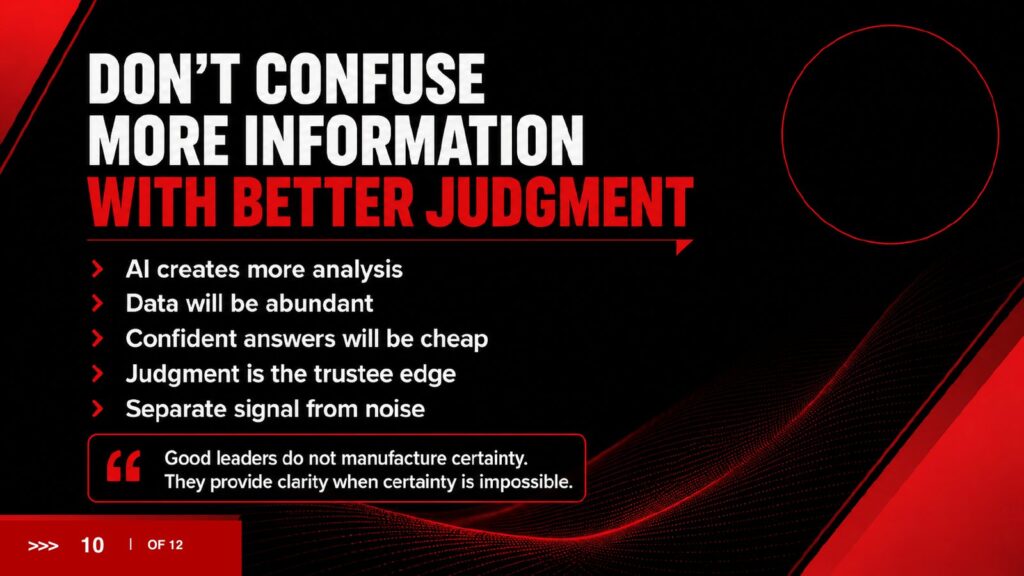
A board does not need another technology lecture. It needs to know which assumptions are expiring, which questions it should be asking and where judgment matters most. That is why Jim builds the keynote around the decisions the people in the audience are actually responsible for.
Shaping the Future, Trustee to Trustee: how a broad future-of-change brief became a focused conversation for pension trustees about governance, assumptions, judgment and the decisions they must make in a faster world. 18-month decisions. 70-year promises.
See the full brief ↗All 2027 Briefs ↗

Client stories
Different client. Different audience. Different strategic problem.

Finastra
Global banking technology and business-model disruption.

Credit Union Leadership
Board and executive strategy on demographics, technology and member expectations.

Banking Scorecard
Mobile, smartphone payments and non-bank competitors - calls that became mainstream.
Payments & Platforms
VISA, American Express, Discover, Elavon and financial technology ecosystems.
Deep customization
Client calls, industry research, event objectives, trend analysis and current developments are built into the keynote.
Listen → research → map the trends → build the story → connect the audience → leave a playbook.

These sections first appeared on financial.jimcarroll.com, Jim’s former financial industry site, and now live here with their original copy and images.
From the research archive
Quick answers
Jim Carroll builds each financial services keynote around the forces changing the decisions in front of the audience. Among them: banking increasingly becomes software rather than a place; trust becomes the differentiator in digital finance; AI underwriting tests fairness and explainability; and fraud expands in an era of synthetic identities. Typical audiences: banking leaders, financial-services executives and advisory organizations.
Documented financial services engagements on this site include iA Financial Group, Jenius Bank, Enterprise Bank, First Financial Resources, Northwest Farm Credit Cooperative, Deltec Bank, BlackRock and Eversheds, among 19 in all. Each one is written up as a case study.
Yes. Every keynote starts with a conversation with your team and typically 25–50+ hours of fresh research into your audience, your organization and the issues your leaders are working through. For financial services audiences, the research themes include AI agents and customer advice; synthetic identity and digital fraud; embedded finance and distribution; and human judgment and governance. The final emphasis depends on who is attending.
Yes. The financial services brief (15 pages) sets out a client challenge, the relevant forces of change, a keynote direction and Jim’s industry experience. It is an illustrative scenario; the real proposal is shaped around your event.
Yes. He delivers virtual keynotes from his own broadcast studio, and has opened congresses in Muscat, Dubai, Marrakesh, Tokyo and São Paulo with live translation into as many as five languages.
Send a short inquiry: your industry, who is attending, the event type and date, what is changing fastest around the audience, and what you want them doing differently afterward. Jim reads and answers every inquiry personally, usually the same day. Fees are on request, and booking through a speakers bureau or direct costs the same.
Other industries
Make it about your audience
Bring the event objectives, the people attending and the questions you want them discussing afterward.