 WorldSkills
 The Home Depot
 Lockheed Martin
 American Federation of Teachers
1990s-05
DIGITAL LEARNING
Data swamps, wireless classrooms, online knowledge and changing careers.
Industries · Education & Workforce
The future of learning is a practical issue for employers and educators alike. The keynote connects AI and accelerating knowledge to careers, credentials and institutional change.
Begin with your audience
Education leaders, employers, training organizations and workforce professionals.
The future of learning is a practical issue for employers and educators alike. The keynote connects AI and accelerating knowledge to careers, credentials and institutional change. The final emphasis depends on who is attending, what they already understand, and the strategic choices your event is intended to support.
The shift
Knowledge cycles are shortening while many education and employment structures still operate on older timetables. The challenge is to make lifelong learning, practical skill evidence and adaptability normal parts of institutions and careers.
The 12 forces ↓Education & Workforce · 12 forces
What this means for leaders: The following twelve shifts connect technology and market change to practical choices for organizations in education & workforce. They are analysis, not claims that every development is universally deployed or inevitable.
These are the trends Jim is talking about with education & workforce leaders right now.
The research lens
These themes provide a direction for research, rather than a fixed set of slides. A leadership session can examine assumptions and investment priorities in depth. An industry conference can build a shared view of the changes affecting its members. A customer event can explore the future of the markets your customers serve.
The useful life of a technical skill can be shorter than the training program built to teach it. Schools, employers and individuals therefore need systems for continuous renewal rather than the assumption that a credential settles competence for a decade. The essential strategic shift is from 'What do we know now?' to 'How fast can we learn what comes next?'
Adaptive platforms can help learners practice at an appropriate level and identify gaps early, but an algorithm cannot decide the purpose of education. Educators must protect critical thinking, motivation, social learning and access while using technology to improve feedback. Effectiveness should be tested through actual learning gains rather than platform engagement metrics alone.
Degrees and certificates remain valuable signals, yet employers increasingly need evidence that someone can perform a rapidly changing task. Skills demonstrations, portfolios, apprenticeships and credible microcredentials can complement traditional qualifications. The challenge is to maintain standards while creating more flexible and understandable paths into employment.
AI tutors and content tools create opportunities for personalized support, but they also destabilize conventional homework and assessment. Institutions must redesign what learning evidence means, what assistance is acceptable and how teachers remain accountable for outcomes. The priority is not to ban every tool or embrace every promise, but to develop defensible pedagogy and governance.
Technical careers are evolving alongside robotics, energy systems, advanced manufacturing and connected infrastructure. Apprenticeship programs and training providers need direct feedback from the workplace, modern equipment and instructors supported to keep current. Closing the skills gap requires shortening the distance between a new industry requirement and a usable learning experience.
Much important learning happens during work: a maintenance problem, a customer question or an unfamiliar piece of software. Embedding guidance and coaching in these moments can be more effective than pulling people out for occasional generic training. Employers should measure whether performance improves in practice, not merely whether an online module was completed.
Long careers will involve more transitions between roles, industries and technologies than traditional pathways assumed. Workers need portable capabilities, credible retraining routes and confidence that change is possible. Institutions can help by connecting foundational learning to modular, continuing education without presenting every pivot as starting over from zero.
Curriculum committees, accreditation cycles and funding processes may move more slowly than the technologies students will encounter. Education leaders must preserve rigor while creating faster ways to pilot, review and retire course content. The objective is disciplined adaptability, not constant curriculum upheaval driven by hype.
AI use in education requires clear boundaries around student data, transparency, accessibility, academic integrity and teacher judgment. A governance compact should be understandable to students and staff and adaptable as tools change. Purchasing software before settling these responsibilities creates institutional risk as well as confusion about what is permitted.
Employers often complain about skills shortages while remaining distant from the design of training. Better partnerships can clarify real competencies, provide practical experience and improve pathways into hiring. They must avoid turning schools into narrow vendor-training centers; foundational judgment and transferable skills still matter when particular tools become obsolete.
Reliable connectivity, accessible interfaces and suitable devices are now basic participation requirements in many learning settings. AI-rich environments can widen gaps if unequal access is ignored. Leaders should evaluate digital inclusion as a practical delivery issue involving support, affordability and accessibility—not merely the existence of an online portal.
Completion rates say little about whether people are better prepared for changing work. Institutions and employers need to measure retention, transfer of learning, adaptability and confidence in unfamiliar tasks. The question worth asking is whether graduates and employees can recognize when yesterday's answer has stopped being useful—and learn a better one quickly.
From forecast to decision
This is not a fixed slide deck. The right keynote starts with the audience, the current evidence, the genuine opportunities and the choices leaders must make. These forces are research directions; the specific examples and action framework are customized for the organization at the event.
Every education & workforce keynote pairs these forces with what the sector’s fastest innovators are doing about them. What world-class innovators do ↗
From the industry brief
The sample guide develops five connected movements. The emphasis and examples are refined around the actual audience and event objectives.
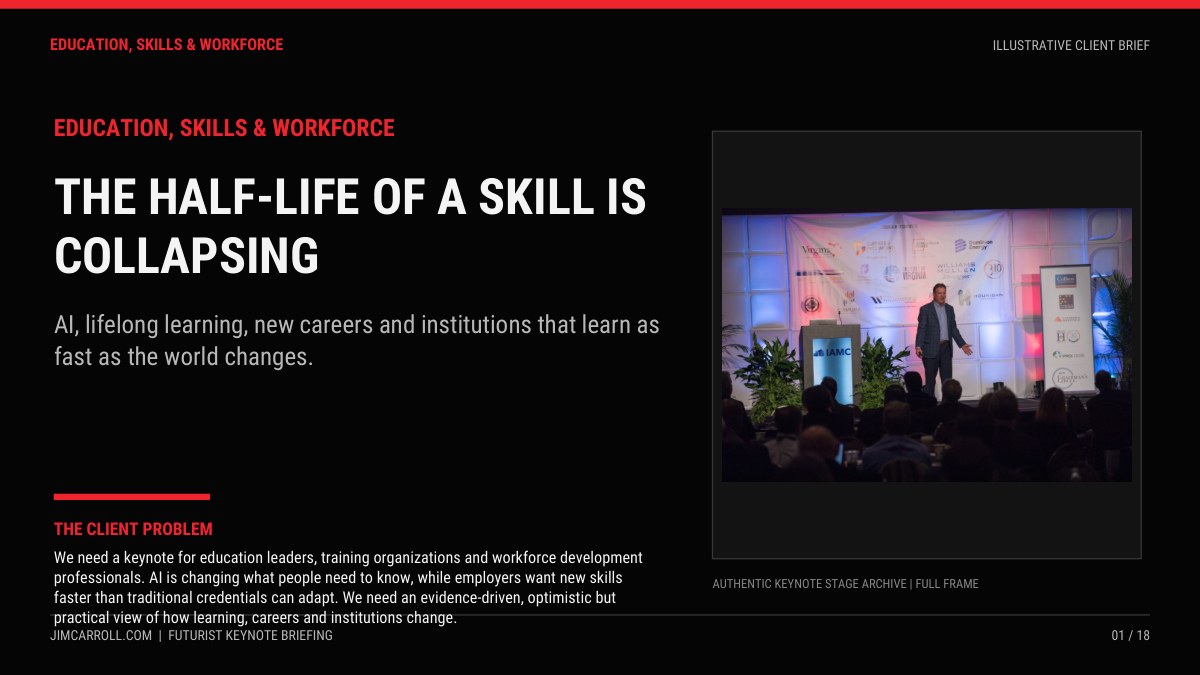
Illustrative industry brief · 18 pages
The complete guide develops the client challenge, relevant forces of change, keynote direction and industry experience. It is an illustrative briefing scenario, not a quotation from an actual client inquiry; the live proposal is shaped around your audience, priorities and objectives.
Read the education & workforce brief (PDF) ↗All 21 briefs ↗Documented education & workforce engagements
The published record
Relevant published engagements from JimCarroll.com. Cross-industry examples show adjacent markets and questions; the specific scope of each assignment is described in its original story.
The deep dive
Just-in-time knowledge. Skills acceleration. AI. Lifelong learning.
Education is being reshaped by collapsing knowledge half-lives, AI, personalized learning and the reality that many students will work in jobs that do not yet exist.
Download the education & workforce keynote brochure (PDF, 2.5 MB) ↗
The sector story
Education is being reshaped by collapsing knowledge half-lives, AI, personalized learning and the reality that many students will work in jobs that do not yet exist.
Learning is what adults will do for a living.

Experience
Pre-2006 engagements included the College Board Colloquium, American Federation of Teachers, Maine Technical College System, Calgary Board of Education/CCTCA, Clark County and St. Vrain school districts, First Nations Education Council, and universities and colleges across Canada and the U.S.
1990s-05
Data swamps, wireless classrooms, online knowledge and changing careers.
2006-12
Just-in-time knowledge, personalized learning and institutional agility.
2013-19
WorldSkills, credentialing, career colleges and workforce alignment.
2020-25
Remote learning, new credentials, skills-first hiring and AI tools.
2026+
Learning velocity becomes the core competitive skill.
Potential keynote directions
These are directions, not canned speeches. Each keynote is customized around the audience, strategic issues and decisions ahead.
01
Knowledge velocity, AI and institutional reinvention.
02
How AI changes learning, teaching, assessment and skills.
03
Aligning schools and workforce systems to fast-changing skills.
04
Why learning velocity matters more than static expertise.
05
Credentials, careers and new institutional models.
06
How education leaders create agility in a slow system.
Trend stack
The future arrives through multiple overlapping shifts, not one technology in isolation.
01
AI tutors, copilots and adaptive learning reshape instruction.
02
The right learning arrives at the moment of need.
03
Expertise expires faster; continuous reskilling becomes normal.
04
Learning becomes more individualized, modular and outcomes-driven.
05
Microcredentials, skills evidence and alternative pathways expand.
06
Education prepares people for a moving target, not a fixed job list.
Leadership
The strategic advantage is recognizing which assumptions have expired, building capacity to experiment, and moving fast enough to matter.
Think big. Start small. Learn fast. Scale what works.
Client stories
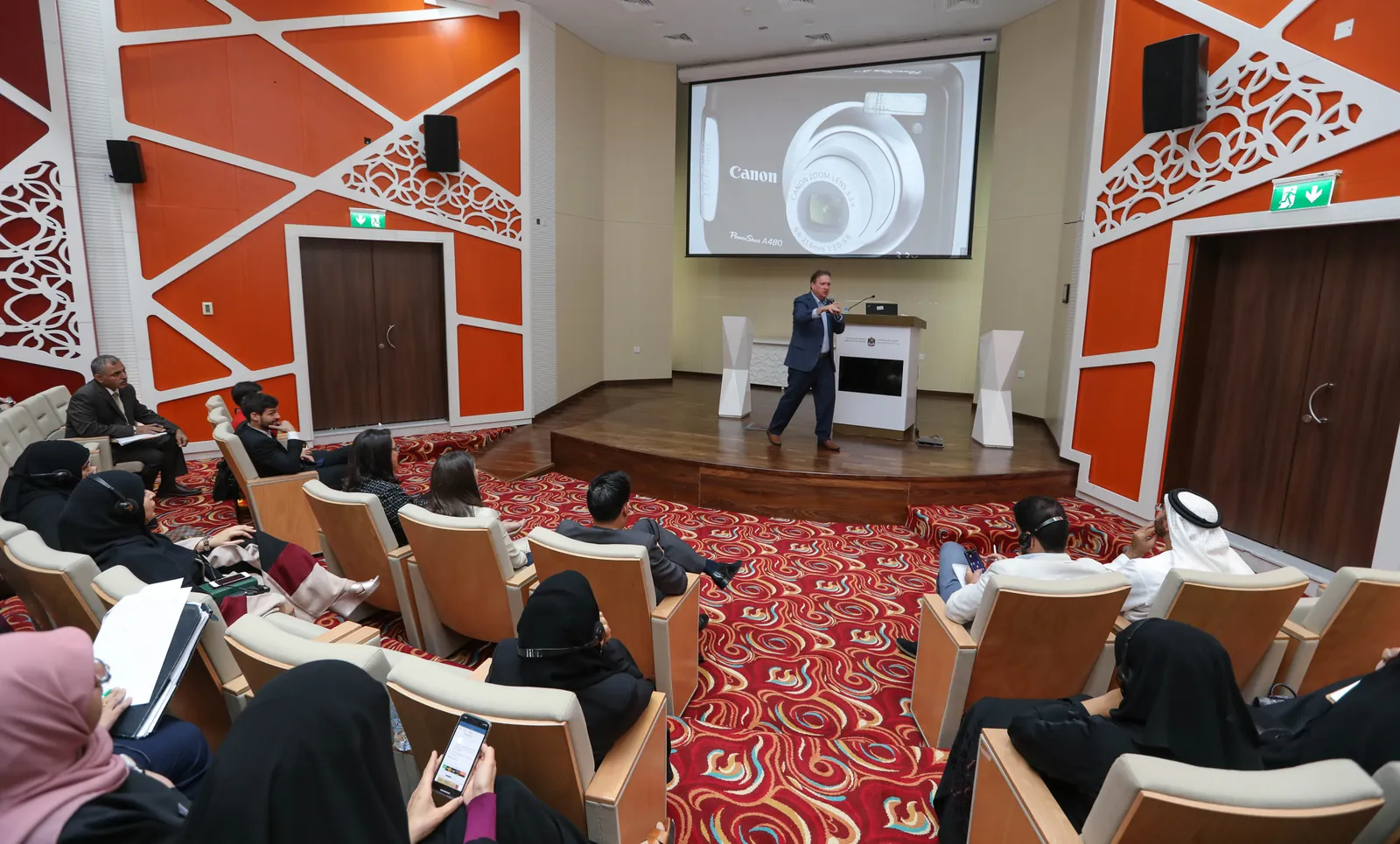
Different client. Different audience. Different strategic problem.
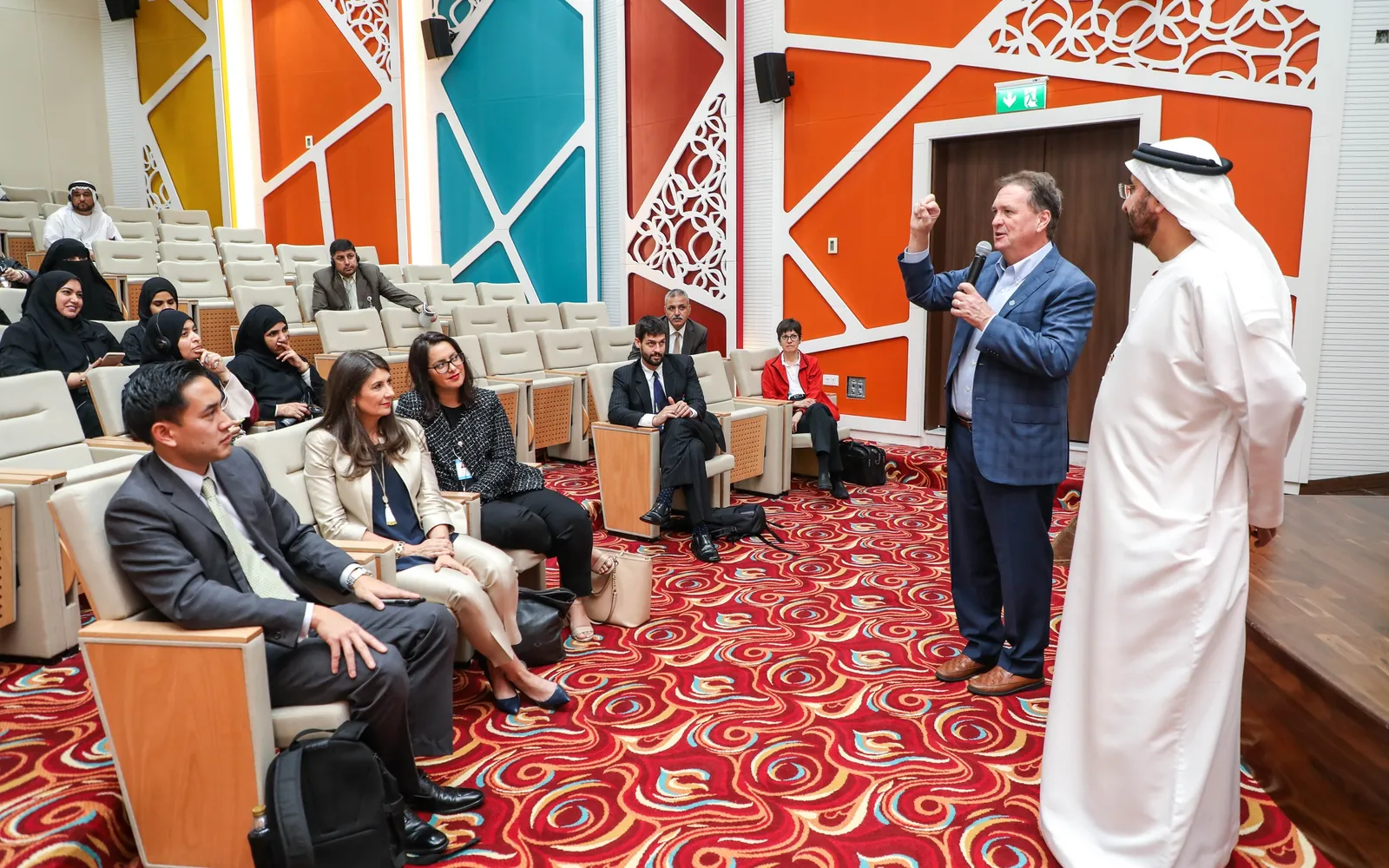
Dubai Education
Future-focused education leadership in a global setting.

EdNET 2016
400 education-business executives: think big, start small, scale fast.

College Board
Long-term future of higher education for presidents and chancellors.
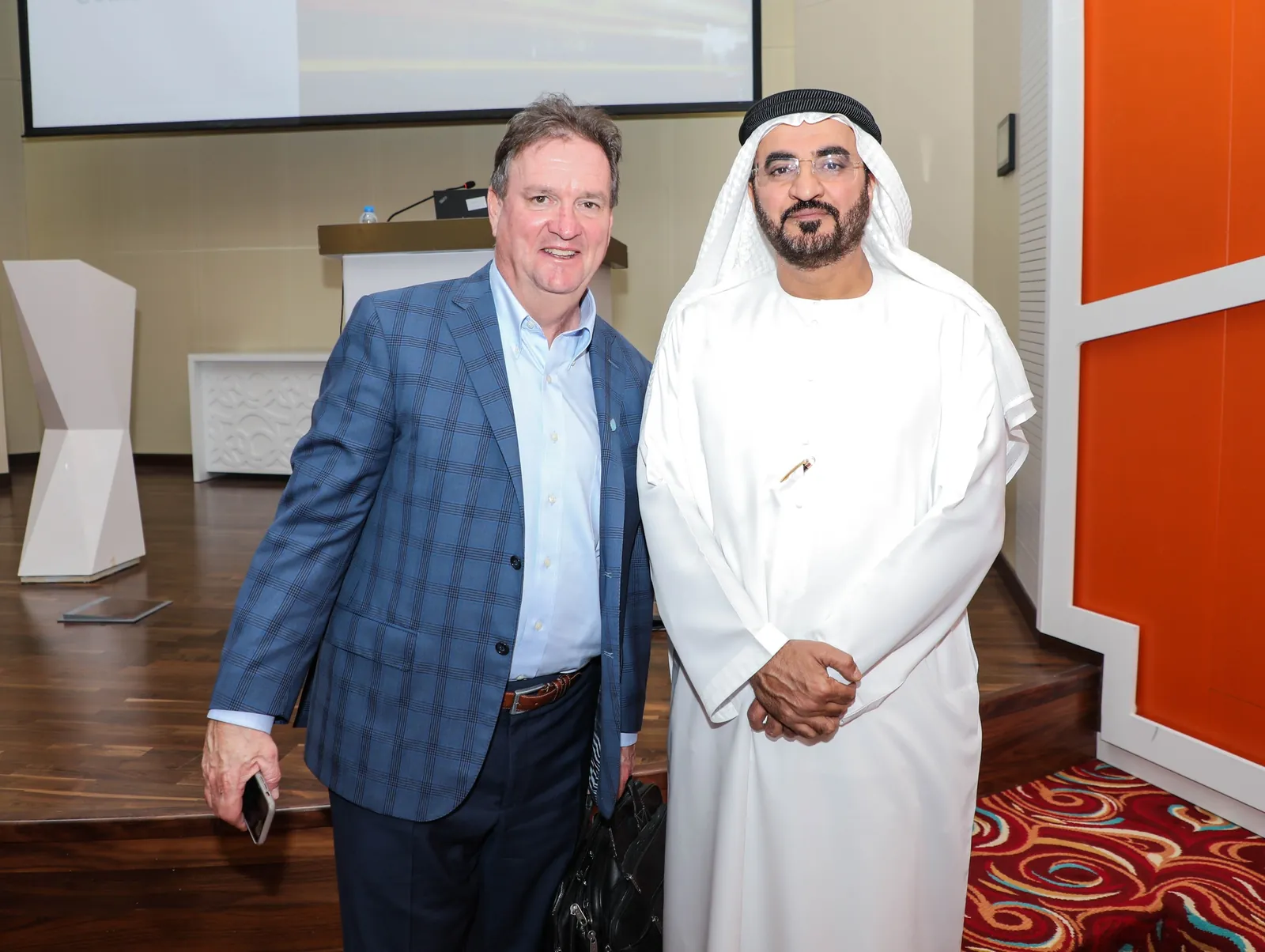
WorldSkills International
Future careers, skills and knowledge as a competitiveness issue.
Deep customization
Client calls, industry research, event objectives, trend analysis and current developments are built into the keynote.
Listen → research → map the trends → build the story → connect the audience → leave a playbook.
These sections first appeared on education.jimcarroll.com, Jim’s former education industry site, and now live here with their original copy and images.
From the research archive
Quick answers
Jim Carroll builds each education & workforce keynote around the forces changing the decisions in front of the audience. Among them: the half-life of useful knowledge keeps shrinking; adaptive learning changes how capability develops; credentials compete with demonstrated skills; and AI tutors transform teaching and assessment questions. Typical audiences: education leaders, employers, training organizations and workforce professionals.
Documented education & workforce engagements on this site include WorldSkills, The Home Depot, Lockheed Martin and American Federation of Teachers. Each one is written up as a case study.
Yes. Every keynote starts with a conversation with your team and typically 25–50+ hours of fresh research into your audience, your organization and the issues your leaders are working through. For education & workforce audiences, the research themes include AI and personalized learning; skills-first hiring and credentials; continuous career reinvention; and partnerships between employers and educators. The final emphasis depends on who is attending.
Yes. The education & workforce brief (18 pages) sets out a client challenge, the relevant forces of change, a keynote direction and Jim’s industry experience. It is an illustrative scenario; the real proposal is shaped around your event.
Yes. He delivers virtual keynotes from his own broadcast studio, and has opened congresses in Muscat, Dubai, Marrakesh, Tokyo and São Paulo with live translation into as many as five languages.
Send a short inquiry: your industry, who is attending, the event type and date, what is changing fastest around the audience, and what you want them doing differently afterward. Jim reads and answers every inquiry personally, usually the same day. Fees are on request, and booking through a speakers bureau or direct costs the same.
Other industries
Make it about your audience
Bring the event objectives, the people attending and the questions you want them discussing afterward.