Transportation & Logistics · 12 forces
The forces changing the decisions.
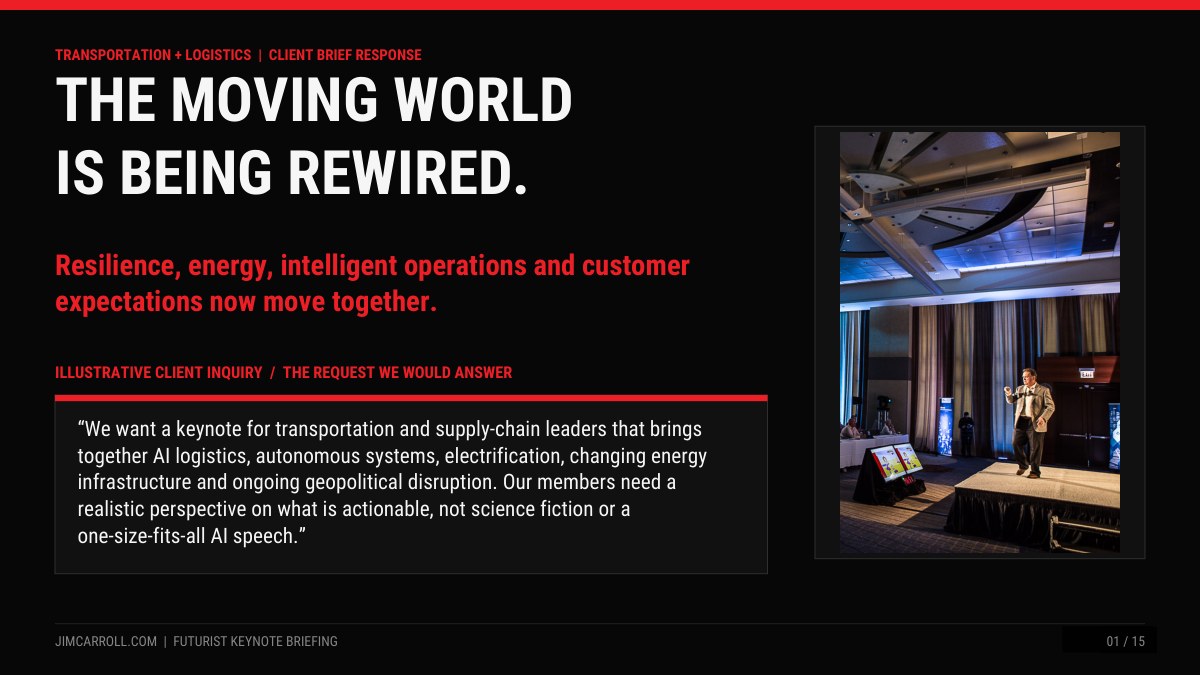
What this means for leaders: The following twelve shifts connect technology and market change to practical choices for organizations in transportation & logistics. They are analysis, not claims that every development is universally deployed or inevitable.
These are the trends Jim is talking about with transportation & logistics leaders right now.
The research lens
- AI logistics and intelligent operations
- Autonomy and operating safety
- Electrification and infrastructure
- Resilience and customer expectations
These themes provide a direction for research, rather than a fixed set of slides. A leadership session can examine assumptions and investment priorities in depth. An industry conference can build a shared view of the changes affecting its members. A customer event can explore the future of the markets your customers serve.
- 01
Predictive logistics reduces uncertainty across freight networks
Freight networks generate information about shipments, capacity, weather, routes and delays that can help operators anticipate exceptions. The real benefit is making a corrective decision before a missed delivery cascades through customers and suppliers. Logistics leaders should connect predictive signals to clear responsibilities and alternatives rather than build a visibility platform no one can act upon.
- 02
Electric fleets change infrastructure and operating cost
Electric trucks and other fleet technologies can change fuel and maintenance costs, but performance depends on routes, charging, payload, temperature and infrastructure. The strategy is not a single fleetwide replacement date. Operators should test representative duty cycles and plan depot power, service skills and operational contingencies together.
- 03
Autonomous systems emerge in constrained environments
Autonomy is advancing first in constrained and repeatable logistics environments where routes, conditions and exception-handling rules can be defined. Ports, yards, warehouses and selected corridors each present different economics. Leaders should evaluate safety evidence and specific use cases instead of relying on universal predictions about the day every truck will drive itself.
- 04
Ports and terminals become connected data systems
Ports and terminals increasingly rely on timely information about equipment, cargo, arrivals and onward transport. Better integration can reduce waiting and improve coordination, but only if operators share trustworthy data and manage disruptions collectively. The prize is a more responsive gateway, not merely a more visually impressive control room.
- 05
Last-mile delivery experiments with new operating models
Last-mile delivery is shaped by density, customer expectations, labor, returns and local regulation. New methods—from micro-fulfillment to alternative vehicles—must be evaluated against realistic route economics. The winner is not necessarily the most futuristic delivery robot, but the model that consistently provides useful service at a sustainable cost.
- 06
Vehicle telematics change uptime management
Vehicle and equipment telemetry can support maintenance, driver coaching and operational planning. The challenge is to convert alerts into action without overwhelming teams or misusing personal data. Fleet managers should focus on uptime, safe operations and service outcomes rather than measuring every possible behavior simply because sensors allow it.
- 07
Supply-chain resilience changes route choices
Supply-chain resilience changes the value of alternate routes, inventory options and supplier relationships. The lowest cost plan may also be the most brittle when a port, border or carrier fails. Logistics executives need to know which dependencies are genuinely critical and how quickly alternative arrangements can be activated.
- 08
Warehouse robotics shift workforce and throughput
Warehouse automation can improve picking, handling and throughput while changing workforce roles and facility design. Success depends on product mix, peak variability, safety and how well automated islands integrate with human work. Operators should evaluate complete process performance rather than the speed of one impressive machine.
- 09
Regulatory fragmentation complicates cross-border movement
Cross-border operations face different rules, documentation, security requirements and policy shifts. Technology can simplify compliance, but it cannot make regulatory differences disappear. Leaders need flexible systems, reliable data and strong exception processes so shipments are not stranded when a rule or procedure changes.
- 10
Emissions management becomes a network design factor
Emissions targets and energy costs increasingly affect route, equipment and facility choices. Progress requires credible measurement and realistic comparisons across transport modes and duty cycles. Logistics companies should seek operational improvements that lower cost or exposure while being transparent about trade-offs rather than claim a universal zero-impact solution.
- 11
Real-time visibility raises customer expectations
Customers increasingly expect to know where a shipment is and whether its promised arrival remains credible. Real-time information is useful only when it is accurate and paired with effective communication. Carriers and logistics providers should improve the reliability of commitments and recovery from exceptions rather than simply publish more granular tracking dots.
- 12
Cybersecurity becomes essential to fleet continuity
Connected vehicles, warehouse systems and third-party platforms create cyber dependencies across the supply chain. An outage can interrupt dispatch, billing or physical movement. Resilience needs vendor planning, access controls, manual fallback and rehearsed response that reflects how quickly digital disruption can become a logistics problem.




 Kwik Fit
 BNSF Railway
 American Truck Dealers
 HAVI Global Solutions
 Kalmar Ottawa
 IRU World Congress
 Trapeze Group
 Mercedes-Benz
 Omnitracs
 Corcentric
 Colorado Department of Transportation
 NATSO