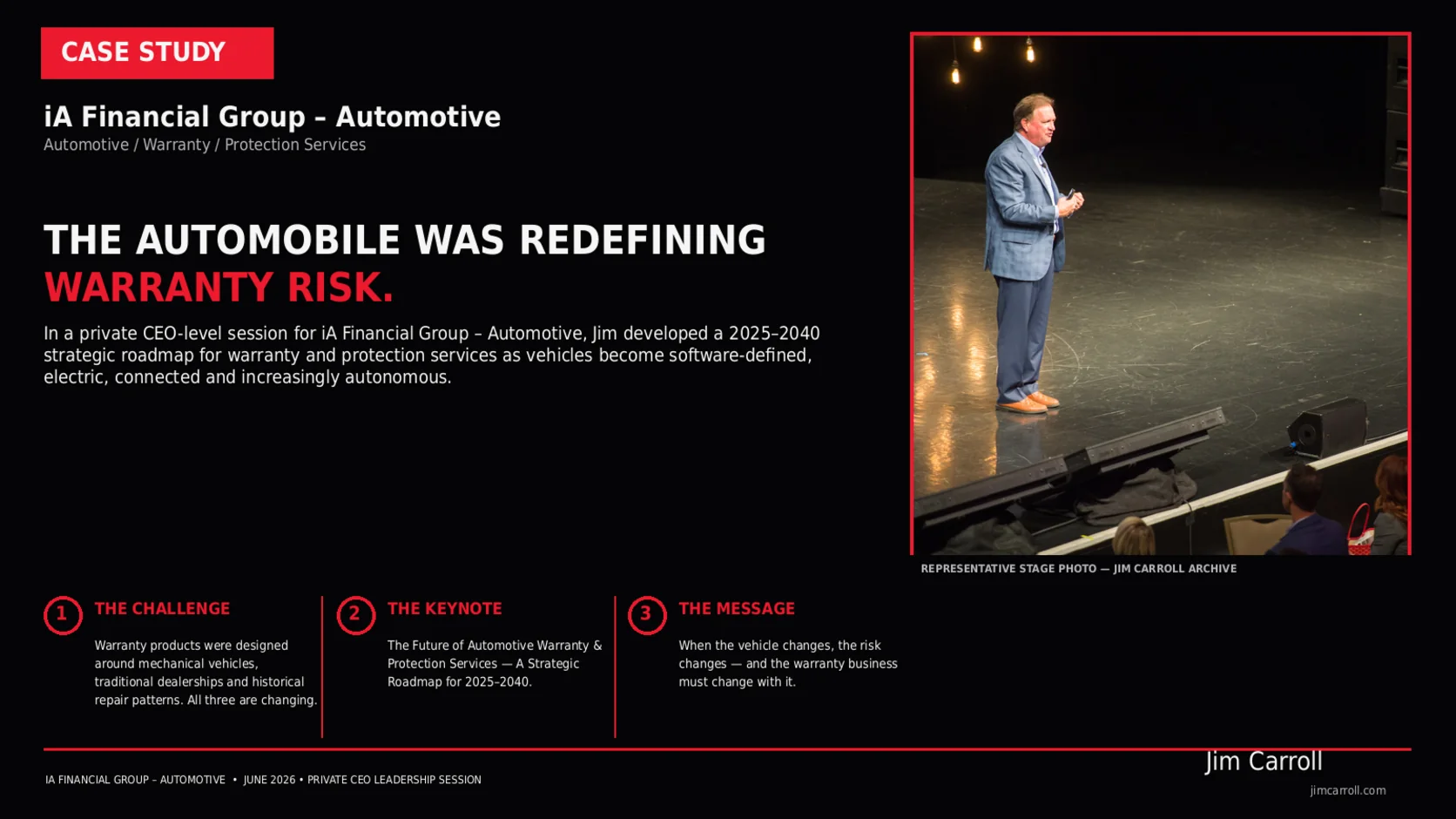
For a private CEO-level session with approximately 15 senior leaders from iA Financial Group – Automotive, Jim Carroll developed a highly customized strategic foresight briefing on the future of automotive warranty and protection services.
The horizon was deliberately long:
2025–2040.
That was necessary because the automobile itself is undergoing structural change.
Vehicles are becoming more software-defined.
Electric powertrains are replacing mechanical complexity with a different kind of technological complexity.
Ownership models are shifting.
Autonomy is emerging.
Connected vehicles generate enormous streams of data.
And manufacturers increasingly control the customer relationship through direct and agency-based distribution models.
Those changes fundamentally alter the assumptions behind warranty, protection, service and risk.
The Challenge: Warranty and protection products were designed around a mechanical automobile, traditional dealership models and historical repair patterns. All three are changing.
The Keynote: The Future of Automotive Warranty & Protection Services — A Strategic Roadmap for the 2025–2040 Horizon
The Message: When the vehicle changes, the risk changes. When the risk changes, the warranty and protection business must change with it.
Six Trends Shaping Automotive Warranty & Protection:
- Software-Defined Vehicles
More vehicle functionality is controlled through software, changing failure modes, service requirements and product risk.
- Electrification
EV platforms introduce different component lifecycles, battery risks and maintenance economics.
- Agency Distribution
OEM-controlled and direct-sales models are changing traditional dealer relationships.
- Connected Vehicle Data
Real-time diagnostic information creates opportunities for predictive service and more dynamic protection products.
- Autonomy
Increasing vehicle intelligence changes assumptions about responsibility, component risk and service complexity.
- Predictive Warranty
Data and AI make it increasingly possible to move from reactive claims toward anticipating failures before they occur.
The core strategic point was straightforward:
The warranty business cannot remain mechanical in a software-defined automotive world.