01
Edge intelligence
Intelligence moves from centralized systems into devices, equipment and products.
Industries · Technology & AI
The AI build-out depends on much more than software. Compute, optics, energy, cooling and components create connected infrastructure challenges and commercial opportunities.
Begin with your audience
Technology suppliers, infrastructure leaders and executive audiences.
The AI build-out depends on much more than software. Compute, optics, energy, cooling and components create connected infrastructure challenges and commercial opportunities. The final emphasis depends on who is attending, what they already understand, and the strategic choices your event is intended to support.
The research lens
These themes provide a direction for research, rather than a fixed set of slides. A leadership session can examine assumptions and investment priorities in depth. An industry conference can build a shared view of the changes affecting its members. A customer event can explore the future of the markets your customers serve.
From the industry brief
The sample guide develops five connected movements. The emphasis and examples are refined around the actual audience and event objectives.
What grows when the models, applications and deployed endpoints multiply.
Why data movement makes fibre, photonics and optical systems central.
Energy availability, cooling and location as strategic choices.
Electronics, semiconductors, supply chains and critical component availability.
Investment decisions, optionality and practical adaptation amid uncertain demand.
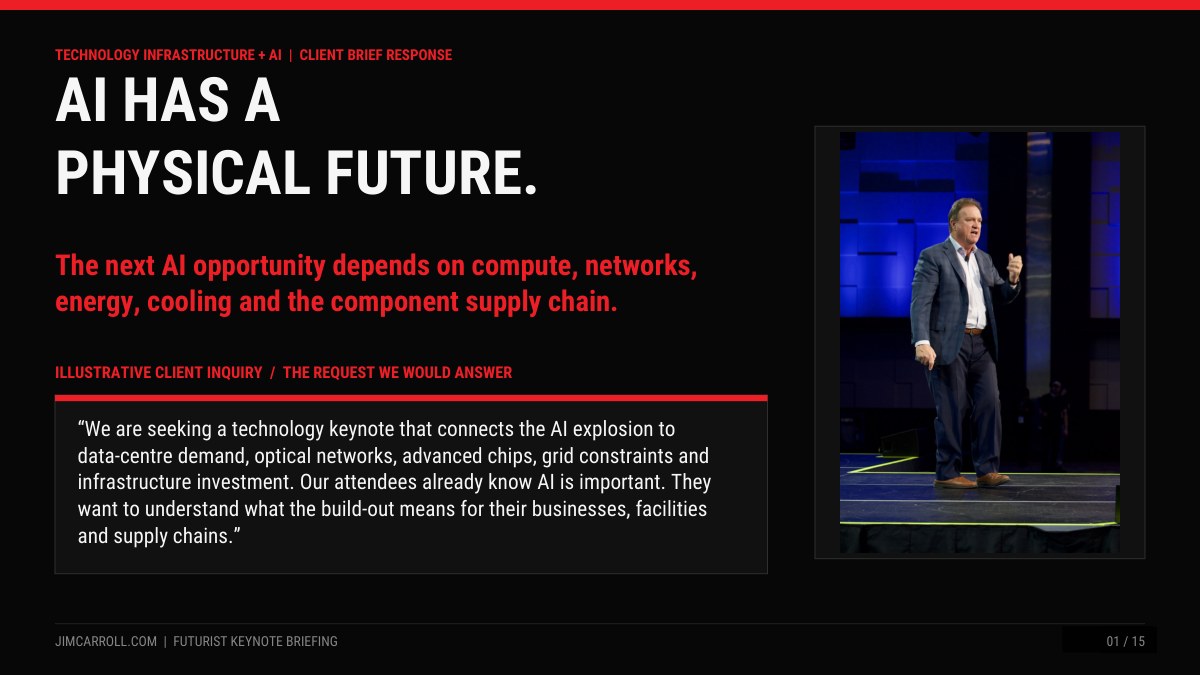
Illustrative industry brief · 15 pages
The complete guide develops the client challenge, relevant forces of change, keynote direction and industry experience. It is an illustrative briefing scenario, not a quotation from an actual client inquiry; the live proposal is shaped around your audience, priorities and objectives.
Read the technology & ai brief (PDF) ↗All 21 briefs ↗Documented technology & ai engagements







The published record
Relevant published engagements from JimCarroll.com. Cross-industry examples show adjacent markets and questions; the specific scope of each assignment is described in its original story.
The deep dive
Futurist Jim Carroll / What technology changes next
Intelligence is moving into chips, machines, products, science and the physical world. Understand what it changes next—and what to do about it.
Bring Jim to your event ↗
The next technology era
Technology used to enable change. Now it accelerates the rate of change itself.
AI accelerates computing. Computing accelerates science. Science accelerates design. Robotics brings intelligence into the physical world. Infrastructure determines how quickly it can all scale.
The strategic question is what happens when these forces begin accelerating one another.
Jim Carroll helps technology leaders—and the customers they serve—see the connections, understand the consequences and act before yesterday’s assumptions become tomorrow’s constraints.
The flagship technology keynote
Go beyond today’s AI headlines to the next wave: edge intelligence, robotics, compressed design cycles, computational science, strategic semiconductors and the compute–energy collision.
One customized keynote. An interconnected technology story. Practical implications for your audience.
Proof / Technology leaders
Real organizations. Different strategic questions. Explore the original two-image case studies.
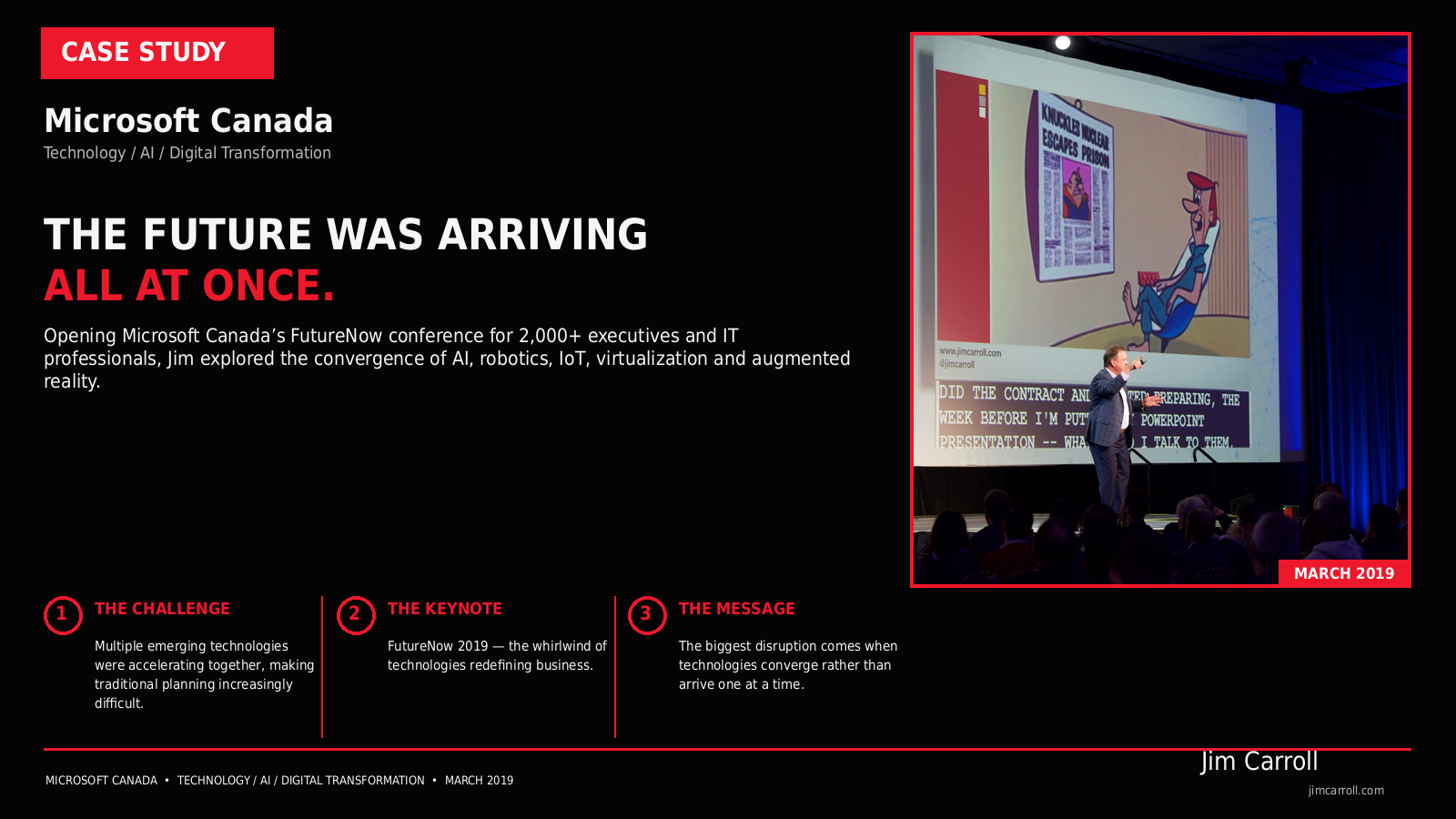
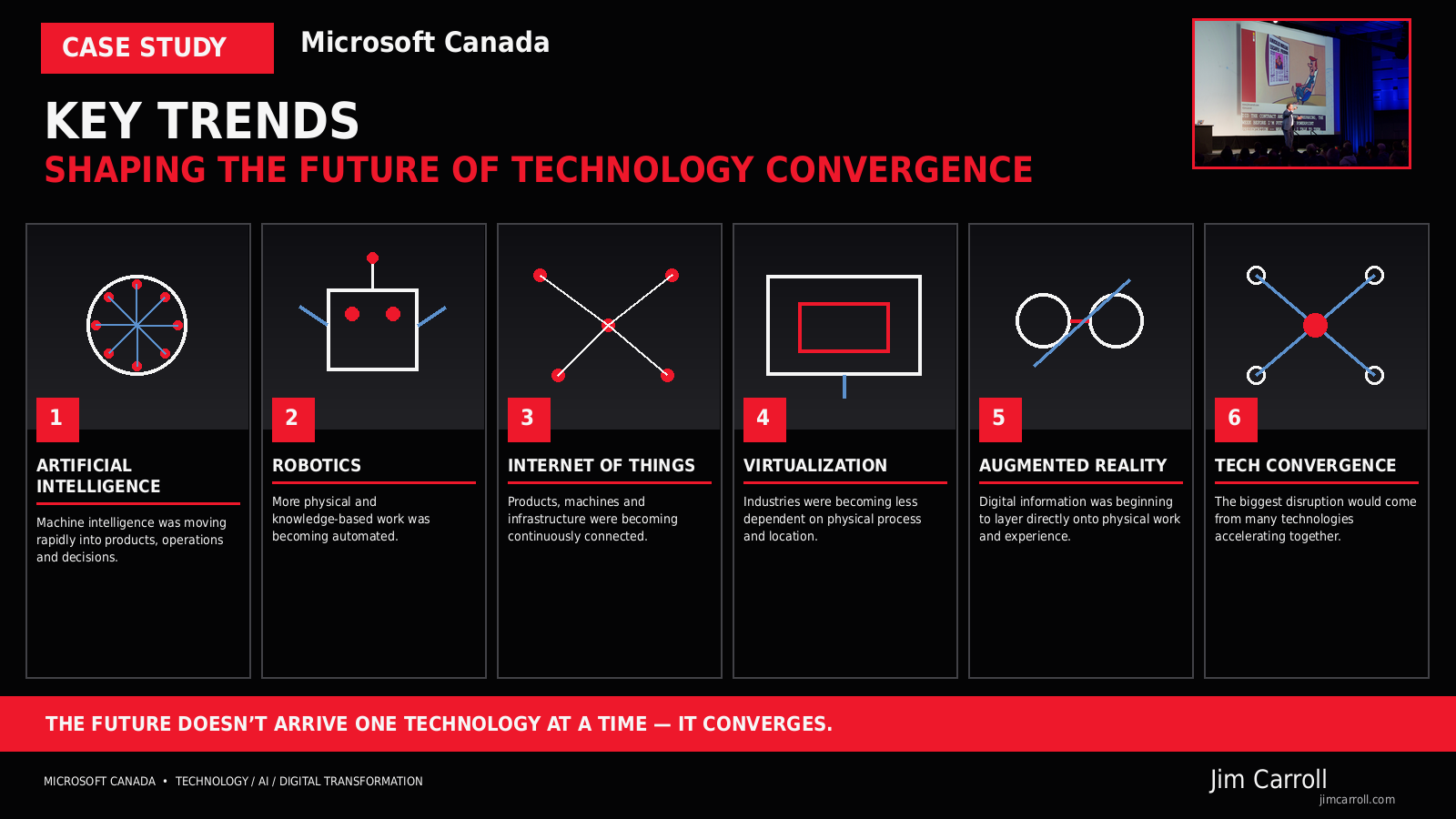
Opening keynote for more than 2,000 executives and IT professionals in Toronto. AI, robotics, connected systems and industry virtualization were presented as one strategic story.
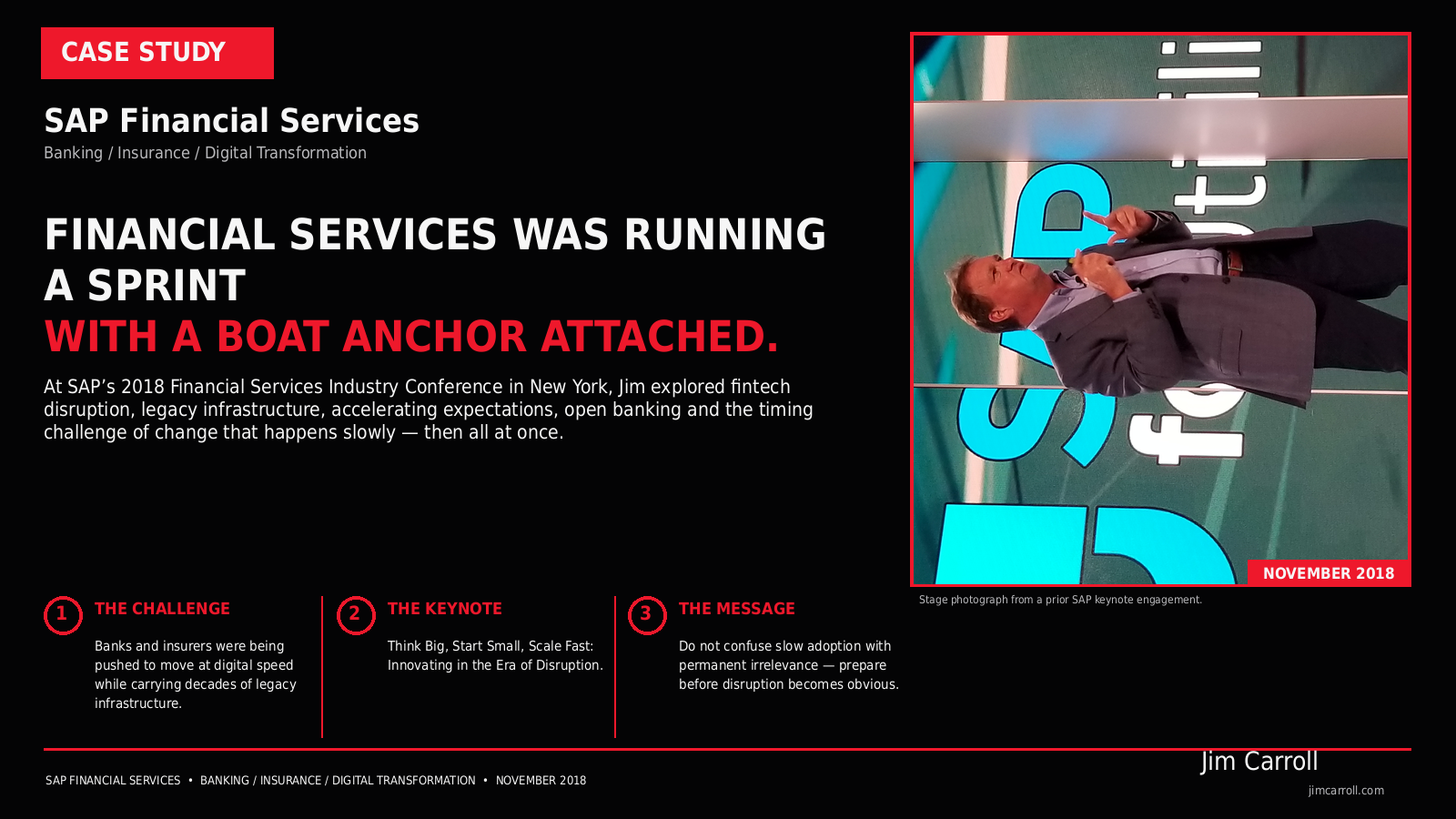
A customized financial-services perspective on how technology changes customers, business models and the pace of innovation.
Why the timetable keeps changing
None of these trends happens alone.
AI needs compute. Compute needs chips and electricity. AI can help design chips, discover materials and optimize infrastructure. Those advances create capacity for the next round of innovation.
The connections matter as much as the individual technologies.
Intelligence becomes an enabling layer across the technology system.
Processing capacity becomes a strategic business requirement.
Intelligence moves into products, machines and infrastructure.
Discovery and development cycles accelerate.
Power, grids, cooling and supply chains shape what can scale.
The consequences reshape competition, skills and leadership.
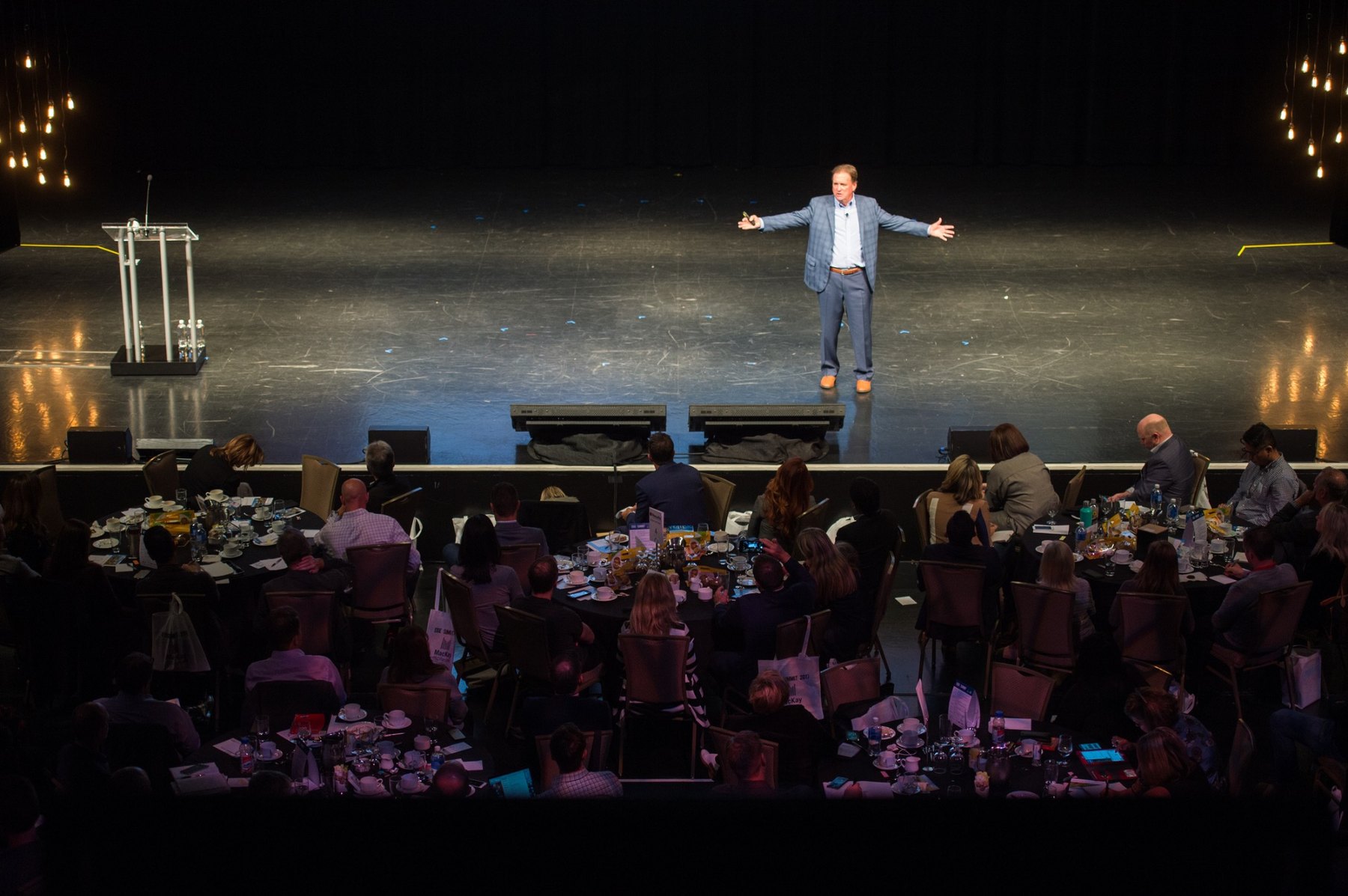
From the stage / The leadership challenge
The opportunity horizon
Look beyond a single technology. Watch how the next wave changes products, infrastructure and competition.
01
Intelligence moves from centralized systems into devices, equipment and products.
02
Robotics, machine vision and autonomous systems bring intelligence into the physical world.
03
Software moves from answering questions toward performing complex workflows.
04
AI, simulation and advanced computing accelerate discovery and experimentation.
05
Chips connect industrial capability, supply-chain resilience and national strategy.
06
Digital ambition encounters the physical constraints of electricity, cooling and infrastructure.
07
Sensing, drones, connected systems and advanced electronics create new capabilities.
08
Emerging architectures challenge assumptions about security, simulation and optimization.
Leading through overlapping disruption
Cloud is still evolving while AI transforms software. Edge intelligence expands while robotics accelerates. Supply chains reorganize while compute demand tests the limits of energy infrastructure.
There is no clean handoff between technology eras. Leaders need to keep learning, testing and adjusting while the current transformation is still underway.
You pivot while you’re still pivoting.
Technology / Industry by industry
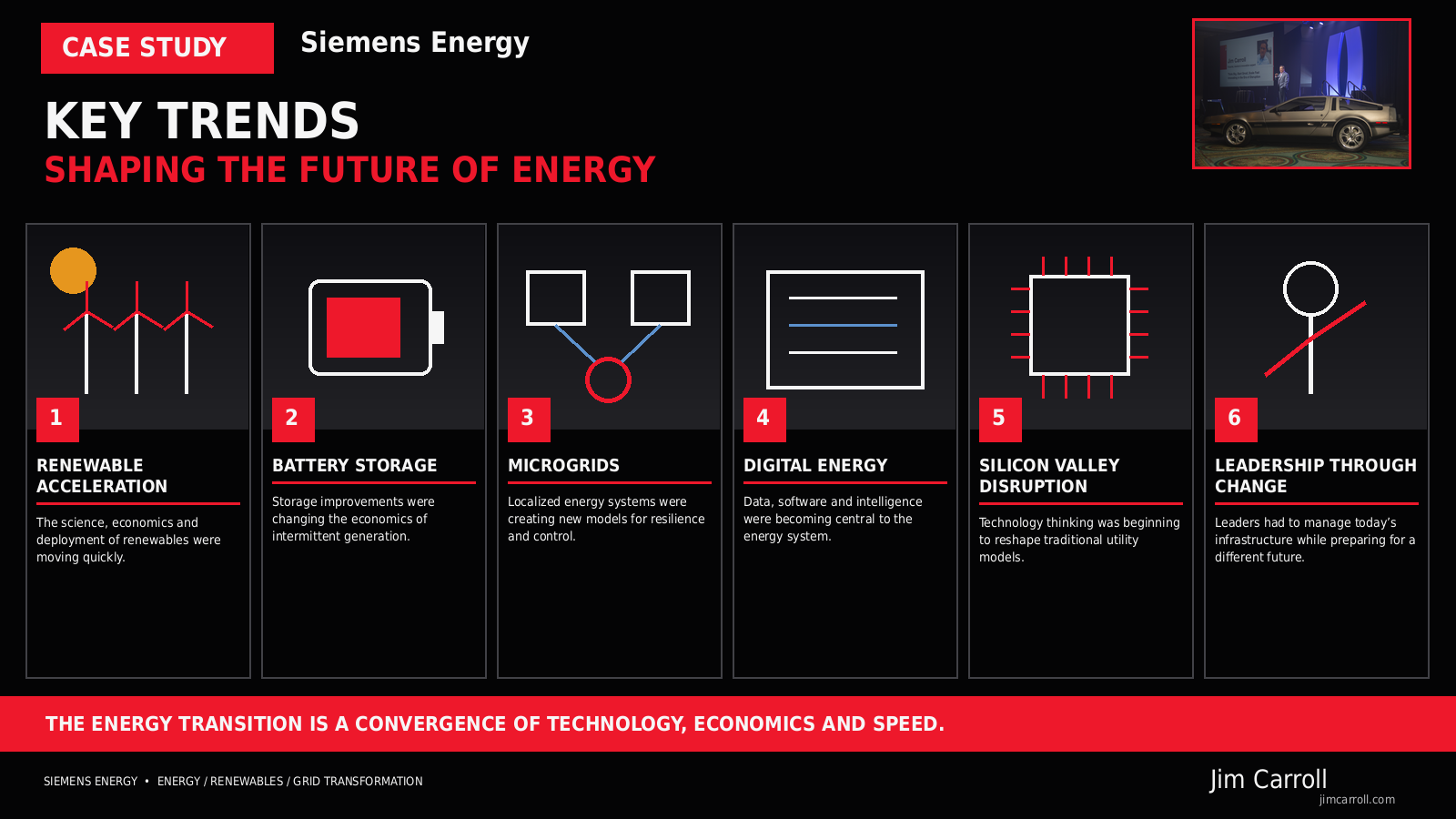
The implications depend on the room. Energy, manufacturing, finance and healthcare each face a different strategic question.
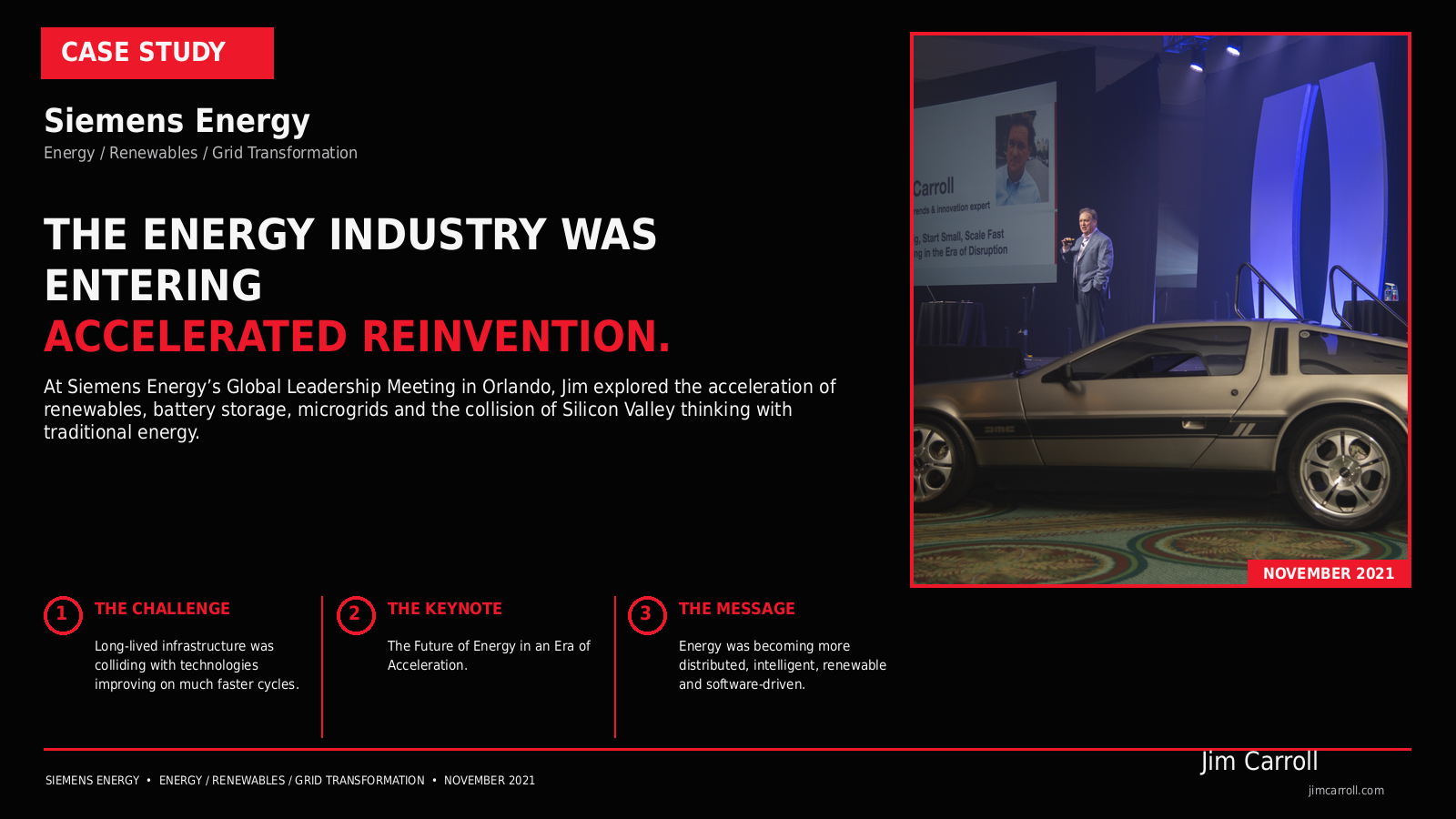
A sector-specific exploration of energy transformation, emerging technology and the leadership response to a changing industry.
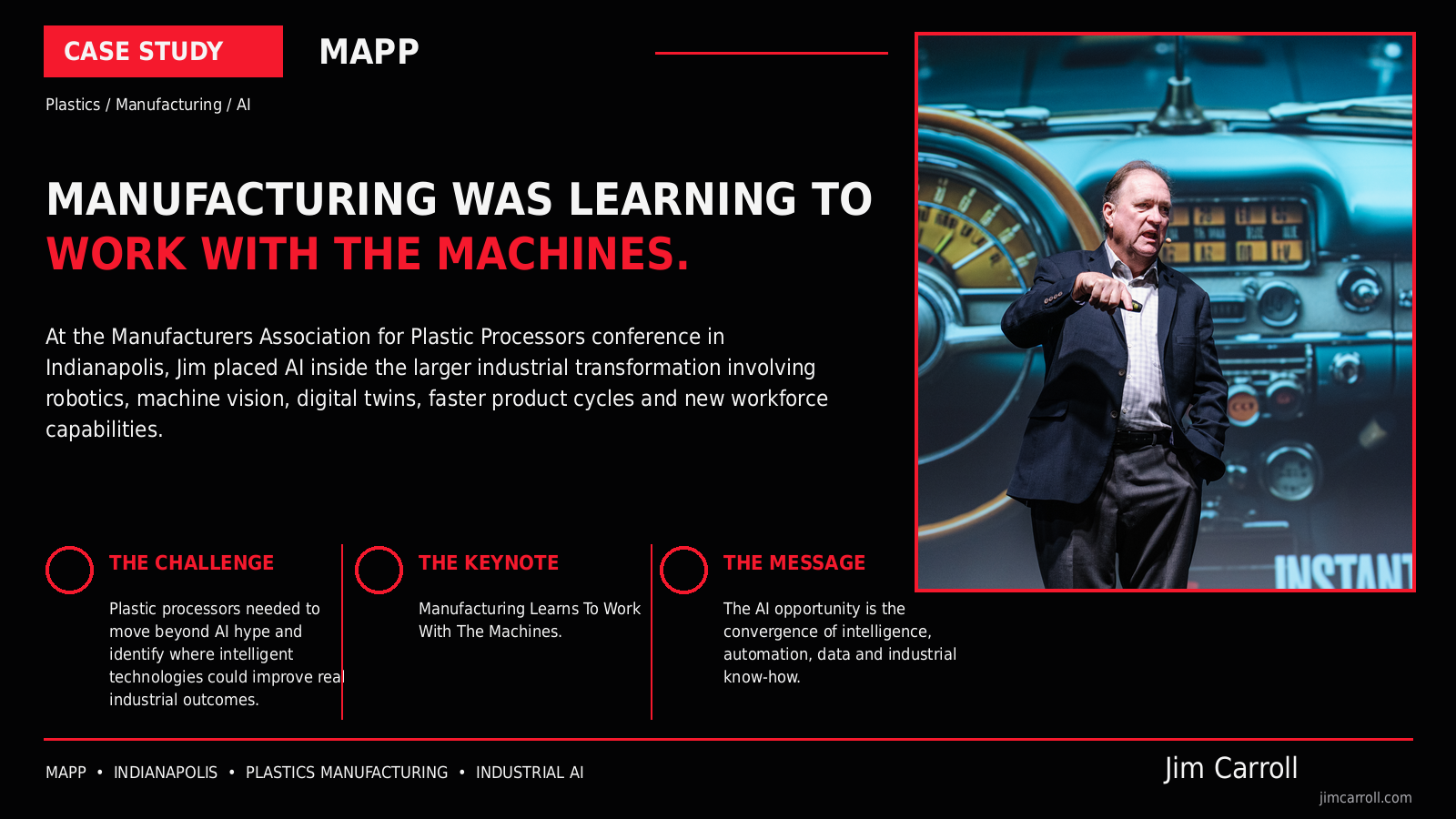
A manufacturing keynote exploring robotics, cobotics, digital twins, spatial virtualization, machine vision and the AI-enabled industrial Internet of Things.
Every industry becomes a technology industry
AI becomes both electricity load and grid-management capability.
Digital twins, robotics and machine vision reshape the factory.
Discovery, diagnostics and care become more computational.
Intelligence changes risk, service and decision-making.
Sensors, autonomy and crop science reshape the farm.
Predictive systems and agents change how commerce happens.
Simulation, intelligent equipment and robotics change delivery.
Connected vehicles, autonomy and electrification reshape mobility.
From megabits to yottabits
Machine-generated information, sensors, scientific systems and connected infrastructure produce more information than people can absorb.
When everyone has access to the same AI tools, advantage depends on judgment, experience, curiosity and a distinctive way of seeing what comes next.
Researched for your audience
Jim Carroll knows your industry before he walks onstage.
Preparation starts with your customers, competitors, technology, business model and strategic challenges. The result connects future trends to decisions that matter in your room.
For the Electronic Components Industry Association, that means looking beyond AI to robotics, edge silicon, defense electronics, energy, supply chains, talent and compressed design cycles.
Discuss your event ↗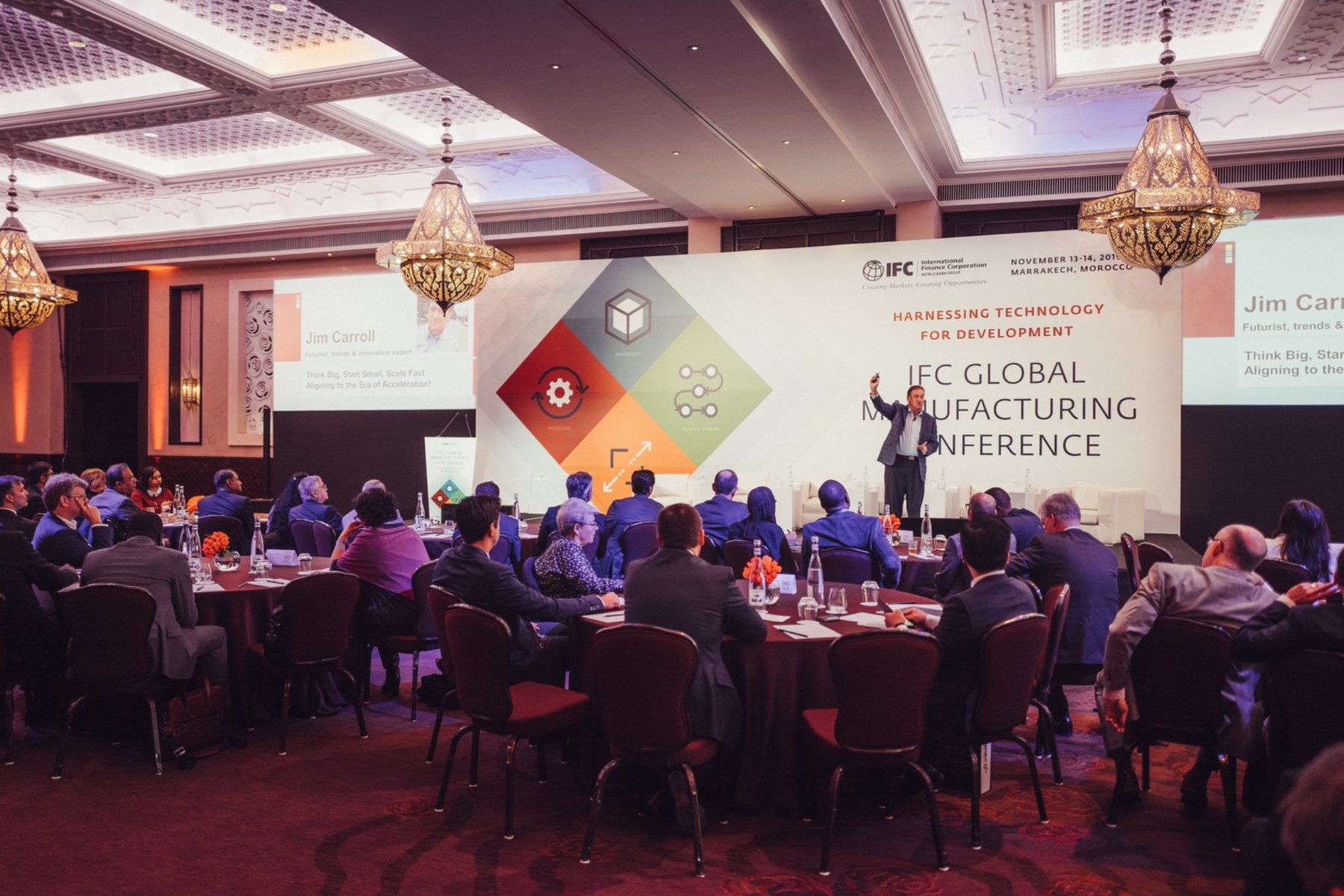
Your next event
Bring Jim Carroll to your technology conference, customer event, leadership meeting or executive summit.
Researched. Relevant. Actionable.
Talk to Jim ↗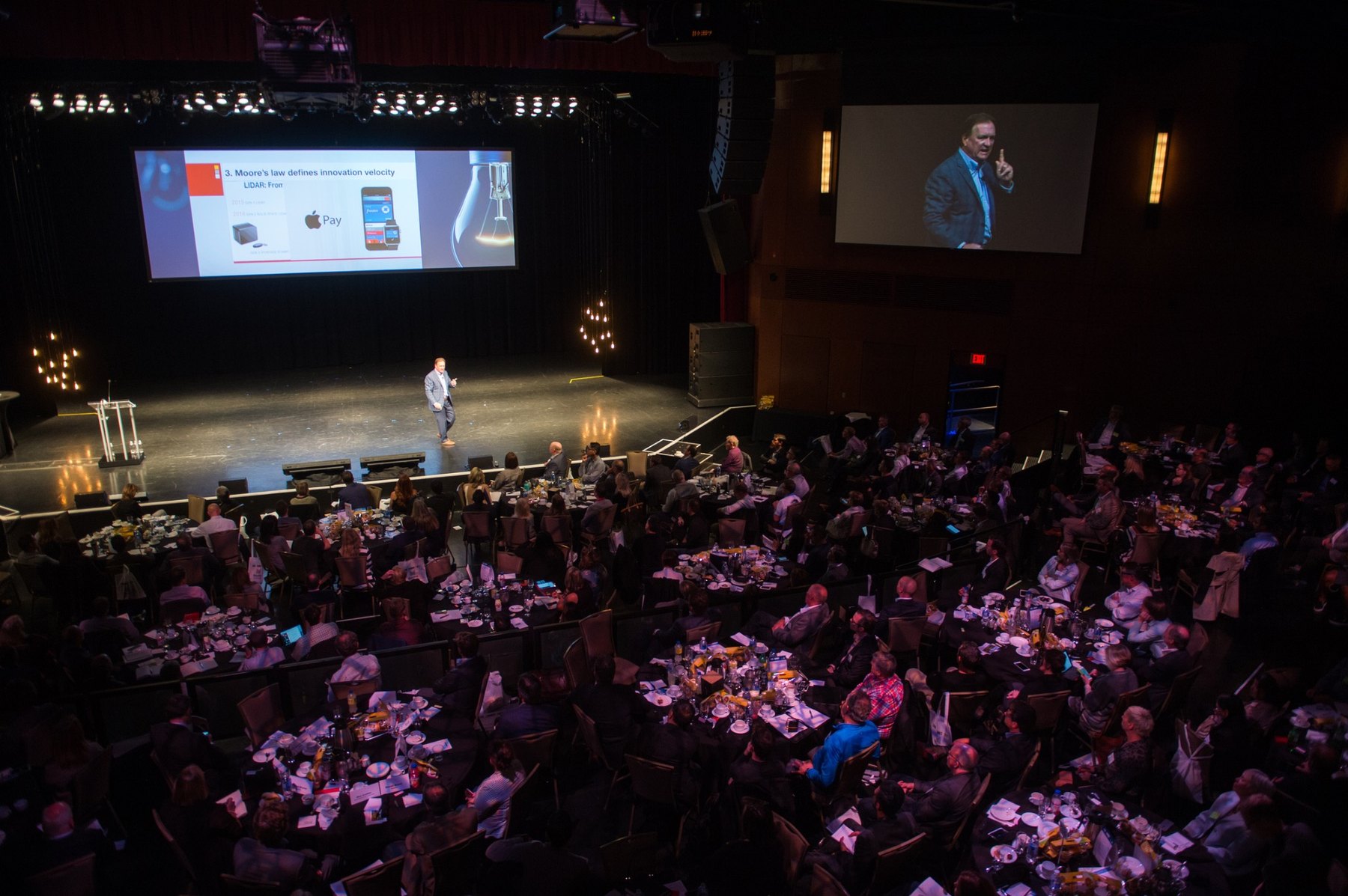
These sections come from technology.jimcarroll.com, Jim’s technology industry site, migrated here with their original copy and images.
From the research archive
Other industries
Make it about your audience
Bring the event objectives, the people attending and the questions you want them discussing afterward.