1990s-05
HYPER-CHANGE
Clicks-and-mortar, China Price, product proliferation and packaging innovation.
Industries · Consumer Products & CPG
A faster market requires a different innovation rhythm. Product science, packaging, demand signals and retail channels belong in the same strategic conversation.

Begin with your audience
Consumer-product executives, brand teams and product innovators.
A faster market requires a different innovation rhythm. Product science, packaging, demand signals and retail channels belong in the same strategic conversation. The final emphasis depends on who is attending, what they already understand, and the strategic choices your event is intended to support.
The shift
Brands need to respond to fast-changing preferences while protecting product quality, trust and supply economics. The key is to build learning and adaptation into the product lifecycle rather than merely accelerate marketing.
The 12 forces ↓Consumer Products & CPG · 12 forces
What this means for leaders: The following twelve shifts connect technology and market change to practical choices for organizations in consumer products & cpg. They are analysis, not claims that every development is universally deployed or inevitable.
These are the trends Jim is talking about with consumer products & cpg leaders right now.
The research lens
These themes provide a direction for research, rather than a fixed set of slides. A leadership session can examine assumptions and investment priorities in depth. An industry conference can build a shared view of the changes affecting its members. A customer event can explore the future of the markets your customers serve.
Consumer expectations move quickly while product design, testing, packaging and distribution often operate on slower cycles. Brands need to shorten learning loops without turning every fleeting social-media signal into a new SKU. The strategic advantage is knowing which changes deserve a response and organizing product development around evidence rather than yesterday's annual calendar.
Customization can allow brands to meet narrower preferences, but greater choice complicates manufacturing, inventory and fulfillment. Winners will balance flexible production with a disciplined range that customers can understand. The business case must include operational complexity and quality, not just the excitement of offering more combinations.
When products connect to apps, data and remote services, value can continue after the purchase. That creates new possibilities for maintenance, personalization and recurring relationships, alongside cybersecurity, privacy and lifecycle obligations. The product team must plan service quality and software support as seriously as the original package and physical design.
Retail media and first-party consumer relationships change where brands spend to be discovered. Data-rich platforms can promise precise targeting, but marketers still need to understand incremental sales, trust and how much control they surrender over customer relationships. The strategic choice is to build a learning capability rather than simply shift the media budget to another platform.
Packaging must increasingly satisfy several objectives at once: shelf impact, product protection, transport efficiency, material cost and changing environmental expectations. An attractive claim is not enough when disposal infrastructure and consumer behavior vary by market. Manufacturers should evaluate verified whole-system performance rather than optimize one sustainability metric in isolation.
Generative and predictive tools can speed consumer research, concept exploration and early creative work. But synthetic respondents and rapid designs are not substitutes for observing actual buyers, safety testing or regulatory review. The real opportunity is to screen ideas faster while reserving human judgment and authentic validation for the decisions that carry the most risk.
Creator communities can reveal emerging tastes before traditional market research cycles are complete. The challenge is distinguishing genuine behavior shifts from temporary attention and commercial amplification. Product leaders should design transparent listening and experimentation processes, then connect the evidence to commercial decisions without surrendering the brand's long-term identity.
Customers increasingly ask how a product was made, what it contains and whether the evidence behind its claims can be trusted. Better traceability can improve recalls, supplier coordination and confidence, but it must be substantiated. Brand credibility is strengthened when product provenance is a verifiable operating capability rather than an elaborate marketing story.
Demand signals, store data and manufacturing schedules can support more responsive replenishment. Yet forecasting is only useful when suppliers can change production or logistics without unacceptable cost. CPG executives need to redesign decision rights and partner communication alongside algorithms so that faster information becomes a faster, better response.
A disrupted ingredient, factory or shipping route can become a consumer-facing brand failure very quickly. Resilience therefore includes supplier diversity, substitutability, inventory strategy and clear communication, not just lowest-unit-cost sourcing. Brands should identify which dependencies would seriously compromise their promises to customers and build options before disruption arrives.
Population age, household formation, cultural patterns and lifestyle changes can shift the meaning of an established consumer category. Managers who rely on yesterday's 'typical shopper' may misread emerging demand. The strategic response is to study actual purchase occasions and unmet needs rather than assume the same demographic segment behaves consistently across every market.
When content is easy to manufacture, authentic product utility, design quality and earned trust become more important. Consumers can be overwhelmed by identical claims, AI-generated imagery and synthetic reviews. Brands should differentiate through demonstrable experience and reliable evidence, not by producing more of the same polished marketing material at greater speed.
From forecast to decision
This is not a fixed slide deck. The right keynote starts with the audience, the current evidence, the genuine opportunities and the choices leaders must make. These forces are research directions; the specific examples and action framework are customized for the organization at the event.
Every consumer products & cpg keynote pairs these forces with what the sector’s fastest innovators are doing about them. What world-class innovators do ↗
Discuss your event ↗Watch 5 consumer products & cpg videos ↗
From the archive: dated engagements and retrospectives
From the industry brief
The sample guide develops five connected movements. The emphasis and examples are refined around the actual audience and event objectives.
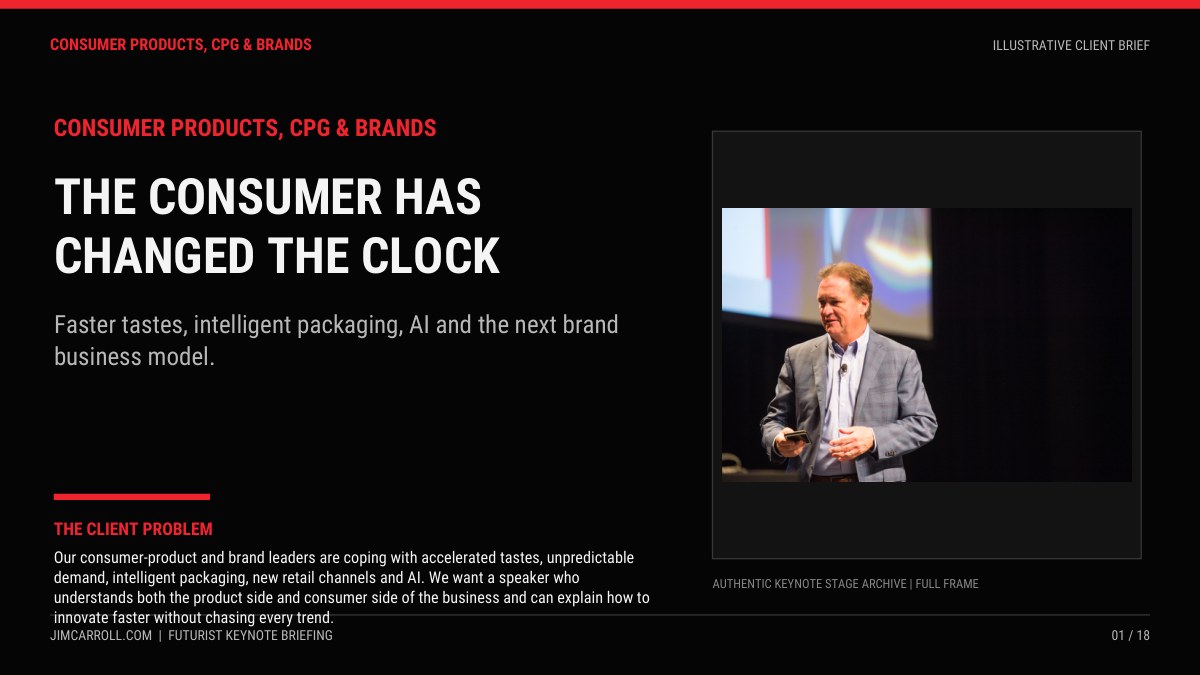
Illustrative industry brief · 18 pages
The complete guide develops the client challenge, relevant forces of change, keynote direction and industry experience. It is an illustrative briefing scenario, not a quotation from an actual client inquiry; the live proposal is shaped around your audience, priorities and objectives.
Read the consumer products & cpg brief (PDF) ↗All 21 briefs ↗Documented consumer products & cpg engagements

 Global Cold Chain Alliance2023 · Case study ↗
 Revionics2019 · Case study ↗
 BENEFIQ2018 · Case study ↗
 United Suppliers Technology Exchange2017 · Case study ↗
 NAMA2017 · Case study ↗
 pladis2017 · Case study ↗
The published record
Relevant published engagements from JimCarroll.com. Cross-industry examples show adjacent markets and questions; the specific scope of each assignment is described in its original story.
The deep dive
Fast consumers. Short lifecycles. Intelligent packaging. Relentless innovation.
Consumer products live in the collision between fickle customers, margin pressure, short product lifecycles, supply-chain volatility, packaging innovation and rapidly changing health and sustainability expectations.
Download the consumer products & cpg keynote brochure (PDF, 2.4 MB) ↗
The sector story
Consumer products live in the collision between fickle customers, margin pressure, short product lifecycles, supply-chain volatility, packaging innovation and rapidly changing health and sustainability expectations.
The package is the brand - and the product lifecycle is collapsing.
Experience
Pre-2006 work included Nestlé, Nestlé Purina, StarKist/Heinz/FMC FoodTech, Procter & Gamble, TetraPak, Reader's Digest Food & Entertainment, snack-food and confectionery associations, CFIG, PMMI and Frito-Lay/PepsiCo.
1990s-05
Clicks-and-mortar, China Price, product proliferation and packaging innovation.
2006-12
Health, convenience, demographic shifts and faster product cycles.
2013-19
Intelligent packaging, traceability, direct-to-consumer and mobile influence.
2020-25
Supply-chain shocks, sustainability, creator trust and transparency.
2026+
Agentic shopping, hyper-personalization and machine-readable brands.
Potential keynote directions
These are directions, not canned speeches. Each keynote is customized around the audience, strategic issues and decisions ahead.
01
Fast consumers, short lifecycles and innovation velocity.
02
Personalization, demand sensing and machine-mediated buying.
03
Business-model and packaging innovation that breaks category assumptions.
04
Traceability, safety, sustainability and connected experiences.
05
Health, convenience, science and rapidly changing preference.
06
How to build agility when loyalty and demand move fast.
Trend stack
The future arrives through multiple overlapping shifts, not one technology in isolation.
01
Products can thrive in short micro-bursts rather than long stable cycles.
02
Health, value and cultural trends can reset demand quickly.
03
Packaging becomes data, traceability, safety and experience.
04
Cost, sourcing and geopolitical volatility require more options.
05
Human signals and transparency become more valuable in an AI-saturated market.
06
Products, offers and even formulations become more individualized.
Leadership
The strategic advantage is recognizing which assumptions have expired, building capacity to experiment, and moving fast enough to matter.
Think big. Start small. Learn fast. Scale what works.
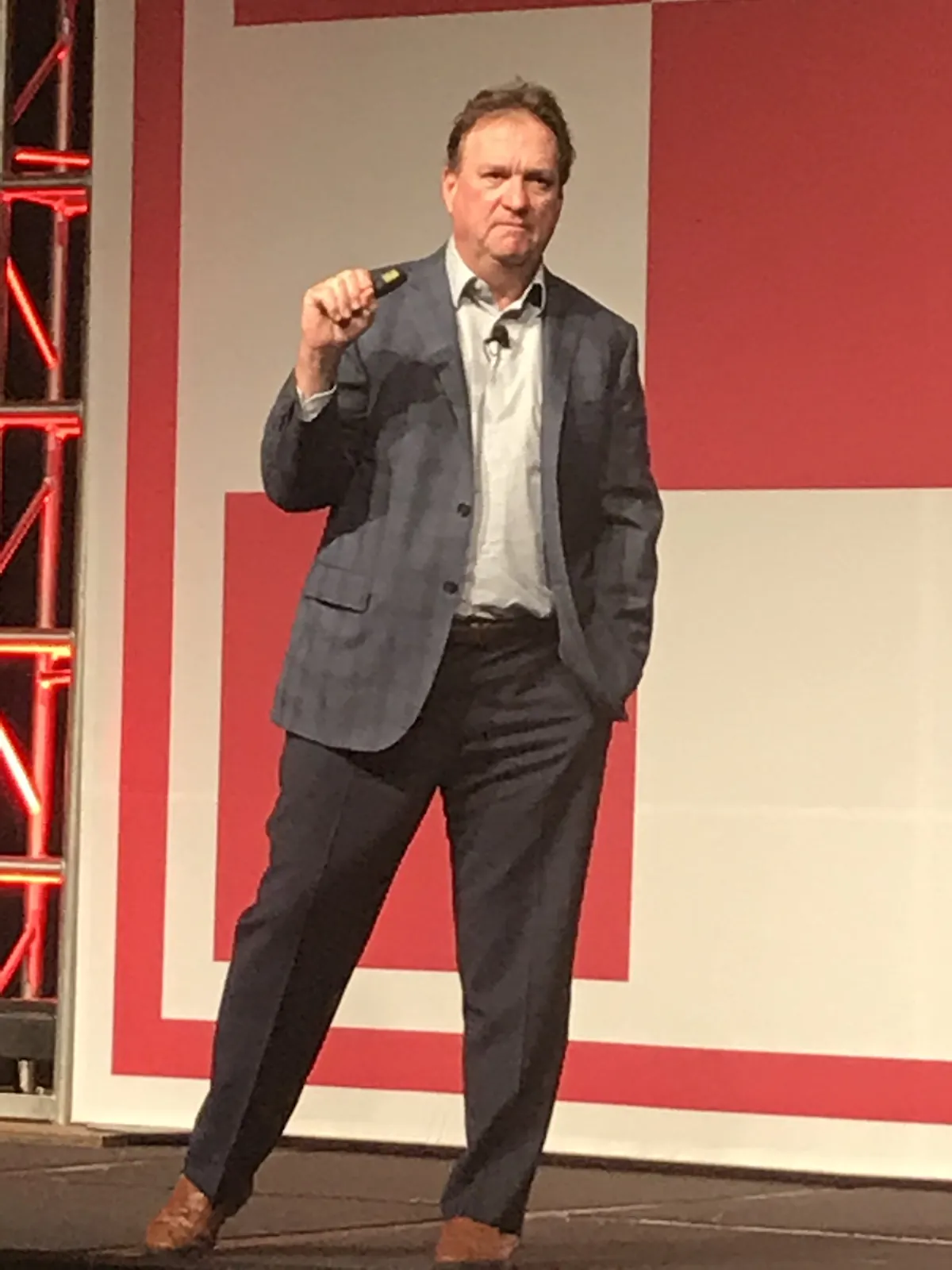
Client stories
Different client. Different audience. Different strategic problem.
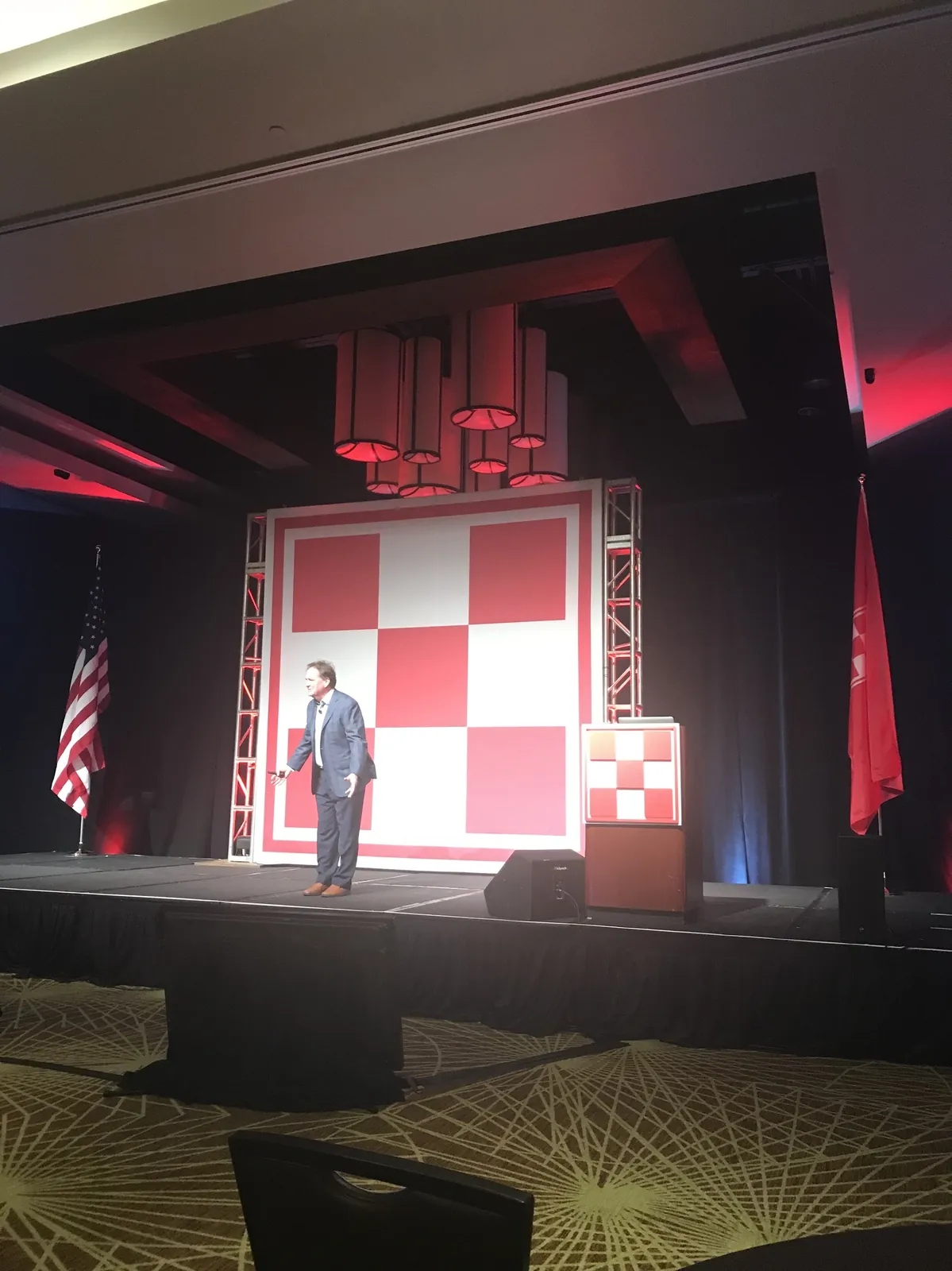
Nestlé / Purina
Consumer trends, innovation and the acceleration of food and pet-care markets.
Packaging & CPG
TetraPak, PMMI, FMC FoodTech and packaging innovation.
What's Your Tin Can?
StarKist's pouch as a signature metaphor for breaking a century-old category assumption.
Future Consumer
Attention, trust, convenience, health and AI-driven personalization.
Deep customization
Client calls, industry research, event objectives, trend analysis and current developments are built into the keynote.
Listen → research → map the trends → build the story → connect the audience → leave a playbook.
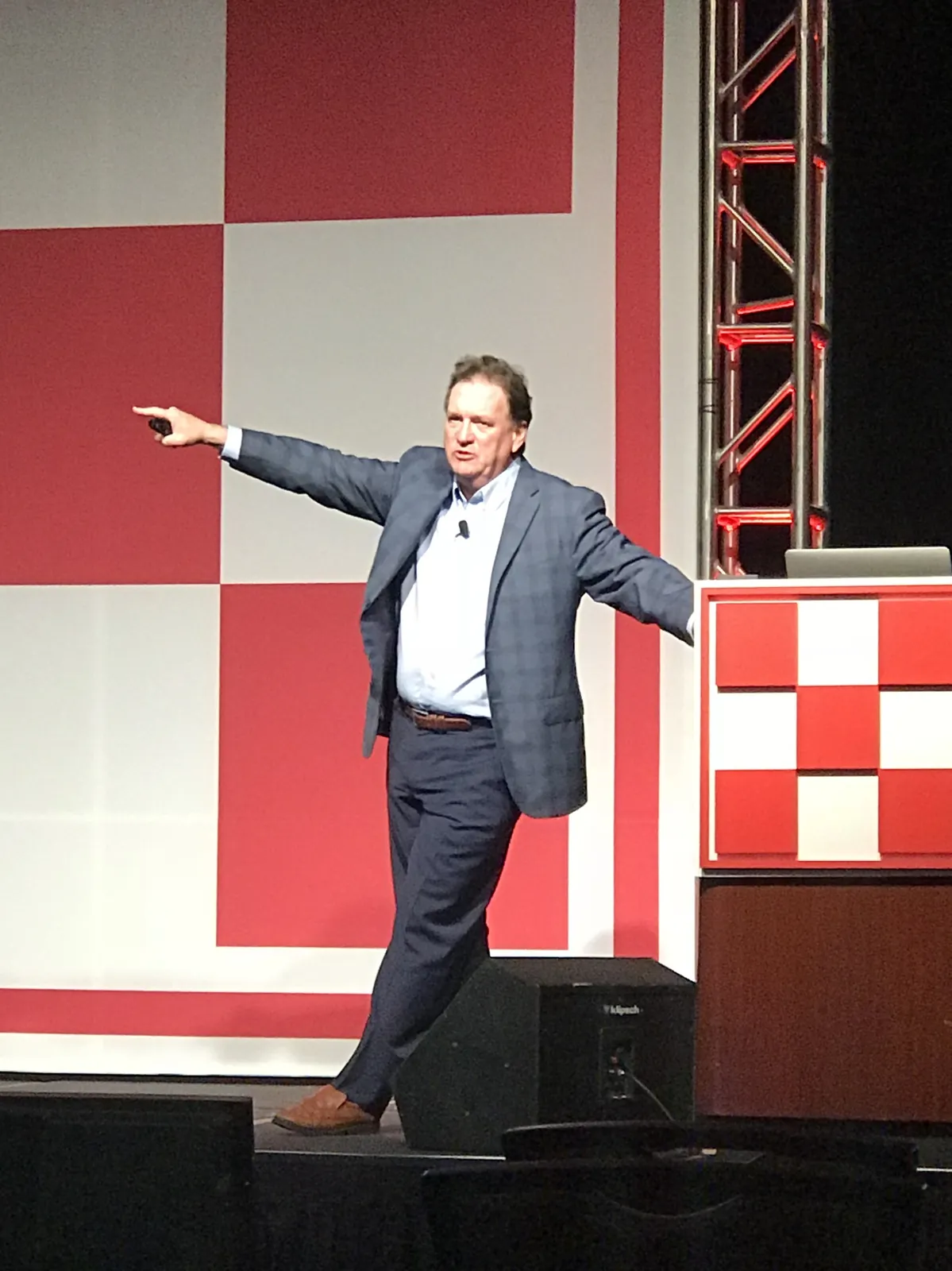
These sections first appeared on consumerproducts.jimcarroll.com, Jim’s former consumerproducts industry site, and now live here with their original copy and images.
From the research archive
Quick answers
Jim Carroll builds each consumer products & CPG keynote around the forces changing the decisions in front of the audience. Among them: product lifecycles compress under fast-changing consumer tastes; mass customization challenges conventional batch economics; connected products blur the line between goods and services; and retail media and first-party data change brand investment. Typical audiences: consumer-product executives, brand teams and product innovators.
Documented consumer products & CPG engagements on this site include Global Cold Chain Alliance, Revionics, The Wegner Group, BENEFIQ, United Suppliers Technology Exchange, NAMA, Xcelerate Retail and pladis, among 10 in all. Each one is written up as a case study.
Yes. Every keynote starts with a conversation with your team and typically 25–50+ hours of fresh research into your audience, your organization and the issues your leaders are working through. For consumer products & CPG audiences, the research themes include shorter taste and demand cycles; intelligent products and packaging; AI across R&D and forecasting; and materials, sustainability and distribution. The final emphasis depends on who is attending.
Yes. The consumer products & CPG brief (18 pages) sets out a client challenge, the relevant forces of change, a keynote direction and Jim’s industry experience. It is an illustrative scenario; the real proposal is shaped around your event.
Yes. He delivers virtual keynotes from his own broadcast studio, and has opened congresses in Muscat, Dubai, Marrakesh, Tokyo and São Paulo with live translation into as many as five languages.
Send a short inquiry: your industry, who is attending, the event type and date, what is changing fastest around the audience, and what you want them doing differently afterward. Jim reads and answers every inquiry personally, usually the same day. Fees are on request, and booking through a speakers bureau or direct costs the same.
Other industries
Make it about your audience
Bring the event objectives, the people attending and the questions you want them discussing afterward.