Leadership & Disruption · 12 forces
The forces changing the decisions.
What this means for leaders: The following twelve shifts connect technology and market change to practical choices for organizations in leadership & disruption. They are analysis, not claims that every development is universally deployed or inevitable.
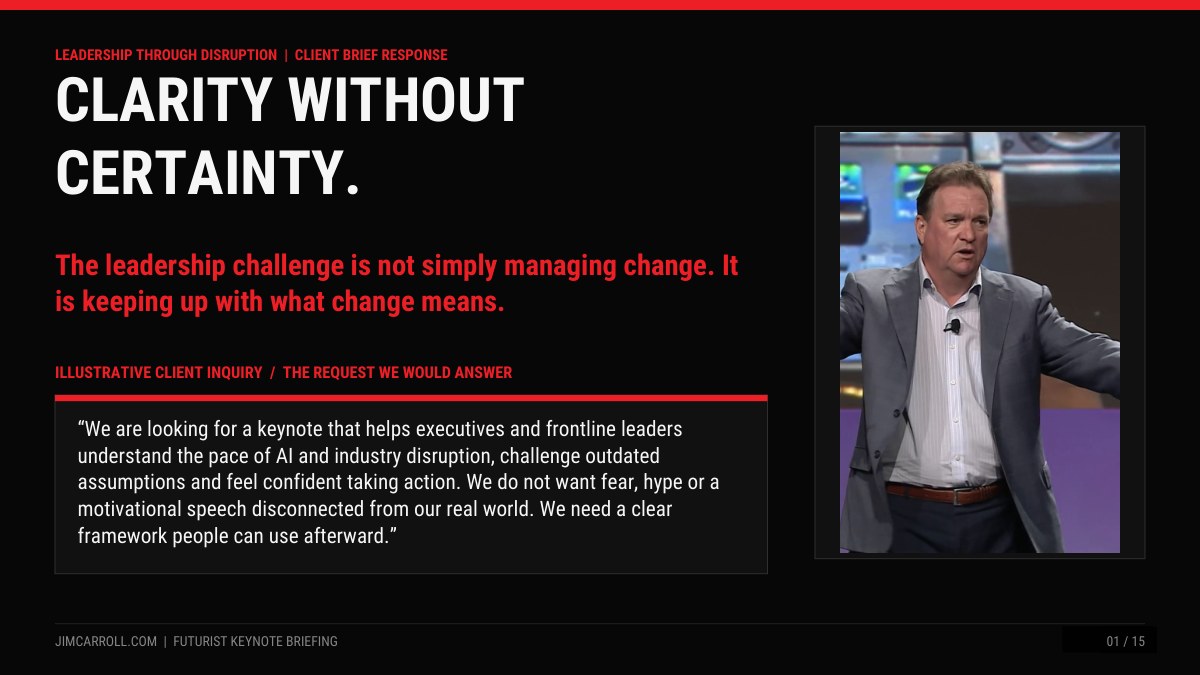
These are the trends Jim is talking about with leadership & disruption leaders right now.
The research lens
- The acceleration gap
- Challenging outdated assumptions
- Culture and decision speed
- Think Big. Start Small. Scale Fast.
These themes provide a direction for research, rather than a fixed set of slides. A leadership session can examine assumptions and investment priorities in depth. An industry conference can build a shared view of the changes affecting its members. A customer event can explore the future of the markets your customers serve.
- 01
The acceleration gap widens between fast and slow organizations
Technology, markets and customer expectations may accelerate faster than an organization's decision-making habits. This is the acceleration gap: the widening distance between what the outside world demands and what internal processes permit. Leaders need to examine where approvals, incentives and inherited assumptions prevent useful action, rather than treating speed as a motivational slogan.
- 02
Leaders need better mental models for 2030 decisions
The real danger is making a 2027 decision with a 2017 mental model. Organizations can have excellent data and still interpret it through assumptions formed for a slower era. Leadership teams should explicitly list what they believe about customers, technology, competition and talent—and test whether those beliefs remain defensible before committing the next strategy.
- 03
Uncertainty requires judgment rather than false confidence
Uncertainty is not evidence that the organization should stop deciding. It is a reason to use scenarios, clear assumptions and reversible commitments where possible. Good leaders do not manufacture certainty; they communicate the limits of what is known and create a process for updating decisions as conditions change.
- 04
Innovation stalls in organizational pilot purgatory
Pilot purgatory occurs when organizations keep demonstrating promising ideas without building the structures to scale them. The obstacle may be governance, funding, incentives or fear of changing established work. A useful innovation program defines in advance what success looks like, who owns scale-up and when a pilot will be expanded, revised or ended.
- 05
Strategic humility helps teams challenge assumptions
Leaders who admit that their knowledge is incomplete are better positioned to learn from colleagues, customers and emerging competitors. Strategic humility does not mean weak conviction; it means confidence in the process of testing assumptions. Organizations should reward thoughtful challenge rather than create environments where the highest-ranking person's first opinion becomes the unchangeable answer.
- 06
Think BIG Start Small Scale Fast becomes operating discipline
Think BIG, Start Small, Scale Fast offers a practical way to balance ambition with learning. The big idea establishes direction, the small experiment produces evidence, and scaling converts insight into organizational value. The discipline fails when teams skip evidence, refuse to stop weak experiments or allow successful tests to remain permanently isolated.
- 07
The half-life of expertise changes leadership development
Expertise is valuable, but parts of it can become outdated much sooner than people expect. Leaders need continuous learning systems that reward curiosity and cross-functional knowledge. The critical talent question is not simply what people know today, but whether they can recognize the moment that established knowledge stops fitting the problem.
- 08
The future belongs to teams willing to be unique
Organizations gain little by recruiting creative people and then rewarding only conformity. Uniqueness becomes a competitive strategy when teams can pursue genuinely different ideas, customers and approaches with discipline. Leaders should protect constructive dissent while still demanding evidence, accountability and a clear connection to real opportunity.
- 09
Governance must match the speed of emerging risk
When technology-enabled risks move rapidly, annual audit and governance rhythms can become disconnected from operational reality. Risk oversight needs current information, defined ownership and the ability to adapt controls without sacrificing independence. Boards and leaders should examine the speed at which they discover, understand and respond to emerging risks.
- 10
Failure should generate learning not reporting theatre
Failure can be a source of learning—or a theater of reports that never changes future behavior. Productive organizations examine what assumptions were wrong and what they will do differently. Leaders should measure whether lessons alter decisions and systems rather than merely how polished the post-project documentation looks.
- 11
Continuous reinvention is a measurable organizational capability
Reinvention should be a repeatable ability rather than an emergency event after disruption becomes undeniable. Organizations need routines for sensing change, reallocating resources and developing options before the crisis point. The best evidence of agility is not a transformation slogan; it is a track record of thoughtful adjustments made before old assumptions collapse.
- 12
The Infinite Pivot replaces one-time transformation planning
The Infinite Pivot recognizes that strategy increasingly requires repeated alignment with an accelerating world, not a single once-and-for-all transformation program. Leaders need a clear sense of purpose combined with flexible methods, learning and execution. The question is whether the organization can keep moving toward a meaningful goal as the routes to it continue changing.