01
GROWTH
New markets, new crops, value-added products, new revenue models and new customer relationships.
Industries · Agriculture & Food
Science, sensing and autonomy connect the future of farming to decisions about land, labour, capital and resilience.
Begin with your audience
Farmers, co-ops, agribusiness leaders and agricultural suppliers.
Science, sensing and autonomy connect the future of farming to decisions about land, labour, capital and resilience. The final emphasis depends on who is attending, what they already understand, and the strategic choices your event is intended to support.
The research lens
These themes provide a direction for research, rather than a fixed set of slides. A leadership session can examine assumptions and investment priorities in depth. An industry conference can build a shared view of the changes affecting its members. A customer event can explore the future of the markets your customers serve.
From the industry brief
The sample guide develops five connected movements. The emphasis and examples are refined around the actual audience and event objectives.
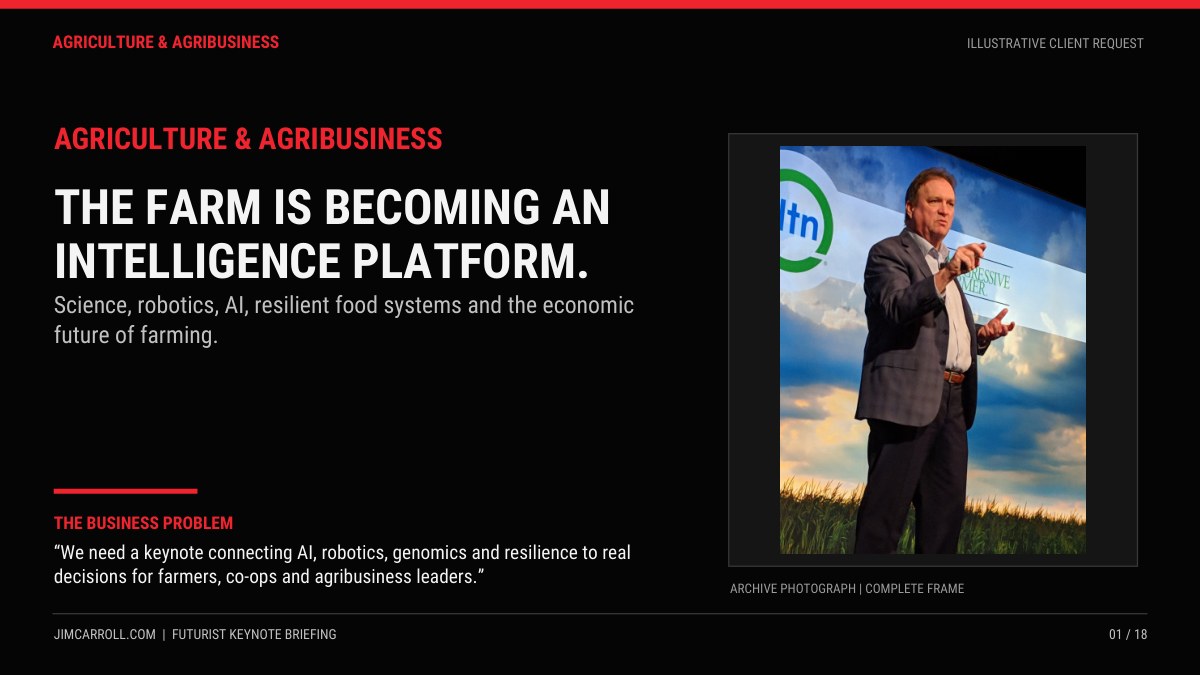
Illustrative industry brief · 18 pages
The complete guide develops the client challenge, relevant forces of change, keynote direction and industry experience. It is an illustrative briefing scenario, not a quotation from an actual client inquiry; the live proposal is shaped around your audience, priorities and objectives.
Read the agriculture & food brief (PDF) ↗All 21 briefs ↗Documented agriculture & food engagements


What clients say
Agriculture-specific feedback sits alongside a long record of client comments about customization, relevance and delivery.
“You certainly challenged us as to the pace of change... at the same time that you inspired us to embrace its opportunities. You were outstanding!”
“Ranchers are pretty conservative - particularly here in Texas - but you were the best speaker we've ever had at our event!”
“We selected Jim because of his accessibility and passion to tailor his expertise to fit our vision. This combination produced exceptional results.”
“I can think of no greater keynote speaker presentation through which I've sat... the thought leadership and action-provoking sentiments he evokes are truly remarkable.”
Agriculture client experience
Representative agriculture, food, producer, financial and supply-chain organizations that have engaged Jim.
The published record
Relevant published engagements from JimCarroll.com. Cross-industry examples show adjacent markets and questions; the specific scope of each assignment is described in its original story.
The deep dive
Faster science. Smarter farms. Relentless opportunity.
For more than three decades, Jim Carroll has helped farmers, growers, ranchers, agricultural companies, cooperatives, lenders and food organizations understand what comes next - and what to do about it.
A sector in acceleration
Agriculture is becoming one of the world's most technologically and scientifically sophisticated industries.
Artificial intelligence, robotics, machine vision, genomics, autonomous equipment, connected livestock, advanced weather intelligence, soil sensing and new production models are changing what it means to farm.
Yesterday's farm ran on daylight. Tomorrow's farm runs on data.
Grab the full 20-page PDF ↗
The innovation agenda
Successful agricultural organizations increasingly innovate around three overlapping needs.
01
New markets, new crops, value-added products, new revenue models and new customer relationships.
02
Automation, better data, precision inputs, smarter water use, predictive insight and intelligent operations.
03
Genomics, biology, artificial intelligence and rapidly evolving agricultural knowledge that must be absorbed faster than ever.
Potential keynote directions
These are not six off-the-shelf speeches. They are possible directions for a deeply customized agriculture keynote, selected and blended around the audience, event theme and strategic issues in the room.
01
Faster science. Smarter farms. Relentless opportunity.
02
Resilience at the speed of change.
03
What happens when intelligence comes to the farm.
04
Robotics, autonomy and the intelligent farm.
05
Innovation, opportunity and the world's oldest profession.
06
Building the adaptive farm of tomorrow.
A recurring theme
The difference is less about technology than mindset. The same trend can look like a threat to one person and an opportunity to another.
The future doesn't happen to the future-positive farmer. They participate in building it.
The stuck skeptic
The future-positive farmer
Agriculture intelligence • a living foresight layer
The future isn't a single prediction. It arrives in layers. Some shifts are already operational. Others are gathering speed. A few are still weak signals. The job is to know the difference.
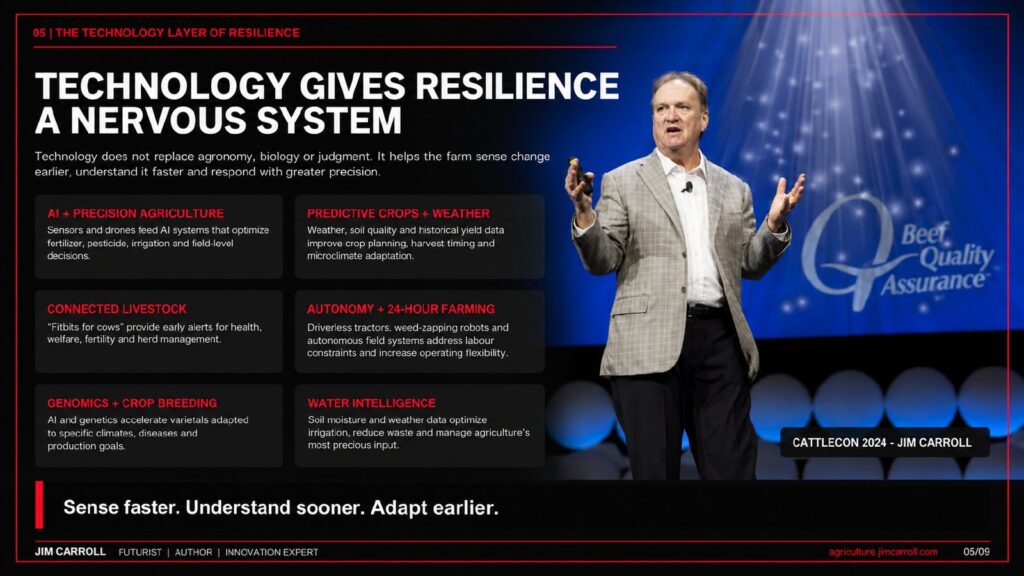
The farm becomes an intelligence platform. Sensors, imagery, weather, soil and machine data increasingly collapse into a continuous decision system.
Autonomous equipment and machine vision begin removing one of agriculture's oldest constraints: human operating time.
Genomics, controlled environments, biological tools and AI compress discovery cycles and make production increasingly adaptive.
Solar, storage, biogas, electrification and microgrids turn farms into active participants in distributed energy systems.
The real danger? Making tomorrow's agriculture decisions with yesterday's assumptions.
Future of Agriculture
The future is not one trend. It is the collision of biology, technology, science, climate, economics and human adaptability.
01
Drones, sensors, satellites and machine vision become a real-time decision platform for irrigation, inputs, disease detection, yield and harvest timing.
02
Autonomous tractors, robotic field equipment and machine vision remove one of agriculture's oldest constraints: human operating time.
03
Soil moisture, organic matter, microclimate and nutrient data turn the field itself into a continuous information system.
04
Genomics, bioinformatics, gene editing and biological tools compress agricultural discovery cycles and create new varietals, traits and markets.
05
Rumination collars and animal sensors provide insight into health, activity, fertility, nutrition, breeding and calving.
06
Indoor growing, LEDs, robotics, hydroponics and AI create programmable, year-round production that increasingly resembles advanced manufacturing.
Signals I'm watching
Trends tell you what is becoming established. Signals tell you where to look before everyone else is looking there.
Farm autonomy matters when it shifts from a clever machine into an operating model. Watch the change in labour, timing and scale.
When discovery cycles compress, old assumptions about products, crops, traits and markets expire faster. Watch knowledge velocity, not just technology.
Spatial intelligence moves agriculture from periodic observation toward continuous awareness. Watch what happens when decisions become predictive.
Resilient Agriculture
It is the ability to continuously sense, adapt, learn and redesign before the next disruption arrives.
Cover crops, reduced tillage, organic matter and soil biology improve water retention, input efficiency and recovery.
Diversity becomes a risk strategy across genetics, production models, markets, revenue streams and supply chains.
Managed grazing can improve root depth and nutrient cycling while connected livestock adds measurable insight.
Trees, shelterbelts, hedgerows and perennial buffers can strengthen erosion control, water, shade, biodiversity and microclimate.
Microclimate data, moisture sensing and predictive irrigation turn water management into a strategic capability.
New revenue streams, value-added production, energy and diversified markets create choices when conditions change.
2027 Brief · Resilient agriculture
A keynote title is only the starting point. For a European agri-food innovation audience, "resilient agriculture" became a systems view of the farm: biology, climate, data, economics, supply chains and people, built for permanent volatility.
Farming 2036: Resilience at the Speed of Change. A fast, visual five-act closing keynote: resilience is not recovery; design for resilience, not just yield; the farm becomes a real-time intelligence system; diversity creates optionality; the resilient farm needs a resilient farmer. Selected pages
Ask Jim to build the direction for your audience ↗See the brief ↗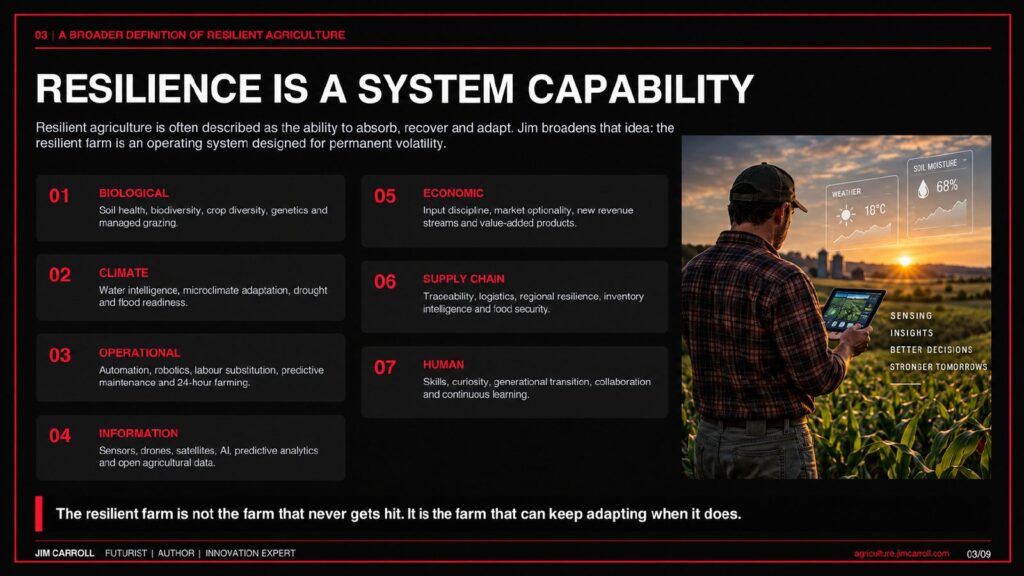
Beyond the field
Solar, storage, biogas, manure-to-energy, electrification and microgrids create a new role for agricultural operations in distributed energy systems.
Distributed solar, wind and biological feedstocks create new energy resources.
Falling battery costs create resilience and increase operational flexibility.
Microgrids and intelligent controls allow farms to optimize when and how power is used.
Supply chain & business model
Trade, logistics, traceability, packaging, cold chain, retail, geopolitics and consumer expectations now sit inside the agriculture strategy.
Resilience is now measured from seed to shelf.
The future is not only about growing more. It is about capturing more value through value-added agriculture, direct-to-consumer models, specialty production, controlled environments, agritourism, biomaterials, energy and new crop applications.
Foresight has receipts
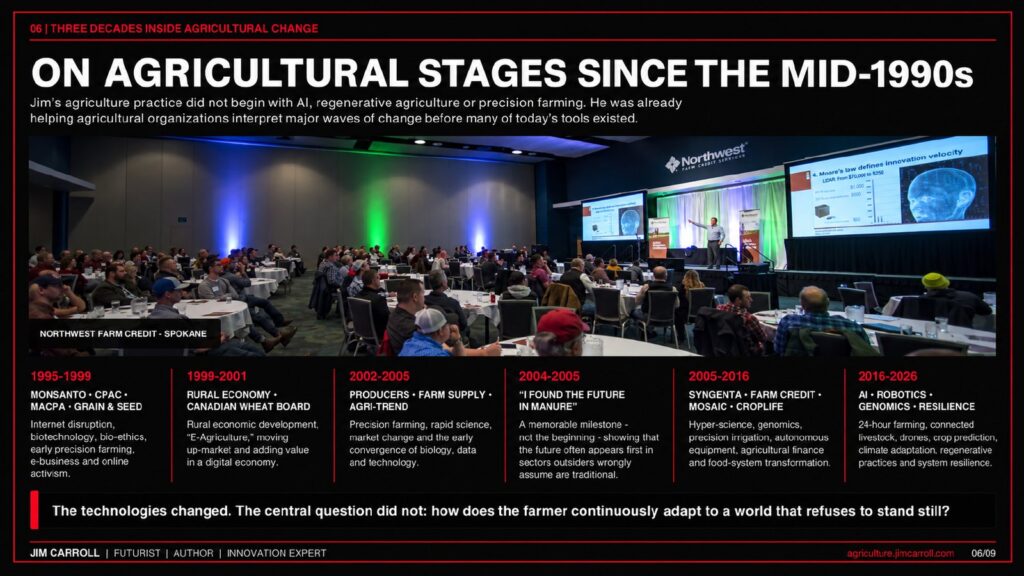
Jim was speaking about digital agriculture, biotechnology and precision farming in the 1990s. The point isn't that every forecast lands perfectly. The point is to build a record, revisit it and learn from what actually happened.
Internet disruption, biotechnology, bio-ethics, precision agriculture, e-commerce and online activism were already reshaping the long-term agricultural story.
Drones, driverless tractors, genomics and connected livestock moved from future concepts toward practical operating tools.
AI agronomy, machine vision, autonomous systems, resilience and distributed energy converge into a farm that continuously senses, learns and adapts.
Client Stories
Actual agricultural stages. Actual industry audiences. Different strategic questions every time.
DTN Agriculture / Progressive Farmer
More than 700 farmers and agricultural professionals. Robotics, autonomous operations, drone-based spatial analysis and the transition toward 24-hour farming.
See the full agriculture PDF ↗
CattleCon 2024
AI, connected livestock, predictive herd management, technology adoption and the acceleration of the ranching supply chain.
Download the agriculture brief ↗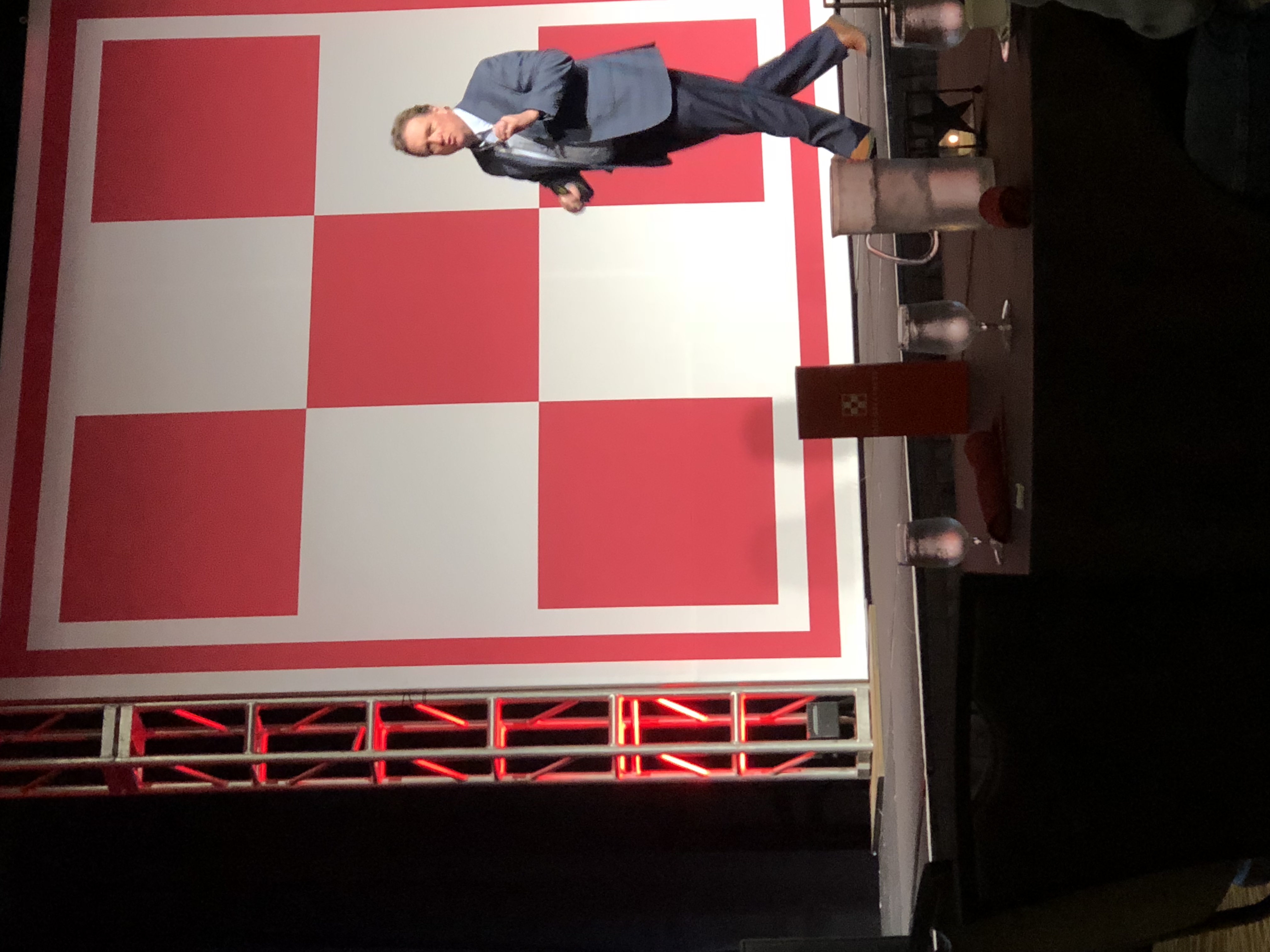
Purina
More than 500 dealers. Precision agriculture, genomics, drones, generational change, data insight and the potential Amazonification of the dealer model.
Simplot
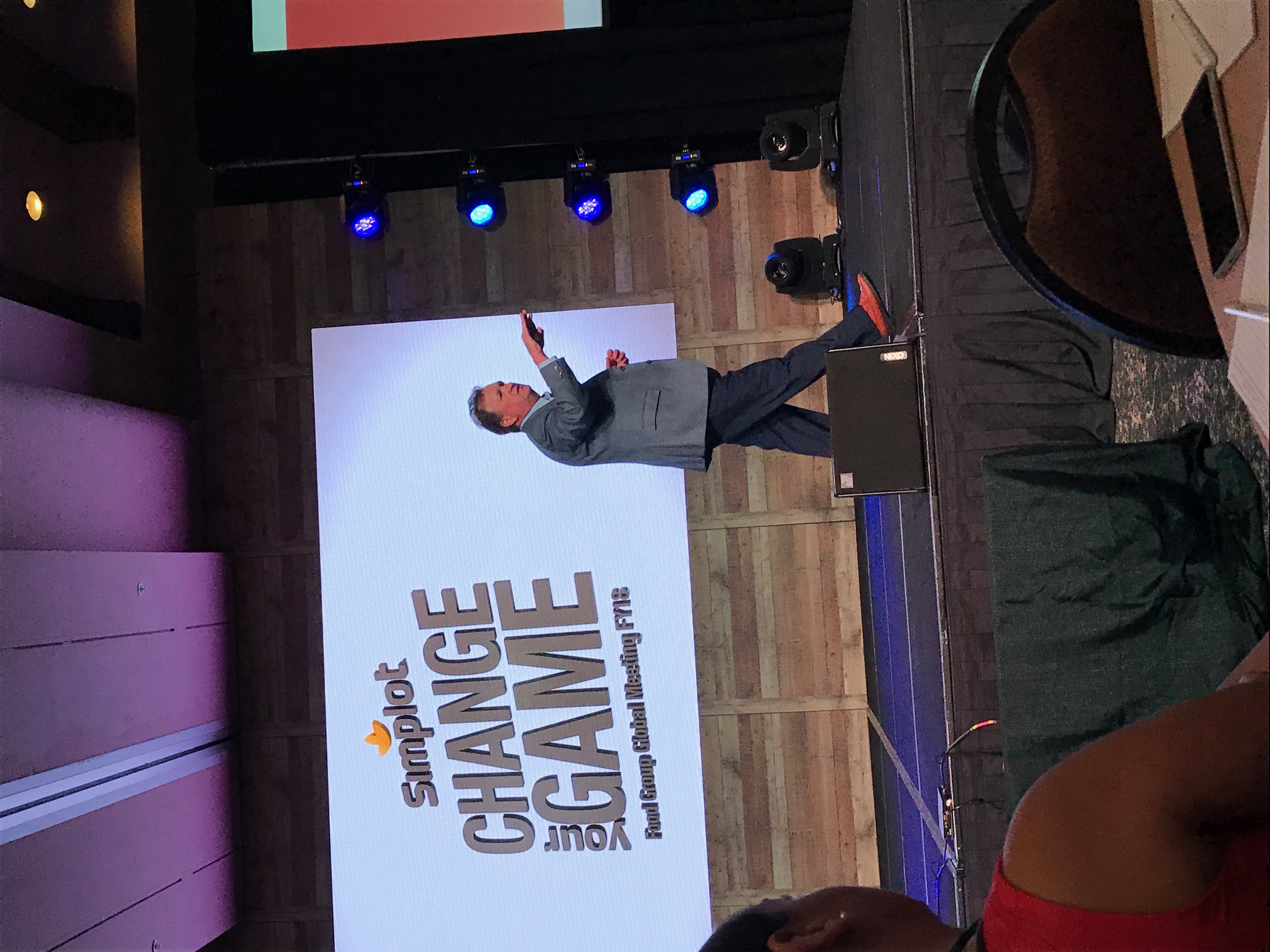
More than 400 executives across marketing, product, legal, finance and supply chain - connecting agricultural science to changing consumer and food-market realities.
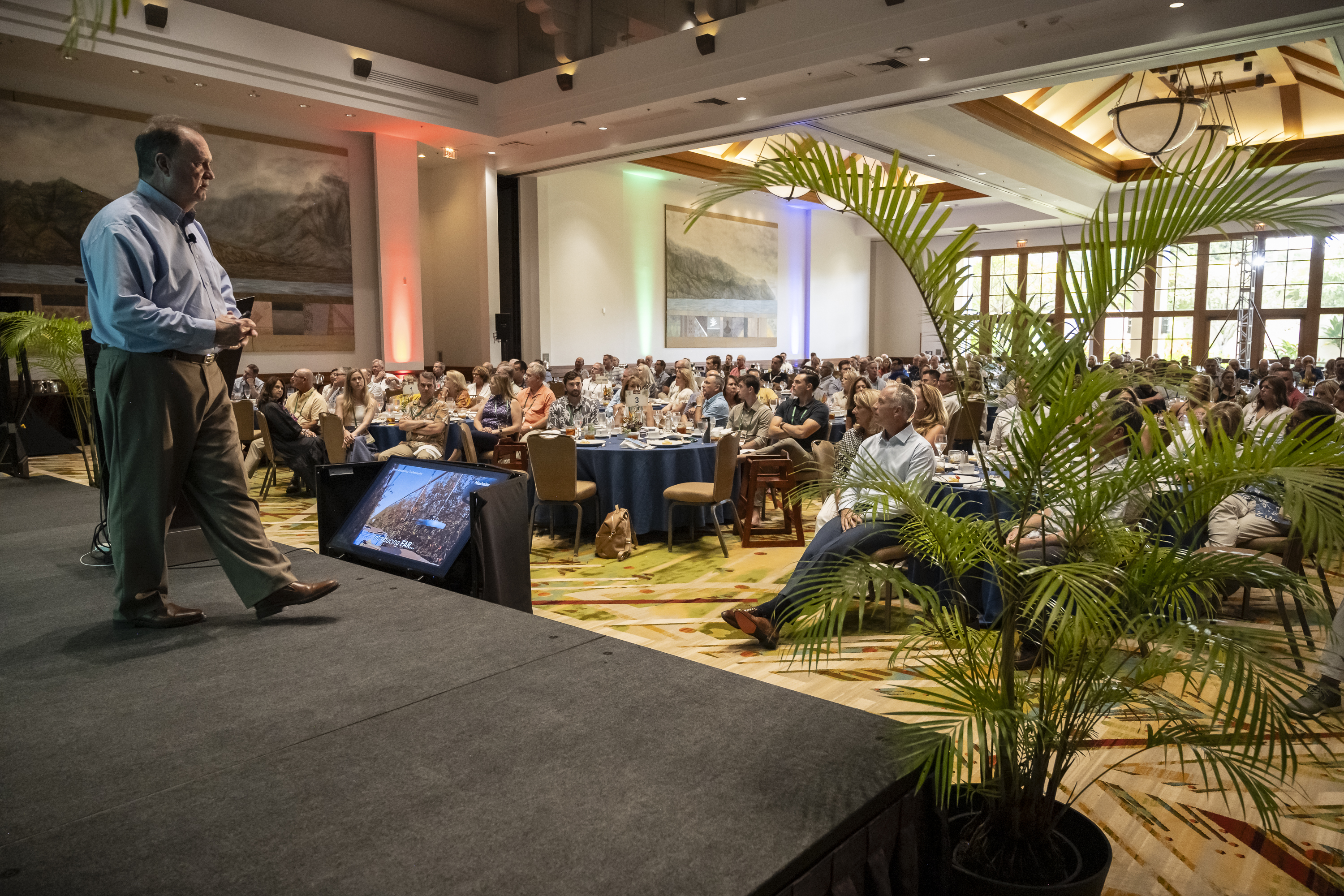
Western Growers
Near- and long-term implications of AI for growers, including virtualized farms, weed-zapping robots, genomics and machine-vision crop intelligence.
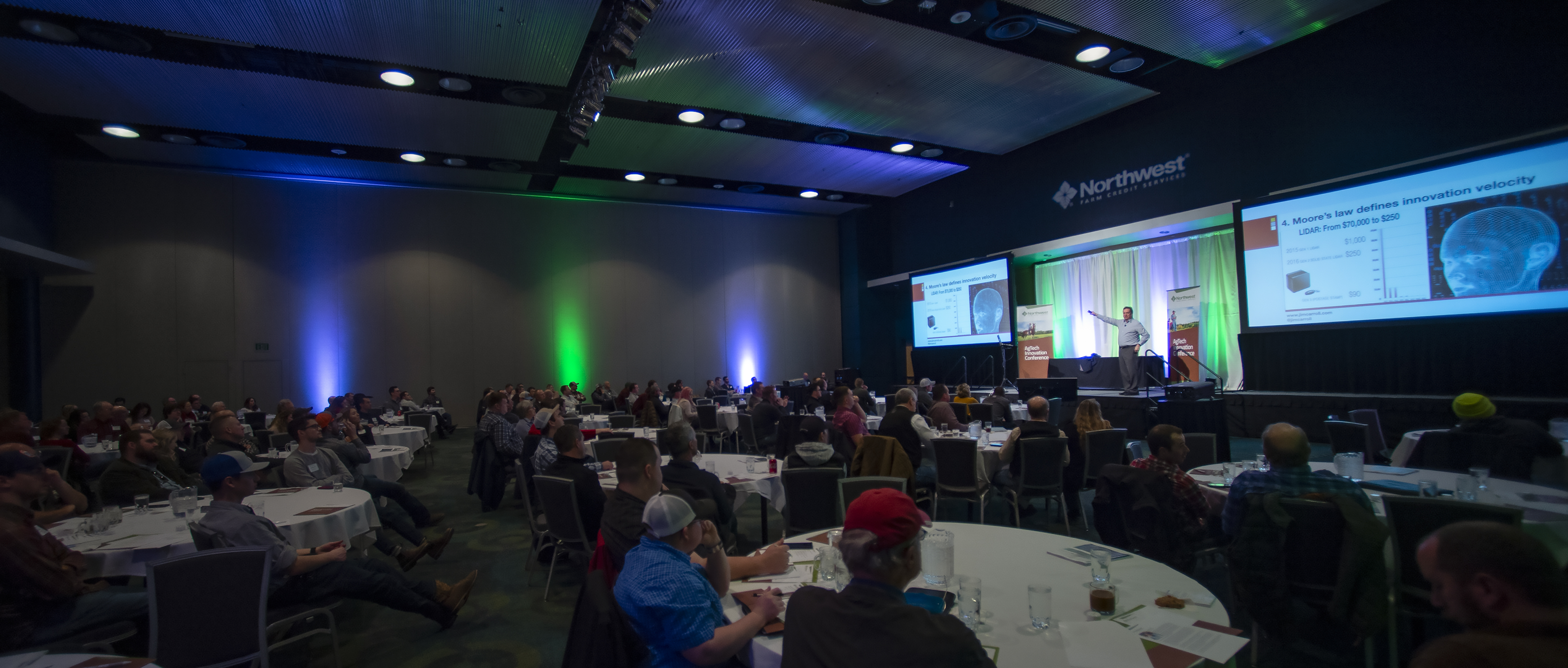
Northwest Farm Credit
Genomic science, intelligent packaging, drones and location intelligence - and what accelerating change means for farmers, producers and agricultural finance.
Watch Jim talk agriculture
Deep sector research delivered with a fast, visual style designed to make complex trends understandable, relevant and memorable.
Grab the agriculture PDF ↗Watch
The video loads from YouTube only after you press play.
Experience
Jim was speaking about digital agriculture, biotechnology, precision farming and online activism in the 1990s. The technologies changed. The central question did not.
That question from an attendee after one crop-protection keynote remains one of Jim's favourite compliments - and the simplest explanation of what deep customization looks like.
FUTURIST.INFO connects Jim's agriculture thinking to a much larger body of trends, signals, ideas, predictions and historical source material. It is the deeper research layer behind the keynote.
“How long have you been a farmer?”
1990s
Internet disruption, biotechnology, bio-ethics, precision agriculture, e-commerce and online activism.
2000s
Precision farming, rapid science, smart manure management, genetics, changing markets and new agricultural knowledge.
2010s
Drones, robotics, driverless tractors, genomic science, connected livestock and real-time agricultural intelligence.
2020s
AI agronomy, 24-hour farming, machine vision, climate adaptation, regenerative systems and resilient supply chains.
2030s
Continuous sensing, accelerated science, autonomous systems, distributed energy and increasingly programmable production.
Deep customization
Not from a generic speech inward.
A major keynote can involve client calls, industry reports, research papers, current news, agenda analysis, audience issues and sector-specific examples. No two presentations are the same.
LISTEN → RESEARCH → MAP THE TRENDS → BUILD THE STORY → CONNECT THE ROOM → LEAVE A PLAYBOOK
These sections come from agriculture.jimcarroll.com, Jim’s agriculture industry site, migrated here with their original copy and images.
From the research archive
Other industries
Make it about your audience
Bring the event objectives, the people attending and the questions you want them discussing afterward.