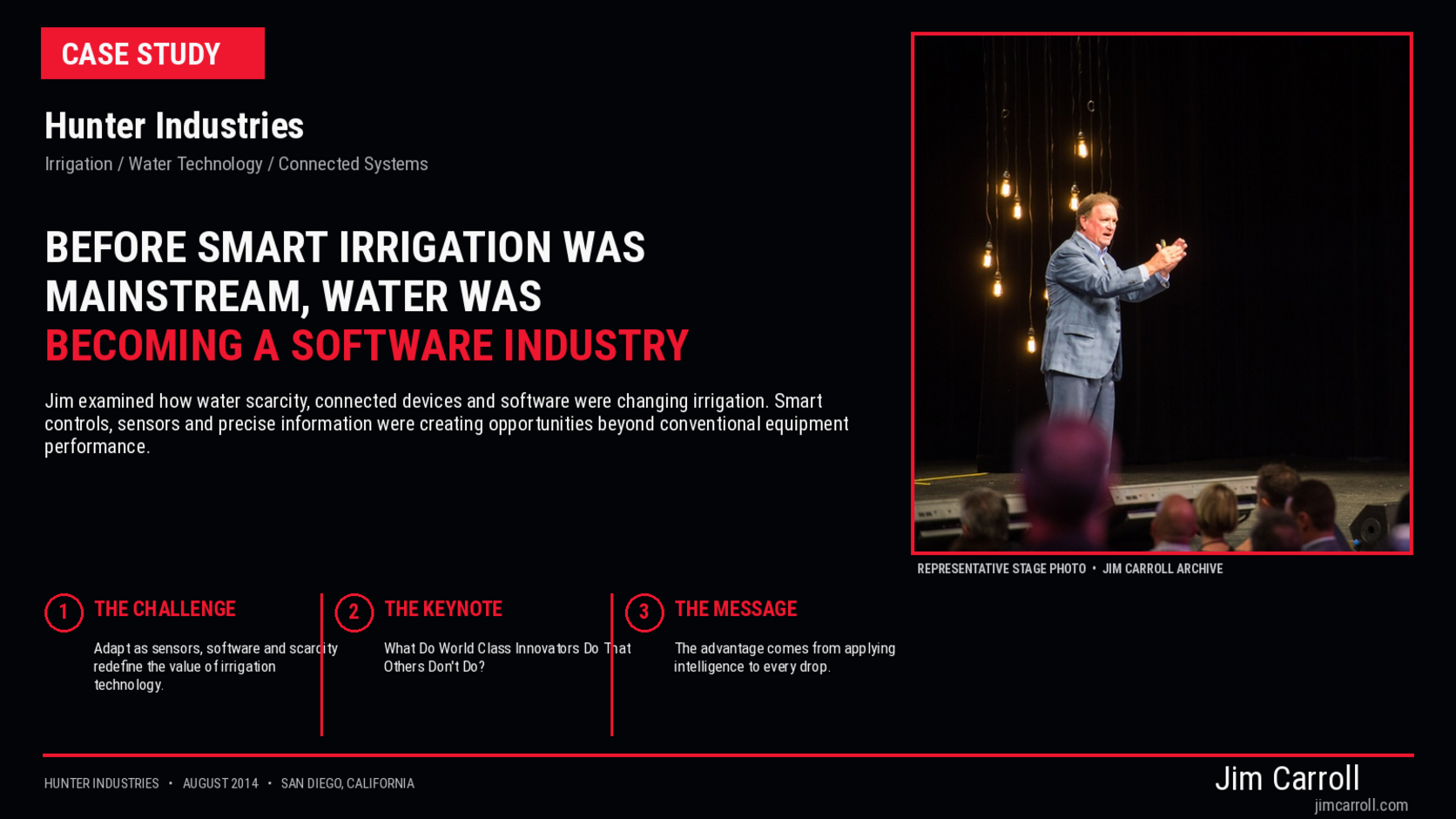
When Jim Carroll spoke to Hunter Industries in San Diego in August 2014, irrigation was becoming a much more technologically dynamic business. Water scarcity, rising demands for conservation and growing use of connected devices were converging with the traditional world of pumps, controllers, valves and landscape systems. Hunter's strategic question was whether innovation would continue to come primarily from equipment improvements or increasingly from the intelligence used to decide when and where water should flow.
Carroll's keynote emphasized how quickly connectivity and software were entering physical products. He compared the pace of technology development with the longer innovation cycles familiar in established equipment industries. The threat was not simply a better sprinkler head from a conventional rival. It was an emerging ecosystem of digital controls, environmental monitoring, new software services and startups that might change how consumers and commercial operators valued water-management capability.
The presentation made water use itself visible. Carroll used examples showing how much water is embedded in ordinary food and manufactured products, reminding the audience that conservation is a global economic issue rather than a narrow landscaping concern. Agriculture, expanding cities and changing climate pressures created incentives for improving how resources were measured and managed. The opportunity for irrigation specialists was to connect deep field experience with better information.
Smart controllers, sensors and hyperlocal weather data provided concrete areas of change. Systems capable of responding to environmental conditions promised a shift from fixed watering routines toward more precise scheduling and monitoring. Carroll also examined emerging ideas such as plants signalling water requirements. Such concepts should be understood as experimental or forward-looking examples in the 2014 presentation, not proof that a particular Hunter product was already providing them.
The broader strategic issue was that customers could increasingly evaluate water systems by performance rather than by standalone hardware features. Software could help interpret data, report consumption, adjust controls and make conservation more tangible. A supplier that understood new data capabilities could move closer to solving a customer's overall water-management problem, rather than compete exclusively on the specifications of a physical component.
Carroll closed with the innovation habits required to participate in that future: watch emerging competitors, learn beyond the industry, question familiar assumptions and move more quickly from trends to practical experiments. Hunter Industries illustrated how an established manufacturing category could be influenced by digital technology without abandoning its core technical expertise. The keynote's distinctive historical value lies in showing that the future of water management was being discussed as a connected, data-driven opportunity in 2014.
The Challenge: How could an irrigation-equipment company adapt as resource scarcity, intelligent sensors and software-based decision tools changed the definition of water-management value?
The Keynote: What Do World Class Innovators Do That Others Don't Do?
The Message: The future of irrigation would increasingly be measured by how intelligently water is applied, not merely how reliably equipment distributes it.
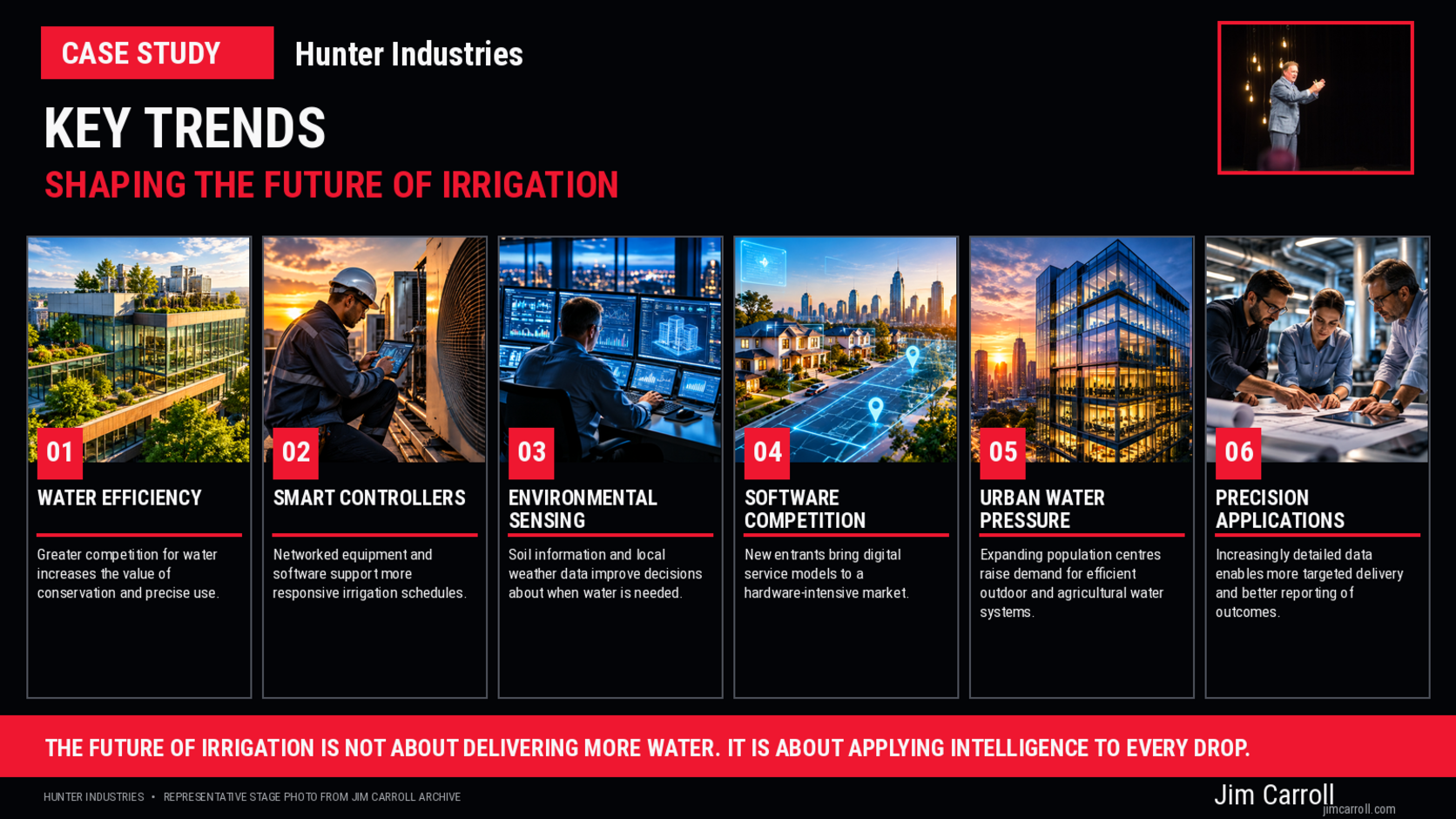
Six Trends Shaping Irrigation:
- Water Efficiency: Greater competition for water increases the value of conservation and precise use.
- Smart Controllers: Networked equipment and software support more responsive irrigation schedules.
- Environmental Sensing: Soil information and local weather data improve decisions about when water is needed.
- Software Competition: New entrants bring digital service models to a hardware-intensive market.
- Urban Water Pressure: Expanding population centres raise demand for efficient outdoor and agricultural water systems.
- Precision Applications: Increasingly detailed data enables more targeted delivery and better reporting of outcomes.
THE FUTURE OF IRRIGATION IS NOT ABOUT DELIVERING MORE WATER. IT IS ABOUT APPLYING INTELLIGENCE TO EVERY DROP.