2027 Brief · Agriculture & food systems
Farming 2036: Resilience at the Speed of Change
A closing keynote direction for a European agri-food innovation community: turning resilience from a defensive idea into a future strategy.
“Agriculture has always been an exercise in adaptation. What has changed is the speed, complexity and number of things to which agriculture must now adapt.”
Selected pages from the brief
The thinking behind the pages
01The Audience
A European agri-food innovation community: farmers, founders, researchers, investors, policy stakeholders and food-system leaders, gathered to explore how agriculture can become sustainable and fit for an uncertain future.
02The Challenge
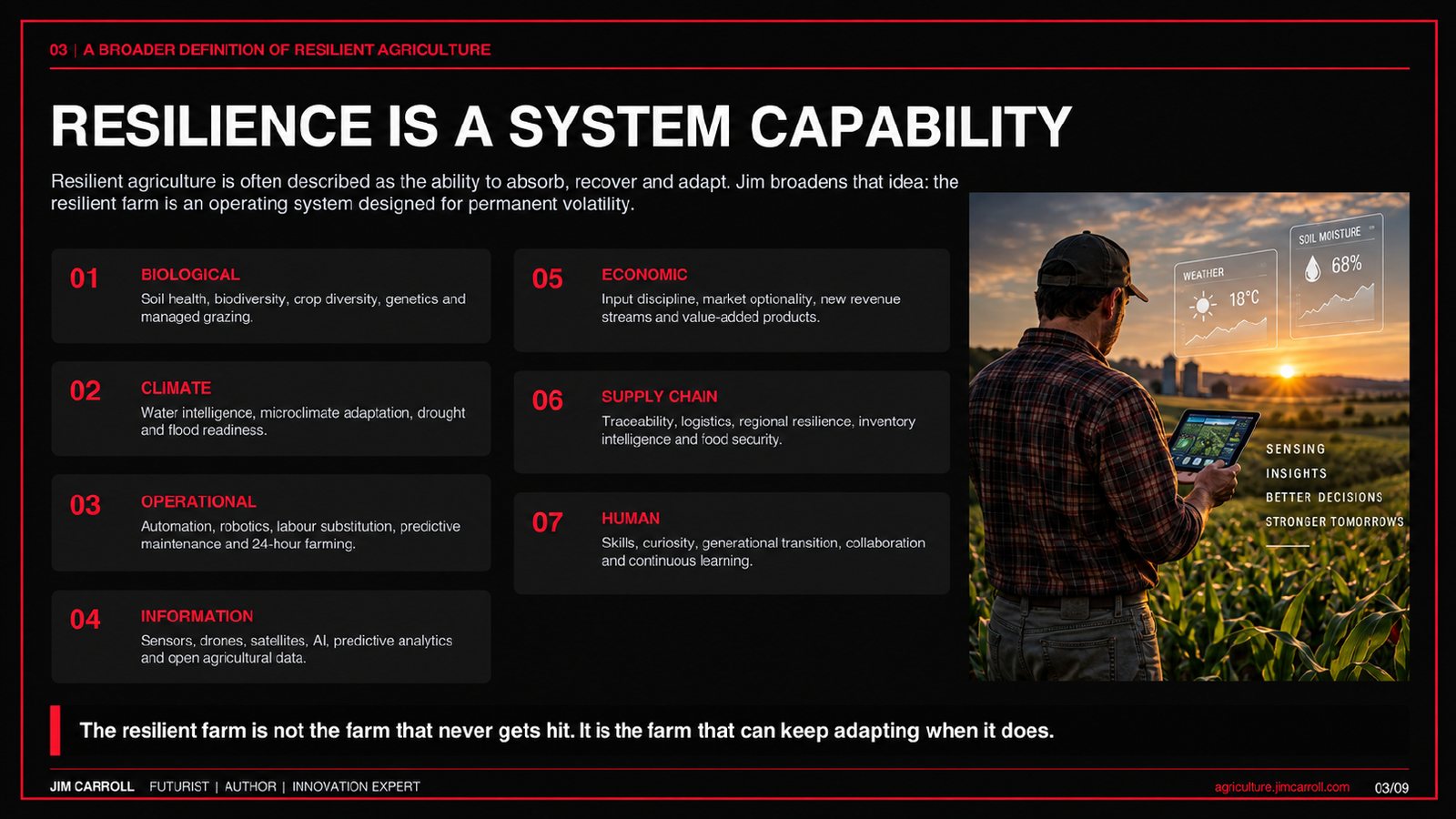
Resilient agriculture is often described as the ability to absorb, recover and adapt. But there is no “return to normal.” Weather, markets, inputs, science and expectations keep moving.
The goal is not to predict the next shock. It is to build an agricultural system that is better prepared for whatever arrives next.
03The Forces Reshaping Their World
Resilience is a system capability. The resilient farm is an operating system designed for permanent volatility:
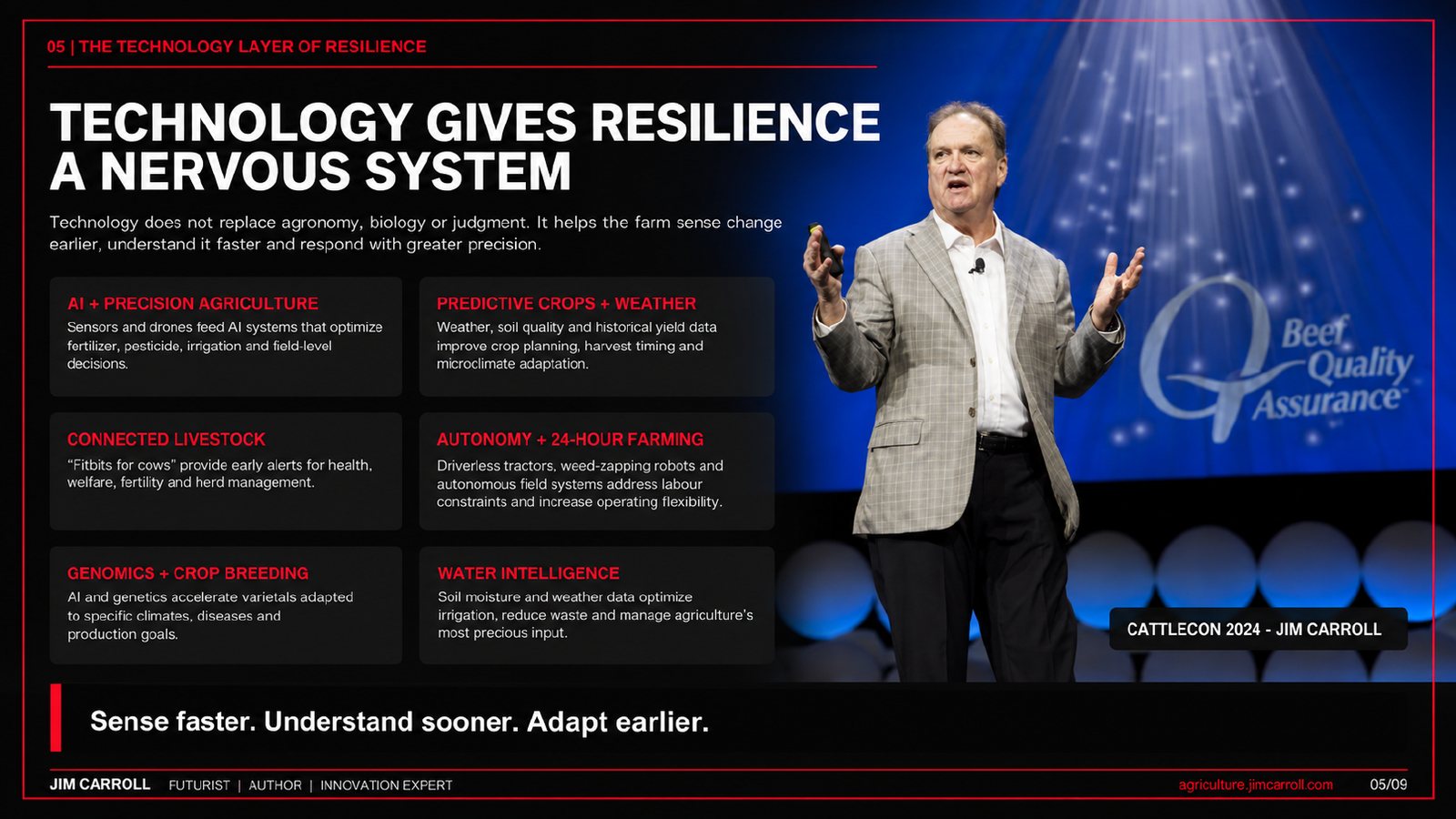
Technology gives resilience a nervous system: AI and precision agriculture, predictive crops and weather, connected livestock, autonomy and 24-hour farming, genomics and crop breeding, and water intelligence. Sense faster. Understand sooner. Adapt earlier.
04The Questions Leaders Need to Ask
- Which parts of our system are most exposed to the next shock?
- Where does diversity give us more choices when conditions change?
- What could we sense earlier, and how fast could we respond?
- How do we make AI, genomics and precision farming useful without the hype?
- What does the resilient farmer need to learn next?
05The Keynote Direction
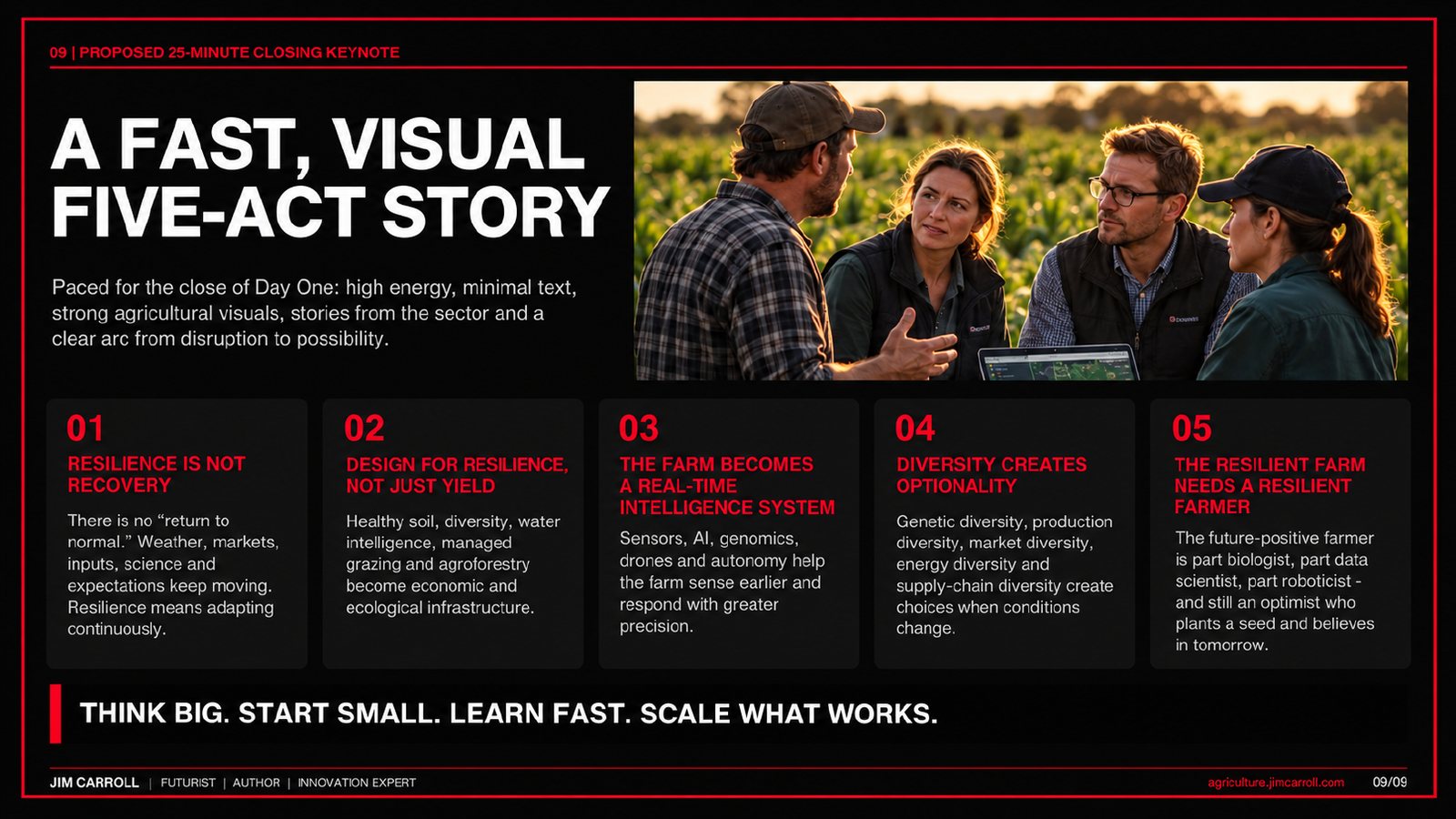
A fast, visual five-act story that connects the day's conversations into a single framework for action:
- Resilience is not recovery. Resilience means adapting continuously.
- Design for resilience, not just yield. Healthy soil, diversity, water intelligence, managed grazing and agroforestry become economic and ecological infrastructure.
- The farm becomes a real-time intelligence system. Sensors, AI, genomics, drones and autonomy help the farm sense earlier and respond with greater precision.
- Diversity creates optionality. Genetic, production, market, energy and supply-chain diversity create choices when conditions change.
- The resilient farm needs a resilient farmer. Part biologist, part data scientist, part roboticist, and still an optimist who plants a seed and believes in tomorrow.
06What They Leave With
A practical mindset and questions they can use immediately after the event: Think big. Start small. Learn fast. Scale what works.
“The resilient farm is not the farm that never gets hit. It is the farm that can keep adapting when it does.”
Built for This Room. Not Recycled for It.
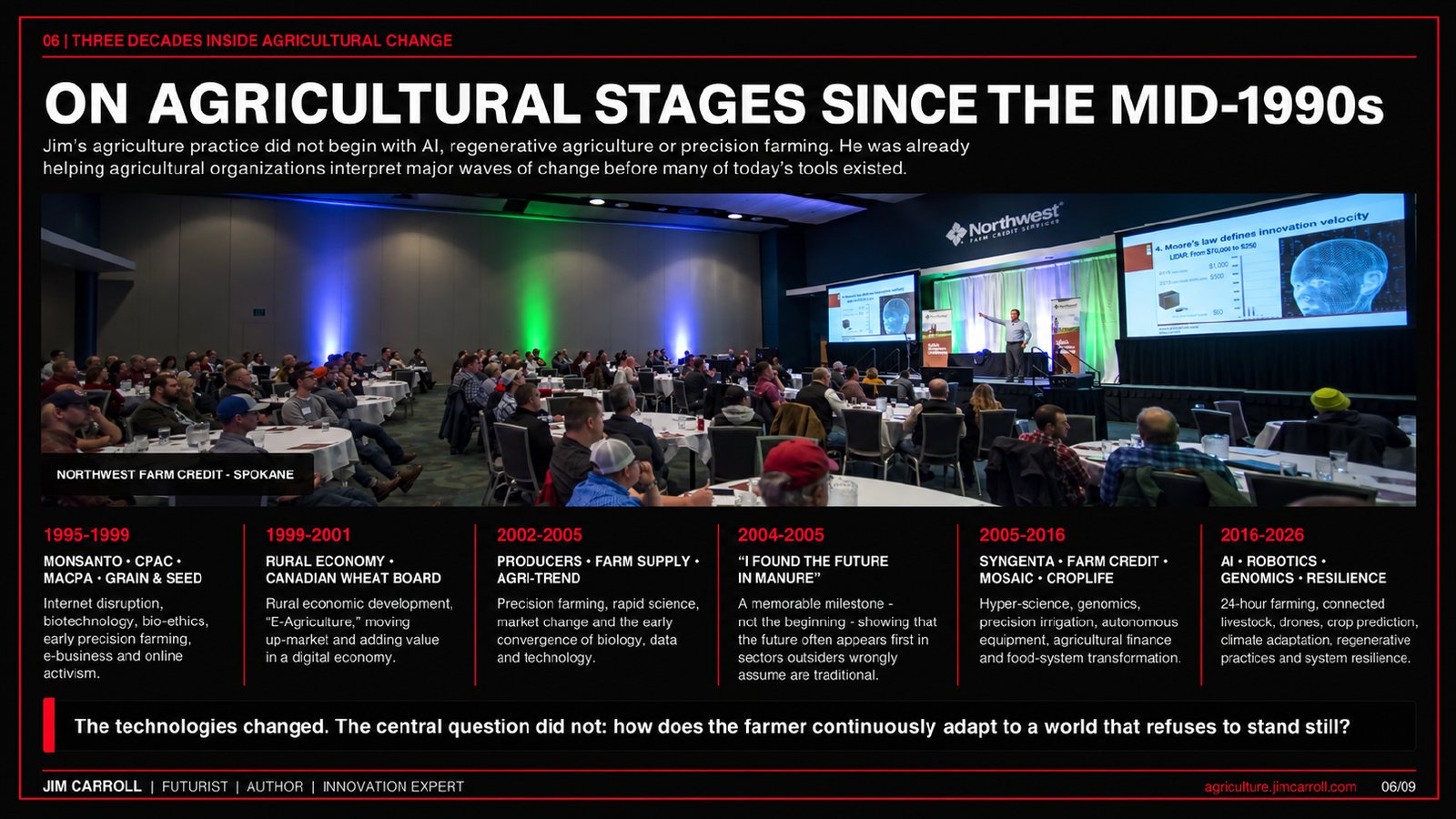
Jim has been on agricultural stages since the mid-1990s, across crop science, farm finance, producer groups, co-ops, livestock, food, packaging and supply chains, for organizations including Monsanto, Syngenta, Mosaic, Farm Credit, Wilbur-Ellis, Simplot and the Canadian Wheat Board.
BUILD A BRIEF FOR MY EVENTAGRICULTURE ↗
More 2027 Briefs: Shaping the Future, Trustee to Trustee · Paving the Future