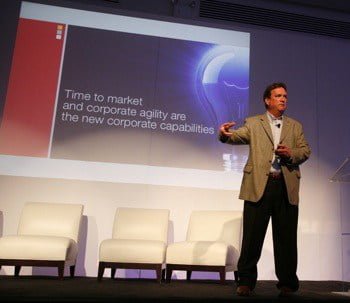
Jim Carroll was the keynote speaker at the Manufacturing Jewelers and Suppliers of America (MJSA) Conference in April 2008, addressing one of the jewelry industry’s most pressing strategic questions: how companies of any size can adapt and evolve in today’s fast-paced global economy. MJSA’s membership spans manufacturers, designers, suppliers, and retailers across the fine jewelry sector, and Jim’s message — drawn from his work with leading global organizations — focused on the innovation disciplines that separate companies that thrive from those that merely survive. His talk challenged the industry to look beyond the immediate cycle and embrace the disruptive forces reshaping manufacturing, retail, and consumer expectations. It was an early signal of the urgency Jim would bring to manufacturing audiences for years to come.
Innovating in a flat world – the jewelry industry
I keynoted the 2008 Manufacturing Jewelers and Suppliers of America Expo New York yesterday, on the theme of “”How to Unlock Your Potential in the High Velocity Economy.” Just about a week from now, Dubai will hold a similar event. The challenge for the AJMA members is that they now find themselves in a world that has gone massively global and is far more competitive; and as the world has flattened, so too have their challenges. They’re competing not only against the City of Gold, but countless other highly innovative jewelry centers.
The focus of my keynote: what to do after the world gets flat! How can they innovate to deal with the unique challenges of today? Most certainly, the challenges go far beyond just globalization: rapidly changing consumer attitudes are also playing a key role. I used some recent insight from research firm Mintel UK, which provided a few fascinating nuggets:
- only 5% of all the customers surveyed buy jewelry frequently – compare that to the trends with consumer electronics spending – a lot of discretionary spending now goes to the latter, and not the former.
- 22% compare prices before they buy
- 15% buy online
- 17% of women are finding jewelry sold in supermarkets an “increasingly attractive” option
These are all the classic signs of commoditization of an industry — wherein existing competitors find themselves in a never-ending black hole of being forced to compete on price.
How do you innovate your way out of this? The advice I included in my 75-minute talk covered a vast number of issues; here’s a few of the things they should focus on:
- faster time to market : fashion happens faster; they need to deal with this. If P-Diddy appears with a new ear-stud and it gets noticed, kids will want it. Agile jewelers align themselves to such instant production, by revamping their process and cost structure.
- innovate upside-down. Adopt new design philosophies: rather than innovating, focus on upside down innovation. Work with their retail partners to restart the design process. Innovative organizations recognize they can’t do it all. They seek partners with everything they do, recognizing that there are of lot of really wonderful innovative ideas that transcend their organization and their culture. This allows them to discover new innovative ideas they hadn’t thought of before; a process I call upside down innovation.
- revamp manufacturing capabilities: a lot of these folks manufacture to inventory, and with the high and fluctuating cost of gold and other metals, that’s an expensive business model to maintain, particularly in the context of increased global competition. Leading edge manufacturers are using CAD/CAM tech to change their design process and are learning to shift their business model as a result.
These were just a few of the issues I covered ; the key is accepting the fast-change that envelopes the industry, and challenging your assumptions and habits to move forward!
Where’s the growth?
Gloom has set in on global markets. Volatility rages. Some organizations have gone into a mode of “aggressive indecision,” deferring action while they try to figure out “what comes next.” A pretty lousy strategy that is doomed to fail in the longer term.
Future oriented leaders understand the reality of growth. They know that we live in a time in which opportunities for growth abound. They’ve aligned the mission of the organization so that they are capitalizing on real opportunity, not short term economic challenges.
Growth is everywhere.
It’s easy during a time of economic volatility to lose sight of where the global economy is really headed. Yet while stock markets might rock, innovation thrives.
New ideas continue to be explored, markets grow, and industries emerge. A variety of trends indicate that opportunities for growth continue to surround us.
Read this document to get in the right frame of mind for the future…..and think growth. Think opportunity. Innovate for future, don’t stagnate with the past.
Download Where’s the Growth? Global Innovation Opportunities for the Long Term
![]()
10 Great Words: inspirational innovation insight
Years ago, I wrote a little article, “10 Great Words,” as a way of summarizing how to instill an innovative mindset.
It remains one of the most heavily viewed pages on my site. I use the words within my keynotes, providing motivational guidance to people on how they can challenge assumptions and eliminate habits.
I often notice people in the audience quickly writing the words down; I’ve heard of others who have printed off the list of 10 words and have posted them to their cubicle. Simply as a way to stay focused on creativity and innovation.
The list also made it into my Ready, Set, Done: How to Innovate When Faster is the New Fast book.
I’ve just wrapped it up in a new PDF ; feel free to share the document with your staff, team, and leadership; it’s proven to be a wonderful summary of how to stay motivated and focused on opportunity!
High velocity e-commerce: a keynote for VISA
I’m about off to keynote a conference for Visa. With executives in the room from Apple, Sony, Ticketmaster, HomeDepot and other organizations that are e-commerce heavy hitters, I’ll be focusing on the message, “what do high velocity companies do to stay innovative?”
Much of the conference so far will have focused on the high velocity change that swirls around the issue of e-commerce: the rapid emergence of new payment technology (i.e. cell phone payment infrastructure), continued market growth as e-commerce becomes a routine part of daily life, and internationalization of market and opportunity (China now has the largest Internet population, with 250 million users.) There’s also a significant platform shift as mobility takes on an increasing role: Investors Business Daily just reported that already, 16% of US cell phone users do online banking with their device, and 25% shop online. Such numbers pale in comparison to even more rapid change in Asia and Europe.
How do you stay innovative in a world of fast change?? I have several messages:
- prepare for market / product / infrastructure rapidity: fast innovators make sure they have a collaborative team structure that can assemble into fast-teams, ready to tackle new projects, demands, market shifts and other changes. It’s all about corporate agility.
- structure for intensity: prepare for the rapid emergence of new technologies, and organize yourself with partners to help you nail implementation. Mobile payment technology is going to have a sweeping impact, and it’s rollout will occur in but a few short months. That’s the new intensity of business cycles.
- empower for quality: if you shop online, you expect operational excellence, no questions asked. You can only do that by empowering staff to act on the ground, making quick decisions so that quality of experience is not compromised. Read my When FedEx Fails post of a few days for an important lesson on today’s empowered consumer.
- enhance capability from generational diversity: Older generations are still struggling with fast pace change: that’s one of the key trends I identified in my most recent Future Trends report. Savvy organizations are learning to implement fast by combining the different talents of different generations; by providing for cross generational collaboration, they are drawing upon a set of unique skills to act even faster, thus managing to stay ahead of the pack.
10 years ago this market didn’t exist. Today, it is valued in the hundreds of billions, and growth continues to compound. Anyone in this space is faced with a lot of real, significant change: with technology, customers, expectations, competitors, business models and just about everything.
You stay innovative by structuring yourself to stay just one step ahead of the future.
High velocity leadership: how to stay focused on growth

Organizations today are looking for deep insight into the trends that will affect their markets and industries.
CEO’s are focused on the need for innovation, knowing that a world of high velocity change requires that they respond to opportunity and challenge in an instant. They are looking for guidance on establishing high-performance, innovation oriented teams that are focused on achievement.
I’ve been doing quite a bit in this area; the other day, I spent time with a global organization, for a full day, with a keynote and workshop focused on the issue of “growth.” It’s easy — in a challenged economy — to lose sight of opportunities for growth.
That’s what I talk about in the recent interview by Credit Suisse.
With this particular client — and many others — I went beyond a keynote, and participated for the balance of the day through a series of workshops. This new document outlines what I do: I’m often called upon to deliver unique, half day or full day executive retreat, leadership oriented programs.


GET IN TOUCH
Jim's Facebook page
You'll find Jim's latest videos on Youtube
Mastodon. What's on Jim's mind? Check his feed!
LinkedIn - reach out to Jim for a professional connection!
Flickr! Get inspired! A massive archive of all of Jim's daily inspirational quotes!
Instagram - the home for Jim's motivational mind!