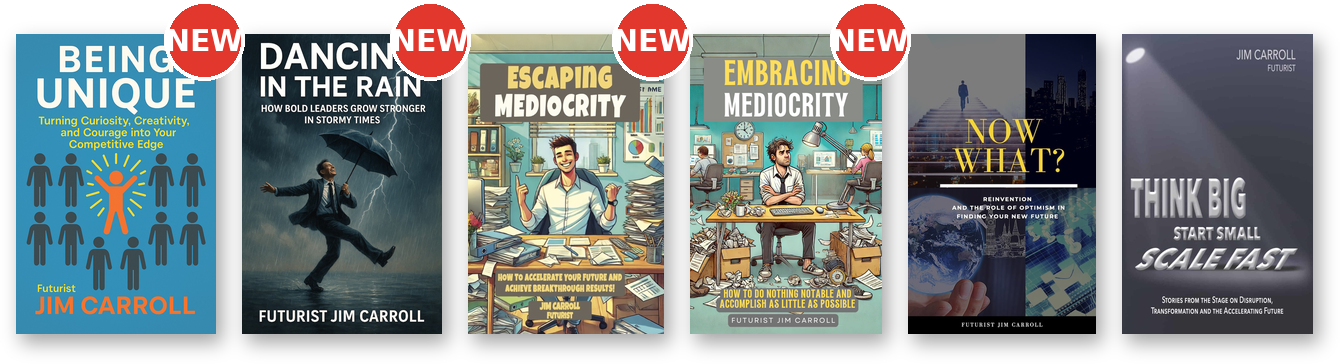

Jim Carroll was the keynote speaker at the Financial Directors Annual Meeting in May 2009, addressing senior finance executives on the trends reshaping business strategy and the role of financial leadership. The meeting brought together CFOs and financial directors at a moment when the global economy was in the midst of unprecedented disruption, making Jim’s forward-looking perspective on innovation and change particularly timely. He challenged finance leaders to move beyond crisis management and embrace the longer-term strategic thinking that would position their organizations for growth and resilience. His session set the tone for an agenda focused on helping financial executives lead with clarity and confidence through uncertainty.
Followup to BCAMA conference – Keynote feedback!
 Some very nice feedback from my keynote for the BC American Marketing Association Big Ideas conference last week; my theme was “Moving Beyond the Meltdown: Aligning Yourself for Growth Through Innovation.”
Susan Kirk blogged about it in her summary, noting:
Futurist Jim Carroll started his presentation with a cool text/sms poll (poll everwhere) asking the audience when they think the economic recovery will happen. No surprise the majority said 1-2 years. He’s a great speaker and talked about innovation and the necessity for a relentless focus on growth and continuous improvement. Here’s a quote from his website:
“Forget about the concept of innovation as simply involving the design of cool new products. In the high-velocity economy, where faster is the new fast, it’s your ability to adapt, change, and evolve, through a constant flood of new ideas, that will define your potential for success.” (From the opening chapter of Jim’s newest book, Ready, Set, Done: How to Innovate When Faster is the New Fast) /keynotes.htm
There’s a very interesting blog post by Michelle Evans over at her blog, “im.seeking.balance” — she summarizes the key points of every speaker at the conference in a very comprehensive summary.
Her summary comment from that page on my presentation:
I loved this session. Even thought the key take-aways seem quite simple, it was a very inspiring presentation. It made me feel like I’m on the right track with my goals and philosophies. So here’s what I got from this: Now is the time to innovate. Evolve your brand. Move towards mobile. Connect. Engage. Try new things. Keep learning and changing.
It’s always tremendously refreshing to see feedback like this; I went out on stage with a tremendous amount of enthusiasm, determined to build a positive message for people who are looking for inspiration in these difficult economic times. With feedback like this — and with comments made in the #bcama Twitter stream, it proved to be a great success!
The Internet economy: How it will drive recovery

From my May CAMagazine column.
As we worry and wonder about the state of the global economy, we should remind ourselves that one thing is certain. At some point in the future,newspapers will run banner headlines featuring the words “Economic Recovery.”
The challenge with this particular downturn is that every single event — downsizing, layoff, missed earnings target or corporate bankruptcy — is now repeatedly examined in depth on 24-hour news channels. As a result, it’s easy to lose sight of the following key trends, which will help lead us into economic recovery.
Infrastructure: There is no doubt there will be a significant national economic stimulus due to infrastructure spending, but I believe we’re entering the era of smart infrastructure, which will involve more than shovels and buckets. For example, roadworks projects will use smart-highway technology, such as the linkage of spatial databases (think Google Maps) to GPS technology embedded in cars. It won’t be long before you can put your car on autopilot, so to speak, carefully keeping up with traffic flow as measured by highway-embedded sensors. Science fiction? I don’t think so. Put it this way: every bit of new infrastructure will be integrated with the Internet, and that will provide for some fascinating opportunities.
Healthcare: The ramp-up in healthcare spending that will occur as boomers age will be staggering, and this will perversely drive job growth at the same time it strains the budget. In the US, healthcare spending could equal 60% of gross domestic product in some states within 10 years. Such stark realities are driving furious rates of business model, technological, structural and other innovations in healthcare, much of which will involve sophisticated Internet technologies. For years, I’ve been talking about the potential for bio-connectivity devices: smart home-based medical monitoring technologies doctors can use, via the Internet, to monitor noncritical-care patients. Such innovations will drive a variety of growth-oriented markets.
Environment: Despite the slowdown, there is no pullback in major efforts to deal with challenging issues, which means ecological spending will continue to drive growth markets. McDonald’s is investing in a new company-wide intelligent energy infrastructure management system to deal with annual energy costs of US$1 billion. It expects to reduce overall costs by 20% by having the ability to remotely manage and monitor fryers, air conditioning, water usage and other devices throughout thousands of its restaurants. This will involve using the Internet as a backbone to a sophisticated global energy management system.
Industry reinvention: Similarly, connectivity will play a key role in the reinvention of products and industries. There is a lot of talk about the concept of Car 2.0, which involves a fundamental reinvention of current transportation mind-sets. There is a strong belief that we will see a reinvention of the auto industry, particularly as Silicon Valley begins to laser-aim its focus at the next generation of automotive business model. The next-generation automobile, if it emerges from the land of high-tech, will have “connectivity” as its middle name.
The change agenda of Generation Y: As I described in last month’s column (“They’ll spice up your systems,” p. 14),the members of this technologically aggressive, entrepreneurial generation will completely reshape the fundamentals of every industry, driving economic growth.
All in all, my view is that beyond a three- to six-month horizon, we will start to realize areas of economic growth, and the Internet will continue to play a key role.
I read a book today, oh boy! “Bothered by My Green Conscience”
Fifteen years ago, I met Franke James — a brilliant designer, artist, and creative thinker. At the time, she had been the lead designer for a conference program for which I was the lead speaker.
Our paths diverged, and I had not seen her for some time, but was aware of her ongoing work. In 2004, I needed a cover design for my upcoming book, “What I Learned From Frogs in Texas: Saving Your Skin with Forward Thinking Innovation.”
I thought of Franke, met with her again, and contracted her on the spot. Her design was unequivocally brilliant.
Paths diverged again — and then she’s back. Last night, I read Franke’s new book, “Bothered by My Green Conscience: How an SUV-driving, imported-strawberrty-eating urban dweller can go green.”
It’s an absolutely stunning, delightful, colorful, inspirational and thought provoking romp through Franke’s unique adventure to change her life to pay more respect to the environment. It’s artistic, creative, and unique. I don’t think I’ve quite ever read a book like this.
It’s not really a book that you read; it’s more of a colorful diagram that you work your mind through. Franke’s unique skill has always been her ability to draw her thinking. And that’s what she does in this book — it’s an absolutely fascinating display of what can be done when a truly unique, creative mind sets out to tell a story in a unique and innovative way.
You really need this book – both for the unique creative way in which she tells her story — and for the importance of the message that it provides. Inspirational!
- Buy Bothered by My Green Conscience on Amazon

- Learn more about Franke James

Time for a little innovation oxygen? Why wasting time is a GOOD thing…..
 When my friend Scott Kress summited Mount Everest last year, he used a little bit of oxygen for the final push. Many climbers do — sometimes you need the extra energy to accomplish something massive!
So it is with innovation — sometimes you need some help to accomplish great things. I’ve written an article this morning, “Time for a little oxygen?” that offers some thoughts on how you can kick up your innovation efforts a bit more.
Here’s an extract:
To get into a frame of mind of acting fast, everyone needs to be able to learn a lot, very quickly. One way of doing that is by encouraging people to “waste” time. That’s right – I really recommend that as a business strategy.
How can people understand the high velocity change in markets, business models, competitive challenges, the emergence of new means of marketing and branding, and all kinds of other issues, if they are restricted to formal education programs? How can they learn about the new products that they need to sell when those products are coming to market so quickly? How can they learn new methods of dealing with a customer by taking an in-house course that was developed over a year ago, when the market was completely different from today?
That’s where frivolous education comes in, as a complement to traditional, formal corporate education programs.
Why not establish some “playtime” with your sales force, with the purpose being to try out a multitude of new technologies: encourage browsing through industry magazines, surfing the Web for market research, etc… Such activities may help bring understanding to how the customer is changing. So in fact, what may appear to be “wasting time,” really is not so
.
As for Scott, his time spent summiting Everest certainly wasn’t a waste of time. He’s an Executive MBA teacher, consultant and speaker, and the experience has given him a unique message on leadership, teams, and effective strategic planning!
- Read the article Time for a little innovation oxygen?
- Learn more about Scott Kress
10 Things You Need to Do to Innovate in a Recession
 Business Week ran an article in January, “10 Worst Innovation Mistakes in a Recession.”
It’s easy to point out mistakes. It can be harder to indicate what you should be doing.
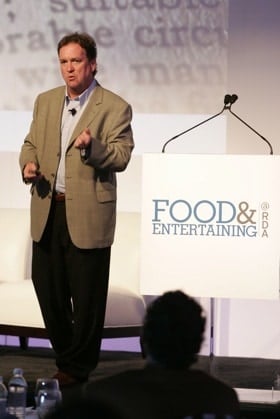
I’ve been out speaking to organizations about trends, the future, innovation and creativity for fifteen years. Since last year, when the meltdown began, I’ve been keynoting events worldwide, rapidly adjusting my theme to one of “how you can innovate during a recession.” I’ve had the opportunity of seeing first hand quite a few very innovative strategies from CEO’s and others in a wide variety of events, and I keep modifying my message at rapid speed to incorporate a vast variety of ideas.
So I just took a few minutes to post a comment to the Business Week site, and I’ll post my quick thoughts here too. Here’s a list of 10 off the top of my head:
1. Focus your team — relentlessly — on growth. I keynoted a global organization in Las Vegas in February. The CEO got on stage before me — and spoke about the recession for one minute. He then spent 19 minutes speaking to the growth opportunities that the organization could pursue. That’s what everyone needs to do right now. There are growth opportunities in every industry. Focus on them!
2. Respond faster. When I keynoted a food industry summit in New York, we spoke of the need to respond faster to the fact that consumer preferences were changing more rapidly than ever before. More people eating at home, sensitive to dollars, looking for food-comfort. Reformulate new brand and product options faster. Just do it. Don’t study — do.
3. Invest in the brand. Brands can become weaker in a recession, particularly as consumers scramble for value. Decide where you want to reposition your product/brand, and act fast to do it rather than studying it to death.
4. Mix it up. Don’t assume that worked before the recession will work now. Try out a lot of ideas, particularly around value. “I’m experimenting rapidly with price points and product mix.”
5. Invest in experience. Lots of your staff will be down in the dumps, and are spinning their wheels. Get a message out that NOW is the time to invest in experience. Try things out, to build up the collective experience of your team.
6. Kill off the innovation killers. Reframe your team, so that they are thinking “what a great idea,” rather than viewing with suspicion any new ideas. Remember — everyone is worried about being laid off, and paranoia sucks the life out of innovation faster than anything else.
7. Collaborate within the industry. When I keynoted the American Nursery and Landscape Association recently, I stood in awe of the blog they were running that was offering practical, on the ground, easy to implement ideas that retailers could put into their stores NOW.
8. Seek ideas. Go knowledge farming once a day, looking for ideas on customer service, operations, IT strategies, and just about anything else. There’s a flood of ideas out there — now’s a great time to chase them down and do things.
9. Partner up. Sure, resources are scarcer during a recession. That’s why you can speed up innovation with anything — from advertising, to customer service, business model implementation, IT strategy, opportunities for operational excellence or just about anything else — by seeking partners to help you out. That will help you achieve key goals faster.
10. Get over it. Lots of organizations are still stuck in the anger and denial phase of the Seven Steps of Economic Grief. Make a decision to get into the acceptance stage, and move on. This will recession will pass, just like every other one.
There are dozens more…..


GET IN TOUCH
Jim's Facebook page
You'll find Jim's latest videos on Youtube
Mastodon. What's on Jim's mind? Check his feed!
LinkedIn - reach out to Jim for a professional connection!
Flickr! Get inspired! A massive archive of all of Jim's daily inspirational quotes!
Instagram - the home for Jim's motivational mind!