
Disruption is real, it’s big, and it’s happening faster than you think.
Do you think your business model, your products, your organization, your culture, your legacy … will survive tomorrow? It won’t, unless you challenge yourself to change!


Disruption is real, it’s big, and it’s happening faster than you think.
Do you think your business model, your products, your organization, your culture, your legacy … will survive tomorrow? It won’t, unless you challenge yourself to change!
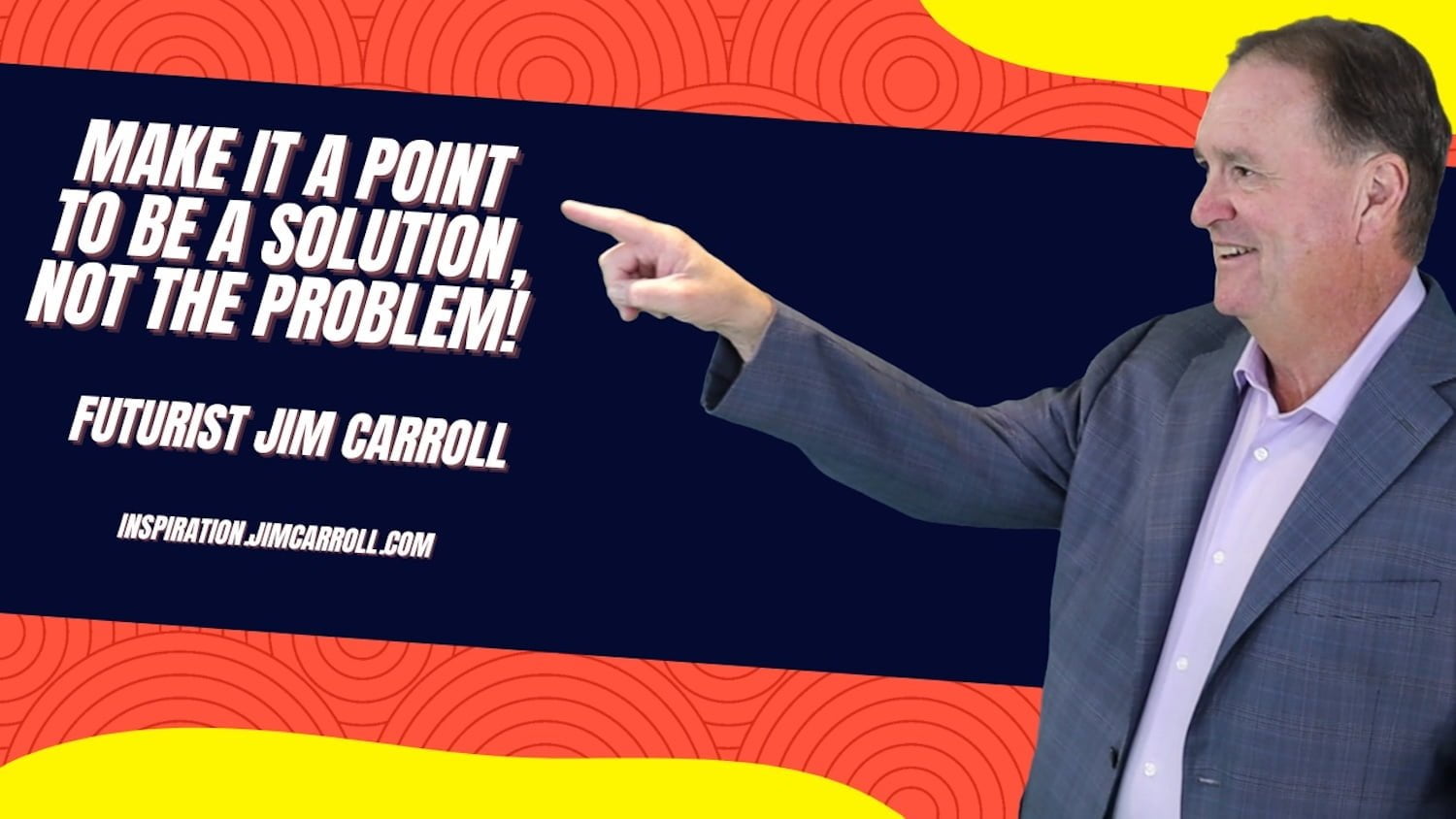
“Make it a point to be a solution, not the problem!” – Futurist Jim Carroll
People don’t like whiners.
They are inspired by inspirers!
Success based on optimism is not that difficult – it’s about the attitude that you arrive with each and every day.
Show up with the right mindset and you’ll set yourself on the right course.
Define yourself with the enthusiasm of your action, not the apathy of poor performance.
Focus on your optimism, abandon your pessimism.
Pursue big ideas, and abandon trivial thoughts.
Develop the willingness to embrace change rather than fight it.
Pursue the ability to inspire your team, rather than dragging them down.
Become known for the goals you can achieve rather than the deadline you miss.
Don’t fight the small fight, stick in it for the big win.
Choose to be a positive force for change, not a negative drain of depression.
Be that person known for action, not the cause of inaction.
Be a funnel for new ideas, not a barrier to new thinking.
Be respectful of where you’ve managed to go rather than where you might have been.
Be inspired by your success rather than focusing on your failures.
Live for tomorrow rather than worrying about yesterday.
Creative pathways for success rather than barriers to opportunity.
Open doors for others around you rather than putting in place roadblocks than hinder their actions.
Don’t participate in the negativity around you – choose to be your better self.
Be kind, not evil.
Find problems. Fix them. Repeat.

It’s not that hard!
Have a great day!
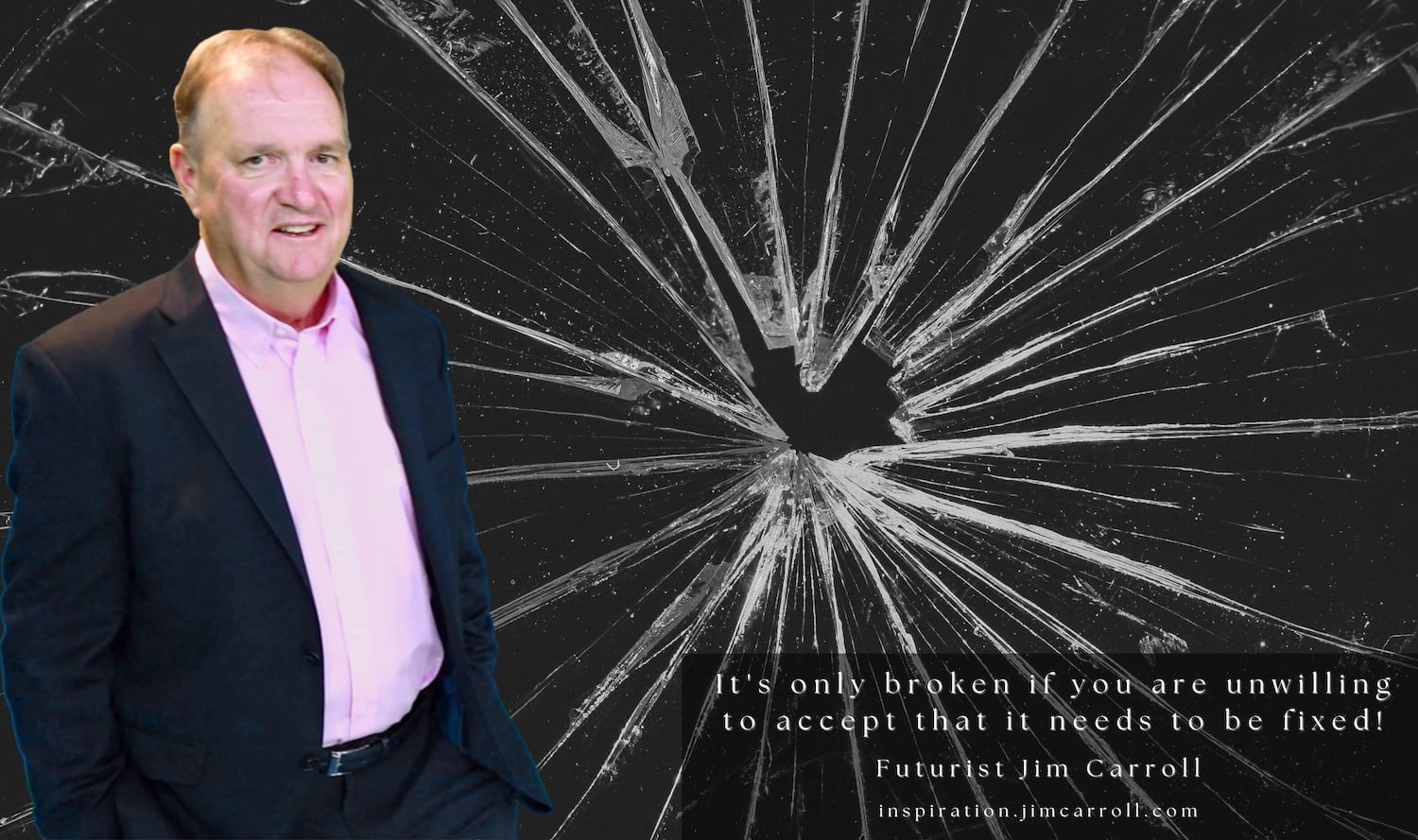
“It’s only broken if you are unwilling to accept that it needs to be fixed!” – Futurist Jim Carroll
Anything that is broken has the potential to be fixed. The first step, though, is acceptance. Often, that’s the biggest problem in the way of a successful path forward – if you can’t admit that you are truly broken, you’ll never discover a pathway to repair!
Think of what happens when something is broken and denial sets in. Think of the worst customer experience you’ve had most recently – perhaps a long call-hold wait time or the inability to find service at a ‘customer-service’ desk. You’ve had so many of these as of late that you are frustrated, angry, and weary – and yet you see this type of thing happen again and again with the same organization. Eventually, you give up on doing business with them. But think of it in their eyes – it’s pretty likely that they don’t see that anything is broken with their customer service culture!
Denial is a dangerous drug.
Organizational failure often begins with an inability to accept that consistent failure runs rampant, and that small signs are indicative of deep rot. Let me rant with an example: I’m a regular traveler of Toronto’s Pearson International Airport, which post-Covid bears the dubious distinction of being one of the top-worst airports in the world. Everything remains somewhat broken still – long security lines, lost baggage, planes held at the gate on arrival, ostensibly due to overcrowding in the customs hall. (My most recent experience with this three days ago had a completely empty customs hall shortly after this announcement. Go figure!)
You can judge the fact that an organization is unwilling to admit it is broken by consistent failure. For me, it’s been the escalators at this airport – they never work! They’re always down, in a state of repair, or simply, blocked off. My Twitter feed is full of snarky whining like this:

The failure of this simple operational function is so consistent that it’s almost become expected that when we transit the airport, things are broken, leading to snarky exchanges like this.

I really should show more maturity, but this thing has been going on for years. Meanwhile, the organization puts out fancy press releases about how it is working tremendously hard to improve things and make things better! Hint – it’s not!
How do you address the issue of denial? In my view, the Board of Directors should commission a study to determine why it has consistently, for well over a decade, managed to run an airport in which the escalators never work, and use that as the springboard to examine how it has allowed a culture of failure-acceptance to creep into every aspect of its operational activities. (They might also consider that the rest of the modern world has put in modern sensor-based technology which instantly advises them of infrastructure issues like this. But I digress.)
Small consistent failure provides a map to deep systemic denial!
Here’s the thing – everything can become broken – business models, product integrity and reliability, skills relevance, customer support channels, logistics, and more. Anything, at any point in time, goes into a status in which it doesn’t function correctly and eventually goes into a state of non-repairability. People too become broken – society is seeing an acceleration of mental illness, substance abuse, depression, and addiction.
Whether personal or business based, when something is broken, it can only be fixed if acceptance takes hold. it can never be fixed if you can’t admit it’s broken in the first place. This has long been true – but now, the challenge of acceptance has been challenged by vast numbers of society who have decided since they don’t quite like the current reality, they’ll simply invent a new, fictional one. Their chance of success at fixing their broken life, business model, career skills, and future, in that case, become marginal, next to none.

This brings me to the issue of leadership – when business models are broken, real leaders don’t cling to them, trying to preserve the past. They recognize that their plans, strategies, goals, and activities have been shattered and that it’s time to move on. This is what differentiates successful organizations from marginal performers in the era of disruptive business model change! (Can you tell I struggled a bit with the theme for today’s post?)

Bottom line: acceptance of your future is the first step in moving toward a better one! Recognizing that you need to fix things is the first step in actually doing so. Maybe moving beyond denial into understanding is the one key thing you really need to focus on!
Our World in 2030: The Post-Pandemic Trends That Redefine Your Future
All of us know that the ultimate impact of the global pandemic has been an acceleration of the many disruptive trends that were already well underway pre-Covid. Clearly, the global pandemic has changed the axis of our universe – what was disruptive before is now potentially massively transformative. But how can we best align to this new and complex future? Futurist Jim Carroll will take us on a voyage of 3 key issues – exactly how the pandemic shifted the future; what impact has it had on the timing of that future; and what unique new risk management issues might we now be facing going forward as a result?
The first big issue involves an ‘acceleration of the acceleration gap.’ Pre-pandemic, organizations were already dealing with a world of business model disruption, the acceleration of technology, the faster evolution of key skills, and other critical issues – and had to work hard to close the gap and keep up. Now, in the harsh light of our new world, one thing is clear – the future is even more complex than it was before, and even faster. In that context, a simple fact has emerged – there is a massive and growing gap between the speed of change and the ability of organizations to keep up. Bridging this gap is critical to future success – and the significance of your inability to bridge the gap is even bigger than it was before.
Second, the timing of the arrival of the future has shifted in fundamentally different ways as a result of the global pandemic. Getting the timing right has become an increasingly important part of aligning to disruptive trends and opportunities. The future today is guided by certain truisms – it happens slowly, but then, all at once; is suddenly shifted with a reality that volatility has become a new normal, and trends that once seemed far-fetched can suddenly take on a new significance in the light of new acceleration.
Third, the acceleration of trends and volatility with the timing of their arrival has led to new issues to think about when it comes to managing complex new forms of accelerated risk. Whether driven by hyper-connectivity, rapid innovation, the more rapid adoption of new business models, or faster technological evolution, it’s pretty clear we will continue to witness the rapid emergence of new forms of risk amidst increasingly complex business market turmoil.
All of this is happening as we head into a world that almost certainly involves new economic volatility and an economic recession. History has taught us that organizations that avoid the trap of aggressive indecision that is driven by economic uncertainty are those that thrive with an inevitable upturn. Jim will share with us the powerful lessons that come from focusing on the future despite lingering economic uncertainty.
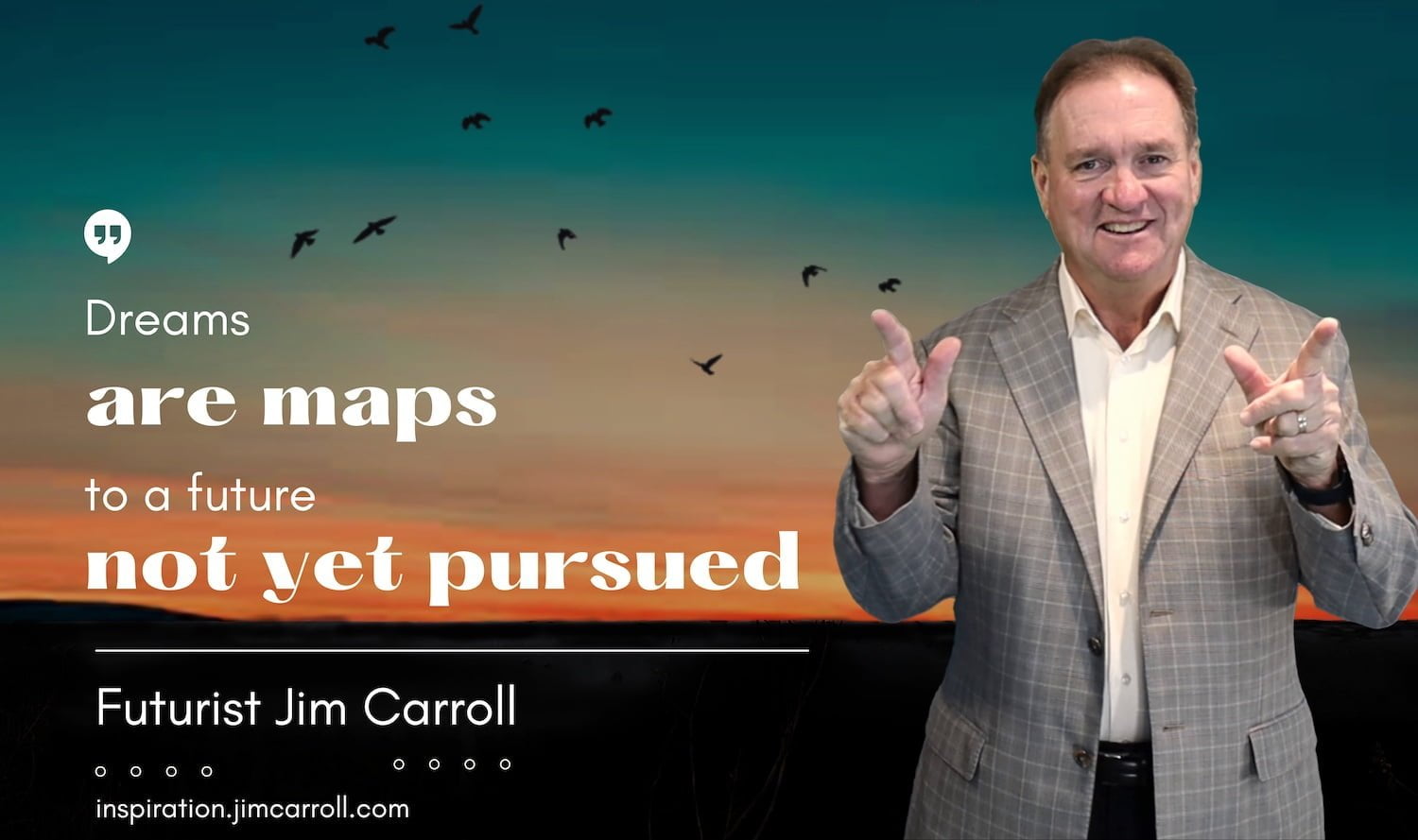
“Dreams are maps to a future not yet pursued!” – Futurist Jim Carroll
On our last evening in Switzerland after my keynote for a group of senior risk executives, we had a delightful visit and dinner with the daughter of our long-time friends Nicola JD Maher and her husband John. We published Nicola’s book, The Tiniest Warrior, many many years ago when she and her husband John lived near us outside Toronto. The book told the nursery rhyme story that Nicola wove into her mind, and it was the story she told to her young twins Henry & Lydia while their tiny sister struggled through a premature birth at the height of the SARS outbreak in Toronto in 2004. Their children grew up with ours; there were many soccer, and baseball games, and social get-togethers over the years.
So it was a wonderful opportunity to reconnect with young Lydia, who has now grown into a lovely young woman living in Zurich with her partner Adi.

Newly engaged, they are about to embark on a grand adventure, but in more ways than one, as they began to chase their passions and pursue their goals. We had a long conversation about their hopes for the future and the path they hope to take, and that became the genesis of today’s Daily Inspiration.
Lydia is best described as a data scientist; having previously worked for the deep data firm Palantir, she has big goals in the field of catastrophe risk management and insurance based upon very discrete and localized data insight. Adi has spent the last four years working within the emerging field of bio-diversity and has big ideas as to where the future could go with discrete levels of sensor-based diversity management as well as DNA-based tracking within the field. I’m not quite sure I understood it all, but I do understand bold goals and big visions when I hear them described. Their passion as they described the opportunity in front of them was palpable.
And so the two of them are ready to pursue these opportunities on their own, without the shelter and convenience of a traditional career path. They are big believers in the future they perceive and the dream of what they could accomplish. While listening to them, I was reminded of my own big dream to escape the clutches of a traditional corporate career to pursue and forge a new path that was emerging with global connectivity. Looking back, I do not regret my decision, supported by my wife, to jump out on my own and pursue what I believed was the right thing to do.
Listening to Lydia and Adi reminds me of the importance of chasing dreams, pursuing visions, and building opportunities. When you have a passionate belief in what you can accomplish, you’ve got to take the shot and jump at the opportunity that your future presents. Otherwise, you end up living a life of regret, always wondering if your dashed hopes and missed dreams might have truly turned into the future that you perceived you could follow.
And so, the evening became a delightful reminder of the importance of creating the future we want, not just chasing the future we might have. Our dreams are the maps we should follow, the guideposts we should pursue, and the road to the future we should pursue. We should never ignore them, but must follow them.
Godspeed Lydia and Adi!
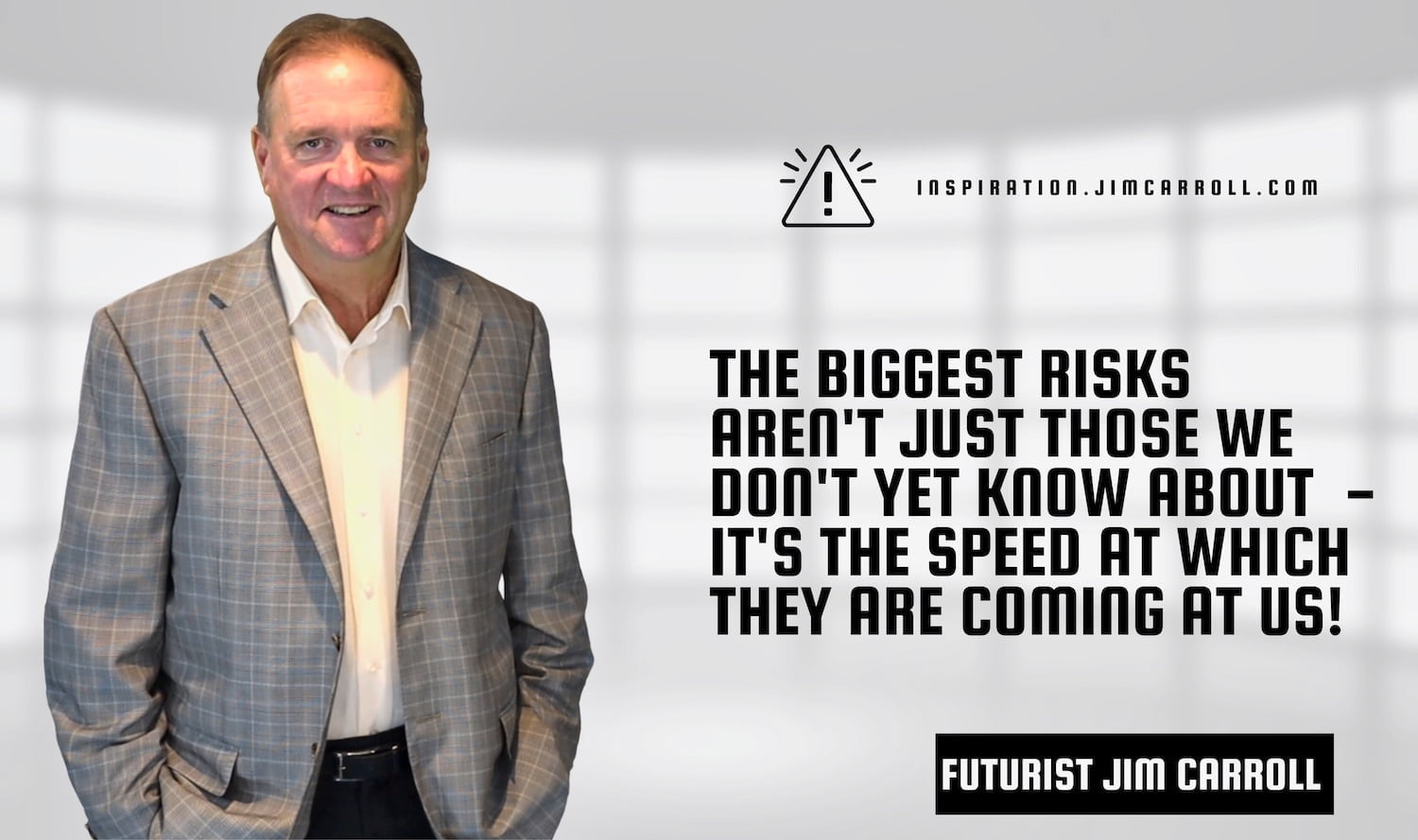
“The biggest risks aren’t just those we don’t yet know about – it’s the speed at which they are coming at us!” – Futurist Jim Carroll
I’ll be on stage this morning at a resort outside of Lucerne, Switzerland. In the room will be the heads of risk management for a vast number of global organizations. Their function is to assess, manage, and mitigate potential future risk – and my job as a futurist is to give them a bit of insight into what they need to anticipate.
So in a nutshell, I’ll them what they really need to worry about is the stuff that we don’t yet know about, yet which is going to come at them really, really fast!
Which is, essentially, an unknown, fast risk.
I’m not copping out on them – I can and will provide an overview of some key risk issues that they need to think about.
But for me, the biggest risk, next to geopolitical instability, is the speed of new risk. For example, this slide from my deck puts into perspective my thoughts on the accelerating risk of artificial intelligence image and video generation.

The entire field of AI text-to-image has matured at a staggering speed in just the last 3 months, with new advancements in sophistication occurring on an almost daily basis. Text-to-video AI systems seem to be evolving at an equally blinding speed. The impact, while providing much fertile ground for creative imaginations, also presents society and organizations with complex new risks. The blur between reality and fiction is going to disappear fast, and everyone is going to soon find it incredibly hard to manage the new risks that come with this trend. The risk is accelerated by the fact that many in society are already primed to be unable to parse fact from fiction – and politicians eagerly ride this trend.
And so someone will soon be able to fake a corporate CEO making some sort of false statement, with the fact that it is fake being barely imperceptible. How do you manage this risk when you barely have this risk on your list of those to be taken seriously? How do you manage this risk when the technology behind it is developing so, so quickly?
This fits into the biggest risk I worry about – and that is that history now shows us that any great technology idea is now used for nefarious purposes.

Case in point: the Internet has proven to be a wonderful tool for mankind, but is equally proving to the technology which is providing for the destruction of democracy worldwide and the rise of right-wing authoritarianism. I read the book of my fellow speaker at this event, Anna Applebaum, who offers up a chilling view of our future. It’s quite the book and will scare the hell out of you, and rightfully so: Twilight of Democracy: The Seductive Lure of Authoritarianism offers up a chilling view of our current reality.
That’s why my Daily Inspiration hit around this theme of the ‘future of risk‘ 3 years ago, before my keynote for the 2019 National Safety Council conference, which featured this idea:
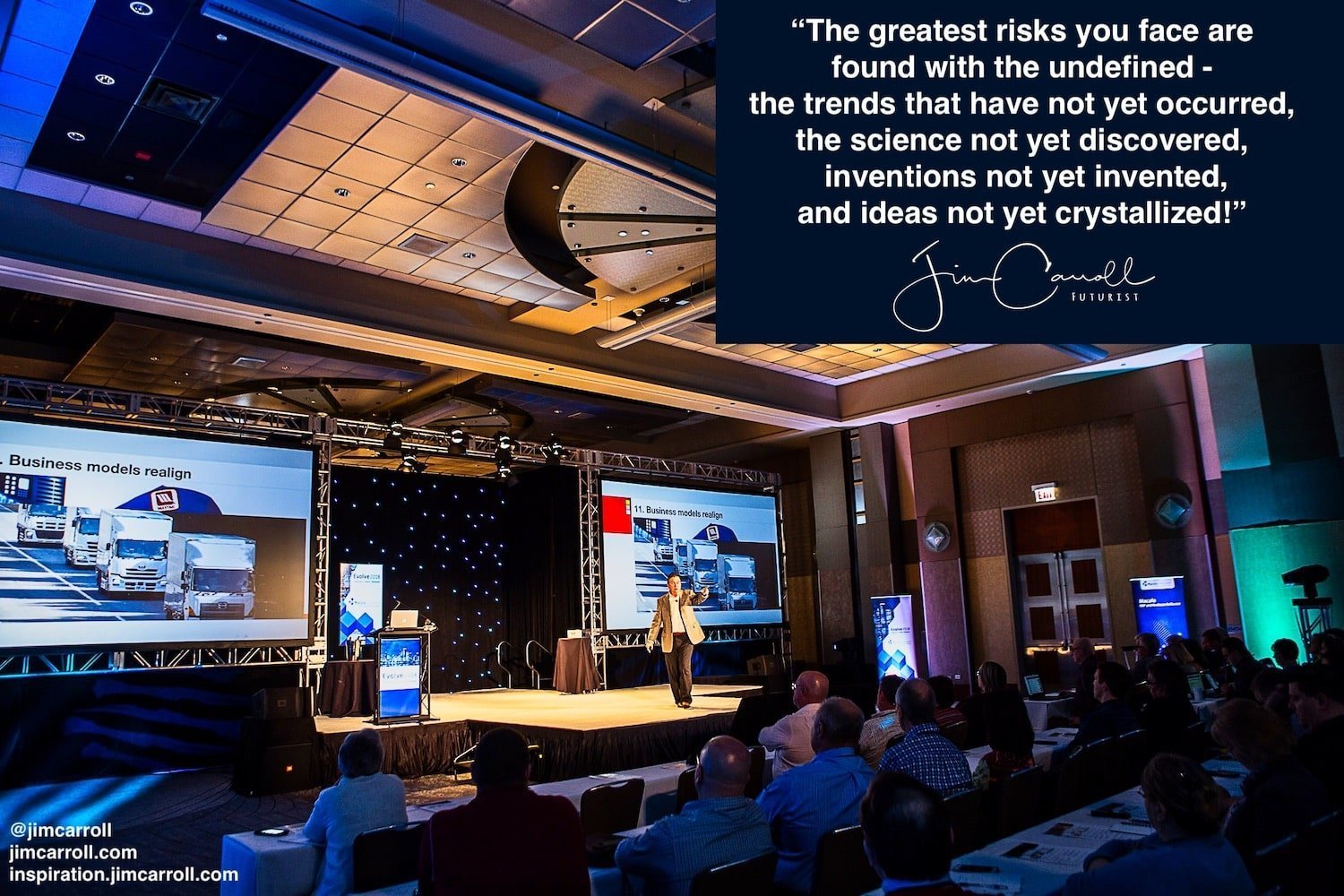
“The greatest risks you face are found with the undefined – the trends that have not yet occurred, the science not yet discovered, inventions not yet invented, and ideas not yet crystallized!” That message became a key part of my storyline on stage:

Bottom line? While risk management professionals are busy understanding, managing, and mitigating existing risks, it’s the unknown that might get someone in the end. And those unknowns are coming at us at a staggering speed.
Think about a few other issues with accelerating change: how will we know if the spatial vision algorithm used by a cobot (cooperative robot) working next to a human has been properly programmed? When we have fleets of interconnected, AI-driven packing and shipping devices scurrying around our factory floor, how do we ensure the proper assumptions have been built into the model? When we build and implement the Industrial Internet of Things (IIOT) into our processes, how will we ensure their security and integrity, thus providing for proper safety? And how do we manage the new risk that comes from artificial intelligence that is unfolding at such a speed that the blur between fiction and reality is soon set to totally disappear?
These are the things that I think about as a futurist.
We’ve got a lot of challenges around us today, but there is a lot yet more to come.
In the end run – it’s the unknown that will get you every time!


GET IN TOUCH
Jim's Facebook page
You'll find Jim's latest videos on Youtube
Mastodon. What's on Jim's mind? Check his feed!
LinkedIn - reach out to Jim for a professional connection!
Flickr! Get inspired! A massive archive of all of Jim's daily inspirational quotes!
Instagram - the home for Jim's motivational mind!