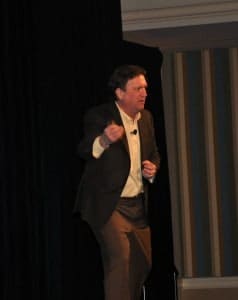
When you’ve got 4,000 people from large cities and small towns across America, thinking about how to solve some of the big problems faced by society, you can suggest small ideas, or whacky ideas. Here I am on stage, with a suggestion involving the latter.
Courage to Go Forward Into The Future!
When you open up a conference for 4,000 people, you really need to get them inspired and ready to take on the challenges that they face in the future!
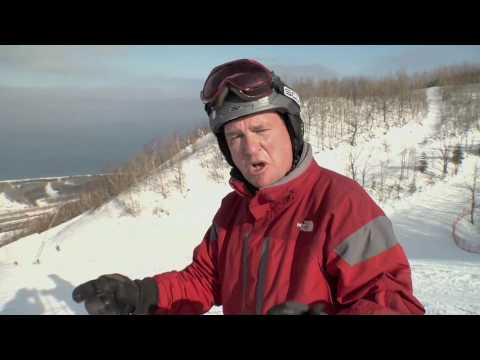
Here’s the first few opening seconds from my keynote earlier this year for the National Recreation and Parks Association annual congress. An insprirational clip!
Innovation and the concept of “chameleon revenue”
I am not alone in thinking we’re in the midst of a significant economic transformation. As Mick Fleming, president of the American Chamber of Commerce Executives, said recently, “It’s going to be a move from a bad economy to the next economy.”
What is the shape of the next economy? In many cases, it will involve structural change based on an acceleration of business cycles. Consider manufacturing, for example. We’re moving from a world of mass production to mass customization, or what I call agility-based manufacturing. I often cite the case of Honda, as noted in a 2008 article on the financial website Bloomberg: “Honda’s assembly lines can switch models in as little as 10 days.” By contrast, the article suggests, it could take months for most rivals to make the same change.
Companies such as Honda can see what’s selling strongly and quickly reorient their production to fit that demand. In the meantime, its competitors are busy cranking out 700,000 versions of the same old car, hoping to sell it to consumers who have already moved on to something different. It’s no wonder Detroit is being killed off by its long-term reliance on gas-guzzlers.
Everyone now understands that the old Detroit-based manufacturing business model was deeply flawed. The newer model, based on agility and flexibility, is the model of the future. If an organization can rapidly change its production to accommodate what consumers are willing to buy, it has a good chance of future success.
This ability to respond quickly to change is a corner-stone of opportunity. Competitors will emerge, particularly as the new connected generation rejects existing business models and innovative people continue to shake up the fundamentals. Take the business model of Wizzit, a South African cellphone-based banking system, which could cause upheaval throughout the banking sector as mobile technology garners more of our attention.
Furthermore, the nano-cannibalization of markets is becoming a business trend rather than an aberration. For example, Apple broke new ground years ago by tossing out an entire iPod Nano product line worth billions of dollars of revenue, replacing it with a newer, up-to-date product. Imagine even considering that. How could it cannibalize its own product revenue?
I recently spoke at a leadership meeting for a global organization, where the CEO spoke of a future in which the company’s success would come from what he called “chameleon revenue” – the sales derived from entirely new product lines. The chart he presented said it all: the organization’s future consisted of a steady decrease in baseline revenue and accelerating revenue streams from markets it currently does not participate in.
I think this will become the norm for most organizations. The ability to rapidly enter and exit markets will define future success. The ability to sustain multiple, short-term product life cycles, each perhaps no more than 36 to 48 months long, will be a critical success factor. Agility at discovering, producing and capitalizing on new revenue sources will be a fundamental necessity. In other words, your ability to change your spots and your colour on a dime will be the key driver for your potential.
Which begs the question: does your financial system have the capability to provide information on your chameleon revenue streams? Does it provide the insight and analytical tools to tackle product life-cycle revenue so the organization can assess how quickly its chameleon revenue streams are evolving? If it doesn’t, what do you need to do to adapt?
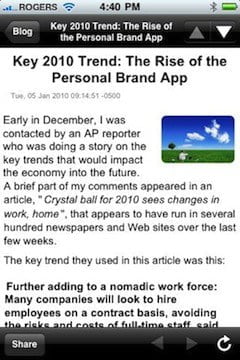
From Jim Carroll’s CAMagazine December column
Location Intelligence and the Future of Recreation!
Here I am speaking to an audience of 4,000 at the National Recreation and Parks Association Congress in Salt Lake City – a keynote in which I challenge recreation professionals to think about the future!
This was the keynote in which I received an email thanking me for “changing lives.” It was a powerful day, a powerful talk, and I’ve got lots more video to share in the days to come!
Keynote: Toronto to Sydney, live and interactive via fiber optic
Earlier this week, I spoke to a group of executives for a financial institution in Sydney, Australia, live via a fibre optic link — a distance of almost 10,000 miles (or 15,000 kilometres)
The client had wanted to bring me directly to Sydney, but the timing conflicted with a number of other events. Hence, the alternative method of “getting me there.”
Utilizing the services of Toronto based TV2GO, we had a direct fiber optic video and audio link into the conference at the Hotel Intercontinental in downtown Sydney. In addition, I had a live feed of the audience; not only that, but a number of “runners” had microphones available which provided for a direct, instant 2-way Q&A session at the end of my talk. In addition, I had a full Powerpoint deck running on separate screens in Sydney, transitioning to my cue from Toronto.
I’ve worked with TV2Go before, including on a live feed into CNBC for the Business of Innovation show.
If you are looking to me into your next event, you might consider this type of fiber optic or satellite link. With TV2Go, I can get myself via satellite and fiber connectivity to major conference centers or hotels in North America and South America, Europe, the Middle East, and Asia, if they are properly equipped. In the case of Sydney, the financial institution set out to find the facility with the greatest technical experience with this type of thing: hence, the Hotel Intercontinental.
The folks at TV2Go are experts in such international link-ups : their staff speaks, in addition to English, “Italian, French, Spanish, Romanian, Hungarian, German, Egyptian Arabic, Russian, Turkish, and even a little Japanese.” The organization routinely sends feeds into Mexico, Brazil, Argentina, the UK, Spain, France, Germany, Poland, Romania, Russia, Israel, Lebanon, Afghanistan, Iraq, Iran, India, South Africa, Tanzania, and even the Sudan.
What we need at your end is a facility that is capable of receiving a fibre optic feed via one of their global partners; or that can ‘see’ one of the dozens of satellites to which they can uplink. These include Telesat, Intelsat, PanAmSat, SES Americom, New Skies, Hispasat, LORAL and Eutelsat satellites.
The key to making this work is having a fibre/satellite friendly AV team at the other end. In the case of my Sydney, Australia event, Stuart Haynes was a real pro. He’s with the Intercontinental Sydney, and has managed dozens of such events through the years. On short notice, he pulled together an AV team that managed the feed, provided for several cameras in the room to feed back to Toronto, and an AV team that transitioned through my slide deck on cue.
Overall, a tremendous experience, and one that you might consider for your next corporate event.
:
Regions that rock: and how quickly Dubai lost it’s image!
Back in the spring, when the entire world was caught up in the midst of global economic doom, I had a long conversation with a Dubai-based journalist. He was seeking my insight for an article on what a nation, city or economic region should do to remain competitive in the global economy.
I didn’t realize it at the time, but I suspect his call was related to an article that had run the day before (“Dubai turns to PR to revive its image,” The Financial Times, April 2, 2009), noting that the city state had hired a public relations firm to handle its financial communications strategy and “head off negative media coverage of its troubled economy.”
The world certainly changes fast and, as I stated in my August column, “a brand is no longer what you say it is — it’s what they say it is.” I was talking about consumer products, but we now live in a time when the perception of an entire economic region can change literally overnight.
Think about that in the context of Dubai: just a short time ago, it was one of the world’s most dazzling success stories. Then came the market meltdown, the huge challenges in the global economy — and suddenly the shine was off this burgeoning world-class city. Today, of course, it looks a bit more like a financial basketcase than a shimmering global success story.
I spoke to the fellow about a wide variety of issues, but emphasized that one of the most important things politicians, economic development officers, community leaders, boards of trade executives and others should be thinking about now is their region’s image on the global stage. Given the rapidity of the meltdown and changing circumstances, locations that were once seen as vibrant, progressive and growth-oriented are suddenly finding themselves with a different “brand.”
And who would want to rest their personal future economic success upon the brand of an economic region in decline? Who would want to relocate a business to such an area, or consider a career-based move to an area that had a damaged brand?
Clearly, success in a global economy on the rebound will go to those regions that can continue to draw growth industries, specialized skills and global attention; and to those willing to innovate in terms of how they promote their brand.
:


GET IN TOUCH
Jim's Facebook page
You'll find Jim's latest videos on Youtube
Mastodon. What's on Jim's mind? Check his feed!
LinkedIn - reach out to Jim for a professional connection!
Flickr! Get inspired! A massive archive of all of Jim's daily inspirational quotes!
Instagram - the home for Jim's motivational mind!