

The International Manufacturing Technology Show is one of the largest manufacturing conferences in the world. I was invited to lead a panel discussion focused on how the industry has reinvented itself through innovation. It’s a quick, short clip that puts into perspective why manufacturing is leading the way in innovation.

Interview: Jim Carroll on Innovation
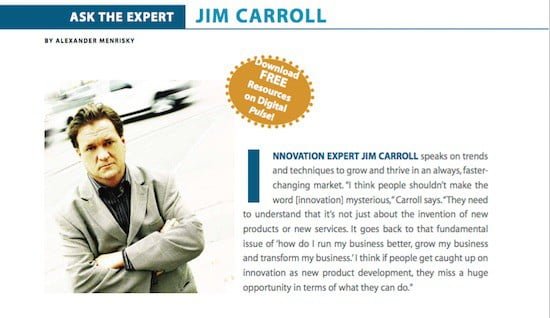
Here’s a quick little article in which I’m asked a variety of questions around innovation. Get the PDF.
A few key observations that I make:
- “I think people shouldn’t make the word [innovation] mysterious. They need to understand that it’s not just about the invention of new products or new services. It goes back to that fundamental issue of ‘how do I run my business better, grow my business and transform my business.’ I think if people get caught up on innovation as new product development, they miss a huge opportunity in terms of what they can do.”
- “One of my catchphrases, which I picked up from a big financial client, is: “Think big, start small, scale fast.” That can work for big organizations, but it can also work for a small company.
“Think big”—you’re small and obviously want to grow. You’ve got to have really big ideas and big goals in terms of what you might hope to accomplish, in terms of trying new ideas and exploring new things and doing things you haven’t done before.
“Start small”—play with a lot of new technologies, try a lot of new ideas, take risks. Do some projects in which you might succeed at some things and you might fail, but at least do things. So you start small, you try out a whole bunch of small things. This builds up your experience, and the more experience you have, the better position you’re in for success in the future.
“Scale fast”—learn how to scale it. How do you ensure you can keep doing these things as you grow?
Think Big, Start Small, Scale Fast: Futurist Jim Carroll Speaks At Worldskills Leaders Forum
In August, I had the pleasure of attended the WorldSkills 2015 competition in Sao Paolo Brazil, and opening the associated leadership forum with senior executives, educators and government officials from around the world.
WorldSkills? You haven’t heard of it? I came away convinced that it is one of the most important, and yet ‘under-the-radar’ global initiatives that provides future opportunity to the next generation of student, industries and nations. I will be blogging more on my observations in the weeks to come.
For now, read this article which summarized my keynote, and catch a clip where I spoke about the challenges that come from the acceleration of the knowledge required in the area of skilled trades.
Think Big, Start Small, Scale Fast: Futurist Jim Carroll Speaks At Worldskills Leaders Forum
(Article from the WorldSkills Web site)
On 13 August, at the WorldSkills Leaders Forum, as part of the WorldSkills Conference Programme, Jim Carroll, one of the world’s leading experts on international trends and innovation spoke on the rapid changes facing the world.

“65% of children in preschool today will work in a job that does not exist now,” announced Carroll to the approximately 450 international leaders of technical and vocational education within governments, industry, education, and unions gathered at WorldSkills São Paulo 2015 to build the global skills movement.
Carroll established that today is the era of major transformation and supremacy of big ideas. Organizations not only need to consider what their current competition will be doing in the future, but also need to assume that new entrants to their profession will reinvent the approach of businesses that operate as they have always done.
“Learning is what most adults will do for a living in the 21st century,” noted Carroll. Technology will change every element of our lives at such a rapid pace that half of what vocational students learn in their first year will be replaced with new technology knowledge in three years.
To be successful in a fast paced environment, Carroll recommended people “think big, start small, and scale fast.”
His advice to the WorldSkills community was to constantly question how the hyper connectivity offered by technology will impact the skilled careers. Carroll encouraged participants to look at the future with optimism not fear. Carroll is recognized as a thought-leader and author of “The Future Belongs to Those Who Are Fast” and “Ready, Set, Done: How to Innovate When Faster is the New Fast”.
The WorldSkills Leaders Forum is a global event on the most topical themes – based on input from WorldSkills Delegates and Members. The WorldSkills Leaders Forum event itself serves to kick-start dialogue among attendees – individuals and organizations striving to exploit and develop the power of the global network of WorldSkills to meet the needs of industry, commerce, and those who educate and train the next generation professional – to the mutual benefit of all concerned.
The Colloborative Mind: The Acceleration of Knowledge Through Crowd-Thinking
For years, I’ve spoken throughout my client base as a keynote speaker as to how the essence of global research and development is changing.
This includes keynote presentations to some of the world’s leading educational associations and corporations; industry and professional conference associations; and even two events for NASA, with a number of astronauts, astrophysicists and other deep thinkers in the room!

My emphasis has always been that the Internet has led us to a new world of ‘crowd-thinking’ in which anyone can look at any idea, and figure out how to pursue the idea, and develop a new skill, capability, form of insight or simply a new “thing.” The foundation for crowdthinking includes crowdfunding initiatives; vast knowledge and information archives; the sharing economy, global collaborative communities and other fascinating developments. It’s a trend that is shaking up R&D efforts worldwide, because it accelerates knowledge. Ultimately, crowd-thinking is leading to some very significant change in every industry. More on that later….
No trend is complete without it ‘hitting home’ in a personal way. That’s why you need to watch this this fabulous time-lapse video, which my 22 year old son painstakingly filmed, edited and pulled together over a period of over a month. Watch it here, or view his blog post about the project WcFotography.
The slider makes the camera moves a fraction of an inch, then waits, and then takes another picture. Repeat, several times over an hour. Stitch together multiple photos into video clips; link those together, layer on some fabulous music, and you’ve got a true piece of art.
Willie built the hardware and figured out the software, by tapping into the global creative mind. You can get a basic sense of how it works below. When he first got it working — which, even though I was away at a keynote — was a truly inspiring and fabulous moment!
As an avid part-time professional photographer (see WcFotography.com) involved in corporate, wedding and other photographic shoots, Willie is always eager to push his skills to the limit.
Willie spotted the idea for a time-lapse slider when it was floated as a KickStarter project — but at $1,000, it was a bit out of his range. He decided that he could build one on his own; he researched the project and found both the hardware and software solutions online. Through a sometimes excruciating process through the summer, he saw the project through to success. The slider was built using a Raspberry Pi computer; rails, a motor and timing belt that he sourced through eBay; and software that was developed by a fellow named David Hunt in Ireland, who ultimately provided Willie with the inspiration for his project.
Once it was finished, Willie took the rig back to university, and on weekends and during time off, visited his beloved Gatineau Park to capture a wide variety of fabulous photographic-video sequences.
As a dad, I couldn’t be prouder.
I’d encourage you to share the video — it’s posted above on Vimeo. I’d also encourage you to check out his photography Web site. If you’re based in Ottawa, Ontario, Canada, you might consider engaging him for your next photography project!
Learn more over at http://www.wcfotography.com.
Avoiding the BIG MISS – Will Your Company and Industry Be the Same in 10 Years?

In many of my keynotes focused on future trends and the necessity for constant, fast innovation, I often speak about the massive transformation occurring in most industries as the result of the acceleration of business models through technology.
Just consider the impact of Apple Pay, which speeds up the pace of change in the credit card industry; Internet-linked medical devices which allow for virtual healthcare; and Tesla Motors, which is shaking up the global auto industry.
What’s the impact? One estimate suggests that up to 40% of the S&P 500 will no longer exist ten years from now, if they fail to keep up with fast moving technology trends. That’s a pretty staggering thought.
Given this, every CEO in every industry needs to think as to how they avoid THE BIG MISS — playing up a golf analogy — and avoid the disruption occurring all around them.
While preparing for my keynote for the Sporting & Fitness Industry Association keynote, I reached out Derek Sprague, President of the PGA of America, for his observations on how technology has impacted the golf industry, and more specifically, the membership of the association, the PGA Professional. These are folks who are instrumental in the management and growth of golf courses, professional instruction on learning the game, and other aspects of a multi-faceted career. (I was the opening keynote speaker for the 94th Annual General Meeting of the PGA a few years back.)
Derek nailed it in two succinct observations:
In the last five years, video software, launch monitors and game tracking devices (like Game Golf) have brought the technology tools of elite professional players to the masses. Understanding how to integrate volumes of performance data into traditional teaching methods has become “commonplace for PGA Professionals.”
Not only that, but yield management and mobile-oriented buying platforms aren’t just for hotels and airlines anymore. As consumer expectations for technology driven experiences increase exponentially, answering the phone and handwriting tee times onto a paper tee sheet are no longer the norms.
That’s a pretty concise summary – the skills of the membership base has to change at a very fast pace as dealing with new technology comes to dominate an increasing aspect of their role. And it won’t end anytime soon — for example, think about how quickly drone technology will come to challenge the game in new and different ways.
Here’s a video clip from my keynote, about why it’s necessary to avoid THE BIG MISS.

Video: Meet Jim Carroll!

Essentially, Jim assists in organizations in dealing with the future, trends and innovation through three distinct types of events:
- as the opening or closing keynote speaker for the annual meetings/conferences of national or international associations
- keynotes or workshops for private corporate leadership events, ranging from small groups of 15 to several hundred executives, often sponsored by the CEO, for a vast range of global Fortune 1000 companies
- keynotes or panel discussions on customer oriented meetings or promotional events


GET IN TOUCH
Jim's Facebook page
You'll find Jim's latest videos on Youtube
Mastodon. What's on Jim's mind? Check his feed!
LinkedIn - reach out to Jim for a professional connection!
Flickr! Get inspired! A massive archive of all of Jim's daily inspirational quotes!
Instagram - the home for Jim's motivational mind!