
I’ve been covering the link between future trends and innovation strategies for 30+ years. I went back through my blog posts, stretching to 2002, to dig out the nuggets of innovation insight I’ve discovered along the way. This series revisits those stories, tests what still holds up, and turns them into practical lessons for what comes next.
I’ve come back to this idea repeatedly in my work because the mindset behind innovation usually changes before the results do. What people notice, question, challenge, and act on determines how ready they are for what comes next.
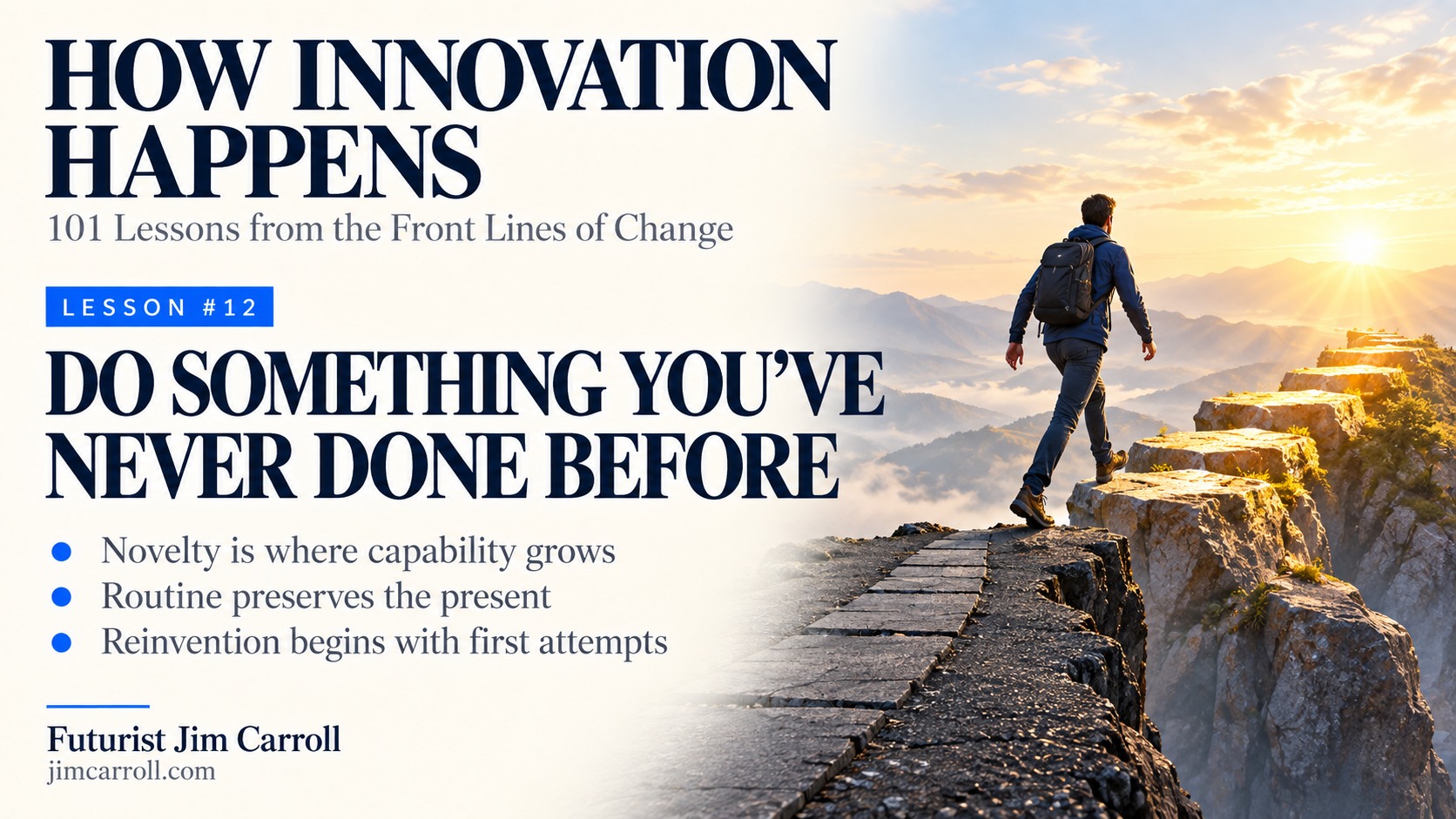
Innovation is not only an organizational capability. It is a personal habit.
I took up skiing at 40. The point was never that everyone should ski. The point was that doing something genuinely new forces you back into beginner mode. You become uncomfortable. You make mistakes. You ask basic questions. You discover how quickly your brain can adapt when it has no choice.
Those are exactly the muscles innovation requires.
People who live entirely inside routines gradually lose their tolerance for uncertainty. Organizations do the same thing. Deliberately doing something unfamiliar keeps your capacity for adaptation alive.
So what does that mean in practice? It means challenging the assumption, habit, or hesitation that is keeping you anchored to the present. Here are three places to start.
Action Items:
- Choose one skill this year in which you are a complete beginner.
- Put yourself in a situation where asking basic questions is unavoidable.
- Afterward, write down what being a beginner taught you about your workplace.
Explore the full How Innovation Happens series.
Real-World Examples
These researched examples show the lesson at work in the real world.
Apollo 15: Turning pilots into field geologists before going to the Moon
The Apollo astronauts were highly trained pilots and engineers. But when NASA prepared Apollo 15, the mission demanded a different kind of judgment: recognizing interesting geological evidence on an unfamiliar landscape and deciding what samples mattered. The astronauts could not gain that skill by reading a slide deck.
NASA organized substantial geological field training with specialists including US Geological Survey geologist Lee Silver. In 1970, crews and backups took part in twelve field trips, studied rocks from earlier lunar missions and rehearsed field observations under realistic constraints. Ground-based rover simulations and science-support teams further changed the way the crews approached exploration.
NASA’s historical account describes how the emphasis on science reshaped preparation for a mission that would include the first lunar rover. Apollo 15’s science return depended on people with one kind of expertise deliberately becoming beginners in another. The experienced pilots had to accept correction and develop an observational vocabulary that was not native to aviation.
That is experiential capital: acquiring a capability through unfamiliar work rather than merely collecting information about it. Great organizations periodically need their most accomplished people to stop being experts long enough to learn something consequential.
Why it matters: The person who has mastered today’s job may need hands-on practice in a completely different discipline to perform tomorrow’s job well.
Sources:
The Xbox Adaptive Controller: Engineers learn from gamers with disabilities
A conventional game controller is designed around a set of physical assumptions: hands that can grip, fingers that can reach buttons, and bodies that can coordinate movements in familiar ways. Those assumptions leave some players excluded.
When engineers developed the Xbox Adaptive Controller, they worked with gamers who had limited mobility and organizations including SpecialEffect, AbleGamers, Craig Hospital and Warfighter Engaged. The device, introduced in 2018, allowed people to connect external buttons, switches and joysticks to create configurations suited to their abilities. The breakthrough was not just a clever arrangement of sockets.
It required product designers to encounter a gaming experience that their existing design habits had not adequately served, learn from people using assistive technologies, and allow those experiences to shape the hardware and even the packaging. The company described direct collaboration with users and advocates as fundamental to the design.
This is more specific than hiring a diverse advisory board and announcing a commitment to inclusion. The designers had to test their assumptions against how other people actually played. Although the product came from a major technology company, the relevant innovation lesson is the unfamiliarity of the user experience, not the company’s brand.
Why it matters: Going somewhere you have never been can mean entering the daily experience of customers whose needs your own habits prevent you from seeing.
Sources:






GET IN TOUCH
Jim's Facebook page
You'll find Jim's latest videos on Youtube
Mastodon. What's on Jim's mind? Check his feed!
LinkedIn - reach out to Jim for a professional connection!
Flickr! Get inspired! A massive archive of all of Jim's daily inspirational quotes!
Instagram - the home for Jim's motivational mind!