
I’ve been covering the link between future trends and innovation strategies for 30+ years. I went back through my blog posts, stretching to 2002, to dig out the nuggets of innovation insight I’ve discovered along the way. This series revisits those stories, tests what still holds up, and turns them into practical lessons for what comes next.
I’ve come back to this idea repeatedly in my work because the mindset behind innovation usually changes before the results do. What people notice, question, challenge, and act on determines how ready they are for what comes next.
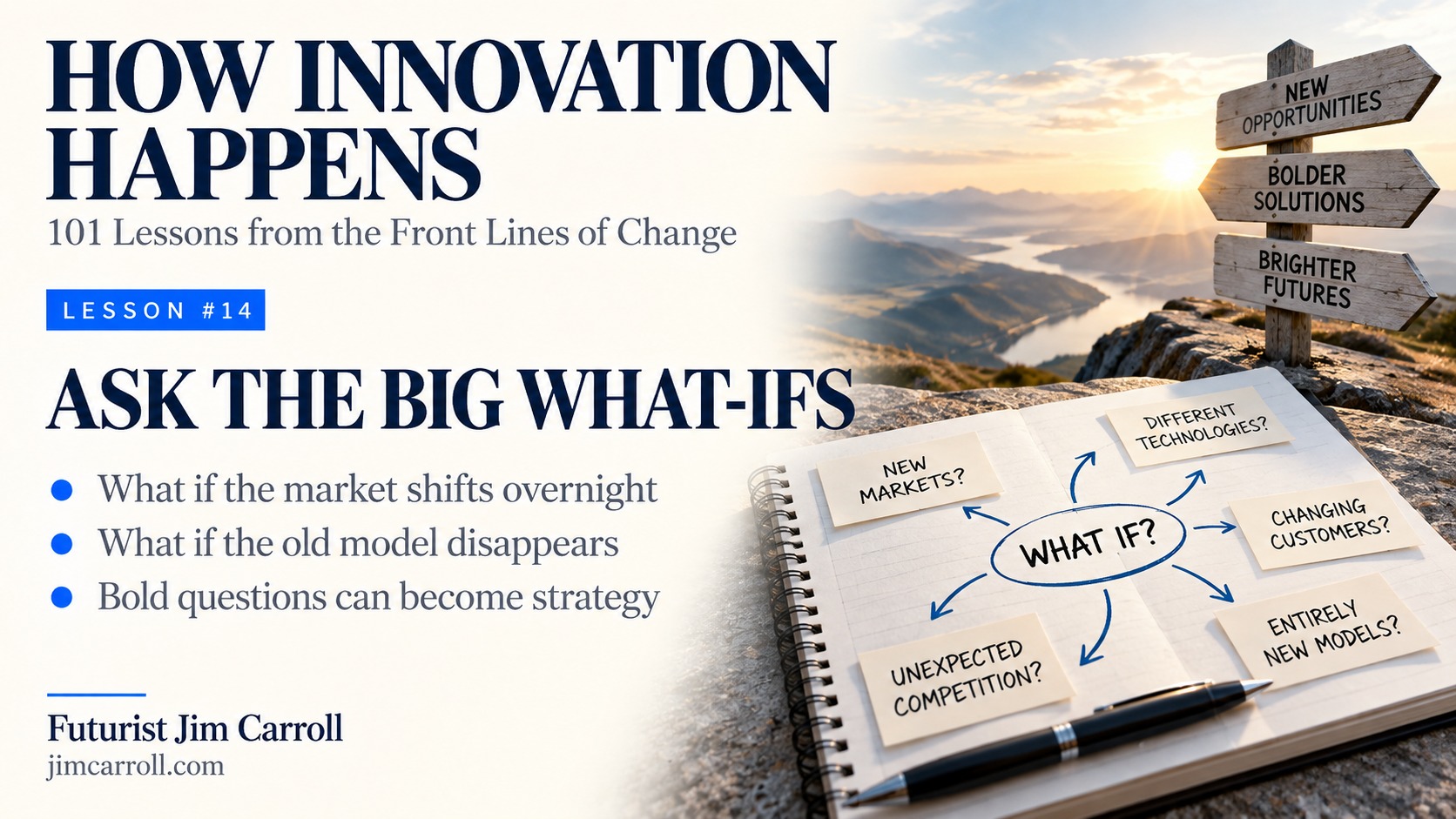
The best strategic questions are often uncomfortable because they make today’s assumptions optional.
What if your product becomes free? What if a new competitor enters from outside your industry? What if a technology removes half the steps in your process? What if customer expectations shift faster than your brand can? What if the skills you depend on become obsolete?
“What if?” is not prediction. It is rehearsal.
Organizations that regularly explore extreme possibilities build mental flexibility before they need it. They also discover opportunities hidden inside scenarios that initially look like threats.
So what does that mean in practice? It means challenging the assumption, habit, or hesitation that is keeping you anchored to the present. Here are three places to start.
Action Items:
- Run a 30-minute “what if?” session with no PowerPoint and no defending today’s model.
- Include at least one scenario that would make your current business model irrelevant.
- Identify one low-cost action that would help under several different scenarios.
Explore the full How Innovation Happens series.
Real-World Examples
These researched examples show the lesson at work in the real world.
The Netherlands: Four possible climate futures instead of one forecast
Water managers in the Netherlands cannot assume they know precisely how climate change, sea-level rise, economic growth and public demand will unfold. The consequences of planning for the wrong future can be enormous because dikes, water networks and land-use decisions have long lives.
The Dutch Delta Programme therefore uses explicit scenarios rather than a single confident forecast. A 2024 update set out four combinations of climate pressure and socioeconomic growth, designed to describe possible conditions in 2050 and 2100. The scenarios are not recommendations to choose among.
Authorities explicitly say all four must be taken seriously when examining water supply, flooding and long-term spatial decisions. Their names, including Warm, Rapid, Space and Steam, help public agencies discuss very different possible constraints. The critical innovation is organizational: it makes uncertainty discussable before uncertainty becomes a crisis.
Instead of relying on the most comfortable prediction, decision makers examine which actions remain robust, which choices preserve options, and where a future threshold would require a different response. The process does not abolish uncertainty, and scenario work can be misused if treated as prophecy. It provides a disciplined way to make the big what-if question part of public investment decisions.
Why it matters: Future-proofing is not predicting one tomorrow correctly; it is making decisions that can survive several plausible tomorrows.
Sources:
NASA DART: What if we could move an asteroid before it threatened Earth?
Planetary defence begins with a frightening hypothetical: what if scientists discover an asteroid on a collision course with Earth? One response would be to maintain a theoretical plan and hope it is never needed. NASA and its partners chose to test a specific answer while there was no immediate threat.
The Double Asteroid Redirection Test sent a spacecraft to strike Dimorphos, a small moonlet orbiting the asteroid Didymos. The target was deliberately chosen because its orbit could be measured and neither asteroid posed a danger to Earth. On September 26, 2022, the spacecraft hit Dimorphos.
Subsequent measurements showed that its orbital period around Didymos had shortened by roughly 33 minutes, demonstrating that a kinetic impactor could change an asteroid’s motion. Later analysis also documented changes in the object’s shape. The extraordinary part is not that NASA managed a dramatic crash.
It is that the mission turned a speculative future emergency into a controlled experiment with observable results. A risk that might seem too remote for action became a concrete engineering question: could a small spacecraft reliably change the trajectory of a much larger object?
Why it matters: The most valuable what-if questions turn abstract future risks into specific capabilities you can test long before the emergency arrives.
Sources:




GET IN TOUCH
Jim's Facebook page
You'll find Jim's latest videos on Youtube
Mastodon. What's on Jim's mind? Check his feed!
LinkedIn - reach out to Jim for a professional connection!
Flickr! Get inspired! A massive archive of all of Jim's daily inspirational quotes!
Instagram - the home for Jim's motivational mind!