
I’ve been covering the link between future trends and innovation strategies for 30+ years. I went back through my blog posts, stretching to 2002, to dig out the nuggets of innovation insight I’ve discovered along the way. This series revisits those stories, tests what still holds up, and turns them into practical lessons for what comes next.
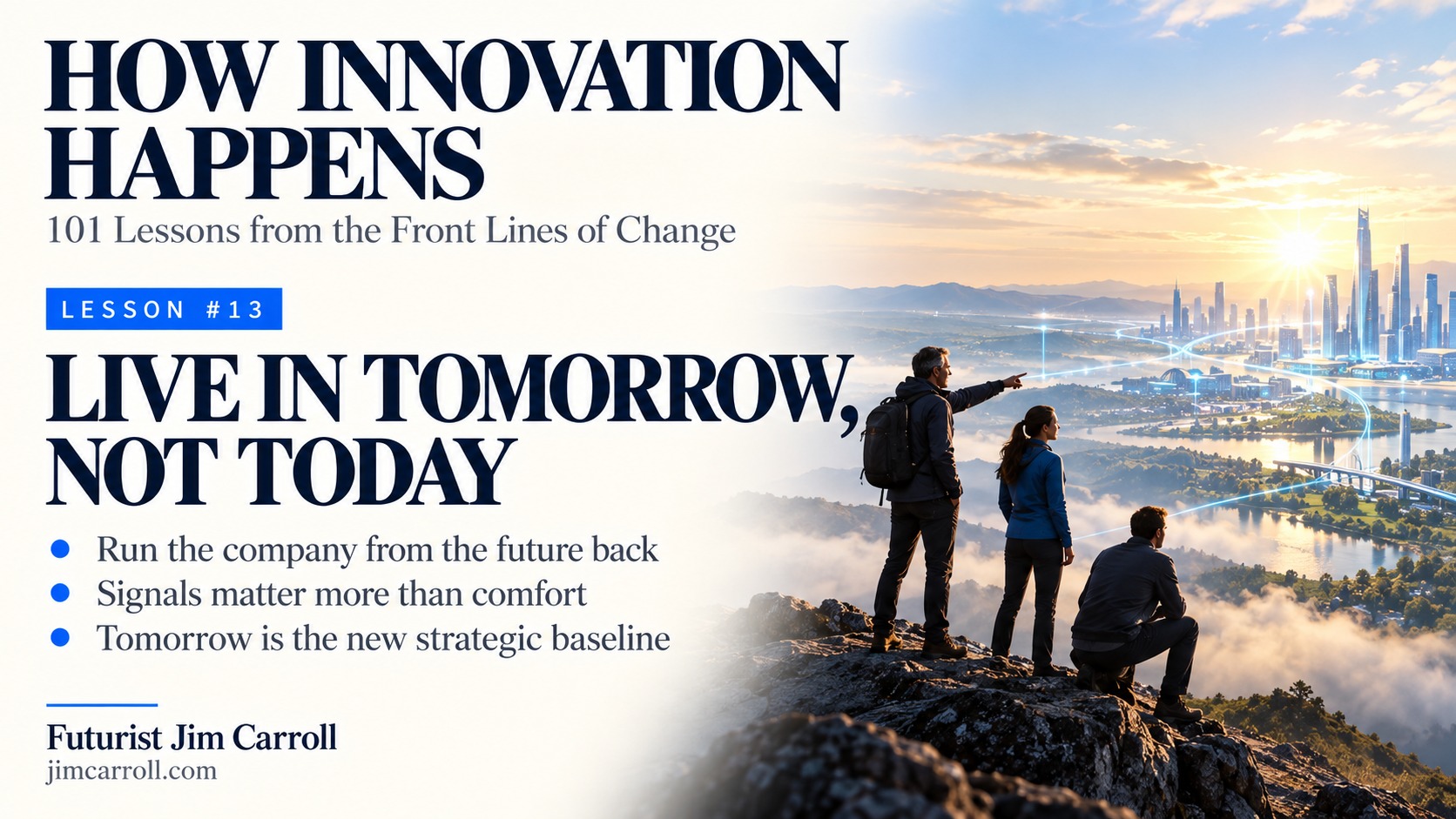
“For innovative organizations, tomorrow is the new today.”
I’ve come back to this idea repeatedly in my work because the mindset behind innovation usually changes before the results do. What people notice, question, challenge, and act on determines how ready they are for what comes next.
The most innovative organizations I have studied spend less time defending what works now and more time preparing for what comes next.
That sounds obvious until you look at how most calendars actually work. Today’s customer problem, today’s quarterly target and today’s operational crisis consume all available attention. Tomorrow gets whatever time is left.
Innovators reverse the equation. They deliberately create space for the trends, technologies, competitors and customer behaviours that are not urgent yet, because they know those things will eventually become urgent all at once.
The future punishes organizations that discover tomorrow only after it has become today.
So what does that mean in practice? It means challenging the assumption, habit, or hesitation that is keeping you anchored to the present. Here are three places to start.
Action Items:
- Reserve a fixed portion of leadership time for issues beyond the current fiscal year.
- Add one “tomorrow metric” to every strategy review.
- Ask what future issue has no owner because it is not yet urgent.
Explore the full How Innovation Happens series.
Real-World Examples
These researched examples show the lesson at work in the real world.
Maersk: Ordering ships for fuel suppliers that did not yet exist at scale
A container ship is a capital asset designed to work for decades. When Maersk began investing in vessels capable of using methanol fuel, it was making decisions about an energy system that did not yet have mature global supply. In February 2021, the company announced an industry-first methanol-capable feeder ship, and later that year placed an order for eight large ocean-going methanol-enabled vessels.
A conventional strategy might have been to wait until green methanol became widely available before committing to a fleet. Maersk instead worked on the demand and the supply problem together, partnering with European Energy and its subsidiary REintegrate to develop e-methanol production for its first vessel.
In 2023, the first ship made its inaugural voyage, with fuel secured for the journey. This is not proof that every aspect of the energy transition is settled. Fuel availability, costs, lifecycle emissions and the competing merits of alternative fuels still matter.
But shipbuilding’s long lead times forced a strategic choice: either specify assets for the world that exists, or begin learning to operate the assets a different future might require. Maersk bought itself experience with tomorrow before tomorrow became routine.
Why it matters: If your assets last twenty or thirty years, waiting for a trend to become completely obvious can be another way of locking the past into the future.
Sources:
Singapore NEWater: Planning the water supply decades before it was needed
Singapore has long understood that national water security cannot be left to rainfall or the hope that a particular supply arrangement lasts forever. It began exploring the reuse of treated water in the 1970s, but the available technology was too costly and insufficiently proven for widespread adoption.
An organization focused only on today’s economics might have filed the idea away permanently. Singapore instead returned to the question as membrane technology improved. Its national water agency, PUB, set up an evaluation team in 1998 and commissioned a full-scale demonstration plant in 2000.
Independent experts reviewed the treatment and water quality. At the 2002 National Day celebration, tens of thousands of people toasted with bottles of the reclaimed water that would become NEWater; the first factories followed in 2003. The symbolic gesture mattered because public confidence was as important as engineering performance.
NEWater became part of a diversified strategy for a country facing enduring water constraints. The original 1970s investigation had not immediately delivered a commercial solution, but it kept an emerging capability on the national agenda until the technology and institutions were ready. That is what it means to operate with a future time horizon.
Why it matters: Being early does not mean spending recklessly before a technology is ready. It means protecting the learning and options needed to act when readiness arrives.
Sources:





GET IN TOUCH
Jim's Facebook page
You'll find Jim's latest videos on Youtube
Mastodon. What's on Jim's mind? Check his feed!
LinkedIn - reach out to Jim for a professional connection!
Flickr! Get inspired! A massive archive of all of Jim's daily inspirational quotes!
Instagram - the home for Jim's motivational mind!