
Futurist Jim Carroll takes you into a fascinating voyage involving artificial intelligence, advanced robotics, virtual reality – and how these trends all come together into a fascinating, accelerating future!


Futurist Jim Carroll takes you into a fascinating voyage involving artificial intelligence, advanced robotics, virtual reality – and how these trends all come together into a fascinating, accelerating future!
“We’ve now entered the stage where we are talking about the need to build a gymnasium for robots so that robots can learn how to be robots!” – Futurist Jim Carroll

If you follow the world of artificial intelligence at all or are an active investor, you will know that Nvidia has, suddenly it seems, become the world’s hottest company.
A manufacturer of chip and computer board technology, its main focus was designing and manufacturing this technology for computer gaming. At the risk of simplifying things, whether by luck or design, everyone discovered that the very same chips could be used to run the incredibly complex software used as the backbone for most artificial intelligence systems. With that, the company has become the most significant player in the A.I. hardware marketplace over the last few years.
Last week, the company held its developer conference – that’s where it brings together key customers, computer developers, and others to hear about its plans for the future. It was not unnoticed that the event was held in the same stadium as the NHL’s San Jose Sharks, and that the overall attendance exceeded that of a typical game night. The CEO, Jensen Huang, is suddenly the most popular technology pontificator on the planet, and he delivered a keynote that took the assembled personage deep into the world of the future of AI.
These talks are often as much aspirational as they are reality-oriented – often a tech company developer keynote is full of promises as to where the company intends to go as opposed to where they actually are. And yet, they aren’t always devoid of facts – they are simply a roadmap to the direction to be followed. And in that context, one section in particular, involving what he announced as Project Groot, caught my attention. In particular, the line that observed that what they planned to do was to allow the building of gymnasiums so that robots could learn how to be robots.

The key section to watch in the video starts at about 01:33:40 on the timeline.
A gym for robots! That phrase certainly captures the attention of a futurist, and it caught mine. With that in mind, let me try and explain what this is all about:
While this concept might delight or terrify you depending on your state of mind, I can assure you that this all makes absolutely logical sense to me. I wrote about the inevitability of ideas like this in my post on “Non-Immservice AR (Digital Twin) technology” in 2023 and another other post in 2019 on ‘spatial inteligence.,‘ among many other posts. I’ve been speaking and writing about this potential future for years, with comments like this:
We’re moving from a world of two-dimensional ‘location intelligence’ – think of all the things involving GPS technology – to a world of 3D spatial intelligence – and the this will lead the birth of several new “next” billion dollar industries
The opportunities are pretty significant. Location intelligence had us mapping in 2 dimensions; spatial intelligence will have us doing the same with 3dimensions. The trend will involve the data used by self-driving cars to ‘see’ around them; cobots or “cooperative robots” working in 3d dimensions to interact with other robots and humans around them; virtual operations using 3D insight headsets, and so much more!
It’s always a thrill to see one of your predicted future trends become real! Let’s just say that this is absolutely fascinating, significant, and far-reaching development that will shape our future for many, many years to come. If you want to try to wrap your head around it, I would recommend this video:
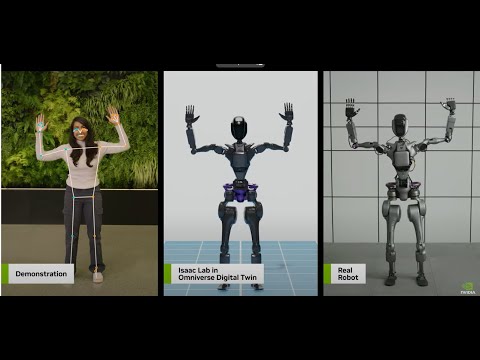
What’s it all about? Essentially, we’ll use something like an Apple Vision Pro to track the movements of a human; we’ll use digital twin technology to learn those movements; and we’ll feed that data to a humanoid robot so they can learn how to undertake that activity. Hence, a gym for robots so they can learn how to be a robot!
Suffice it to say, I’m going to go into my virtual broadcast studio later today to film a clip that will attempt to put all of this into perspective.
Sometimes, when the future happens around you, it’s hard to capture the significance of what you are witnessing. This is one of those moments.
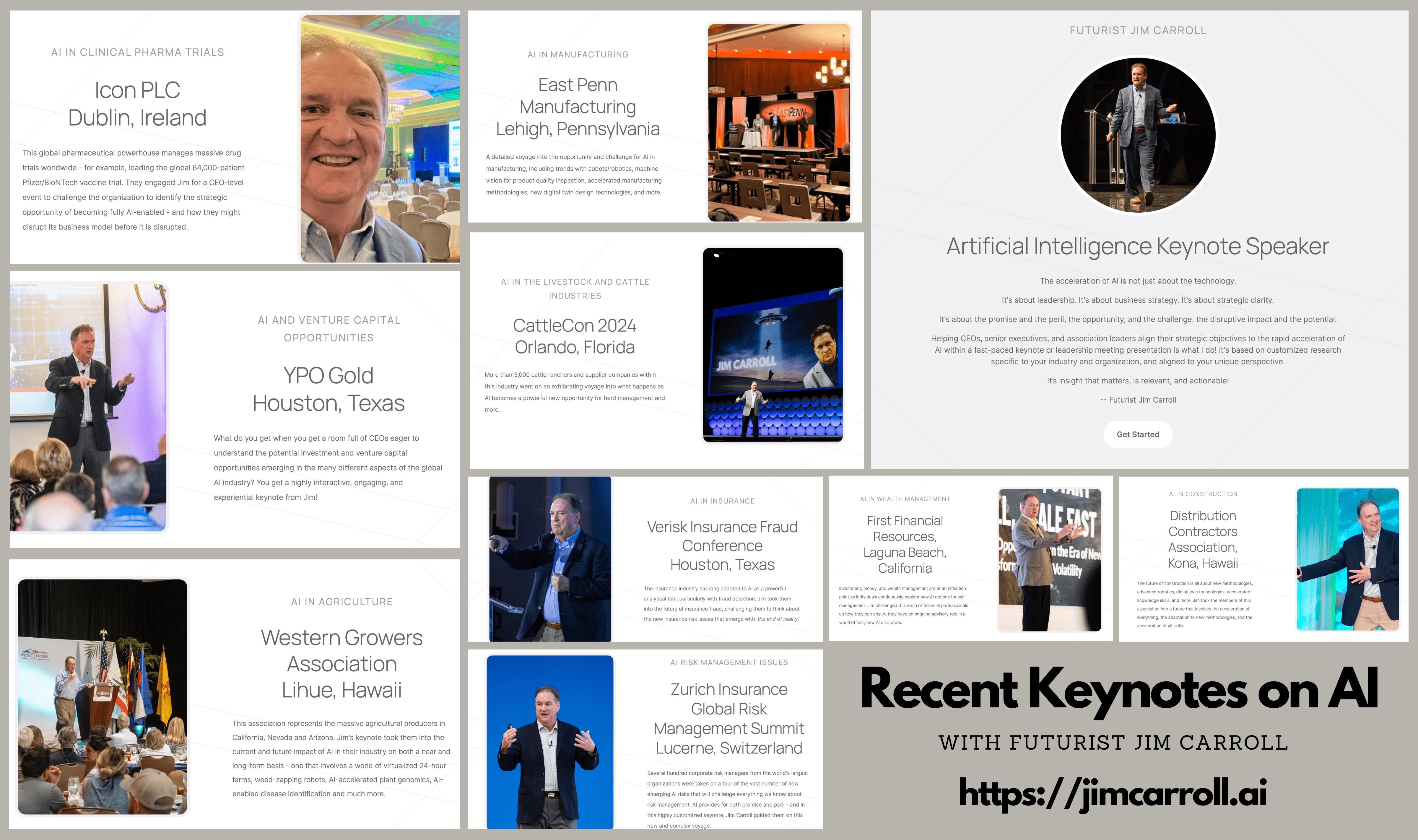
Just a few of the recent clients who have had me in for an executive level overview of the real impact of AI. Not the hype, not just ChatGPT – but the real, substantive, transformative short, medium and long term trends disrupting entire industries.
I rolled out an update to my artificial intelligence focused Website to provide details.
“If you always end up doing the same thing, you’ll never end up doing the right thing!” – Futurist Jim Carroll

You’ll never do the right thing if you keep doing the same old thing – because doing the same old thing is always the wrong thing! Got it?
The photo in today’s quote is from my keynote last fall for the Western Growers Association out in Hawaii. The WGA represents mostly family farms in California, Arizona, Nevada, and New Mexico; the talk was on the impact and opportunities of artificial intelligence in the farming sector.
And today’s quote? Think about the modern farmer of today – in the face of new technologies and methodologies, they certainly can’t keep on ‘doing the same old thing.’ Years ago, I would joke about the imminent arrival of ‘weed-zapping robots.’ Today, it’s no longer a joke – it’s a fast-emerging reality. Trends in the industry are very much impacted by access to and management of scarce water resources – particularly in this region of the world – and so there is a never-ending flood (if you pardon the pun) of new irrigation concepts, ideas, and sophisticated technologies they can try out. Science has a major role to play, and the modern farmer of today’s world could probably be called a scientist-farmer.
Everywhere you look there are new ways of doing ‘things,’ and the only to do the ‘right thing.’
And that’s the situation in pretty much every single industry, job, career, and profession today – nothing is ever the same, everything is changing, and the only right thing to do is to change with it!
So some simple advice? if you are stuck in a rut, get out of it. Avoid getting trapped in routines – make a new routine. Refuse to do something the same way – try a different way. Chasing the same old idea? Find a new idea! Talking to the same old people? Reach out to some new ones! Finding your day-to-day actions dull? Find something to shake them up! Running into the same old barriers? Ignore them and go around them.
That might all sound trite and easy to say but think about this – aligning to the future and mastering tomorrow isn’t just about finding and thinking about the trends – it’s even more so about your mindset of what you are going to do with them.
Some people see the future and never do what needs to be done to get there. Innovators see the same future and change everything they do to be a part of it.
Mindset! It matters!
“World class aren’t afraid of big ideas!” – Futurist Jim Carroll
Futurist Jim Carroll is running his Daily Inspiration series for March 11/18 on the theme of “What is it that World Class Innovators Do That Others Don’t Do?” The leadership ideas are based on an original keynote he gave early in 2009 after a client asked him to identify these issues. He developed this carefully curated list based on 15 years of observations of how his global clients responded to fast-paced change.
Being bold matters.
Being bolder matters more!
The era of ‘moonshot thinking’ and ‘moonshot innovation’ envelopes the mindset of world-class innovators. When I was compiling my list of what world-class innovators do that others don’t do, it was evident that it didn’t just inhabit their minds – it was fundamental to everything they do.
What is moonshot innovation? It’s the philosophy and approach to innovation that focuses on achieving radical breakthroughs and innovations, rather than just making small steps. The term “moonshot,” of course, originates from the ambitious scale of the Apollo 11 mission, which successfully landed the first humans on the Moon—a feat that seemed almost impossible at the time. Moonshot innovation involves ambitious goals, thinking about big opportunities with radical ideas, within available and yet-to-exist breakthrough technologies and materials – in other words, chasing the impossible to make it possible.
After the dot.com collapse of 2000-2001, many people soured on the potential and promise of technology, connectivity, and the future – a sour mindset was pervasive, negativity was persistent, and small minds returned to doing small things. Not so for moonshot thinkers – the following years saw one of the biggest bursts of innovative thinking of all time.
Much of it involved ‘moonshots’ with big goals and big ambitions. The Human Genome Project took on the effort of mapping the entire of human genome, with the big goal of accelerating new medical discoveries and eradicating disease. The Tesla concept emerged, foreshadowing the world of electric vehicles and autonomy. Space was being commercialized with the goals of tourism, manufacturing, and new communication methodologies in mind. CRISPR gene editing, artificial intelligence, brain-computer interface technology – no idea or field of endeavor was too crazy or far-reaching to pursue.
Among some of these efforts was the X-Prize Foundation, a group that established the role of challenging the global scientific community of our time to solve some of the biggest problems of our time having to do with healthcare, the environment, education, and energy. In that context, I started telling the story on stage of George Jeston, Spock, and the Scanadu Scout – a medical tricorder of the 23rd century available to our world of the 21st century.

The key lesson in all of this? Moonshots matter. Bold thinking is everything. Big bets are necessary.
With the identification of ‘big ideas‘ as a key part of my ‘world-class innovation‘ list, I was finally able to identify my key guidance for organizations to go forward by pulling together the various ideas in my list. Bringing it all together, it was obvious that they needed to think big, start small, and scale fast!
The list of world-class innovations became so engrained in my thinking and was presented so often to audiences eager for the insight, that I can rattle off the list at the drop of a hat. One day, just after stage check for a major Microsoft event where I was due to speak, I did a 4-minute rant that brought together all of the key points in one summary clip.

Going forward into the future? You’ll never get there by being small – it’s all about trying to be bigger in your ideas, actions, and imagination than you think you might ever be able to be!
“World class innovators focus on pervasive connectivity” – Futurist Jim Carroll
Futurist Jim Carroll is running his Daily Inspiration series for March 11/18 on the theme of “What is it that World Class Innovators Do That Others Don’t Do?” The leadership ideas are based on an original keynote he gave early in 2009 after a client asked him to identify these issues. He developed this carefully curated list based on 15 years of observations of how his global clients responded to fast-paced change.
Connectivity changes everything!
When I was compiling my list of ‘what world-class innovators do that others don’t do,’ it was obvious that all of them were chasing the new pervasive connectivity that was emerging in our world.
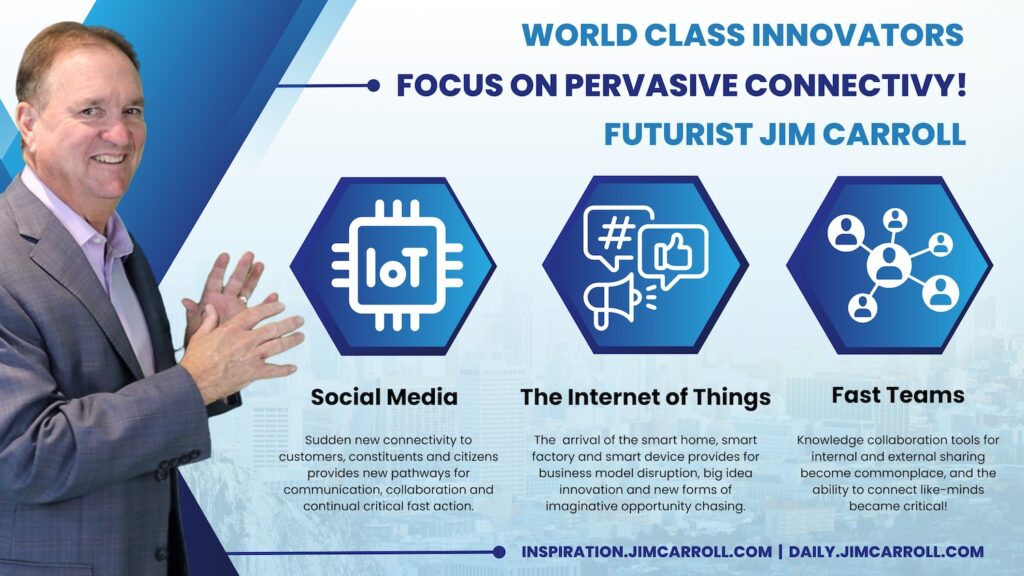
Pervasive connectivity? It takes many shapes and forms, including:
All of these fast-emerging trends provided both big opportunities and massive new challenges.
Social media? Many of my keynotes for leadership teams and associations focused on the need to understand and align to the new form of social interaction that was emerging, and understand the opportunity that lay within. The CEO of Burger King especially wanted my message to several thousand franchise owners in Las Vegas to focus on the fact that customers were talking about them – good and bad – on weird new networks with the names of Twitter, Instagram, and more – and that this could work for them, or against them.

Smart devices? Many technology companies asked me for a keynote that specifically took a look at the new forms of hyperconnectivity emerging in the digital world, and how this could and would lead to new product innovation, the invention of completely new product ideas, and fundamental service reinvention. The opportunity was suddenly there in everything that had the potential to become smart, connected, aware, and shareable. We were on the doorstep of a sudden new opportunity, and it was important to define it, understand it, shape it, and chase it. Hyperconnectivity was even becoming a big opportunity in the world of golf.

Fast, connected teams? There was also a realization that suddenly, there were wonderfully sophisticated new internal and external information-sharing tools that allowed an organization to tap into, share, access, capture, and capitalize upon a new form of collaborative knowledge. The era of the networked organization was clearly upon us, and world-class innovators were eager to demand results from this new form of collaborative creativity to learn how to respond to new issues at speed. All of this was leading to a world of ‘fast ideas.’

Put all of these connectivity trends together – and add a few more – and suddenly the world of hyper-connectivity was providing a new form of product, a new style of organization, and a new means of communication. All the old rules, ideas, and thinking that applied to a previous world of separate, disparate, and unconnectedness no longer mattered, and indeed, were suddenly leadership ideas from the olden days.
And it became a reality as world-class innovators realized that it was within the reality of hyper-connectivity that their future opportunities could be found!
Today? These new forms of connectivity matter even more!


GET IN TOUCH
Jim's Facebook page
You'll find Jim's latest videos on Youtube
Mastodon. What's on Jim's mind? Check his feed!
LinkedIn - reach out to Jim for a professional connection!
Flickr! Get inspired! A massive archive of all of Jim's daily inspirational quotes!
Instagram - the home for Jim's motivational mind!