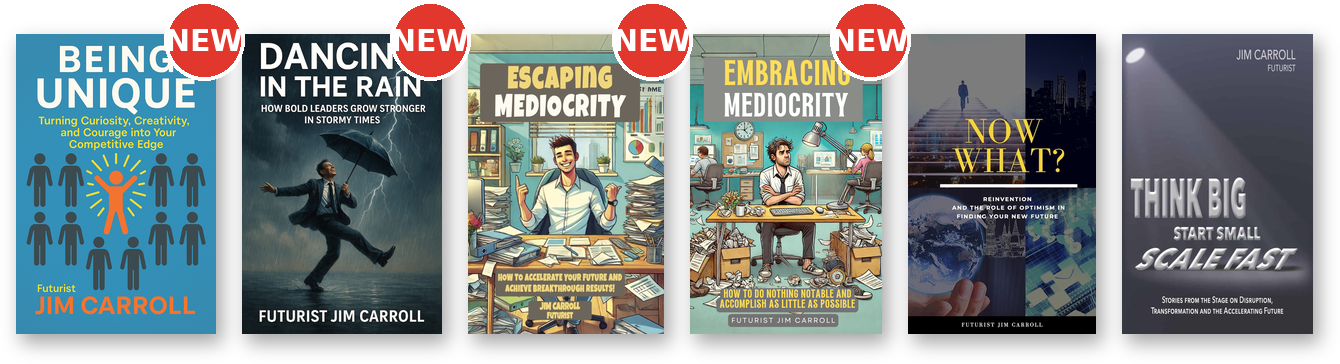

Jim Carroll was the keynote speaker at the National Dairy Convention in 2009, delivering a session titled ‘Greener Dairies: Breaking the Carbon Habit Without Breaking the Bank.’ The event brought together dairy producers and industry leaders to address sustainability, operational efficiency, and the strategic outlook for the sector. Jim challenged producers to think about how emerging environmental technologies and changing consumer expectations were reshaping the economics of dairy farming — and how early adoption of sustainable practices could become a competitive advantage rather than a cost. His talk connected the green innovation agenda directly to the business realities of producers on the ground.
Video – “Learning is what most adults will do for a living in the 21st century”
In February, I was the closing keynote speaker for the American Nursery and Landscape Association. This was a second booking by this group; they had me in previously for a leadership meeting in Vail.
Here’s a clip in which I’m setting the stage for the rapid changes occuring in their industry: in the context of how quickly basic knowledge is evolving, suggesting that “learning is what most adults will do for a living in the twenty first century.”

Does this line of thinking apply to garden store managers/owners? You bet — individuals in the nursery and gardening industry indeed have to be masters of fast knowledge. There is a regular and ongoing release of new products; new store formats; new retail and branding methodologies; not to mention the need to have a lot of innovative strategies as to growing the business during a recession, or managing costs to survive challenging times. It’s all about learning, sharing ideas, and gaining new insight. Continually learning.
If you’ve been reading the press, you know that recently, many meetings and events have been under attack, driven by what has come to be known as the “AIG effect.” Quite a few organizations have cancelled leadership meeting, fearing that it might look bad. Yet any politician or journalist continuing to beat up on the meetings industry should watch the video that “Today’s Garden Center” magazine has put online; it’s a video called “What I Learned at ANLA Management Clinic 2009.”
In it, we’ve got nursery, garden and landscape managers from across the US — small business owners — talking about the things they’ve learned at the conference; the ideas they’re taking away; the specific actions they’re going to pursue from what they’ve learned.
It’s a pretty compelling video, and if anything, it really puts into perspective what these events are all about.
- Watch: What I Learned at ANLA Management Clinic 2009


Growth strategies – What I’ve Seen From the CEO’s
Here’s a brochure extract from another upcoming conference. The theme : “Moving Beyond the Meltdown: Focusing on Growth Through Innovation.”

It’s been a busy six months since the meltdown.
Throughout this time, I’ve been keynoting events all over North America, for organizations and events large and small, focused on the theme of innovation and working our way through challenging economic times.
What has been fascinating is that in sharing the stage with a variety of CEO’s, for both massive, global organizations and smaller associations and businesses, there are many who share a relentless focus on opportunity.
There’s no doubt that there is lot of pain and retraction and pullback out there. But my experience in the last six months indicates to me that there is an equally fast pace of innovative thinking, as to ‘what should we be doing with these new realities in which we find ourselves.’
My most favorable moment comes from one particular event: before I went on stage, the CEO of one particular global organization went on to give his “call to action” to his team.
He spoke about the challenges of the global economy for a little less than a minute — and then went on a fascinating 20 minute outline of the great things that the company could accomplish with revenue growth by focusing on 8 succinct strategies.
I now use his story (and many other similar stories) when I’m on stage, in order to get people thinking about GROWTH again.
What I’m out there talking about are the real, practical strategies that organizations are pursuing to stay focused on opportunity. There are dozens of things I’m seeing happen first hand. Some of the other strategies, off the top of my head (most of which I’ve written about in this blog):
- act faster to respond to fast changing consumer demands
- innovate locally in a global economy
- focus on customer retention as a core strategy
- go upside down – innovate with supplier partners to achieve faster product or service innovation
- enhance community knowledge – rapidly leverage best practices
- speed up efforts to collaborate internally, and reshape hierarchy to be able to respond to faster change
- innovate with skills access in order to form fast teams
- anticipate customers needs before they know they need them – stay in front of your market
The list goes on. The key thing is: when do you innovate? You do it NOW. Watch this Youtube clip.
Experiential Capital
In my book Ready, Set, Done: How to Innovate When Faster is the New Fast, I made this observation: “Innovation comes from risk, and risk comes from experience. The most important asset today isn’t found on your balance sheet – it is found in the accumulated wisdom from the many risks that you’ve taken. The more experiential capital you have, the more you’ll succeed.”
In this clip from a recent keynote, I speak to why experiential capital has become even more important with the economic downturn.

I close with the observation: “Investing in experiential capital is one of the most important things you can do.” When people ask me about the “secrets” of innovative organizations, this is one of the key attributes I outline.
They realize they are immersed in a world of fast-paced ideas — and they take on many different projects, some of which are doomed to fail, in order to build the overall experience of the organization.
Keynote : Facilities 09: Rethinking the hospital
 I’ve been confirmed as the opening keynote speaker for “Facilities 09“, a conference organized by the National Association of Children’s Hospitals and Related Institutions, to be held in Austin, Texas in mid-May.
They’re running with my “Moving Beyond the Meltdown: Aligning for Growth Through Innovation” topic. It’s another group who finds that in order to move the their association forward, they need to move them beyond their current mindset. They’re using the keynote description:
“In the face of widespread economic volatility, organizations have three choices: they can panic, making rash decisions on structure, markets, investments; they can freeze and do nothing; or they can respond to rapid change through innovation, particularly with respect to strategies, structure, capabilities, markets, products, and activities. Jim Carroll, one of the world’s leading futurists, trends and innovation experts with clients such as Lincoln Financial, Caterpillar, the Walt Disney Organization and Nestle, will share his insight on the strategies that leading edge organizations are pursuing to stay ahead of the economy.”
Look, here’s the thing: at some point, whether it’s one year, five years, or even ten years, we’ll be back into a growth economy. People will be busy rethinking business models ; they will be aggressively transforming business methodologies to achieve cost savings; they’ll be partnering in new ways with new partners in order to achieve new goals; they’ll be busy implementing a flood of new ideas driven by rapid science.
In terms of the future of health care facility design, there is no shortage of ideas in terms of design momentum: green building concepts, hyperconnected energy management systems, the concept of the virtual hospital with remote patient management, and the need for rapid implementation of new medical treatment capabilities. All of which (and many more) pose the challenge of : how we design in the context of high-velocity change? And how do we get our mindset out of the challenges of the “here-and-now” so that we’re focused not just on managing the current challenges, but are fully prepared to attack with zeal the opportunities of the future?
That’s the mindset and message that I’ll carry into Austin, Texas in two months.
Think growth!
- Facilities ’09 conference web site

- It’s January 15, 2020: What Have We Learned About Healthcare in the Last Decade?
- Future Medicine: Prescriptions for 21st Century Health Care

Rethinking Innovation
Here’s one thing I’ve been stressing to many of my clients during keynotes, leadership and workshops: organizations need to work hard to ensure they establish an overall culture of innovation. What does that mean? Everyone throughout the organization has a mindset that they are equally responsible for innovative ideas; they’re colaborative with those ideas; and they focus on three key questions: how can we run the business better, grow the business, and transform the business.
Here’s a clip from a recent keynote in which I explore this theme

IBM seems to like my ideas; they put out a white-paper in January of this year, and included a quote that catches the key theme in this video clip:
According to futurist Jim Carroll, transformation is very doable for many businesses: “They are realizing that innovation isn’t some dark, mysterious ancient ritual: they’re realizing that it’s simply a mindset that involves constant probing to see how we can fix things, find new things, or transform things, whether those things be business processes, customer service methods, new products, marketing and distribution cannel concepts, or just about anything else.”:
- IBM White Paper Business analytics: The perfect fit for the agile enterprise



GET IN TOUCH
Jim's Facebook page
You'll find Jim's latest videos on Youtube
Mastodon. What's on Jim's mind? Check his feed!
LinkedIn - reach out to Jim for a professional connection!
Flickr! Get inspired! A massive archive of all of Jim's daily inspirational quotes!
Instagram - the home for Jim's motivational mind!