
I still believe the defining trend of the next decade will involve “pervasive connectivity,” as everything around us “plugs into the cloud” — aka the Internet of Things (#IoT) Here’s a brief video clip from a recent keynote.

Article – “The Future Belongs to Those Who Are Fast”
 Expectation gaps create tremendous opportunity
Chronicle Herald, November 2009
By Kelly Hennessey, ABC
There are two ways your community can look at the rapid-fire pace of change we are experiencing: Bury your collective heads in the sand and hope it goes away, or embrace the opportunity change presents for transformative growth.
Jim Carroll would strongly encourage you to seize transformative growth and the opportunities it presents.
Mr. Carroll, a Halifax native, is a world-leading global futurist, trends and innovation expert speaking today at the Greater Halifax Partnership’s Building Our Future event, the last in a series for 2009.
“There are two trends communities need to face now to stay strong for tomorrow,” says Mr. Carroll. “One trend is the expectation gap.”
Take any segment – health care, pensions, post-secondary education – and boomers expect there is enough money to fund these costs for themselves and their children in the future. The gap?
“We can’t fund our current levels in many sectors into the future,” says Mr. Carroll, “but that’s okay. This quickly changing environment creates the opportunity to innovate – and innovation opens the door to all kinds of new possibilities, new jobs, and new growth.”
Take the health care and life sciences sectors in Halifax. These groups are critical to the economic stability of our region and Mr. Carroll believes as they solve the expectation gap in their sector, it will open up big potential here – and on a worldwide basis.
Which brings us to Mr. Carroll’s second trend: That overseas markets present the next big opportunity for this region.
“Canada has always thought it important to look overseas to reduce reliance on one economic partner. What is happening now is there are more, and more frequent, border irritants to the south. This makes the overseas markets even more attractive and more important.
“Given the global knowledge economy, there is no better time for Nova Scotia to turn aggressively outward and do more of the Bermuda-type ‘in-shoring’ deals.” In January 2009, the provincial government signed a memorandum of understanding between Nova Scotia and Bermuda to encourage new business growth in the areas of knowledge, finance, education and tourism.
Amid the trends, Mr. Carroll makes one other key point: Complacency is not an option for organizations seeking future growth.
“There’s so much going on in terms of disruptive innovation, the rapid emergence of new opportunities and fascinating new technologies for marketing and promoting your business. I think the best thing to do is simply to adopt an attitude that it’s fast, it’s scary, but you’re fully prepared to experiment, try out new ideas, and always stay focused on potential new opportunities.”
“The timing of Jim Carroll’s insight couldn’t be better,” says Paul Kent, President and CEO of the Greater Halifax Partnership. “We’re pleased to bring him back home to invigorate our thinking and open our eyes to the trends we can capitalize on for economic growth.”
The Greater Halifax Partnership is the catalyst for economic growth and confidence in Greater Halifax, the economic hub of Atlantic Canada.
“How cool is that?” “Let’s focus on growth!”
 My news tracker picked up this small interview that appeared in Food Processing Magazine a few months ago.
In a tough economy like this, it’s time to hold the line on spending and to be especially cautious of leading-edge technology. Right?
History’s full of companies that leapt ahead of competitors by increasing spending, especially on innovation, during down times. Jim Carroll, author and innovation consultant, recalled a speaking engagement in which he followed the CEO of a global restaurant chain, who spoke for a brief but powerful 20 minutes.
“For the first minute, he spoke about the global economy and the meltdown. He then spent the next 19 minutes identifying eight growth opportunities and how this organization could do great things if they relentlessly obsessed over them.
“How cool is that?” asks Carroll. “All these other companies are retrenching, pulling back, and here’s a guy who’s saying to his team, ‘Let’s focus on growth.’ ”
He says growth plans and strategic if judicious spending is mandatory for managing during a downturn. Companies that aren’t paralyzed by total spending freezes can get the jump on those competitors who are. And when the economy is back on track a year or whatever from now, Carroll says only then will we be able to point to companies and say which ones lagged and failed and which ones “took risks and did great things.”
:
- Read the original article


PacMan in the streets! Challenge Yourself to Think Differently!
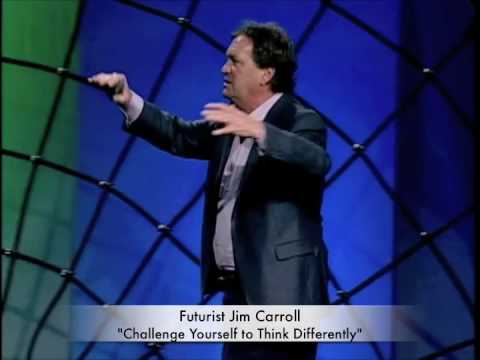
When you’ve got 4,000 people from large cities and small towns across America, thinking about how to solve some of the big problems faced by society, you can suggest small ideas, or whacky ideas. Here I am on stage, with a suggestion involving the latter.
- PacManHatten

Courage to Go Forward Into The Future!
When you open up a conference for 4,000 people, you really need to get them inspired and ready to take on the challenges that they face in the future!
Here’s the first few opening seconds from my keynote earlier this year for the National Recreation and Parks Association annual congress. An insprirational clip!

Innovation and the concept of “chameleon revenue”
 I am not alone in thinking we’re in the midst of a significant economic transformation. As Mick Fleming, president of the American Chamber of Commerce Executives, said recently, “It’s going to be a move from a bad economy to the next economy.”
What is the shape of the next economy? In many cases, it will involve structural change based on an acceleration of business cycles. Consider manufacturing, for example. We’re moving from a world of mass production to mass customization, or what I call agility-based manufacturing. I often cite the case of Honda, as noted in a 2008 article on the financial website Bloomberg: “Honda’s assembly lines can switch models in as little as 10 days.” By contrast, the article suggests, it could take months for most rivals to make the same change.
Companies such as Honda can see what’s selling strongly and quickly reorient their production to fit that demand. In the meantime, its competitors are busy cranking out 700,000 versions of the same old car, hoping to sell it to consumers who have already moved on to something different. It’s no wonder Detroit is being killed off by its long-term reliance on gas-guzzlers.
Everyone now understands that the old Detroit-based manufacturing business model was deeply flawed. The newer model, based on agility and flexibility, is the model of the future. If an organization can rapidly change its production to accommodate what consumers are willing to buy, it has a good chance of future success.
This ability to respond quickly to change is a corner-stone of opportunity. Competitors will emerge, particularly as the new connected generation rejects existing business models and innovative people continue to shake up the fundamentals. Take the business model of Wizzit, a South African cellphone-based banking system, which could cause upheaval throughout the banking sector as mobile technology garners more of our attention.
Furthermore, the nano-cannibalization of markets is becoming a business trend rather than an aberration. For example, Apple broke new ground years ago by tossing out an entire iPod Nano product line worth billions of dollars of revenue, replacing it with a newer, up-to-date product. Imagine even considering that. How could it cannibalize its own product revenue?
I recently spoke at a leadership meeting for a global organization, where the CEO spoke of a future in which the company’s success would come from what he called “chameleon revenue” – the sales derived from entirely new product lines. The chart he presented said it all: the organization’s future consisted of a steady decrease in baseline revenue and accelerating revenue streams from markets it currently does not participate in.
I think this will become the norm for most organizations. The ability to rapidly enter and exit markets will define future success. The ability to sustain multiple, short-term product life cycles, each perhaps no more than 36 to 48 months long, will be a critical success factor. Agility at discovering, producing and capitalizing on new revenue sources will be a fundamental necessity. In other words, your ability to change your spots and your colour on a dime will be the key driver for your potential.
Which begs the question: does your financial system have the capability to provide information on your chameleon revenue streams? Does it provide the insight and analytical tools to tackle product life-cycle revenue so the organization can assess how quickly its chameleon revenue streams are evolving? If it doesn’t, what do you need to do to adapt?
From Jim Carroll’s CAMagazine December column


GET IN TOUCH
Jim's Facebook page
You'll find Jim's latest videos on Youtube
Mastodon. What's on Jim's mind? Check his feed!
LinkedIn - reach out to Jim for a professional connection!
Flickr! Get inspired! A massive archive of all of Jim's daily inspirational quotes!
Instagram - the home for Jim's motivational mind!