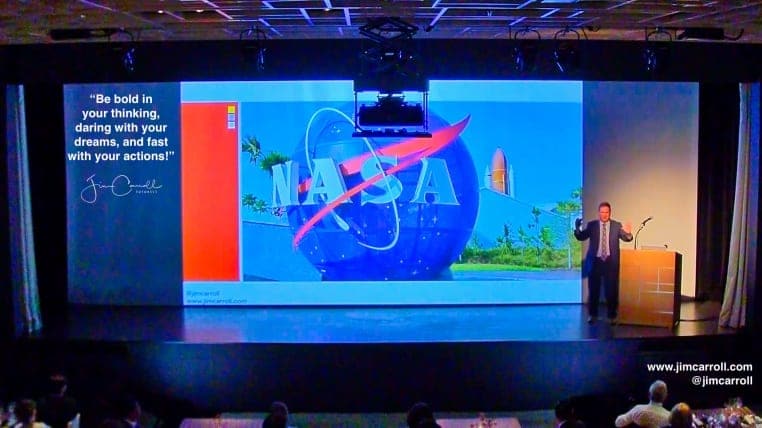
The agency invited Jim to speak to a group of senior leaders to speak on the issue of what leaders do to innovate during times of significant transition, and the transition of innovation throughout the world.

The agency invited Jim to speak to a group of senior leaders to speak on the issue of what leaders do to innovate during times of significant transition, and the transition of innovation throughout the world.
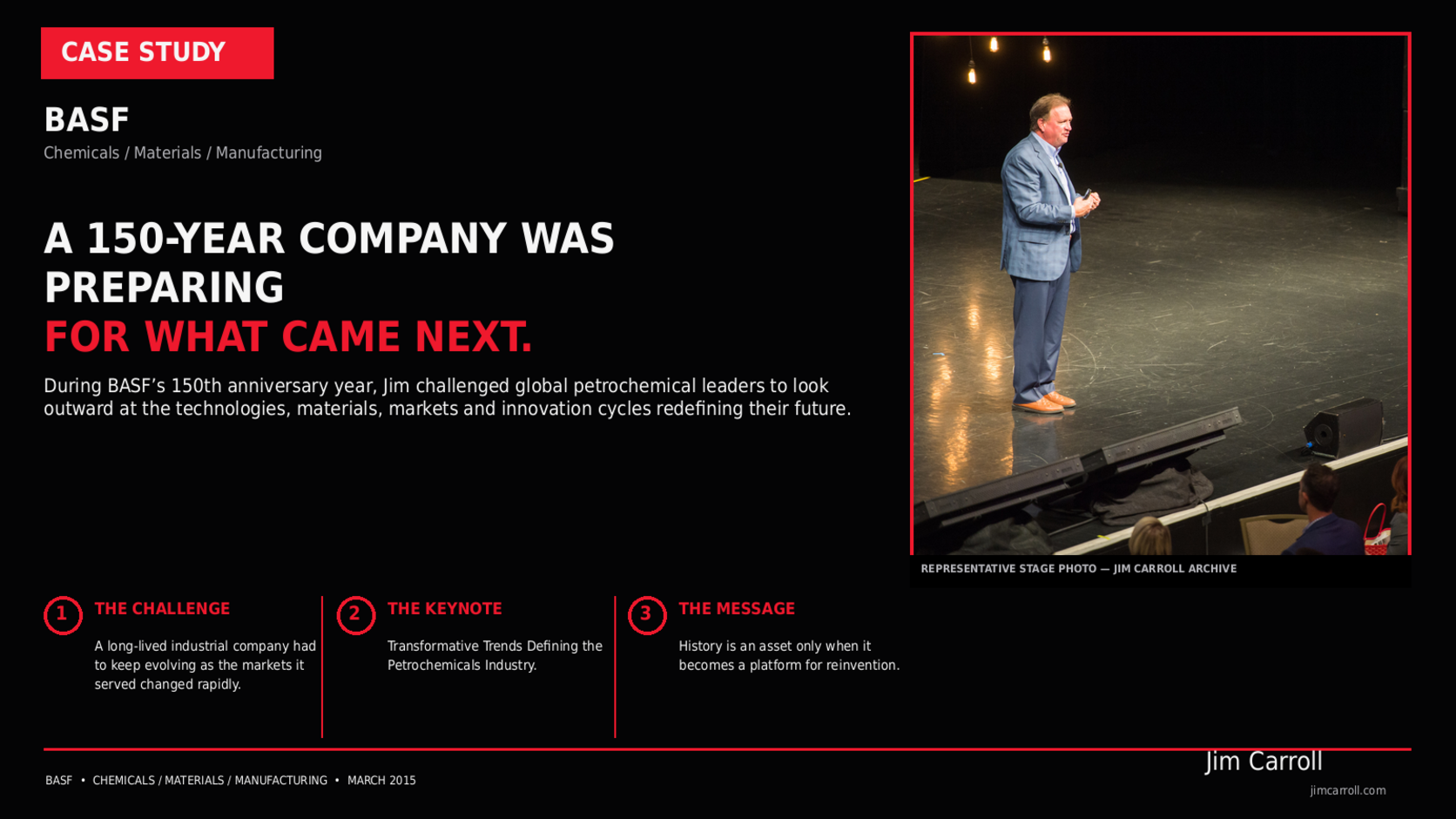
A 150th anniversary naturally invites an organization to look backward.
BASF used the moment to look forward.
During its anniversary year, I addressed international petrochemical executives on the transformative trends defining the future of the industry.
The company theme asked a powerful question:
How can you make tomorrow better than today?
That question went directly to the heart of the keynote.
Petrochemicals sit inside an enormous number of industries.
Automotive.
Construction.
Consumer products.
Packaging.
Energy.
Agriculture.
Advanced manufacturing.
When those industries change, the materials and chemical industries supplying them have to change too.
That meant the future of petrochemicals could not be understood only by watching petrochemicals.
It required looking outward.
At new manufacturing technologies.
New materials.
Changing consumer expectations.
New energy systems.
New forms of mobility.
And the accelerating pace of product innovation.
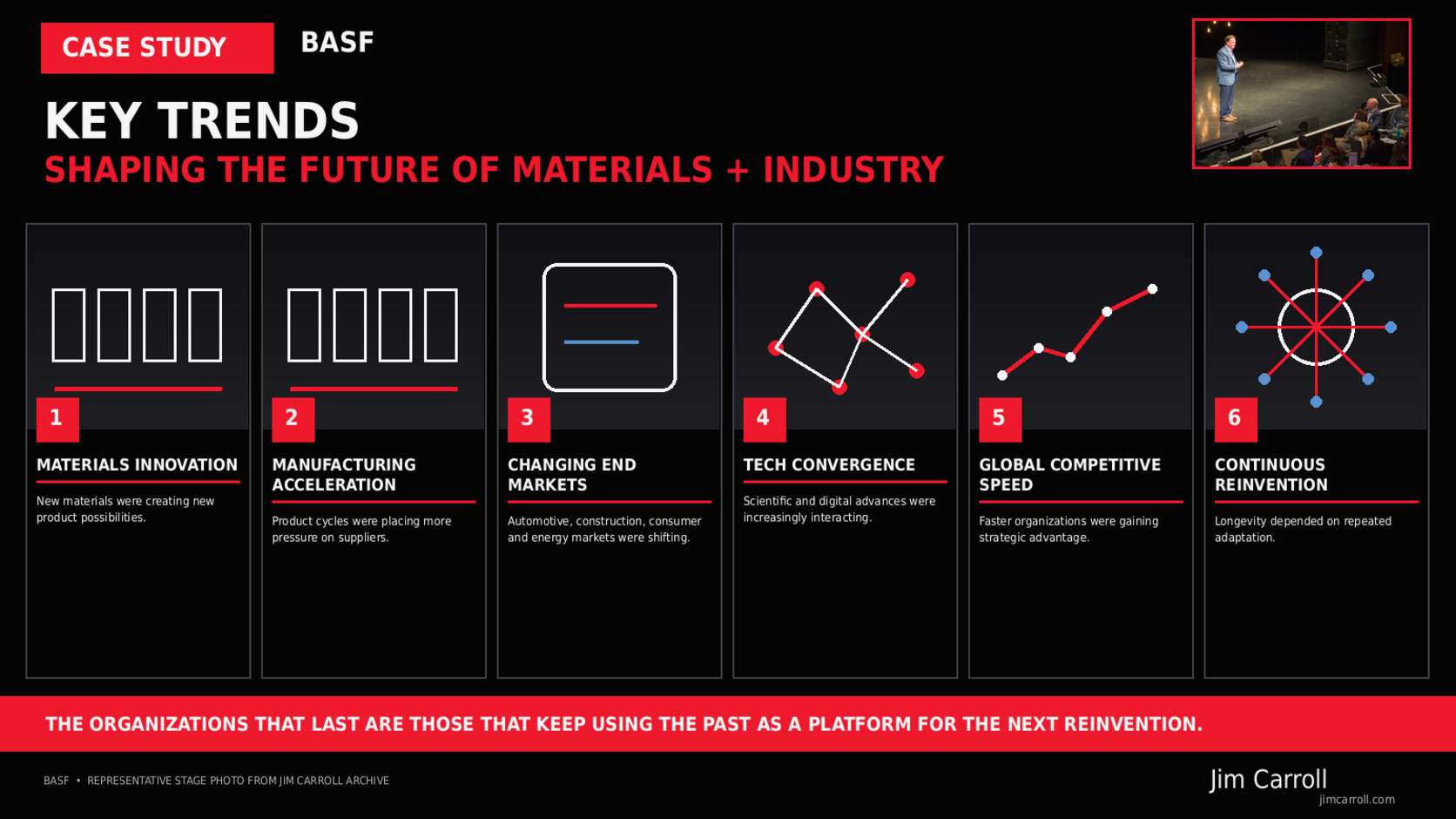
Six themes framed the discussion:
The anniversary context made the message especially relevant.
A company does not survive for 150 years by refusing to change.
It survives because generation after generation finds a way to align its capabilities with new markets, new science and new customer needs.
The challenge is to make that adaptability deliberate rather than accidental.
BASF’s history was an asset.
But the future would still have to be earned.
The organizations that last are not those that protect the past. They are those that continually use the past as a platform for the next reinvention.
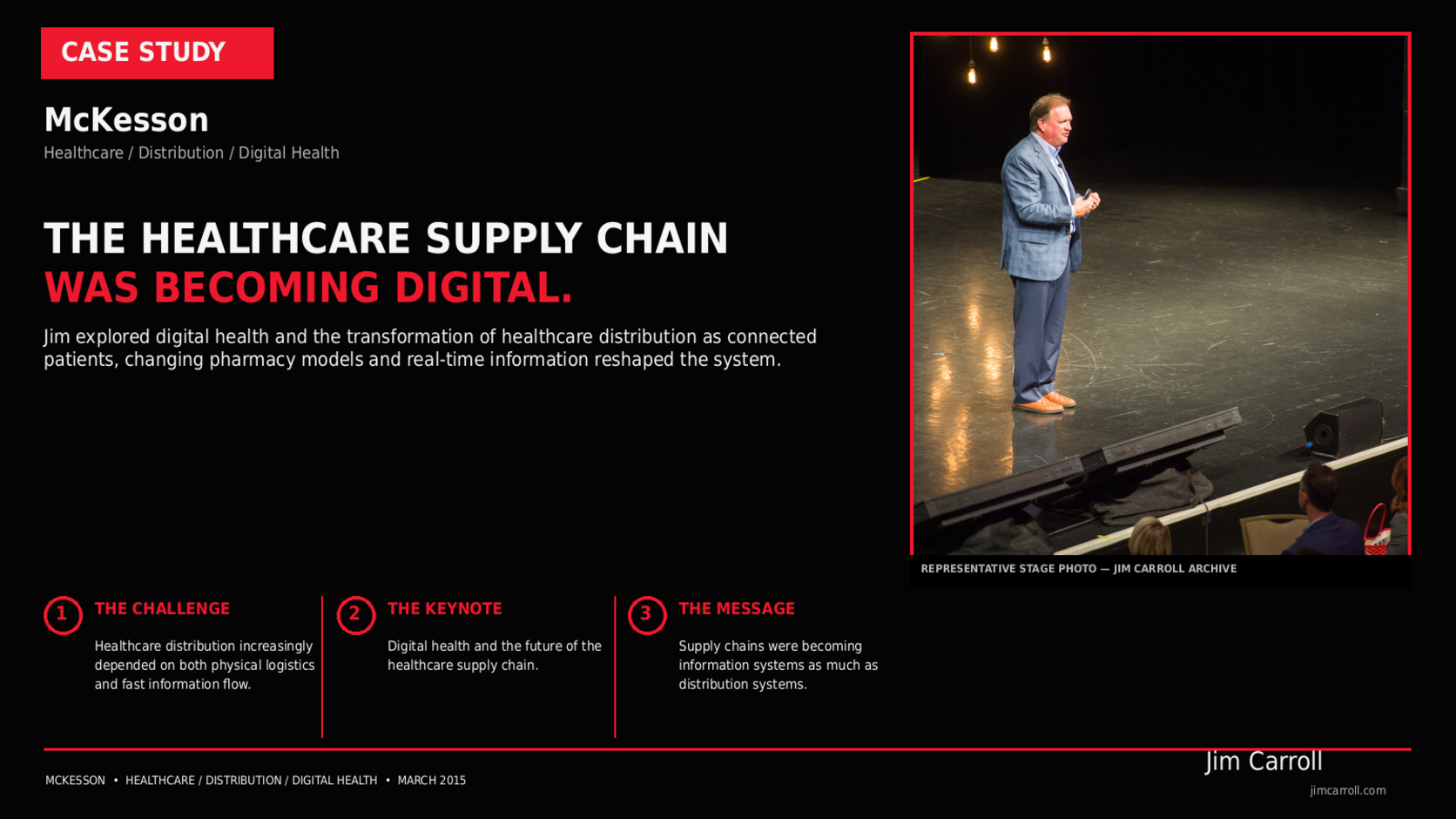
The healthcare system is not only about medicine.
It is also about the complex infrastructure that moves products, information and services to the people who need them.
That was the context for my work with McKesson.
The engagement focused on the future of digital health and the transformation of the healthcare supply chain.
McKesson sat at the intersection of several fast-moving trends.
Medical science was accelerating.
Patients were becoming more digitally connected.
Pharmacy was changing.
Healthcare information was becoming more real-time.
And distribution systems were being forced to operate with greater visibility, speed and precision.
Six themes framed the discussion:
The important shift was that supply chains were becoming information systems.
Physical distribution remained essential.
But increasingly, competitive performance depended on the quality and speed of the data surrounding it.
What is needed?
Where?
When?
How quickly?
And with what level of confidence?
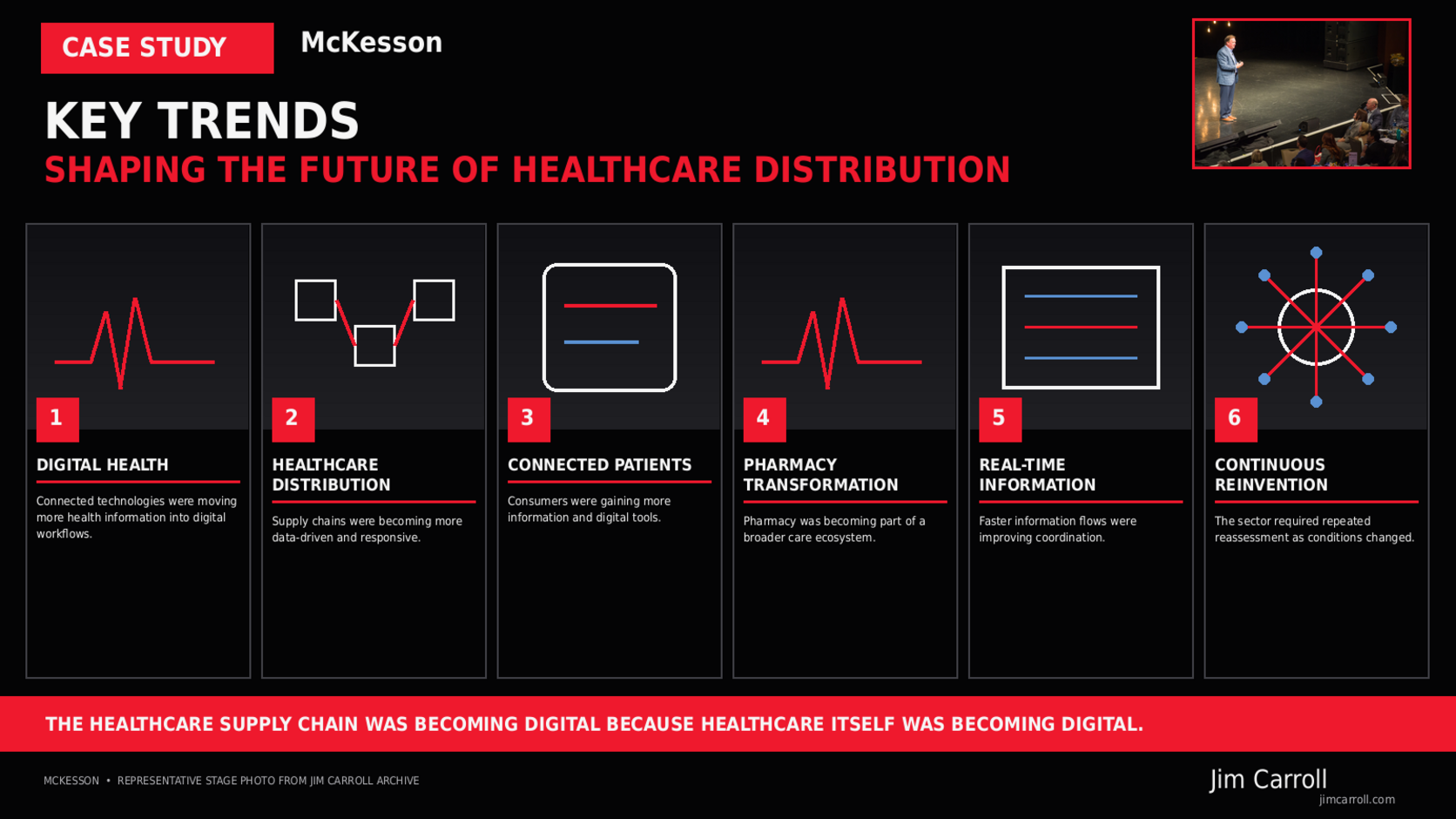
Healthcare distribution was becoming increasingly digital because healthcare itself was becoming increasingly digital.
The organizations that understood both the physical and information flow of healthcare would be best positioned for what came next.
I’m thrilled that I’ve again been cover in CG&T Magazine’s annual outlook . This marks 4 years in a row!
This year my comments are short and sweet – I continue to believe that accelerating change with retail models, products, technology, mobile and just about everything else makes it difficult for organizations to ensure that their capabilities are aligned to their strategies.
Here’s what I wroe for this years piece:
Going into 2015 and beyond, the biggest issue for CG executives will be to think about how they have big holes that they need to fix — and fast.
The challenge is that with this tsunami of change, many companies still aren’t capable of coping, and so many mismatches become painfully clear:
Here are some key secrets of success in an era of high-velocity change: an accelerated innovation cycle, fuelled by the rapid ingestion of new technologies/methodologies. Work on your internal pipelines to gain a faster time to market, and know how to rapidly re-focus resources for opportunity or threat. All that needs to be done in a time in which volatility is the new normal. A pretty tall order, but it will help you close the mismatches that likely exist.

I just found this article, which ran on the ERA blog after my keynote on the future of real estate, for their 2013 conference. It’s a good read!
——
5 Things World Class Innovators Do that Others Do Not,
by Tara Reid, from Owning the Fence, ERA Real Estate Blog
Consider this: 65 percent of current preschoolers, kindergartners and first graders will work in a career that does not yet exist. And, if you are working on a degree based on science right now, it is estimated that half of what you learn in your first year will be obsolete by the time you graduate.
That is how fast things are changing in this world and according to Innovation and Trends Expert Jim Carroll; the future belongs to those who are fast. In fact perhaps media mogul Rupert Murdoch puts it best: “The world is changing very fast. Big will not beat small anymore. It will be the fast beating the slow.”
During the ERA 2013 International Business Conference Think Tank, Carroll explained that to keep up, you have to get ahead the way that today’s best thinkers and changers do. Here are 5 things world class innovators do that set them apart from the rest.
With these five actions in mind, turn your next “oh no!” moment into an “a ha!” moment. Take that threat and turn it into an opportunity to grow. The world is not going to stop changing and trends will pop up even more quickly so grab on, hold on tight, and go for it!



GET IN TOUCH
Jim's Facebook page
You'll find Jim's latest videos on Youtube
Mastodon. What's on Jim's mind? Check his feed!
LinkedIn - reach out to Jim for a professional connection!
Flickr! Get inspired! A massive archive of all of Jim's daily inspirational quotes!
Instagram - the home for Jim's motivational mind!