
Jim put into perspective the impact of social networks upon branding, consumer relationships and marketing for this group of senior executives from some of the world’s largest technology companies.


Jim put into perspective the impact of social networks upon branding, consumer relationships and marketing for this group of senior executives from some of the world’s largest technology companies.
I just came from giving a keynote for the annual conference of a major customer loyalty organization, with the talk focused on some of key trends impacting the world of retail today.
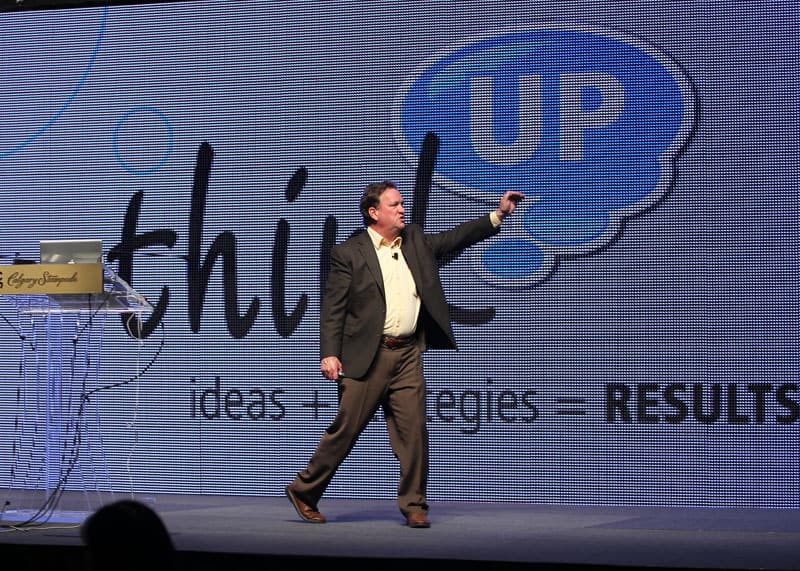
There’s certainly a lot going on and a lot to think about. Extremely rapid business model change, the emergence of new competitors, ongoing consumer confidence volatility, rapid product turnover and faster product life-cycles.
So what are they really, really worried about? Let’s put in context the people I had in the room — senior VP’s and managers in major retailers representing several billions in revenue in a wide variety of markets, including pharmaceutical, grocery, consumer goods and electronics. Not to mention quite a few bankers, responsible for credit card portfolio’s, loyalty programs and other customer oriented programs and infrastructure.
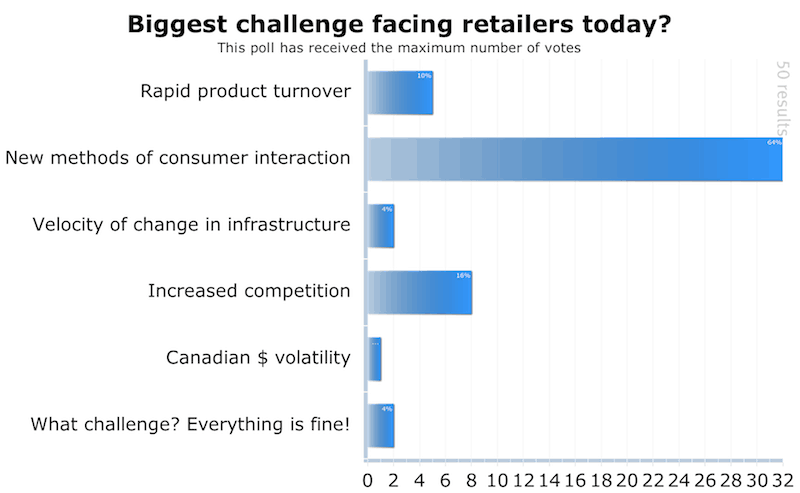
Given all that, the top of mind issue is — new methods of customer interaction.
Look at the poll results below. The issue stands out far and away as the most important concern of the day!
Hence, my keynote was bang-on. I didn’t touch too much on the social networking phenomena, as this type of crowd has been drowning in social-networking Powerpoints.
My focus was on interactivity, location, and intelligence,, and the extremely rapid emergence of new forms of in-store interaction and product sales uplift. Things like digital signage, in-store electronic promotional displays, iPod based coups. A flood of new stuff and new ideas that promote new ways of
Listen folks, I know I’ve said it here before, but I’ll say it again.
2010 is the year of location, combined with mobility, and it’s happening faster than you think.
I’m pumped about this topic and the reaction, so I’ve rolled this into a new keynote description:
Location is the New Intelligence: Customer Interaction in the Era of Pervasive Mobile
We’re at the leading edge of the merger of three perfect trends: the rapid and massive emergence of a massive mobile infrastructure with increasingly intelligent devices. Pervasive location awareness as a results of GPS and location intelligence/mapping trends in those very same tools. And a consumer mindset that is increasingly open to new forms of interaction. The result is massive business model disruption, absolutely transformative market change, and complete obliteration of old assumptions as to the nature of the customer relationship. Smart, innovative super-heroes know that this is an unprecedented time to jump on the emergence of location as the new intelligence, in order to provide for new ways of product uplift in the retail space, changing the very nature of customer loyalty through new forms of interaction, and enhancing existing one-to-0ne conversations through a more direct, distinct and fascinating new form of location based relationships. Futurist, Trends & Innovation Expert Jim Carroll is setting the retail, marketing and advertising world on fire with his fast paced insight into one of the most important trends to shape the customer-business relationship in the last few decades. Move over social networking — location is the new intelligence!
Read more: Location is the new intelligence 
Jim Carroll delivered the general session keynote at the Produce Marketing Association’s (PMA) Fresh Summit in 2010, one of the produce industry’s largest and most important annual gatherings. His keynote challenged attendees with a provocative question: ‘Are you guilty of future crimes?’ — exploring how organizations that fail to innovate today are essentially committing crimes against their own futures. Jim drew on his deep experience with food, agriculture, and consumer trend analysis to push Fresh Summit attendees to think about accelerating disruption in the produce supply chain, consumer expectations, and the competitive dynamics reshaping the fresh food business. PMA highlighted the event in a separate press release, calling Jim a ‘futurist, author and trends and innovation expert’ who would challenge attendees to reinvigorate their business.
With a lot of university graduations and commencements, it might be a good moment and pause to think about a degree that colleges and universities should be offering their students. That’s why I opined a number of years ago that we needed to prepare people for a fast paced future by letting them enroll in a Masters of Business Imagination Degree.
Grab the PDF to the right, and share it around. Here’s how it reads.
“In a time of rapid, disruptive change can be a death sentence – not only for organizations, but for the careers and skills of those who work there! It’s time to abandon the thinking that has had you anchored firmly to the past – and to shift your focus to the future, with enthusiasm, motivation and imagination.
You can do this by abandoning any pretense that the skills of yesterday will be important tomorrow. Figuratively and literally, it is time to move beyond the thinking that has led us to a world of MBA’s – Masters of Business Administration – and focus upon the critical skill that will take you into tomorrow. The world doesn’t need more administrators. It needs more MBI’s – Masters of Business Imagination!
What are the attributes? MBI’s:
Grab the Masters of Business Imagination PDF 
Here’s a summary of my observations from a keynote I did in New York City for retailers, agencies, marketing organizations, food and CPG companies, on some of the trends that are sweeping their industries today.
 The summary is courtesy of the event sponsor, the Readers Digest Food & Entertainment Group.
1. The New Consumer Is Shifting Their Attention Faster than Ever
Consumers suffer from “continuous partial attention” with more stimuli around them than ever before:
Consumers across demographic segments are immersed in this new interactive world forcing brands to engage them across all mediums to stay connected.
This new shopper is not only more scattered and more connected, but also faster – scanning 12 feet of shelf space on average per second. In-store influencers will now evolve at the pace of the iPhone and the Blackberry, challenging marketers to keep up with the pace. Faster is the new innovation and innovation isn’t just about new product design – it’s about responding to fast-paced consumer change.
Marketing Implication: Marketers must work harder than ever to capture the attention of the consumer and make a connection. Brands must keep up with the pace of consumer change in order to stay relevant.
2. The New Consumer Is No Longer Nuclear
The nuclear family is no longer the norm as Americans find new definitions for ‘family’ in today’s world. The following headlines touch on the variety of different ways families are structured today:
Brands must acknowledge these new trends as they develop products and create marketing messages to resonate with today’s consumer.
Marketing Implication: Hyper-nicheing is the new brand reality as the market becomes more specialized and fragmented. Marketers can no longer rely on preconceived segmentation strategies, but rather need to think differently about who they are trying to reach and how to reach them.
3. The New Consumer Is Influenced Differently
We’re in the era of the “Celebrity Baby Blog” where purchases are influenced heavily by what others are doing. And it is not just celebrities that consumers are watching – they are also looking to their peers for advice and brand recommendations. For example, in travel, 79% of travellers trust peer reviews more than ads.
The same thing is happening with consumer products – peer reviews are the new influencers, with 83% trusting the opinion of a friend or acquaintance who has used the product or service.
Marketing Implication: Social networks are the new brand influencers and marketers must find ways to connect with consumers who are highly influential in their peer groups.
4. The New Consumer Is Shifting Their Focus
Socio-economic shifts are affecting consumer behavior at an increasingly fast pace.
For example, the downturn in the economy has quickly had a significant impact on consumers’ eating habits. 71% of consumers are choosing to prepare meals at home instead of eating out and restaurant trips have decreased from 1.5 times a week in 2006, to 1.2 times today. (Food Marketing Institute US Grocery Shopper Trends)
Another prime example of trends reaching mainstream quickly is the health trend. Even the most active consumers shopping at delis are health-conscious. 80% of deli-buyers are making changes to their diets and 90% are now reading deli labels (International Dairy-Deli-Bakery Association)
New markets are constantly emerging, whether it’s fresh-cut snack food, growing from a $6.8 billion industry to $10.5 billion (International Fresh-Cut Produce Association) or rapidly changing tastes – flavors are now moving from upscale kitchens to chain restaurants in 12 months, compared to 36 months 5 years ago.
Marketing Implication: Faster-paced preference change is the new reality and brands must be nimble to keep up with consumer demand.
5. The New Product Is Rapidly Redefined
New products are brought to market faster, redefining the industry quickly and forcing products to keep up.
As scientific knowledge is being shared in real time, ethical packaging innovations are emerging and driving product design.
For example, wax paper infused with cinnamon oil (antibacterial) inhibits 96% of mold for up to 10 days (Investor’s Business Daily). This new discovery allows CPG companies to produce new products with a naturally longer shelf life. Major manufacturers and retailers must respond to these new trends, especially as consumers jump onboard and demand these innovations. Most notably, Walmart has vowed to have zero private label packaging waste by 2010, and to eliminate all packaging waste by 2025 (Modern Plastics Worldwide)
Another example of a new product being redefined at a rapid pace is the “nutri-cosmetic” market – already at $1.5 billion worldwide (only 3% of that is in the U.S.) and predicted to grow at 4.7% a year in the U.S. to $10.6 billion by 2012 (Household & Personal Products Industry). Consumers are embracing new products that can offer positive effects on their appearance, while easily being integrated into their lifestyle.
Marketing Implication: Time to market and corporate agility are the new capabilities to focus on.
6. The New Product Is Upside Down
The way companies are innovating is also changing. The process used to be to get the assortment right, figure out the merchandising, go to stores and create a marketing campaign around it all.
The new innovation model turns that upside down: as large companies are more connected to consumer demand, they can use that insight to come up with the marketing, then determine the merchandising and get the assortment right.
Partnership with retailers and packaging companies in the design of the product is the key trend because these partners are closer to consumer demands and can often guide development of new products through their unique insight. Smart manufacturers are turning to packaging designers to ask for help lowering expenses as oil and raw material prices rise. (Bangkok Post). 73% of packaging machine builders collaborate with customer-packaging engineers. (Control Engineering).
Marketing Implication: Partnership with retailers and packaging companies is the key method to speed up product innovation and efficiently introduce new products to the marketplace.
7. The New Marketing Is Shifting
Consumers are being increasingly influenced by their time spent online. Therefore, online advertising spending is increasing and is predicted to rise to $51 billion in 2012 – up from $21 billion in 2007.
Consumers are looking across all media and being influenced by different sources of inspiration. Different media serves different purposes for consumers and reaches them in different mindsets. For example, certain magazines are set aside for leisure comfort reading, while online media can quickly provide relevant information at the touch of a button.
Marketing Implication: A “healthy mix” is the new advertising recipe for success reaching consumers at different touch-points.
Here’s a short video clip of Jim’s keynote, in which he speaks about the increasing velocity of change in retail.
This is a long post.
Way back in 1997, I wrote a book called “Surviving the Information Age.” It’s now out of print, but a few copies are still at Amazon.
 The book took a long look at the trends that would impact our future. I dug it out again today when CNN ran an article, “Say goodbye to full time jobs without benefits“, decrying the fact that with the recession coming to an end, we were seeing more jobs that were contract oriented rather than full time. Reading the article, it seems they see this as a shocking new trend.
D’uh! What planet are these people on. Countless people have been talking and writing about the significant structural change occurring in hiring practices. I’ve been speaking about it since 1987 when the New York Times wrote an editorial entitled “Tomorrow’s company won’t have walls.”
So in the spirit of going back in time, I offer up an extract from my Surviving the Information Age book, in which I wrote at length about the trend.
I think I’ll re-release the book as an e-Book. It’s uncanny how right it was.
Chapter 5 : From Surviving the Information Age, Jim Carroll, 1997
The world of business is going to be changed by computer technology, not only as a result of the interlinking of business computer systems – but through the emergence of brand new forms of corporate organization that are fuelled by the connections that computers permit between companies and people.
My own career experiences are similar to what many people went through with the recession and business upheaval of the 1980s and 1990s. A lot of people found themselves in circumstances that forced them to re-examine their lives and make some decisions with regard to their careers. Some responded marvelously and others did not.
In my case, I’ve discovered a new flexibility in my attitude towards work: I find that my attitude now is that I have to continually change myself and skills in order to keep one step ahead in the game. Since I don’t have a job, I have to constantly invent one – and make myself available as a temporary worker to any business on the planet.
* * * *
By understanding in general terms what is going to happen in the future in terms of new forms of business organization, you can prepare yourself to maintain your career — and hence your income — through a period of unprecedented change.
One of the most significant changes that is occurring is that the emergence of the wired world will result in a significant change in the relationship between a business organization and its employees.
In the good old days, there was a simple rule that the world of business operated by: people lived close to the place where they worked. Having a job meant that you got up every morning, went to work, put in your seven or eight hours and went back home.
With the wired world, of course, this is no longer true: the matter of location is quickly becoming irrelevant. With the explosion of telecommunication networks, fax machines, voice mail, e-mail and other methods of communication, the fact is that the work that people do is increasingly becoming accessible to the world of business from anywhere. You can expect this trend to continue. For all the hype and hyperbole, business is truly going global and will come to rely on the skills of people wherever they might be on the planet.
* * * *
Back in June of 1989, I read an article in the New York Times entitled “Tomorrow’s Company Won’t Have Walls.” The author did a wonderful job of putting into perspective the fact that traditional forms of business were coming to an end, primarily because of the expansion of global communication capabilities. The author foresaw that the world was already becoming one in which companies were more likely to hire expertise on a part-time, as-needed basis.
His prediction? In the future, because of increasing complexity in the business world, companies would find that they would need a lot of specialized expertise. And with ever-increasing sophistication in communication capabilities, they would find that they would be able to obtain this expertise not by hiring more employees, but by accessing that expertise from contract workers or consultants who happened to make their skills available through sophisticated telecommunications technologies wherever they might be.
Two years after I read that article, which caused me to begin to think about what was happening around me with the recession of 1990–1991, Fortune magazine ran a cover story called “The End of the Job.” The article predicted that we were entering an economy in which “jobs” are disappearing and in which people would make themselves available to companies for short-term assignments.
And by 1996, The End of Work, a book that focuses on the dramatic change occurring in our economy, rocketed to the top of the international best-seller lists. One of the key premises of the book? The economy of the temporary workforce is upon us.
In his book Job Shift, William Bridges (1994) coined the phrase “dejobbing” to describe this trend to non-standard employment. He says that workers are going to be more like independent business people (or one-person businesses) than conventional employees. They are likely to work for more than one client at a time and to move back and forth across organizational boundaries — being employed full-time for a period of time, then hired to do contract work, then hired to consult, and then brought back in-house (perhaps part-time this time) on a long-term assignment. He concludes that, although there will always be enormous amounts of work to do in our economy, the work will not be contained in that old familiar employment form of standard full-time, full-year jobs.
All these articles and books centre on two themes: the ever-increasing reliance on the temporary “workforce for hire” and a reduction in the duplication of skills throughout an organization.
Over time, companies will become leaner and meaner than they are today. They will be built around a small, core group of staff responsible for keeping the business running and will obtain the rest of their needed expertise through an ongoing and ever-growing reliance on contract workers. And specialized expertise need not be duplicated. In the old days, companies may have had a human resource expert for every division and every office location. Today, they can rely on one expert, or perhaps two or three, and make that talent available to the rest of the organization through e-mail and other methods.
These changes are real and aren’t science fiction. Take a look around your world, and I’m sure you can see the signs that it is beginning to happen. Fortune 500 organizations continue to shed staff at alarming rates, as the era of downsizing and rationalization continues unabated. You’ve either been directly affected or will be in the future.
* * * *
If you think about it, the wired world is the grease that is fueling this new type of corporate organization. The reason? With the explosion of communication capabilities, organizations can go out and access the expertise and talent of any number of people around the planet. Why hire staff when you can hire a temp? If you spend a bit of time thinking about the implications of this change, you will see that through the next decade some rather remarkable changes are in store.
The era of the job for life has clearly come to an end, and the concept of the job is becoming irrelevant as well. A new way of thinking is emerging in the corporate world, built upon a reluctance to increase staff levels, with the result that we are becoming an economy of consultants who sell their skills and talents to business on an as-needed basis.
It used to be that companies entered into an employer–employee relationship in order to obtain access to some type of specialized skill or knowledge. If the company needed a new marketing specialist, it went out and hired a marketing specialist. Then came the recession of the early 1990s. With the onslaught of restructuring that occurred, companies came to appreciate that it cost a heck of a lot of money to fire people, since severance packages had become quite expensive.
A new way of thinking began to occur in the corporate world, built on this logic: if we hire staff, we might have to fire them some day, particularly if we have another recession. It costs a lot of money to fire people. So why not hire people, not as staff, but on contract or as temporary workers? The role of the wired world? Guess what. A lot of those contract and temporary workers are found on the end of a telecommunications line.
In the wired world, the only thing that counts is knowledge. If the knowledge is accessible from anywhere in the world, then companies will find themselves in the position of being able to choose the best talent and expertise they need to do a particular job from a group of global, skilled consultants.
The impact? A new era of career competitiveness is about to unfold as a number of highly skilled workers sell their capabilities and talents to a global audience of business organizations. The result? Marginal performance is no longer going to be good enough: in the new dog-eat-dog world of networked business, the old rule that those with the best skills and capabilities will be in the greatest demand will be even more true than it is today.
Because they can supply their skills from anywhere through the tools of the wired world, this elite group of individuals will call the shots. They will make lifestyle decisions that will let them service their national and global client base from a rural electronic cottage, thus enjoying the fruits of the wired economy, at the same time watching their children grow up. A new era of career decisions based upon lifestyle choices is upon us. As we enter an economy in which location doesn’t matter, the natural result is that more people will choose to work from the places they want to, rather than where they have to.
You can enhance your future career and job opportunities by adapting your skills so that they are marketable and accessible via the wired world. That simple rule, people lived close to the place where they worked, that I mentioned earlier is clearly and unequivocally changing as a result of the wired world, since you don’t need to be near your job in order to do the work!
On the other hand, we might consider that the rule hasn’t changed: people who have mastered the technology that lets them provide their skills to others, wherever they might be, live close to the place where they work — online!
The matter of location is quickly becoming irrelevant, with the explosion of telecommunication networks, fax machines, voice mail, e-mail and other methods of communication. The office of the future will look like your bedroom — because it will be.
As companies begin to rely more and more on outside expertise, the number of core employees required will continue to decrease. The impact on downtown urban areas will be dramatic. There will be fewer people working in office towers. The real estate industry has a phrase for this: “see through buildings.” That’s because they will be.
Guess what — the work force of the twenty-first century wears sweatpants, not suits, since they shop at WalMart, not Hugo Boss, for their day-to-day work attire. And while downtown real estate will suffer, the home improvements industry will expand, as people build a more comfortable home office environment.
If you really want to know what is happening in the world around us, talk to your letter carrier. She will tell you that her pack is getting heavier, year after year, because of the number of people working at home. Visit a local photocopy or office supply store at 10 in the morning, and you’ll find a variety of semi-scruffy professionals loading up on supplies or getting some copies made.
Today, 41% of Canadians have home computers, according to Statistics Canada. Not all of them are used solely for games and homework; an increasing number sit in the home office, tools with which the new home-based workforce is meeting the challenge of the changing business world.
You can ensure you are a survivor by understanding what it takes to build, manage and work in a home office and by getting into the wired state of mind.
It won’t be easy. Our economic systems are increasingly characterized by baby boomers and the older generation, comfortable in their unchanging ways and who are now faced with a new, wired and technically sophisticated Generation-X. Increasingly, economic survival is dependent upon mastery of technology, and it should be obvious who has the upper hand in this game!


GET IN TOUCH
Jim's Facebook page
You'll find Jim's latest videos on Youtube
Mastodon. What's on Jim's mind? Check his feed!
LinkedIn - reach out to Jim for a professional connection!
Flickr! Get inspired! A massive archive of all of Jim's daily inspirational quotes!
Instagram - the home for Jim's motivational mind!