
“Don’t be someone who asks, ‘where did that come from?’ Be the person who states, ‘I saw it coming, and decided to act accordingly!’ ” – Futurist Jim Carroll
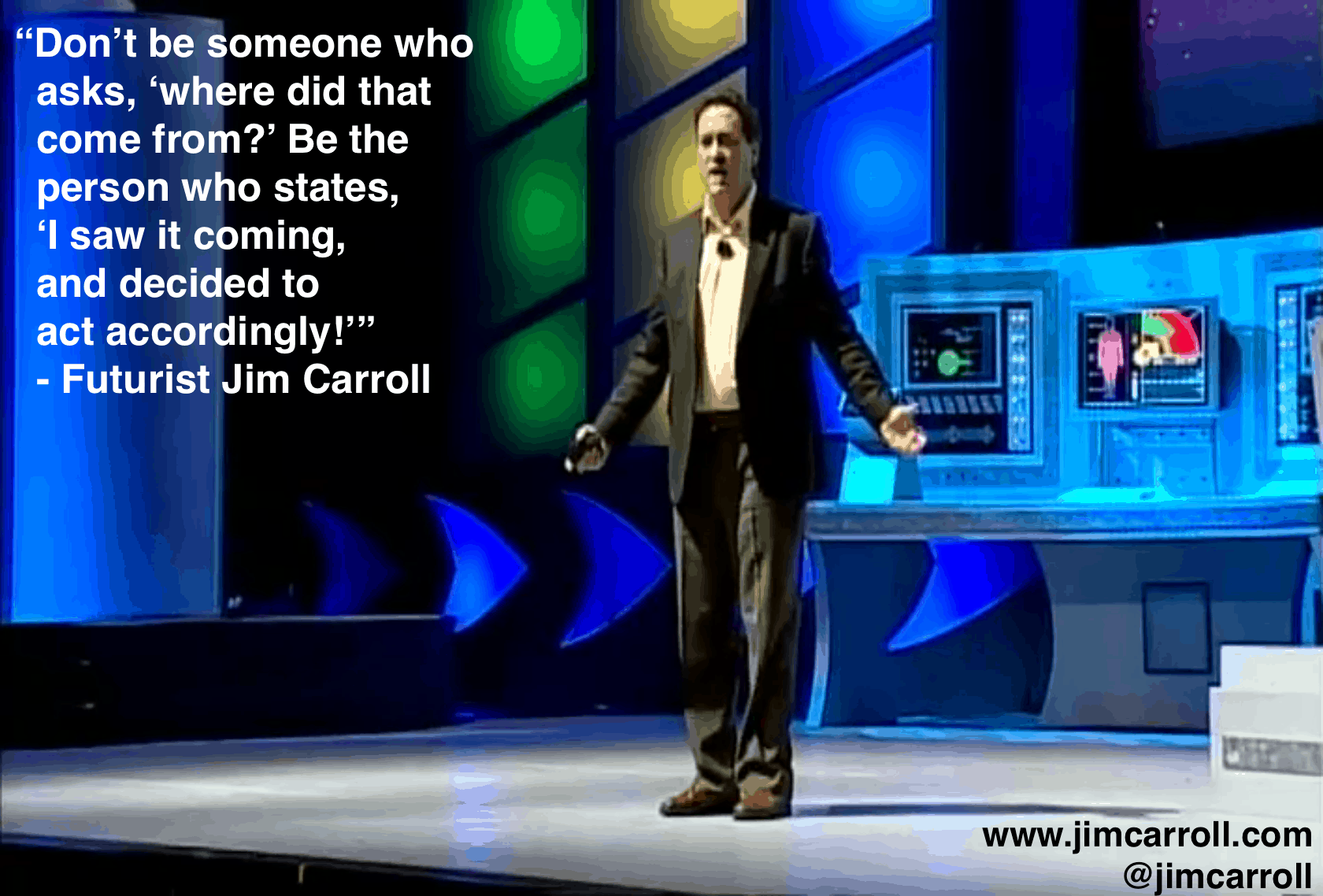

“Don’t be someone who asks, ‘where did that come from?’ Be the person who states, ‘I saw it coming, and decided to act accordingly!’ ” – Futurist Jim Carroll
Today, the Wall Street Journal ran an article,”Why Saudi Arabia’s Oil Giant Aims to Be Big in Chemicals, Too“, with the subhead: “Aramco’s plans to vastly expand its petrochemical operations are part of the kingdom’s effort to remake its economy as oil’s future clouds.”

Why would one of the world’s largest oil companies shift to a new focus on the chemical industry as their key opportunity? One reason is that the math, and hence the scope of the opportunity, is so overwhelming. (The other being that in a world awash in oil, energy is no longer a growth industry. So after the world gets flat, you put a ripple in it!)
Here’s why: years ago, I dug out a fascinating observation having to do with the world of chemistry. I’ve used this in keynotes for BASF, the American Chemical Society, and many others. Consider the simple math at hand that spells opportunity with a capital ‘O’.
19 billion known chemical substances to 5 billion? That’s a pretty exponential change….
Why is this important? I always point out on stage, when using these stats, that the discovery of a single new chemical substance led to the opportunity for Apple to miniaturize the hard drive — that led to the first iPod.
Which was the birth of a multi-billion market.
For every new chemical substance, similar massive new opportunities exist.
That’s what it means to live in an exponential world! And that is what it means to focus on future opportunities through innovation. Which is precisely what Said Aramco is focused on….
And we’re off! A key client just confirmed that for the start of 2017, they need one of my key messages …. right now, in an era of massive uncertainty, they want to kick off the year by shaking off aggressive indecision, and by aligning themselves to fast paced trends. So I wrote them a keynote description that will help them to navigate this complex new world.

Keynote: Innovating in The Era of Accelerated Uncertainty: How to Adapt to the New World of Volatility
2017 is being marked by the return of higher levels of economic uncertainty, much of it driven by new political realities. Business hates uncertainty — and many react by turning off their innovation engines, waiting to see what happens next in a world in which volatility is the new normal. Yet in the face of new challenges, organizations have three essential choices: they can panic, making rash decisions on structure, markets, investments; they can freeze and do nothing; or they can respond to rapid change through innovation, particularly with respect to strategies, structure, capabilities, markets, products, and activities.
Jim Carroll, one of the world’s leading futurists, trends & innovation experts, shares his insight on the strategies that leading edge organizations are pursuing to stay ahead in a new world of uncertainty. It’s timely and critical insight! Many CEO’s and senior executives understand that in addition to managing existing challenges, now is the time to focus on trends and the future — they must act quickly to establish an innovative mindset before aggressive indecision settles in. Jim provides his unique insight on staying ahead in volatile times, through his signature keynote addresses, discussions at small intimate management/Board meetings, or by speaking and participating in large scale senior management and leadership meetings.
In this keynote, Jim offers his insight into how to innovate in perilous times. History has taught us, over and over again, that those who are aggressive with innovation, and who align themselves to future trends in times of uncertainty, are those who win in the long run. His keynote is loaded with powerful guidance, research and key lessons from the breakthrough performers of the past. Insight from those who have managed to accomplish great things because of a decision to focus on innovation right in the middle of an economic challenge or an era of uncertainty, rather than waiting for future clarity.
I was interviewed recently by Independent Banker magazine for my thoughts on trends impacting the world of banking. I do a lot of keynotes in this area — with clients such as VISA, the National Australia Bank, the Texas Credit Union League, American Express, CapitolOne, the American Community Bankers Association, Wells Fargo and many, many more.

The full article is available at their Web site: [icon name=”external-link-square” class=”” unprefixed_class=””]
Instill an innovative mindset to push your bank into the future
By Sam Schaust
Innovation is not a word solely owned by today’s tech giants in Silicon Valley. Or so thinks Jim Carroll, a futurist from Toronto who has given dozens of keynote speeches on the power of innovation to companies such as Walt Disney, Wells Fargo and NASA.
“A lot of eyes gloss over the word ‘innovation,’ and people think the word only applies to someone like Steve Jobs who designed cool stuff that changed the world,” Carroll says. “They might think, ‘I’m a banker. What can I do?’”
To Carroll, anyone is capable of innovating an aspect of the community banking industry. However, he believes to do so, three essential questions must be asked , the first of which is: What can be done to run the business better?
“There are plenty of opportunities to implement more information technology to reduce costs, streamline processes and become more efficient,” he says.
Which begs the second question: What can be done to grow the business?
Concepts regarding “how to use mobile to capture the millennial generation” and “how to utilize leading-edge transaction technology or new products to attract untapped customers,” Carroll notes, are typical subsections of this question. “Essentially, it all comes down to how you think differently to attract new sources of revenue,” he says.
Finally comes the question: What can be done to transform the business? “Transformation of the business is all about preparing for the fact that, for example, with credit-card payments, now Apple and PayPal are competitors,” Carroll says. “With an increasing number of organizations getting into the banking space, you may need to change the essence of what you do and how you do it to keep up with reality.”
Staying current with today’s banking industry—along with innovating for the future—could require an internal shake-up. As Carroll suggests, “By hiring somebody who thinks just like you, you aren’t going to get any creative, innovative ideas. Instead, if you hire somebody you don’t like or who is dramatically different from you, then you’ll get those different opinions.”
Groundbreaking ideas often can come from outside of your field of business, Carroll believes, adding that adopting “an outsider mentality” could prove to be a valuable asset.
“With an increasing number of organizations getting into the banking space, you may need to change the essence of what you do and how you do it to keep up with reality.”
—Jim Carroll, Futurist
Thinking opportunistically
To bring about a new revenue opportunity, Carroll sees an advantage in embracing methods that break from the traditional structure. “Part of what I talk about is speed of opportunity,” he says. “What’s happening out there is new opportunities are emerging faster and you’ve got to have a culture and capability to grab onto that very quickly.”
Growing through experience
Carroll believes that an innovative attitude at a community bank needs to be set from the top. “It’s got to start at the board,” he says. “Although, that’s the toughest thing and it simply doesn’t come overnight.”
By adopting a forward-thinking mindset, mistakes are sure to be made, Carroll adds. “Be an organization that doesn’t just celebrate wins, but failures, too,” he says. “In today’s world, organizations will get ahead through the depth of their financial capital. That’s important, but there’s also our experiential capital—the experience we gain from trying something new.”
By hiring somebody who thinks just like you, you aren’t going to get any creative, innovative ideas.” — Jim Carroll, Futurist
Innovation typically comes from a general interest for what’s occurring beyond one’s industry, Carroll notes. By simply embracing the what’s new or unusual, “we build up our experience,” he says. “And the more experiential capital we have, the better positioned we are to make big, bold leaps in the future.”
Interested in a keynote on the future of the automotive/trucking industry? Read this!
This January, I’ll keynote the American Financial Services Association 21st annual Vehicle Finance Conference & Expo in New Orleans.
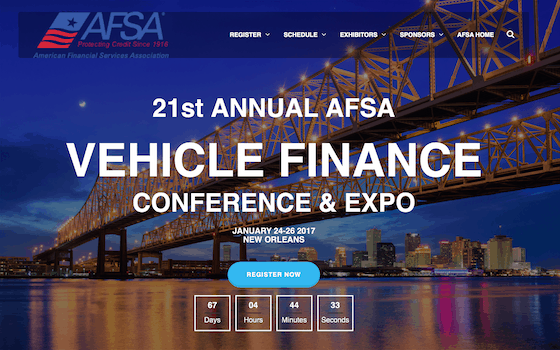
The event draws some heavy hitters who will share their insight into what comes next, including the CIO for Toyota Financial Services, the President & CEO of TD Auto Finance U.S., the Executive Vice President for Ford Motor Credit Company, among others.
I’ll take a deep look at what is happening with the automotive world in the future — the reality and evolution of self-driving, autonomous vehicle technology, intelligent and smart highway infrastructure, the evolution to prognostic, self-diagnosing vehicles, the sharing economy and new business models, the acceleration of connectivity and innovation in the automotive sector, and the implications of all this on the future of automotive lending!
It should be fun!
This is one of many keynotes I’ve done in and around this sector. It involves a lot of deep research on the latest trends and initiatives, as well as comprehensive discussions with the client and industry insiders.
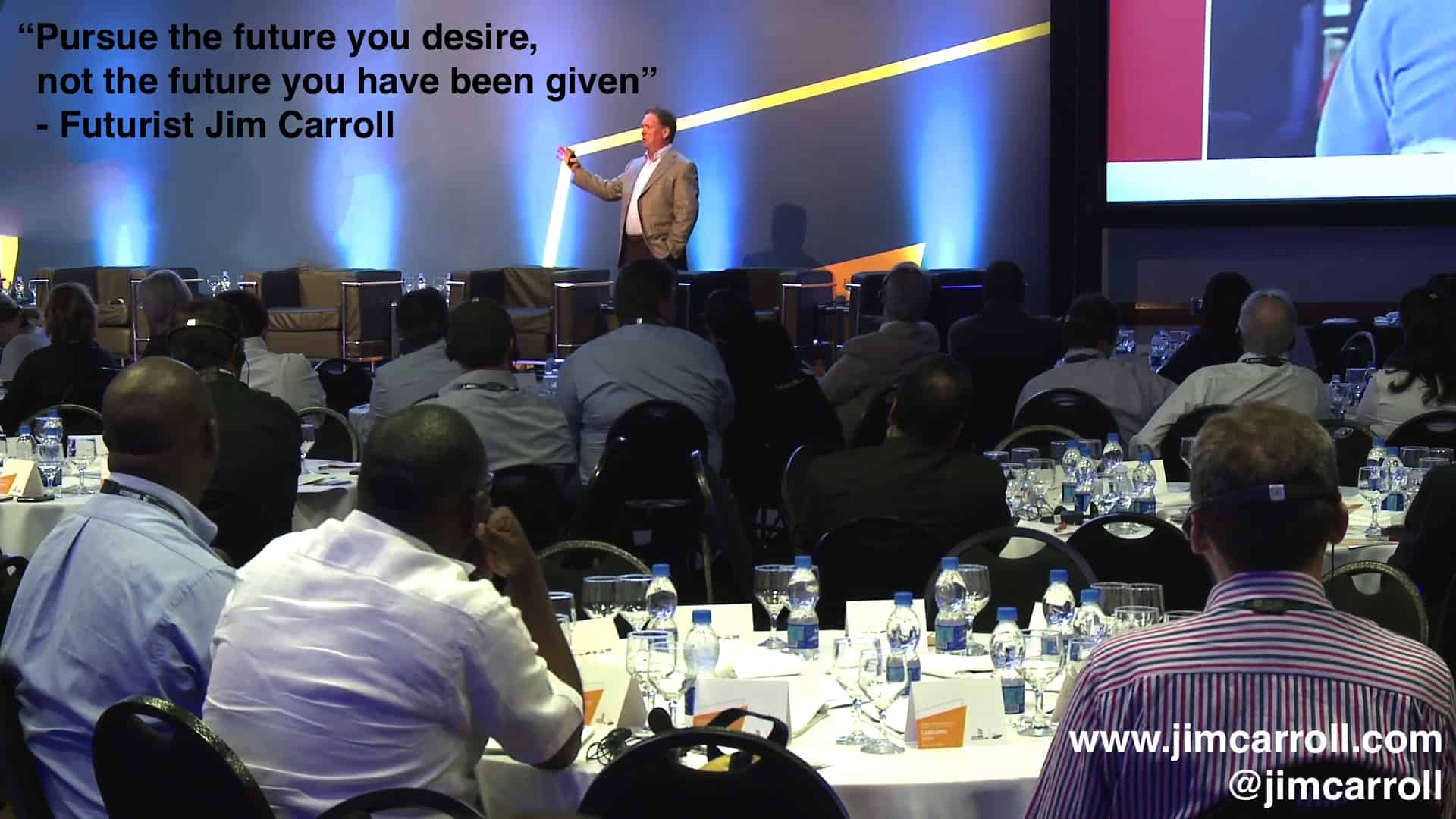
“Pursue the future you desire, not the future you have been given!” – Futurist Jim Carroll


GET IN TOUCH
Jim's Facebook page
You'll find Jim's latest videos on Youtube
Mastodon. What's on Jim's mind? Check his feed!
LinkedIn - reach out to Jim for a professional connection!
Flickr! Get inspired! A massive archive of all of Jim's daily inspirational quotes!
Instagram - the home for Jim's motivational mind!