Industries · Automotive & Mobility
The car is becoming a platform.
A changing vehicle changes much more than the showroom. Service, financing, warranty, infrastructure and the skills of the workforce all move with it.
Begin with your audience
A conversation for automotive & mobility.
Automotive leaders, dealers, suppliers and mobility organizations.
A changing vehicle changes much more than the showroom. Service, financing, warranty, infrastructure and the skills of the workforce all move with it. The final emphasis depends on who is attending, what they already understand, and the strategic choices your event is intended to support.
The shift
When the vehicle changes, the entire business changes.
The car is becoming a software-rich, sensor-driven and increasingly electrified platform. That alters how it is built, sold, financed, serviced, insured and experienced—and it changes the definition of competitive advantage across the ecosystem.
The 12 forces ↓Automotive & Mobility · 12 forces
The forces changing the decisions.
What this means for leaders: The following twelve shifts connect technology and market change to practical choices for organizations in automotive & mobility. They are analysis, not claims that every development is universally deployed or inevitable.
These are the trends Jim is talking about with automotive & mobility leaders right now.
The research lens
- Software-defined vehicles
- Batteries and the energy ecosystem
- Connected and assisted driving
- New ownership, service and financing models
These themes provide a direction for research, rather than a fixed set of slides. A leadership session can examine assumptions and investment priorities in depth. An industry conference can build a shared view of the changes affecting its members. A customer event can explore the future of the markets your customers serve.
The automobile becomes an updatable software platform
The vehicle is becoming an updatable computing platform whose features, performance and customer experience can continue changing after delivery. This shifts strategic value toward software reliability, data governance, cybersecurity and an owner's ability to understand what has changed. Dealers, suppliers and manufacturers need operating models designed for continuous product evolution rather than a fixed model-year cycle.
Electric propulsion changes dealer and service economics
Electric propulsion changes far more than the powertrain. Parts demand, technician training, charging relationships, battery diagnostics, residual values and customer education all evolve with the installed fleet. The strategic mistake is treating EV adoption as an isolated sales question when it is a change in the entire ownership, servicing and infrastructure ecosystem.
Vehicle data creates new ownership and insurance questions
Connected vehicles generate information about use, maintenance and performance, but that information brings questions of permission, ownership, retention and responsible commercial use. An insurer, dealer, manufacturer and driver may see different value—and different risk—in the same data stream. Competitive advantage will depend as much on earned trust and transparent value exchange as on technical connectivity.
Advanced driver assistance changes risk and liability
Driver-assistance systems change the risk profile before full autonomy arrives. They may reduce some events while adding complexity in sensor calibration, repair, driver expectations and liability. Warranty, claims and service teams should adapt to the capabilities and limits of actual deployed systems, not assume that the presence of an impressive technology label means that responsibility has disappeared.
Charging infrastructure becomes part of the consumer experience
For many drivers, the charging experience becomes part of the product experience. Availability, reliability, pricing, payment, wayfinding and dwell time shape confidence more than headline range figures alone. Automotive and energy executives should plan together: a vehicle technology promise is only as strong as the local infrastructure and service process that makes it usable.
Fleet operations move toward predictive maintenance
Fleet operators can combine telemetry, service history and route information to spot problems sooner and improve uptime. The goal is not monitoring every parameter; it is identifying the small number of signals that allow a maintenance decision before a vehicle is stranded. It changes supplier contracts, technician workflows, asset replacement models and what customers expect from a fleet service provider.
Connected vehicles alter warranties and protection products
Software-rich, sensor-rich vehicles challenge conventional warranty assumptions. A problem may be caused by hardware, a configuration, a software update or an interaction among systems. Protection-product leaders need to rethink diagnostics, contract wording, claims data and customer communication as the definition of a vehicle component becomes less mechanical and more digital.
Vehicle interfaces change how drivers consume services
The connected cabin is becoming an interface to navigation, commerce, entertainment, assistance and services. That opens new revenue possibilities, but creates pressure to protect driver attention, privacy and the integrity of the experience. Successful strategies will distinguish useful contextual help from one more subscription or distraction that customers never asked for.
The supplier ecosystem reorganizes around chips and software
Vehicle production depends increasingly on semiconductors, software integration and sophisticated electronics. This changes purchasing risk and the balance of power among traditional manufacturers, technology suppliers and platform providers. Executives should test supply-chain assumptions against software dependencies and product roadmaps, not merely renegotiate old hardware contracts.
Autonomy arrives in uneven, use-case-specific steps
Autonomy is likely to develop unevenly: specialized industrial yards, defined routes and controlled environments can make progress while difficult open-road conditions remain unresolved. Leaders should build business cases around specific operational design domains, safety evidence and exception handling. The worst planning mistake is assuming a sweeping consumer timeline will determine every mobility use case.
The talent mix moves from mechanical to mechatronic skills
Automotive talent requirements increasingly span high-voltage systems, software diagnostics, electronics, customer education and traditional mechanical craft. A training catalogue designed around last decade's vehicle will produce a service bottleneck as the installed fleet changes. Dealers, colleges and manufacturers need to update learning continuously and create visible pathways for technicians to advance.
Mobility subscriptions and shared usage challenge old revenue models
Subscription features, flexible access and shared use alter how vehicles generate revenue over time. These models may strengthen customer choice in some settings and trigger resentment in others. The essential questions are which services customers really value, who carries residual risk and how to avoid a pricing structure that makes ownership feel unnecessarily complicated.
From forecast to decision
This is not a fixed slide deck. The right keynote starts with the audience, the current evidence, the genuine opportunities and the choices leaders must make. These forces are research directions; the specific examples and action framework are customized for the organization at the event.
Every automotive & mobility keynote pairs these forces with what the sector’s fastest innovators are doing about them. What world-class innovators do ↗
From the archive: dated engagements and retrospectives
From the industry brief
A possible keynote storyline.
The sample guide develops five connected movements. The emphasis and examples are refined around the actual audience and event objectives.
- 01
How the automobile evolved from a product into a platform
- 02
EVs, batteries and the energy ecosystem
- 03
Autonomy, assisted driving and connected intelligence
- 04
New dealer, financing and service models
- 05
Skills, partnerships and practical strategic action
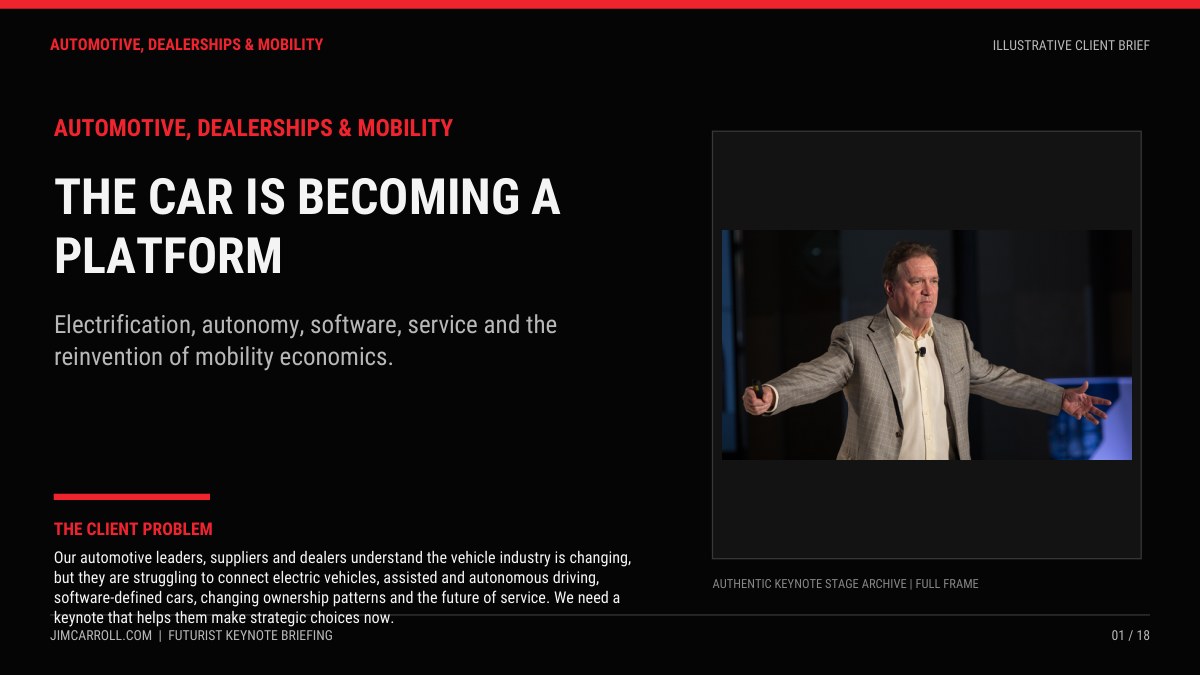
Illustrative industry brief · 18 pages
See the proposed thinking.
The complete guide develops the client challenge, relevant forces of change, keynote direction and industry experience. It is an illustrative briefing scenario, not a quotation from an actual client inquiry; the live proposal is shaped around your audience, priorities and objectives.
Read the automotive & mobility brief (PDF) ↗All 21 briefs ↗Documented automotive & mobility engagements



 Kwik Fit2024 · Case study ↗
 BNSF Railway2024 · Case study ↗
 American Truck Dealers2020 · Case study ↗
 HAVI Global Solutions2019 · Case study ↗
 Kalmar Ottawa2019 · Case study ↗
 IRU World Congress2018 · Case study ↗
 Trapeze Group2018 · Case study ↗
 Mercedes-Benz2017 · Case study ↗
 Omnitracs2017 · Case study ↗
 Corcentric2016 · Case study ↗
 Colorado Department of Transportation2014 · Case study ↗
 NATSO2014 · Case study ↗
- AutoGlass 20192019 · Case study ↗
The published record
Experience you can explore.
Relevant published engagements from JimCarroll.com. Cross-industry examples show adjacent markets and questions; the specific scope of each assignment is described in its original story.
- 2026
iA Financial Group — Automotive — When the vehicle changes, the risk changes.
Read ↗ - 2017
Mercedes-Benz — A different vehicle. A different industry.
Read ↗ - 2016
Corcentric: AI Was Coming For Procurement, Payments And Trucking.
Read ↗ - 2026
Canadian Automotive Dealers Summit 2026: Auto Retail Was Entering the Age of Digital Mobility
Read ↗ - 2024
Kwik Fit: The Shop Floor Was Changing as Fast as the Car
Read ↗ - 2024
BNSF Railway: The Supply Chain Was Entering Its AI Era.
Read ↗ - 2020
American Truck Dealers: The Truck Became A Data Platform On Wheels.
Read ↗ - 2019
HAVI Global Solutions: Supply Chains Were Moving From Efficiency to Intelligent Resilience.
Read ↗ - 2019
AutoGlass 2019: The Windshield Became An Intelligent Device.
Read ↗ - 2019
Kalmar Ottawa: Industrial Mobility Was Becoming Autonomous and Electric
Read ↗ - 2018
IRU World Congress: Transport Was Being Reinvented. The Future Of Mobility Was Global And Digital.
Read ↗ - 2018
IRU World Congress: The Road to 2025 Becomes Intelligent + Electric
Read ↗
5 more documented automotive & mobility engagements
- 2018
Trapeze Group: Urban Transit Was Entering the Autonomous Electric Era
Read ↗ - 2017
Omnitracs: Connectivity Was Becoming the New Horsepower
Read ↗ - 2016
Volvo And Mack Trucks: A Truck Is Becoming A Service Platform.
Read ↗ - 2014
Colorado Department of Transportation: Transportation Infrastructure Was Becoming Intelligent
Read ↗ - 2014
NATSO: Reinventing the Roadside Business Before Transportation Reinvents It
Read ↗
From the research archive
Earlier thinking and historical forecasts.
- 2018Keynote: Ontario Road Builders Association, Toronto, Canada - Transportation Trends & Intelligent Highway Infrastructure
- 2017Keynote: Drive 17, CUDirect, Las Vegas - The Future of Automotive Lending
- 2017Keynote: American Financial Services Association – New Orleans – The Future of the Automotive Industry
- 2013Trend: The Future of the Automobile and Automotive Retail (No One Uses Their Smart TV Because They're Pretty Dumb!)
- 2017Keynote: Omnitracs Outlook 2017, Phoenix, Arizona – The Acceleration of Self-Driving Electric Trucks & Industry Disruption
- 2016Keynote: Volvo/ Mack Trucks, Greensboro, NC - Prognostic Diagnostics, Self-Driving and the Future of Trucks
- 2015Trend Report: The Future of Trucks - Connected, Proactive and Data Driven
- 2014Trend Report: The Future of Autonomous Vehicle Technology
- 2006The Google Car and massive market disruption
- 2024Keynote Case Study: Kwik Fit — The Shop Floor Was Changing as Fast as the Car
- 2020Keynote Case Study: American Truck Dealers: The Truck Became A Data Platform On Wheels.
- 2019Keynote Case Study: AutoGlass 2019: The Windshield Became An Intelligent Device.
Other industries
- Agriculture & Food
- Commercial Real Estate
- Construction & Infrastructure
- Consumer Products & CPG
- Education & Workforce
- Energy & Utilities
- Financial Services
- Food & Grocery
- Golf & Recreation
- Government & Public Sector
- Healthcare & Life Sciences
- Hospitality & Tourism
- Insurance & Risk
- Manufacturing & Industrial
- Media & Entertainment
- Professional Services
- Retail
- Technology & AI
- Transportation & Logistics
- Leadership & Disruption
Make it about your audience
Let’s build a keynote around the future of your industry.
Bring the event objectives, the people attending and the questions you want them discussing afterward.