
“Focus on the possible. Forget the impossible” – Futurist Jim Carroll


“Focus on the possible. Forget the impossible” – Futurist Jim Carroll
“What does not change, does not survive!” – Futurist Jim Carroll

It is quickly becoming apparent that in 2017, there will be the emergence of two economies: one linked to the whimsical desire for the 1950’s, and the other firmly set to accelerate to the year 2050.
Case in point: one will involve a desire to return to coal; the other, to solar, alternative energy and accelerating science. One wishes that we can return to the brute force manufacturing methods of 1950 involving bashing metal; the other involves 3d printing, advanced processes and materials, and much more.
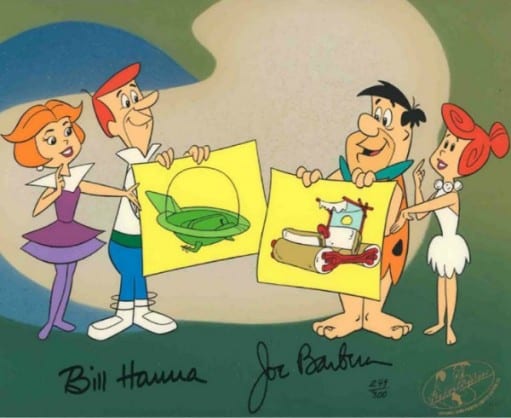
Which economy do you want to link yourself to? One will be driven by politics, and will seem pretty ridiculous years from now. The other will be driven by science, and is inevitable.
I don’t know about you, but I’m with science on this one….
Science acclerates and takes us into a faster future. It provides us opportunities that are unprecedented. For example: what if we could grow plants that became solar panels? What if solar adoption grew as quickly as Facebook did?
Crazy ideas? I don’t think so.
Solar is a barometer for two new economies. I was thinking about that this morning when a Bloomberg article caught my attention: “Solar Could Beat Coal to Become the Cheapest Power on Earth” [icon name=”newspaper-o” class=”” unprefixed_class=””] That’s a 1950 vs a 2050 economic issue right there!
Consider this key paragraph:
In 2016, countries from Chile to the United Arab Emirates broke records with deals to generate electricity from sunshine for less than 3 cents a kilowatt-hour, half the average global cost of coal power. Now, Saudi Arabia, Jordan and Mexico are planning auctions and tenders for this year, aiming to drop prices even further. Taking advantage: Companies such as Italy’s Enel SpA and Dublin’s Mainstream Renewable Power, who gained experienced in Europe and now seek new markets abroad as subsidies dry up at home.
Two really cool statistics stand out from the article:
The trend will start to accelerate further as science accelerates. Science is inviolable. It doesn’t slow down. And solar is science.
The fact is, there is incredible momentum with solar.
Innovation in 2017 will be about linking yourself to 2050….
Here’s a clip where i spoke to the National Rural Electrical Cooperaitve, and am challenging them to think about some of these questions.
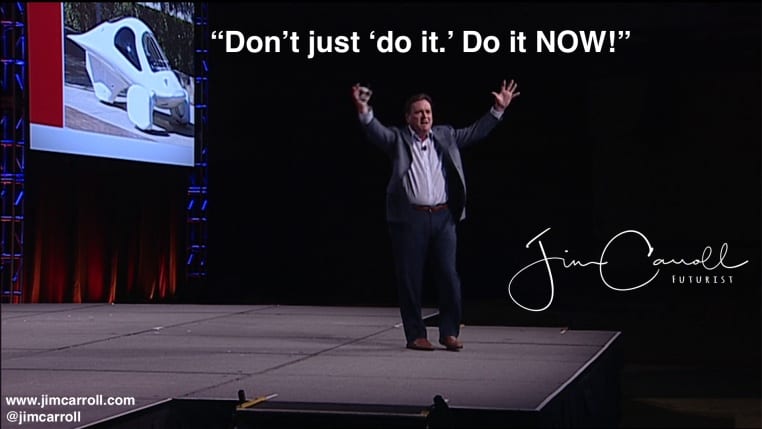
“Don’t just ‘do it.’ Do it NOW!” – Futurist Jim Carroll
“Don’t be afraid of failure. Fear inaction instead!” – Jim Carroll
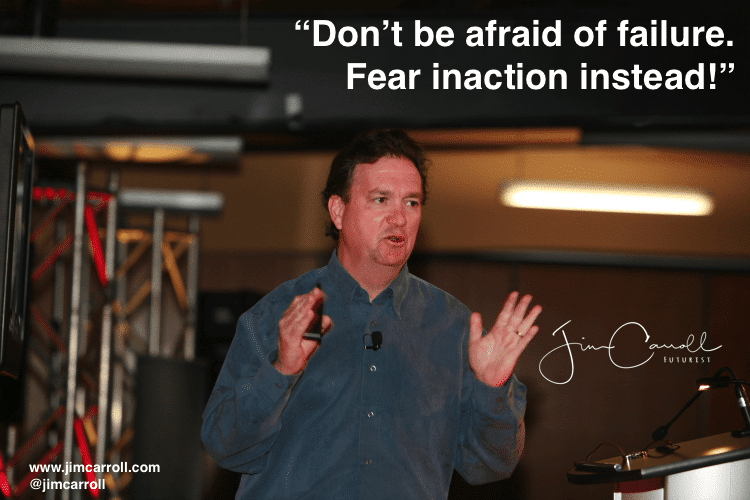
Are you doing enough in your organization to encourage a culture of failure? If not, why not?
Failure is often a prerequisite for success. In other words, many times, you can’t there from here, unless you take a diversion to there…..
That’s an important lesson when it comes to innovation, and it’s always good to keep the idea of failure in mind.
History is littered with examples of massive failures which later led to astonishing success. Consider, for example, the Apple Newton. I remember being given one at an Apple launch event in 1993. I wish I had kept it!
Thinking back, it was an iPhone/iPad long before its time. Yet the Newton failed miserably: it didn’t work well, when it worked at all and was crazy expensive for it’ feature set. Because of its handwriting analysis capabilities — which really did not work well at all –, Newton was fodder for jokes from late-night TV hosts, comic strips, and tech publications. Everyone had a grand old time making fun of the Newton — and of Apple — for bringing to market such a failure!
Years later, Apple would go on to become the world’s largest company with what some might say is the most successful technological invention of all time, the iPhone. Apple positioned itself for success from failure: many of those who originally worked on the Newton went on to develop the iPhone. They learned a lot from their earlier failure, applying those lessons to succeed the next time around.
That wasn’t the only failure in the orbit of companies that surrounded Apple at the time. NeXT Computers, established by Steve Jobs after being unceremoniously dumped from Apple, was but a running joke to many people because it failed in the market in a pretty big way.
But the operating system for NeXT became the foundation for OS/X, the operating system at the heart of Apple’s Mac products today.
It gets better. When Apple went to develop the Newton, it couldn’t find a computer chip with the processing power to do the advanced work required of this first PDA (personal digital assistant – remember that phrase?). The result was that they invested in a small chip company, Advanced RiSC Machines — with a 43% share bought for a $2 million investment.
They sold their share in ARM years later for $800 million. Not a bad return!
And what did they do with that $800 million? It went partway to allowing Apple to buy NeXT from SteveJobs, which led to the reinvention and rebirth of the company. The largest company in the world!
So … Apple failed with Newton. Steve Jobs failed with NeXT. Two failures led to a massive winner.
Failure. We need more of it!
Innovation? Take risks, and be willing to fail!
“Volatility is the new normal. Agility is the antidote” – Futurist Jim Carroll



GET IN TOUCH
Jim's Facebook page
You'll find Jim's latest videos on Youtube
Mastodon. What's on Jim's mind? Check his feed!
LinkedIn - reach out to Jim for a professional connection!
Flickr! Get inspired! A massive archive of all of Jim's daily inspirational quotes!
Instagram - the home for Jim's motivational mind!