

Inspire yourself! Think different!
Daily Inspiration: “You can’t solve a problem with the same mistake that caused it!”
“You can’t solve a problem with the same mistake that caused it!” – Futurist Jim Carroll
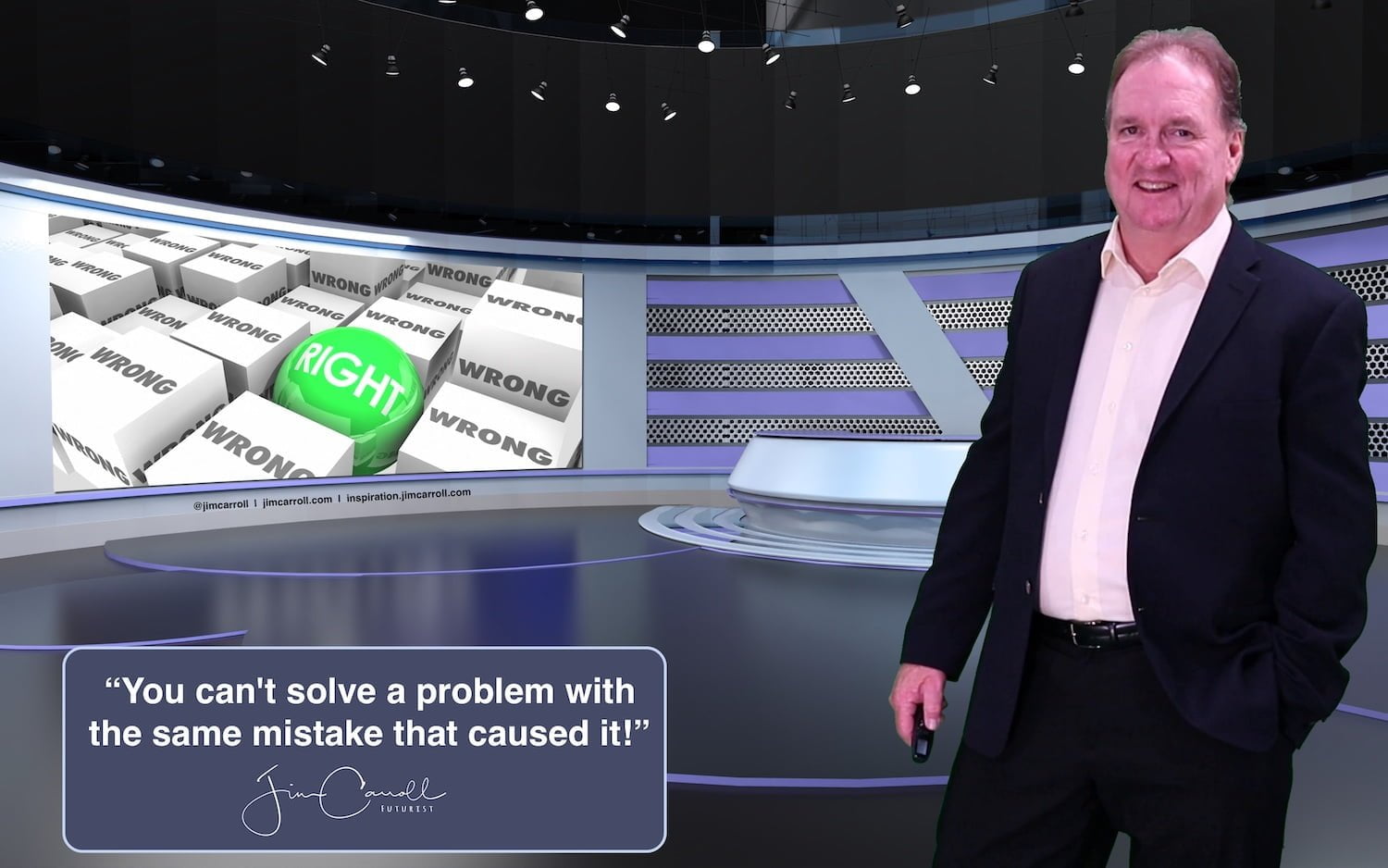
Don’t make the same mistakes – make some new ones!
The challenge when we are trying a new idea is that we tend to repeat what we did before. Sometimes, we get locked into patterns and routines and end up doing the same thing over and over again. Remember that quote attributed to Einstein?
The problem with this approach is that if we keep making the same mistakes through routine, then we really aren’t learning anything. So keep this in mind: you won’t always get it right the first time. Or the second. Or maybe the third. But fail enough in different ways, and you’ll eventually get it right.
It makes more sense for us to make *different* mistakes, compare them to our earlier mistakes, see what was changed, and learn accordingly.
Try different things, and you’ll get different results — and even if you fail, it’s a step along the pathway to success!
And as they say – fail early, fail fast, fail often – just fail differently!
Daily Inspiration: “Build for your future, not your past!”
“Build for your future, not your past!” – Futurist Jim Carroll

It’s easy to cling to yesterday – after all, that’s all you know!
But that won’t get you anywhere, because your only certainty is that your tomorrow’s are going to be vastly different than your yesterday’s – and the only moment that you have to change your trajectory are the decisions you make today!
Think of each and every day as an investment decision – what are you going to do today to build a structure for your tomorrow? What actions will you take that will help you create a platform that you can rely upon? What activities will you undertake today to provide for a more solid base on which to build your tomorrow?
Your future life is a construction project, and you’ll achieve more success if you do the right things today to ensure that you’ve got a solid foundation for growth.
What are you waiting for?
Daily Inspiration: “Do you mean to tell me that you don’t believe that widespread mental instability and mass delusion won’t be a huge workforce problem in your future?”
“Do you mean to tell me that you don’t believe that widespread mental instability and mass delusion won’t be a huge workforce problem in your future?” – Futurist Jim Carroll
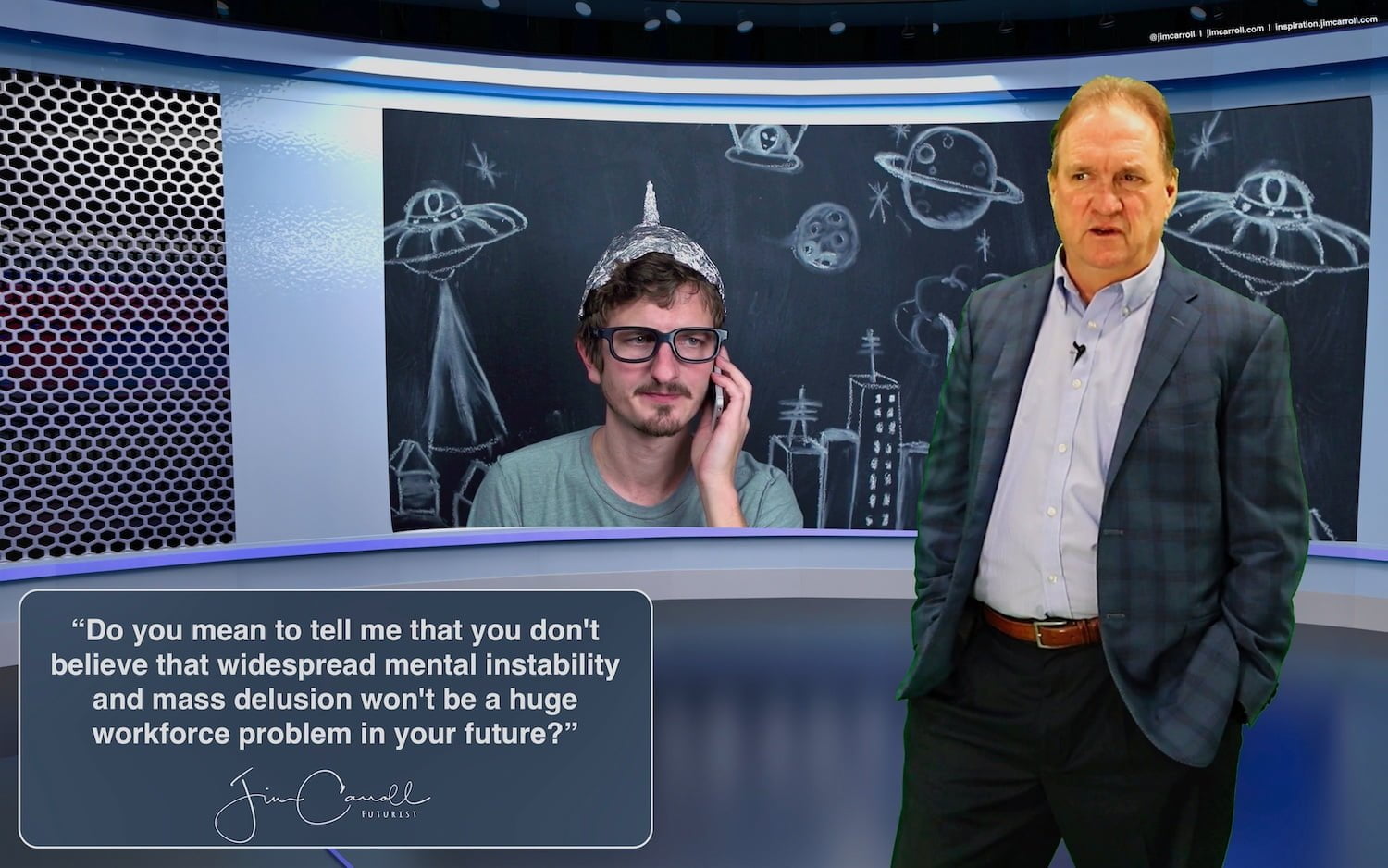
The quiet part should be said out loud: one of the biggest problems that companies will have to manage in the future is how to deal with an ever-increasing quotient of crazy.
How do you manage that as a trend going forward?
I never thought I’d have to put this out there as a trend, but here we are. Organizations are going to have to somehow have to deal with the fact that vast numbers of their workforce have literally gone over the edge. This is not a trivial issue and will come to increasingly define your potential for success. Maybe in the future will come to examine a company’s ‘crazy quotient’ as we examine their SEC filings.
Sanity might even come to be a premium, a rare asset in a time of mass insanity!
It’s pretty unreal to examine the world that now surrounds us. More and more polls are showing that people are subscribing to the insane Q conspiracy theory, that the election was stolen and that the attack on the Capitol was actually the result of a horde of Democrats. Elsewhere, the anti-mask contingent rants that the 5G chip implanted in their brain is resulting in the explosive and sudden growth of the swarm of cicadas, who are actually there to build giant organic on the ground antennae for societal monitoring.
Uh. Yup.
Here’s the thing – there are real implications to real crazy. In one of the more challenging indicators of our time, one individual just had their hazardous goods transport license revoked because they were part of the mob that stormed the Capitol.
What will an airline do when a pilot shows up with that all-knowing whacko look on his or her face? What will a quality control supervisor do when a staff member shows up mumbling that space aliens attacked him on the way to work and absconded with his running shoes? What will the response be when a union goes over the deep end and calls for a workplace strike because the IiOT sensor devices are perceived to be a secret blood pressure measurement network?
What will organizations do as crazy becomes even more widespread?
Like, really?
How will companies manage the crazy going forward?
I don’t know about you, but I watch the trends,
And this one is going to be extremely hard to manage!
Daily Inspiration: “Every great future was once but a small, barely discernible opportunity!”
“Every great future was once but a small, barely discernible opportunity!” – Futurist Jim Carroll

People want to be hopeful about the future – it’s better to see the opportunity it presents rather than the challenge it represents. That was the focus of a keynote as I opened a major annual conference for CPA Canada during this week just over two years ago. A stage! A real stage!
A hopeful vision has been the construct of many a keynote over my career as I built talks around a structure of the small trends that envelope us today that will have a profound impact on us tomorrow. Individually, any trend is disruptive. Combine them together, and it’s transformative. When everything connects, power disperses. Legacy is death: agility and speed are the new metrics for success. These are some of the mantras that should define your future. Disruption is real, it’s big, and it’s happening faster than you think.
The trends that define your future surround you today – and many of them are pretty small in scope. Watch this short clip to remind yourself of the world you find yourself in today.

What are the roots of all this disruptive change? Edge thinking, accelerated science, the collaborative global hive mind, and much more. Here’s a separate clip that puts into perspective the edge of innovation.

The fact is – it’s a great big future. But are you thinking too small?

Now ask yourself – what are you going to do to align to the era of acceleration?
Daily Inspiration: “The pandemic has laid bare the vast gap between Powerpoint promises, potential performance – and actual achievement!”
“The pandemic has laid bare the vast gap between Powerpoint promises, potential performance – and actual achievement!” – Futurist Jim Carroll

We’ve come to expect so much more! Orders must be instant, perfect, on time, and without error. We should be able to instantly find any type of product anywhere at any time despite massively broken global supply chains. Manufacturing lines should continue to operate effortlessly without challenge, despite shortages of raw materials, semiconductors, and skilled workers. Prices should stay stable or decline while demand accelerates!
If the pandemic has done anything, it has widened the gap between those who plan and those who can. Incompetence is being laid bare; an inability to execute becomes instantly exposed; deficient strategies are suddenly shown to be worth their weight in failure.
Nothing makes sense anymore, and that’s the reality you must align to. Expectations have accelerated while capabilities have eroded, and the gap between promises and performance has continued to expand. The impact of Covid-19 has been that many organizations have discovered how to execute quickly, and if you have not bridged the gap between the promises of a Powerpoint presentation and actual execution, your possibilities for success are increasingly reduced. Bridge the gap!
The issue of the customer interaction gap is particularly acute. Does your organization have the right stuff to deal with todays’ information-empowered, globally collaborative, we-know-better-than-you-do customer? Maybe not! The bar of expectations has increased in today’s e-commerce, a curbside pickup-driven world, and you don’t just need to be excellent in customer relationships – you need to be relentlessly excellent!
These are the fundamental truths of the new customer relationship that I wrote into a post years ago. Now reconsider them in the context of our post-pandemic recovery:
- Fix things fast, because things break fast. As things go wrong, fix them fast. Have a communications plan. Be prepared to reassure the customer quickly. In this new era of hyper-information feedback, don’t let the customer sit and stew for a moment — proactive information and proactive action is the only weapon you have, and you have to use it.
- Adopt customer-niceness as a core virtue during the pain period. There are rules and fees and structures that can exist in any customer relationship. But make everyone aware on the team that there are likely some things that are going to have to be waived during the rollout. The core virtue is, “we’re going to be nice to the customer because we know it is not the customer’s fault that things have gone wrong.”
- Admit that mistakes will happen. It’s ok. It’s the 21st century. Bad things go wrong all the time. Accept that, and use that as a go-forward strategy. “Things will go wrong and we will work to fix them fast” is a better strategy than “we plan on rolling it out and holding our breath that things don’t get messed up.”
- Don’t hide from the customers. Customers today can turn on you in an instant. Rumors, stories, misinformation can abound. The customer has a lot of information, and might not always be reading it right — but they can certainly make it go wrong in a hurry. A clear, and open, and honest, reactive strategy with the customer is in your best interest. More communication is the best rule.
- Be open. Solicit feedback – get the customers on side. Don’t just roll out new ideas, technologies, services, or other things, and hope for the best. Know that there will be problems, issues, and things that will go wrong. Start out on the right foot with the customer base when things go wrong by admitting that you screwed up, and by seeking their input, guidance. The new business world is all a beta — Google gets this, and you should get this too.
- Turn customers into fixers. The customer is a new customer. They expect operational excellence, and if they don’t get it off the bat, they are prepared to help fix it. The complexity of a new customer software system can undergo all kinds of testing internally, but some things will never show up until it goes live. That’s why you want to recruit the customer as a problem solver. Turn it from a “bad rollout of new software” into something different, by letting the customer know that you want them to help stress test the system and find the things that aren’t working quite right.
- Get everyone inside on the same page. Let everyone throughout the organization know that something new is going to be happening that could cause customer stress. Get them to understand that the new JOB #1 is Customer-Destressification.
- Have an escalation plan. As things go wrong, be prepared to pump them up the chain in a hurry. Have a team ready to analyze what the customers are saying, do triage on the big ones, and work them quickly.
- Empower people with niceness. Customer-centricity and the instant-age demands that the customer be made happy — quickly. Give staff who have not previously had the authority, the authority to do things to the customer that are nice. That will help to ease the early part of the “pain process.”
- Learn from the experience. Learn from this rollout to figure out how to do it better the next time.
In today’s hyper-competitive environment, your customer relationship can be fleeting at best. They often know more about your market than your staff does. Act accordingly, or you look like a fool — and you end up losing customer loyalty.


GET IN TOUCH
Jim's Facebook page
You'll find Jim's latest videos on Youtube
Mastodon. What's on Jim's mind? Check his feed!
LinkedIn - reach out to Jim for a professional connection!
Flickr! Get inspired! A massive archive of all of Jim's daily inspirational quotes!
Instagram - the home for Jim's motivational mind!