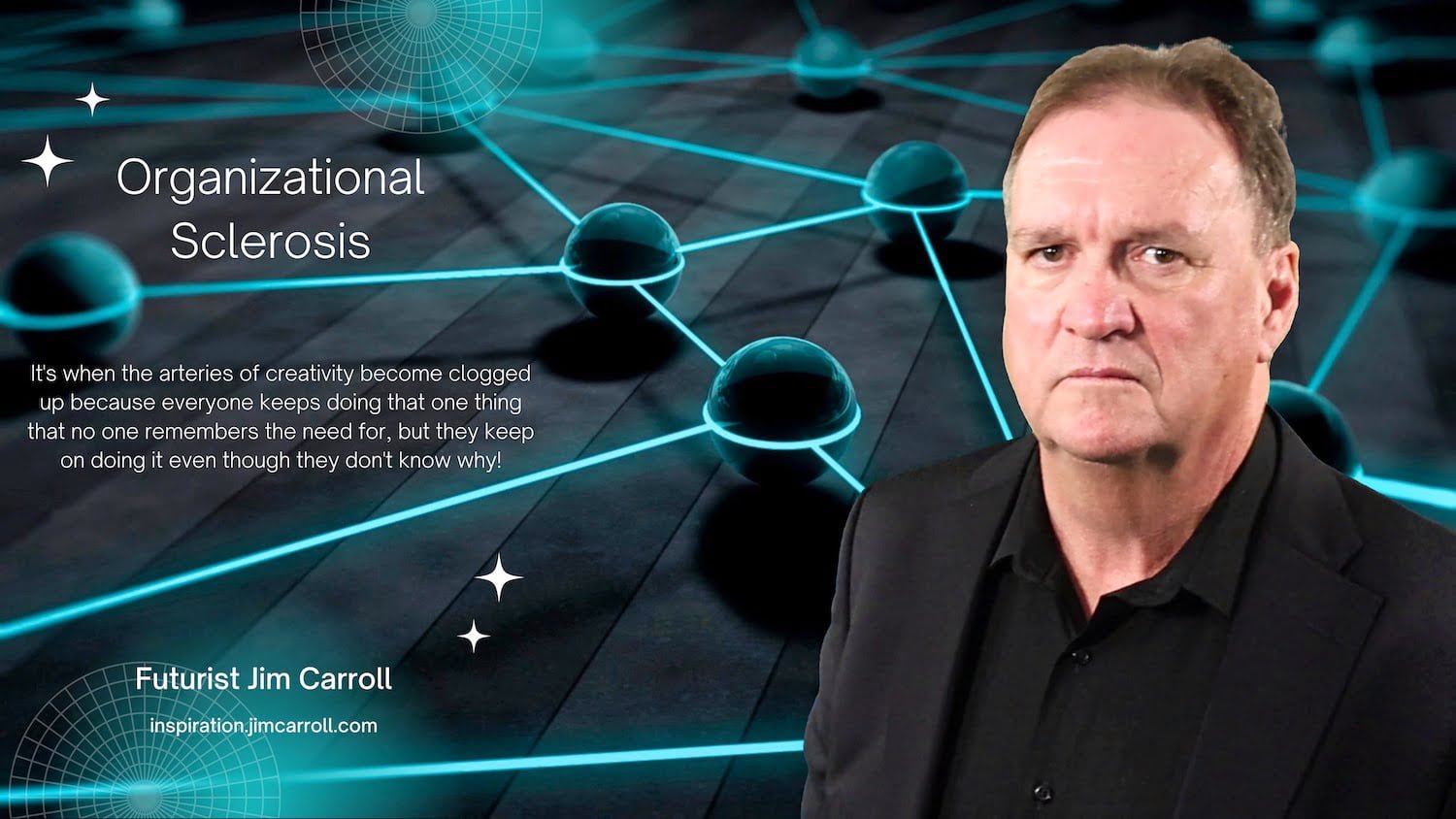
“Organizational Sclerosis: It’s when the arteries of creativity become clogged up because everyone keeps doing that one thing that no one remembers the need for, but they keep on doing it even though they don’t know why!” – Futurist Jim Carroll
“Why are you doing that?”
“I don’t know. We’ve always done it!”
“What does it achieve.”
“I’m not quite sure.’
“Has anyone ever asked if it’s useful, or if we should keep doing it?”
“I don’t know. That’s not my job.”
Companies go into an autopilot death spiral of irrelevant routines, instantly obsolete products, unnecessary processes, useless policies and procedures, and a pathway of inconsequential ideas. No one ever dares to ask if the things that are done still need to be done – and the result is a lemming-like walk into irrelevance
One of the running jokes in the technology world is that Ford has stuck a knob in the middle of the touch screen for its F150 Lightning Electric Vehicle.
This would be like putting a big round knob on the screen of your iPad. You just don’t do this type of thing!
Designing a car or truck today is essentially like designing a computer device – and legacy companies don’t know how to do it. And so, they keep on doing what they’ve done before. Hence, knobs. Here’s the thing – the knob in the Ford F150 doesn’t actually let you do much – perhaps turning the volume up and down is an option. Oh, and there’s a video game that you can play. That’s an important reason to have a knob!
I can imagine the discussion at the Ford Design department went something like this:
“Why is that big ugly knob in the middle of that beautiful touch screen?”
“Wel, because cars and trucks have always had knobs So, we’ve got a knob!”
I’m waiting for a Spinal Tap marketing moment where someone explains that the knob goes to 11!, but I digress.
The interesting thing is that as cars and trucks shift from being big engines on wheels that use carbon to becoming big computers on wheels that are based on batteries, the design, layout, purpose, and functionality of much of the interior changes – and the traditional legacy manufacturing companies don’t know how to do that. This has been the case for quite some time – read my post from 2013:
Here’s the problem in a nutshell as I stated in 2013.
“Many people are coming to the conclusion that most smart TV’s are actually pretty dumb! What we’ve seen in the last several years, with most so-called smart TV’s, is a situation in which television manufacturers, who have never been really part of the Silicon Valley technology and design culture, suddenly began throwing all kinds of features onto televisions, such as Facebook, Twitter, Netflix.
The result is, if you pardon the expression, a real barf-bag of clumsy screen navigation, confusing remotes, ill-designed apps, and, well, just a bit of a major FAIL.
Smart TV’s? No one uses smart TV’s because they’re dumb. And that seems to be a message that is resonating on the Internet; such as this article recently featured on Wired.
“People aren’t using their internet-connected smart TVs for anything beyond, well, watching TV. It turns out, nobody wants to tweet from their TV. Or read books. Or do whatever it is people do on LinkedIn. Worse, more than 40 percent of the people who buy a connected TV aren’t even using it for its ostensible primary purpose: getting online video onto the biggest screen in your home. “
Contrast the Smart TV experience to the Apple TV. The latter has a crisp design, clean, simple and intuitive interface. Quite simply, it just works.
Car companies are now making the same mistakes that TV manufacturers made. The result is that it is obvious that car companies simply don’t know how to design a car anymore because the rules have changed. Sadly, they will keep on doing what they’ve always been doing because that’s what they do! The result? Failure. Consider this comment in 2012 as to what car companies were already doing with their design failure.
Noted the New York Times in an article in June 2012: “‘See, you spin this knob here, which moves you through these selections up here. Then you press down on the knob to select something, but don’t forget about the other menus under this button…”
And that where we are in the auto industry today: we have a lot of car companies working to try to figure out how to make technology work.
The fact is, the issue of the Ford knob is a bigger issue, and it cuts across every single industry because the disruptive trends that are sweeping our world are staggering in scope. Read this post:
Disruption is real, it’s big, and it’s happening faster than you think. Individually, any trend is disruptive.
Combine them together, and it’s transformative. Legacy is death: agility and speed are the new metrics for success. No one company can do everything that needs to be done in an era of fast change.
I speak at leadership meetings worldwide, assisting senior executives at organizations such as NASA, Disney, Godiva, Nikon, Mercedes Benz, Johnson & Johnson, and many more to develop strategies to deal with the massive business models and market disruption.
In this video, from a keynote for a major insurance company, he outlines the insight that he shares with some of the leading organizations in the world.
“The only answer to your belief that you are invincible? LOL!” – Futurist Jim Carroll
Here’s a golden rule to live by: it’s when you think that you’ve got everything under control that you are most at risk for failure!
Why? Hubris.
People set themselves up for failure with an attitude they are infallible, invincible, unflappable. That’s the moment when you are weakest because you’ve let your focus on your success go astray. Feeling invincible is the worst thing that you can do in your continued race for success – but it’s an easy trap to fall into. When you’ve had a good run, you might think that you are on a guaranteed path to success! When you are in the midst of a great accomplishment, you can start to let your guard down.
Companies act the same way – their market is booming, sales are going through the roof, and customers love them! Guess what – if you don’t continuously reinvent, you probably won’t last. Take a look at trend number 24 of my “25 Trends for 2025” – and in particular: “Apple is delisted.’ I’ve taken a lot of abuse for this prediction, and for now, I’m certainly wrong. But I put this together in 2014 to raise a point – no one is ever invincible! Here’s what I wrote:
Once one of the world’s most innovative, cash-rich, highly valued company, Apple enters a new phase in 2025 when it is delisted from most global stock markets. Why? Most industry leaders never survive; there is always someone with a better idea. It’s the age old world of business.
Invincible? You might think that you are on top of the world; that nothing bad can happen; that everything will be perfect; and then, it can all come crashing down in an instant. Often, with spectacular results.
Organizations and the people within them can easily develop an attitude of invincibility when things are great. Success after success develops a culture of complacency, and inevitably, failure results when least expected. Often, this culture develops at the top and permeates throughout the organization. An attitude of invincibility at the leadership level is often the biggest challenge that an organization can face because it’s easy for someone at the top to think that everything is guaranteed. That nothing will topple them. That all the support which has carried them forward so far will continue on, untouched. Until it does.
From a personal perspective, feelings of being invincible are dangerous and can wreak havoc on your overall goals and mindset. Watch for it, be wary of it, and always be on your guard. Nothing is ever guaranteed. As soon as you see dangerous levels of invincibility at hand, you know that the laws of unforeseen consequences can start to bear fruit!
And then, before you know it – wham! Back down you go!
You are never invincible: your potential next failure is always just around the corner, lurking, waiting, hiding in the shadows, ready to pounce on you when you think you are the strongest.
“Wait and see is not a strategy, it’s a sign of weakness, an attitude of defeat, and an admission of failure!” – Futurist Jim Carroll
“We don’t need to do it right now.”
“We don’t see any need for urgency.”
“We can just wait a while”
“Why can’t we wait until we know more?”
‘These are some of the worst phrases used in the world of business today. With almost 30 years in spending time with organizations on their missions of innovation and creativity, I can look back at those where this attitude was rampant at a leadership level – and see that those very organizations are still spinning their wheels.
A lack of urgency in the presence of velocity is the cardinal sin of failed leadership. It indicates a team or individual doesn’t have a clear understanding of the disruptive nature of what comes next, and as a result, believes that they can simply wait it out. I What does it mean when your CEO says we don’t need to do it right now? It means you are in pretty big trouble – here’s why:
they don’t know what’s next
they don’t want to know what’s next
they refuse to accept what’s next
they don’t believe the imminence of what’s next
they don’t think there is any hurry to deal with what’s next
their arrogance blinds them as to what’s next
they are in a state of denial as to the scope of what’s next
they are totally wrong about the speed of disruptive change with what’s next
their age gives them a poor filter to understand what’s next.
Tell me if you disagree! You can’t! With this type of mindset, many organizations have failed ingrained at the top!
Some months back, I hit my virtual broadcast studio to film a clip about hubris. Tell me that you aren’t surrounded by this challenge. I dare you to do it – right now!
Why does this happen? Straight to the point – it’s because of these failures in leadership:
I spend a LOT of time doing talks at corporate meetings; often, a CEO or CxO leadership event for a Fortune 1000 company. There’s usually some big issue on the table – a disruptive trend, massive industry change, or a new competitor that is setting the pace. My job is, in opening these critical offsite meetings, opening up the mind
I’m also there to shake them out of their complacency. Often a senior executive will confide in me that the organizations are stuck, spinning its wheels, unsure of where to start. I’m advised that my job on stage is to give them a mindset to move – and so I do this.
Through 20 years of doing this, I’ve come to learn what it is that kills innovation in many an organization.
Here’s a post of 10 things that happen all too often:
everybody knows something needs to be done
there are an awful lot of ideas as to what to do
no one knows where to start
no one has the courage to take the first step
and in fact, no one has been charged with the responsibility to take over and manage that first step
there is a rampant fear that if we don’t do it, it just won’t end up well
so a committee is established to figure out what the first step should be
in frustration, a pioneer sets out to do something while the committee debates
for many reasons, the efforts of the pioneer don’t go too well
rather than learning from that experience, blame is assigned
the result is that likely some other company – most likely a competitor — ends up doing exactly what should have been done in the first place!
THE FUTURE BELONGS TO THOSE WHO ARE FAST features the best of the insight from Jim Carroll’s blog, in which he covers issues related to creativity, innovation and future trends.







GET IN TOUCH
Jim's Facebook page
You'll find Jim's latest videos on Youtube
Mastodon. What's on Jim's mind? Check his feed!
LinkedIn - reach out to Jim for a professional connection!
Flickr! Get inspired! A massive archive of all of Jim's daily inspirational quotes!
Instagram - the home for Jim's motivational mind!