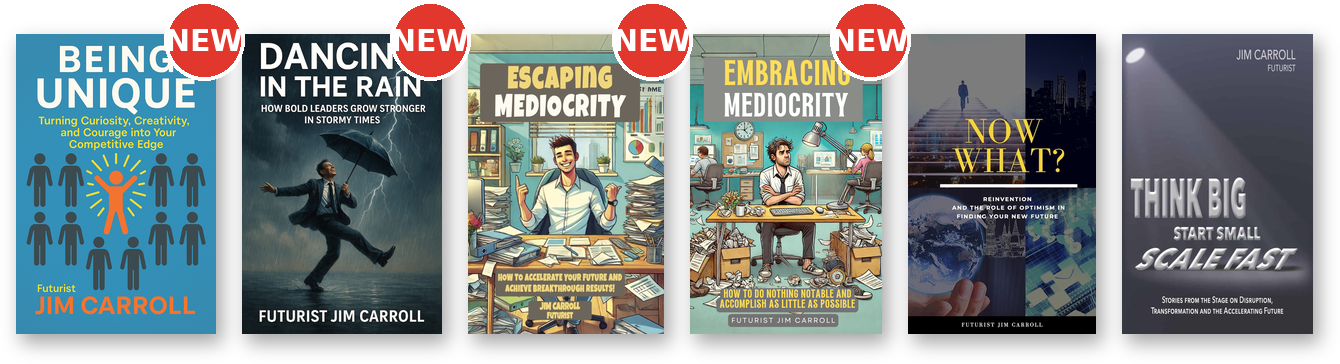

Jim Carroll was the keynote speaker at the Joint Navy and Air Force Child and Youth Programs (CYP) Conference, held January 24–28, 2010. The conference brought together program directors, coordinators, and leaders responsible for delivering child and youth development services to military families at installations around the world. Jim’s keynote provided a futurist perspective on the trends reshaping childhood development, education technology, and the rapidly changing world that military children and families would be navigating in the years ahead. His session connected big-picture trend thinking to the specific mission of those serving some of the most mobile and resilient families in the country.
What do world class innovators do that others don’t do?
 I was in Chicago earlier this week; I had a keynote for the leadership team of a company that’s involved in a sector of the construction industry.
They’ve had some challenges with the economic downturn; they’re also likely to see a resurgence as infrastructure spending kicks in.
But they’re thinking beyond what happens after that — they’re positioning themselves for long term growth — and so they brought me in to stir up some creative thinking as to what they need to do.
The focus of my keynote was the theme: “What is it that world class innovators do that other organizations don’t do?” Here’s some of the insight that I covered.
- World class innovators possess a relentless focus on growth: I deal with a lot of CEO’s at a lot of organizations, and in almost every instance, they’ve engaged me because my message of future growth opportunities resonates with their own attitude. In my view, there are unprecedented opportunities for growth in almost every industry. Spend some time on this blog; read my Where’s the Growth overview and other information, and you’ll come away convinced we live in transformative times that offer tremendous opportunities for growth through innovation.
- World class innovators continually transition their revenue source: they’re focused on ‘chameleon revenue‘. They know that they have to evolve from being a commodity product competing on price, to one that offers a more complex, revenue rich solution. They’re aware that they need to have continuous, relentless product innovation in order to keep their new revenue pipeline full.
- World class innovators solve customers problems – before the customer knows it’s a problem: They excel at anticipatory thinking: where do we need to go with our customers to ensure that we continue to have a strong revenue relationship? What key trends can we ride to maximum advantage that will allow us to provide a constant flood of new, irresistible innovations for our customer base?
- World class innovators source innovation ideas through their customers.: Simply put, they derive new innovation ideas by observing what their customers are doing with their products or services. They know that they aren’t fully in control of the innovation agenda anymore, and that some of the most brilliant ideas are coming from a new source. Notes John Hanks, vice-president, industrial and embedded products for National Instruments: “We have the advantage of working with some of the most innovative people in the world. For example, we could find a customer who is using one of our products in an unexpected and innovative way. It’s then possible for us to take that and add value for another customer, which is one of the ways we can help the innovation process as a whole.”
- World class innovators focus on ingesting fast ideas: there are new technologies, business models, customer trends, product developments, scientific advances and countless other things that are increasing the pace of change. Innovators know that if they plug into the global idea machine, they can constantly discover a tremendous number of insights that help them to move forward.
- Innovators check their speed and focus on corporate agility: they know that to keep up with fast paced trends, it’s their ability to quickly act, react and do that will allow their future success. There’s not a lot of time for debate, studying; inertia is abhorred. They simply DO.
- World class innovators focus on long term wins through constant incremental improvements: they know that some pretty big growth can come from continual small wins and improvement on margins. For example, 7% of power on transmission and distribution lines are lost as heat. Reduce that loss by 10% – and that would equal all the new wind power installed in the US in 2006. That’s why ‘smart grids’ are such a hot topic. Take the auto industry: todays’ typical automotive system uses only 25% of the energy in the tank — the balance is lost to waste, heat, inefficiency. Work on increasing that on a year over year basis, and there are some pretty solid gains through innovation.
- World class innovators focus on skills partnerships as a key success factor: they know that with rapid change, knowledge is becoming an ever more precious commodity, particularly niche oriented knowledge. If they are entering a fascinating new, fast paced market, they realize that there might be but a few individuals or organizations in the world who could help them tackle that new market. They focus on forming fast teams and fast partnerships, drawing a lot of innovation oxygen from that external insight.
- World class innovators focus on pervasive connectivity for next generation product: they know that one of the key trends out to 2020 is that everything around us is plugging together. Soon, every device on the planet will have an IP address on the Internet; we’ll be able to access it’s status and its location. This is transformative stuff, and is one of the primary sources for the next new billions of dollars of revenue in countless industries. Consider the world of HVAC — industrial heating, ventilation and air conditioning equipment: as it is transitioned to the world of “HVAC 2.0”, an intelligent, interlinked, fascinating new world of massive connectivity.
- World class innovators aren’t afraid to back away from big ideas: they know that right now it’s a great time to made bold decisions, and take decisive advantage to forge aggressive new paths against their competitors. While everyone else wallows in aggressive indecision and organizational sclerosis, world class innovators know that it is a great time to do great things.
You know what?
World class innovators win!
Did my keynote go well? Here’s what the client had to say: “Thanks again for your first class presentation! It really hit home and was right on the money!”
:
- Where’s the Growth? (PDF)

- Blog post HVAC 2.0

The future: “…think in terms of transformation .. & .. manage the expectation gap…”
 Another report on my keynote for 4,000 at the annual meeting of the National Parks & Recreation Association, putting into a concise summary the key trends that I covered (from the Parks & Rec monthly magazine).
“… a solid turn-out of nearly 6,000 park professionals and advocates made the 45th edition of Congress a resounding success. …. The theme, “Looking to the Future,” permeated nearly every facet of the event held at the Salt Center Convention Center.
In keeping with the Congress theme, Looking to the Future, opening session keynote speaker Jim Carroll did not disappoint. The Canada-based futurist built his address around key themes and issues likely to confront the field of parks and recreation in the next 10 to 15 years.
Carroll encouraged the packed convention hall to think in terms of transformation.
Other trends Carroll advised attendees to be aware of included:
- healthcare (we’ll be treated for the conditions we’re likely to have before they set in)
- hyper connectivity (mapping, body sensors, and sports equipment)
- Next-Gen re-engagement
- fragmentation (the result of a faster, more connected world that will shape sports, recreation, and hobbies)
- re-defined communities (society’s big problems will be solved locally)
- water/energy/environmental conservation issues
- demographics (think baseball diamonds that evolve into cricket pitches)
- workforce trends (Gen Y has a radically different set of job expectations than its predecessors)
- gaps in expectations (expect a disconnect between what the public wants and what it can afford)
If someone today were to ask me what the most challenging trend will be for first-world nations to deal with — it would have to the last issue.
I’ve got a lot to write and say about the “expectation gap” issue, and have been covering this in dozens of speeches over the last while.
The “expectation gap” is a trend that will define both the opportunity for innovation, as well as distinct perils for standards of living should it not be carefully managed. And to a huge degree, it relates to the political and social maturity that a country can display as it tries to deal with and manage the gap.
More to come!
10 Phrases to Think About for 2010
The chance that your company, markets, competitors will be the same in ten years is virtually zero – so what do you do about that?

Here’s 10 phrases I often use to challenge my clients — often CEO’s of large, multinational organizations — to think differently about our fast paced future:
- experiential capital: it’s the cumulative experience you gain by trying to do new things. Do you have enough of it?
- momentum management: is this a core capability that your organization possesses – can you steer your team through ever more fast paced change?
- chameleon revenue: is your revenue stream capable of it? Can you keep generating new streams of revenue as old streams disappear?
- global idea cycles: do you tap into the global R&D mind for innovation insight, or is your thinking stale, old, out of date, based on the same old sources?
- idea intensity: can you turn the ideas that are out there into reality quickly enough, or do you lose the opportunities to others?
- energy of engagement: is your brand boring and dull, or edgy and interactive?
- ingestion capability: can you ingest new trends, technologies, concepts, business models … before they’re obsolete … or are you stuck in a hopeless rut of indecision?
- fast teams: can you form them as quickly as necessary to get the faster things done?
- massive incrementalism: the oil industry currently retrieves only 1 out of 3 barrels per well on average. A 1% improvement represents huge revenue gains. Every industry I am dealing with sees small marginal wins adding up to huge tactical advantage.
- depth of boldness: are you still thinking small wins, or large, massive tactical manoeuvres?
In other words, when it comes to the future, are you with it, or are you going to wimp out?
Innovators focus on “corporate agility’
How quickly can you scale if you encounter a new market opportunity? How quickly can you react to a crisis. In this clip, Jim takes a look at the concept of corporate agility

Video: Food industry trends – it’s all about velocity!
In the food industry — it’s all faster.
A faster focus on ‘fresh’ food. New taste trends happen faster. There’s faster innovation with ethical packaging.
And so it’s all about time to market. Challenge yourself to think and act differently, when the food industry continues to speed up, and the process of innovation undergoes a deep transformational change.




GET IN TOUCH
Jim's Facebook page
You'll find Jim's latest videos on Youtube
Mastodon. What's on Jim's mind? Check his feed!
LinkedIn - reach out to Jim for a professional connection!
Flickr! Get inspired! A massive archive of all of Jim's daily inspirational quotes!
Instagram - the home for Jim's motivational mind!