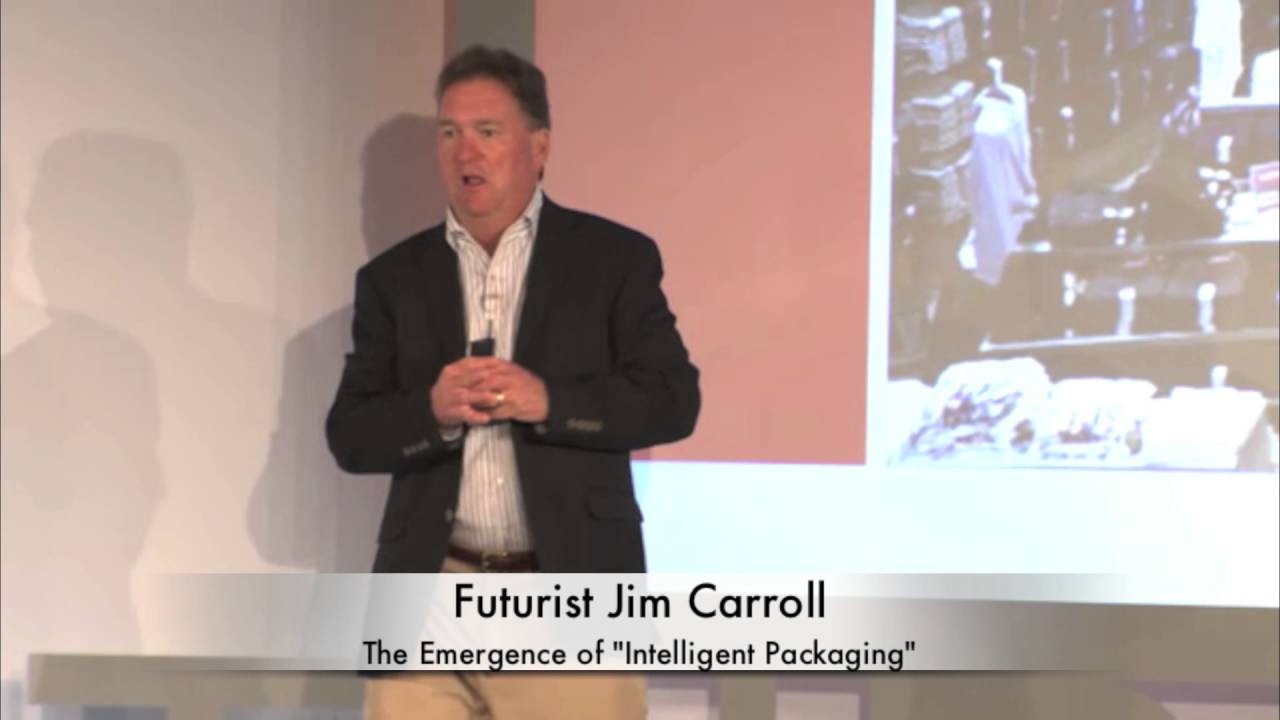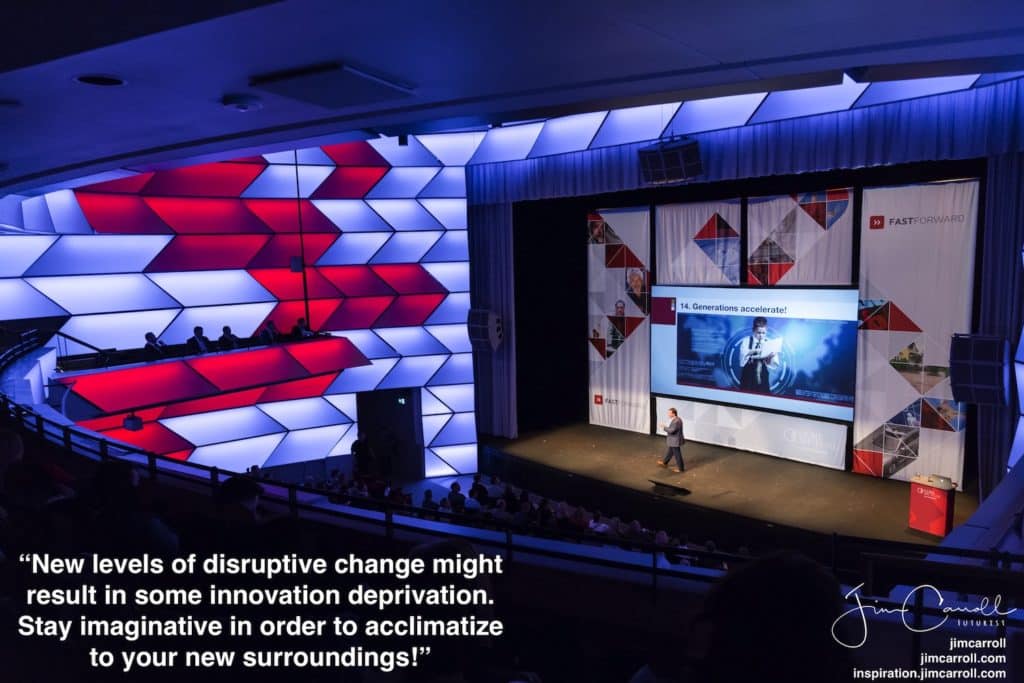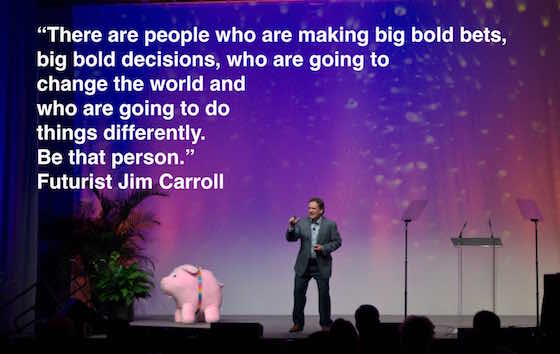
From my keynote for the 2016 PGA Merchandise Show.
Article: If a Panel, a Q&A, and a Keynote Speaker Had a Baby…
An article from Meetings.Net on a recent keynote I did in Orlando….

DigitalNow’s creative Collaboration Sessions engaged the keynoter speakers with the audience in ways that felt fresh and unscripted.
Some 250 association executives and technology experts who gathered at the Hyatt Regency Orlando last week for digitalNow experienced a creative approach to the traditional keynote. Each morning’s general session, which featured a thought leader on a big idea, was followed by a “Collaboration Session.”
Fusion Productions, the Rochester, N.Y.–based company that organizes the forum, and which specializes in new communications technologies aimed at educating and motivating, crafted the staging and format for these creative Collaboration Sessions. They were an interesting blend of a panel, which asked follow-up questions, interspersed with questions from the audience, all facilitated by a skilled moderator.
The staging made for interesting engagement. For example, for the opening morning Collaboration Session, keynoter Jim Carroll, futurist and innovation expert, sat on stage in a director’s chair, with the moderator standing just off to his side. The room was set in crescent rounds. The three panelists, all association CEOs, and thought leaders in their own right, sat in director’s chairs positioned approximately in the middle of the room, spread out in a semi-circle. They posed a variety of smart questions to Carroll, which were seemingly unrehearsed and which he candidly answered (as candidly as one who foresees future trends can answer). The audience piped in on occasion to ask questions, or sent questions via text messaging to the moderator, who skillfully interspersed meaningful comments and questions throughout.
The key to engagement? Not only to change up the seating and format, but to hire speakers who are not afraid to shake up the event, and who know enough about the meeting content to answer a variety of questions in meaningful ways.
Carroll, who in a later interview said he prides himself on being the “content guy who loves to get into the meat of the issue,” when hired by an association or company to keynote. “There’s always an overriding theme or challenge when I talk to the association CEO,” he says. “I get frustrated when an association confronted with big challenges hires ‘Shark Tank’ people as their keynoters. They’re choosing that over content?”
Because he’s hired by so many associations, and writes columns for association magazines, Carroll understands the association business. “Many associations’ annual events are on autopilot. Same old title, same old speakers, they talk about the same old stuff,” Carroll continues. “I see a need in the association world for short-term strategic meetings.” He also sees the need for video learning, particularly among younger people.
Bottom-line, says this futurist, face-to-face meetings will always be part of our future, because “at the end of the day, it’s about getting together for a wine or a beer” to discuss the day’s events and the business at hand. “You can’t do that virtually.”
Video: “When Innovation is Wet: Solving the Global Water Challenge”
Here’s a new video from my Sao Paolo Worldskills keynote: I’m taking about the global water challenge, and opportunities that come from wastewater recycling.
In this context comes Nexus e-Water, an innovative and fascinating solution to encourage use of “grey water”.
The focus of my WorldSkills keynote was how skills, trades, knowledge and education would be challenged by accelerating rates of change. This type of technology is a really good example!
Article: Want to stay relevant? Learn for a living!
Over on the CPA Success Blog at the Business Learning Institute, there’s a good article on the future of knowledge and careers.
It’s based on a keynote I did for the DigitalNow 2016 conference, in which I spoke to 300 association executives on future trends affecting their organizations.
Want to stay relevant? Learn for a living
April 23, 2016 / by Bill Sheridan
Change and complexity? We’ve talked about this stuff to death, but nobody has illustrated for us how quickly things are changing quite like Jim Carroll.
The futurist — who also happens to be an accountant — keynoted the 2016 edition of the always-awesome DigitalNow conference in Orlando by scaring the crap out of the association professionals who paid good money to hear him speak.
Consider these nuggets from Carroll:
- Sixty-five percent of children in preschool today will eventually work in jobs or industries that do not currently exist.
- Half of what freshmen learn in their first year of college will be obsolete by the time they graduate.
“We live in a world of acceleration,” Carroll took the DigitalNow crowd. “The future is becoming the present faster than ever.”
“That future,” he added, “belongs to the fast.”
The culprit for much of this complexity? Technology. Moore’s Law marches on … much faster, in fact, than our ability to keep up.
That’s just the changing nature of the world today. And really, for the youngest generations, it’s not complexity at all. It’s just life, and they’ve been raised to roll with the punches.
For the rest of us, things are getting a little crazy.
Carroll says we’ve lost control of the pace of change within our respective industries. That control now lies with the tech geniuses in Silicon Valley.
What we can control is our ability to learn new skills — and to teach our clients what we’ve learned in the process. That might be our new competitive advantage going forward.
“We live in a world of rapid knowledge obsolescence,” Carroll said. “Our job is to deliver just-in-time knowledge to our clients and customers. We must help them confront their new reality and embrace the opportunities it presents.”
Put another way, Carroll quoted American writer Sidney Perelman: “Learning is what most adults will do for a living in the 21st century.”
Put still another way: The most important skill any of us will have going forward is the ability to learn new skills — to outlearn the pace of change, and help our clients do the same.
As I said earlier, Carroll is an accountant, so he speaks a CPA’s language. In a brief interview after his DigitalNow keynote, he tied his thoughts directly to the CPA profession. Here’s what he had to say.
The Future of Golf – Interactive, Connected, Immersive: My Commentary on the Golf Magazine Article
Back in January, I was thrilled to be invited by the PGA of America to be the opening keynote speaker for the 2016 PGA Merchandise Show in Orlando.

It was the second time they’ve invited me in – I was previously involved in providing an opening keynote for the 2010 Annual General Meeting of the PGA.
In both cases, I’ve done a talk that has focused on opportunities to grow the game of golf, by taking advantage and riding future trends, whether having to do with technology, demographics, or economic factors.
There’s a wealth of insight, including video, scattered throughout my blog. And in my unwavering belief that everyone who has a passion for this sport must do everything they can do to help to grow the game, I’ve managed to get my entire 2016 keynote on my site in video form.
To that end, I was thrilled to see that Golf Digest Magazine ran an article on the Futurists who are providing opportunities for the game going forward. (I will admit though, I was kind of disappointed they didn’t ask me for my thoughts — after all, it sort of seems like I’m becoming the Futurist-in-Residence for the PGA of America. Maybe that might one day come about!)
Over on Facebook, there’s a group of passionate golfers who have established a group dedicated to sharing insight on how to Grow the Game. When the Golf Digest article came out, some questions were made as to how much of it might come true. Given the number of PGA folks in the group who have seen me on stage, it was suggested I might offer up some thoughts. And so here I am!
David Cole – Virtual Reality
David is certainly at the forefront of what is likely to be the biggest growth market in the world of technology in the next 5 years. The concept of virtual reality has been with us for quite some time; yet we are now at the tipping point where it is about to become very affordable, quite common, and certainly transformative.
There’s a lot of development occurring in the world of personal interactive sports and virtual reality; just a few weeks ago, we saw the release of the Oculus Rift, the first virtual reality device that provides for really fascinating, real interactive experiences. It will take us to a world of Xbox-like or FlightScope golf in our home that will make today’s experience seem primitive in comparison. Instead of just seeing August on a screen in front of us, we’ll be able to play Augusta, with our real clubs, in a fully interactive, lifelike 3D experience.
Yet David is talking about an even bigger future: that of immersive sports interaction. A few days ago, I was in discussion with a group that is seeking my insight on the future of the sports stadium experience. There is no doubt that fans in a football or baseball stadium — or at the TPC Stadium course — will use a lot more technology to enhance their experience, and become more involved…..
But David is going one step further. Let’s not just enhance the experience for those in the stadium — lets let others enjoy it too, from the comfort of their own home! Why not used advanced VR to let people travel to the Masters? Why not allow us to watch Brooke Henderson putt from just outside the ropes — even if we are a few thousand miles away — as if we were there? (A little shout out for a fellow Canadian there!)
The key will be putting the enabling technology out on the course in such a way that it doesn’t detract from the tournament or bother the players. To that end, I think Augusta has shown how this can be done with the immersive experience they already provide with the Masters!
David Douguet – Improving Lies – and Jihyun Moon – Making Grass Glow
In the world of agriculture, the acceleration of science is one of the most significant trends that is leading us to a fascinating new world, and both of the goals that are predicted in the article — turf engineered for particular climates, and grass that glows at night — will most certainly come true.
It has to do both with advances in genetic technology, as well as deeper insight into how to re-engineer plant varietals through non-genetic methodologies. And this ability to genetically reprogram seed varietals and combine them with traits from other species — while very science-fiction-like and probably pretty scary for some — is moving forward at a furious pace.
Right now, DNA or genomic-based science is hitting the accelerating speed of change known in the computer industry as “Moore’s Law.” That’s the rule that defines that the processing power of a computer chip doubles every 18 months or less, and the cost cuts in half. That’s why we have the incredible power of a supercomputer of just 10 years ago in our iPhones and Android devices of today. The cost of technology keeps decreasing at a furious rate.
The same trend is occurring with genetics. It took $3 billion to sequence the first genome; by 2009, that was down to $100,000, and just $1,000 a few years later. I often joke on stage that one day soon, we’ll be able to go into a local Best Buy and purchase a genomic sequencing machine. It might seem like a joke today, but it’s not.
What this collapse in cost represents s a future in which ideas like that of Jihyun are very, very real. Imagine what this will do for the game if we don’t have to quit at twilight but can continue on? Just a few years ago, the concept of 24-hour gyms seemed kind of off-the-wall – but because of shifts in work patterns and schedules, more people have a need to fit in their exercise routine at 3 AM. So why not golf?
Dourest plans to rely on the same acceleration of science. We’re getting really, really precise in the world of agriculture, and turf management and designer-turf will have a huge impact on the game. In the world of farming, it’s already possible to have entirely different irrigation, fertilizer, and pest control programs for one farm, and an entirely different set for another farm but a few miles away. I’ve been dealing with seed companies that can engineer a particular type of seed for one region that is totally different from the attributes of a seed engineered for another region.
In this world of micro-climates, we’re developing the ability to micro-engineer our actives forever small land areas.
Overall, this means that the world golf superintendents will continue to become very, very interesting — and very, very challenging. But overall, it will only provide for opportunities of growth for the game. After all, why should we all have to suffer through the shame of blading the ball through Bermuda when a better, more localized version of turf has been engineered?
Kris Hart – Minding Millennials
I love these initiatives!
Everyone knows that there must be tremendous efforts in growing the game through new and different methods of outreach to younger generations. After my keynote at the PGA Merchandise Show, I led a panel that included a number of folks who are making tremendous strides in this regard, including Kris!
CollegeGolfPass seems like a brilliant idea, particularly when you live through the experience of having a high-performing golfer in the family who just didn’t quite “make the team.”
My 21-year-old son Thomas boasts a 1-handicap, and in his first year at university, tried out for the college team. It was fiercely competitive, and it didn’t go so well, such that his opportunity for competitive golf events pretty well disappeared. (I suspect that the sleepless nights that come with frosh week might have impacted his golfing ability that week, though.) Combine that with the idea that committing to the team would have meant playing every day, 7 days a week, with less time focused on his studies, didn’t exactly appeal to him.
Yet he would probably have loved the chance to play in a competitive environment without having to be on an elite squad — precisely what these two organizations seem to be focused on.
It’s good for young people, and it’s good for golf.
David Williams – Searching for Golf Balls You Won’t Lose
GPS-based golf balls are probably the holy grail of the marriage of technology and golf. I suspect they might be as common as nails in the next 5-10 years, and that today’s unlinked golf balls will soon be considered as ‘something from the olden days.’
The opportunity here is closely linked to the issue of engaging the Millennial generation as outlined above. My kids are 21 and 23; they’ve never known a world without the Internet, and laugh at the idea that their dad wrote 34 books back in the ’90s about how to use it! They’ve never known a world for the last 15 years at least, in which they haven’t had a mobile device or smartphone. GPS? It’s been a huge part of their world — I can’t even remember the last time they used an actual paper map.
And their generation will take to GPS golf balls like a duck takes to water. Not just for the convenience, but for the stats! For the last two years, I’ve been religiously using my GameGolf GPS tracker, which gives me a huge range of data on my game performance. (Or, as I tell some people, “it gives me really good data on just how bad a golfer I am.”) I’ve learned that 39% of my shots within 100 yards are within 15 yards (not bad!).
The arrival of GPS golf balls takes us further down the world of interactive and personal-stats-driven golf, which I think will be a great thing!
There’s also a big pace of play issue here. All of us know that one key complaint about golf is that it takes too long in today’s hyper-busy world. (Though personally, I live for the 4 hours 16 minute round that I get at my home club)
Tommy Morrissey – Ending Handicaps
What an inspiring story — and it bodes well for society and for the future of the game. Let’s give a shout out to Rich O’Brien, who runs *another* popular Facebook group that focuses on helping and encouraging disabled golfers.
I think that any golfer realizes that there can be tremendous payback from helping the disabled – both physically and mentally — discover the joy that can come from the world’s most maddening sport.
Over on Rich’s forum, I told the story of a friend of mine that was hugely inspirational.
LDRC
I don’t disagree with the predictions made about the arrival of golfing robots, and the fact that they will engage the next generation, provide for some unique entertainment opportunities and generate a lot of news coverage.
I just hope that I don’t have to bring my high-handicap game to bear against one of these devices!
Henry Boulton – Measuring Mental Toughness
This brings us to Henry’s concept — that just as we physically train for the sport of golf, we will place an increasing focus on mental preparation.
To a degree, it’s happened already — gone are the days of Henry Varden and others preparing for the tournament the next day with buckets of Scotch the night before; instead, we have a world of PGA Pros with an army of sports and game psychologists in tow.
And so if my GameGolf device can provide instant GPS-based measure of my round, it’s not a stretch to think that there will be a device that will help me analyze and dig deep into my mental state, both during and after the round.
Paige Spirant
There was a huge uproar in the world of golf about the role of Paige in the article – and yes, we live in a world in which sex sells.
Despite that, the fact is we live in a celebrity-driven, media-heavy, social-network-immersed world. Paige is one of several who has understood this reality in the world of golf, either by chance/accident or through a deliberate strategy.
Just look at what happened when Bubba unveiled the Bubba-Hover — there were hundreds of thousands of views in just a matter of hours.
Like it or not, in our world of hyper-connectivity, we’re likely to see more folks like Paige gain local, national and global attention for their role as ‘influencers’ of the game, even though they might not have the ultra-low handicap of other golf superstars.
Certainly, that’s the case with me — I’m a relatively high-handicap, yet have passionate love and enthusiasm for the game. It only seems natural as a global futurist who has advised organizations such as Disney, NASA and others, that I might be gaining more attention for my views in the world’s greatest sport.
——-
Bottom line: are the trends outlined in the Golf Digest article good or bad for the game?
My perspective?
Purists will argue that technology and fast science will come to ruin a very traditional game. After my opening keynote for the PGA Merchandise Show, one golfing traditionalist took exception to what I spoke about. I’ll dig out a link to that when I can — right now, I’m about to head out for a round of golf in Phoenix before my next keynote!
When I’m talking about future trends and innovation, my message can provide a degree of discomfort, concern, worry, and sometimes outright anger amongst my audience.
Yet the reality is this: we’re all going to be part of the future, and so we might as well make the most of it.
That’s why the advice has always been this: “Some people see a trend and see a threat: other people see the same trend and see an opportunity.”
Health care: The Future is Now

A report on my keynote for the 2016 Benefits Pro conference in Fort Lauderdale earlier this week.
Health care: The Future is Now
BenefitsPro, April 2016
BY SHAWN MOYNIHAN
When listening to futurist Jim Carroll speak, one thing becomes apparent quickly: The future belongs to those who are fast.
Onstage Monday delivering the keynote at the Benefits Selling Expo inside Great Hall 3, Carroll delivered a rapid-fire, deeply insightful “fast future” presentation on where the future of health care and benefits is headed. And to hear him tell it, it is bright for those who would embrace the impact of mobile technology and how the Internet of Things (IOT) will reshape the entire process of health care a lot sooner than later.
For starters, Carroll explained, 10 years from now, health care will look nothing like it does today. A fundamental transformation, he explained, is on its way, and in many cases, already happening. Genetic testing and DNA sequencing will forever alter the manner in which illness is forecasted, diagnosed and treated: in advance of the condition arising rather than after the fact, the way medical professionals do now.
Years ago, he said, having a hand-held device that monitors vital signs, takes your blood pressure, and reads your EKG was the stuff of science fiction. Today, it is a reality, courtesy of the Scanadu Scout (a tool now being tested by more than 7,000 people in more than 70 countries), and that tech will only become less expensive as time goes on. It’s not farfetched, Carroll added, to imagine a day when you can walk into Best Buy and purchase an inexpensive device that does all these things and more, including diagnosing future ailments.
With the advent of technologies that monitor health signs via wearable devices and mobile devices connected to the Internet, only those patients requiring critical care will also change the way hospitals operate — which is advantageous, considering the number of baby boomers who will comprise so much of the U.S. population in the coming decades.
What does all this mean? Massive opportunity, for those who would think forward and recognize how the IoT will shape the world of pharmaceuticals and benefits. The World Economic Forum posits that the global economic impact of the five leading chronic diseases — cancer, diabetes, mental illness, heart disease, and respiratory disease — could reach $47 trillion over the next 20 years.
What if technology could allow medical science to get out in front of that, so that those costs could be slashed?
Carroll said such a world is not as far off as it would seem. Such revolutionary developments in health care virtualization will be driven by big goals and big thinking, said Carroll. Onscreen, he showed the frightening statistics on obesity levels in the U.S. over the past few decades over a map of all 50 states, staggering numbers that illustrate one of the great health challenges of the modern age. However, that’s not even the biggest worry looking forward.
“Alzheimer’s disease and dementia will be the great challenge of our time,” said Carroll, noting that his mother-in-law had suffered and died from the condition (Jim: it was my father in law...), the sixth-leading cause of death in the U.S. Going forward, however, developments in science will allow for earlier detection and better treatment options.
Luckily, medical knowledge, Carroll said, is doubling every eight years. Previously unthinkable advancements such as the 3-D printing of personalized knee replacements are happening now; the growth of replacement organs is something that will be available to medical professionals within years, not decades. Ingestible technology will be able to show us how we’re responding to medications, by offering diagnostics on how our bodies are reacting to treatment.
The greatest challenge faced by health care CEOs, Carroll said, includes the need to focus on a direct relationship with the customer — which will require wholesale re-engineering of member plans — and rapid deployment of mobile products to meet customer expectations. People will become far more engaged with matters of their own health, as they are empowered with technology that’s connected to their mobile device.
Carroll acknowledged what he called the “organizational sclerosis” that hampers big ideas and innovative thinking, but offered this piece of advice for those whose ideas may alter the health care landscape: “Think big, start small, and scale fast.”


GET IN TOUCH
Jim's Facebook page
You'll find Jim's latest videos on Youtube
Mastodon. What's on Jim's mind? Check his feed!
LinkedIn - reach out to Jim for a professional connection!
Flickr! Get inspired! A massive archive of all of Jim's daily inspirational quotes!
Instagram - the home for Jim's motivational mind!