

M200 is an invitation-only group for senior risk and legal managers of Fortune 500 organizations and insurance organizations. Jim provided a detailed overview of both the short and long-term disruptive impact of AI on their organizations and industries and a concise overview of the challenge of accelerating risk issues.
Daily Inspiration: AI and the Future – “It’s not the trends that have already happened that matters. It’s how these trends accelerate even further tomorrow!”
“It’s not the trends that have already happened that matter. It’s how these trends accelerate even further tomorrow!” – Futurist Jim Carroll
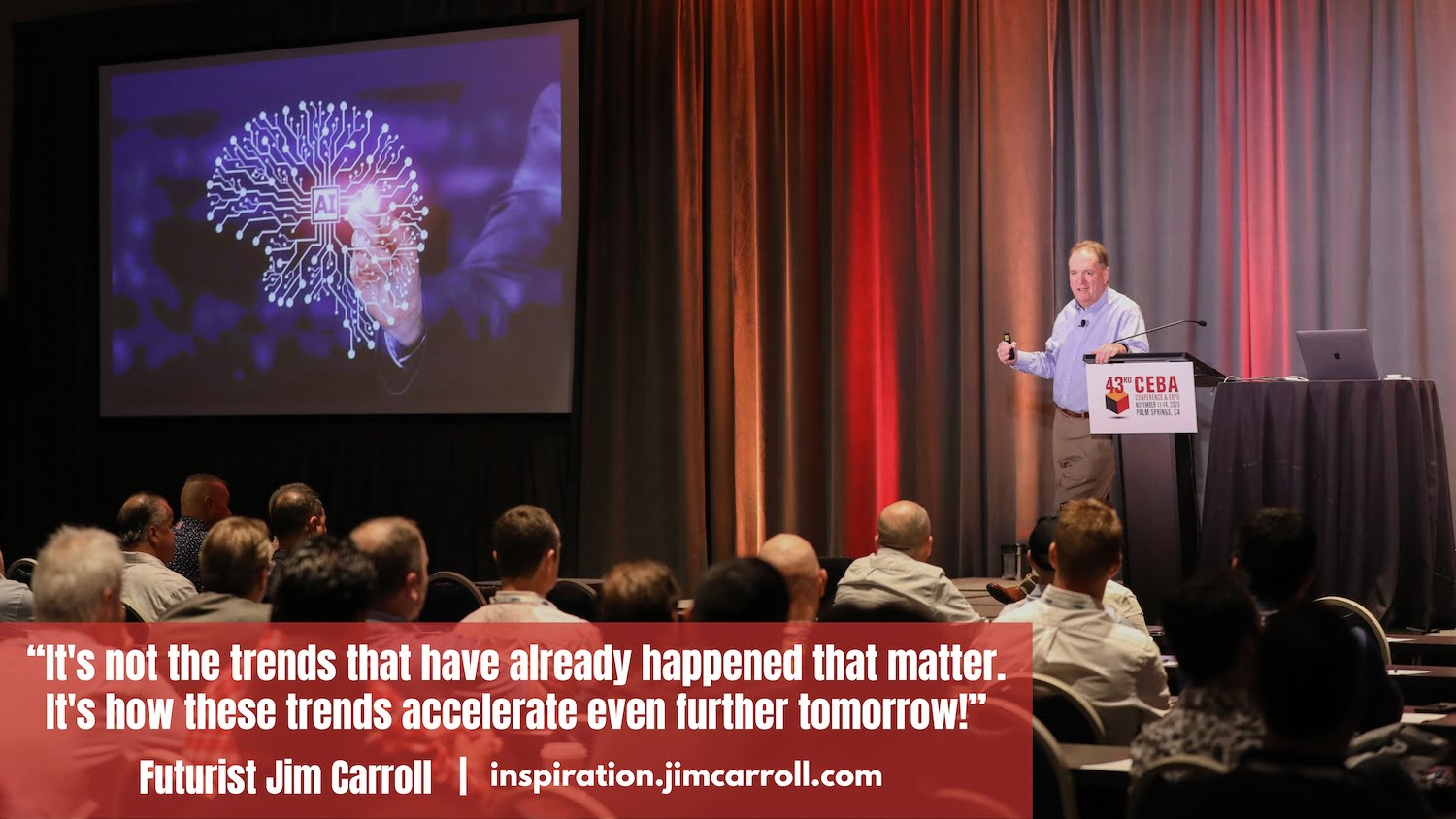
A photo from my keynote earlier in the week for the Controlled Environment Building Alliance in Palm Springs, where I’m speaking to the issue of the acceleration of AI.
Most of us were surprised and stunned by the sudden arrival of large language model technologies like ChatGPT, Midjourney, and Stable Diffusion. The fact that we could ask questions of technology and get reasonably intelligent answers, or instruct a computer to draw an image and it came back with magical results in an instant – we’ve come to believe that we are living in an era of magic. And, we are.
And yet, there is so much more yet to come, because things are speeding up to a rather ridiculous degree. The screenshot I used during my keynote puts things into perspective:

The numbers put it into perspective the trend that is underway: A large language model in 1998 was based on but 60,000 parameters. OpenAI’s GPT-1 had 110 million parameters, and that grew to 1.75 billion parameters for GPT-2. And yet, the next version, GPT-3, was based on 175 billion parameters … and GPT4, 1.75 trillion. What’s next? Models that will approach 10 trillion parameters or more.
I don’t know about you, but when I see exponential growth like this with any trends, I know that something significant is happening.
Over at AssemblyAI, there’s a good article giving this trend a bit more perspective:
GPT-4, one of the largest models, is estimated to possess around 1.8 trillion parameters — 10x more than its predecessor, GPT-3. And this trend is set to continue its blistering pace. According to forecasts by Mustafa Suleyman, CEO of InflectionAI and co-founder of DeepMind, models will be 10x larger than GPT-4 within a year, and we’ll see a hundredfold increase within the next 2-3 years. These predictions underscore the remarkable speed at which the field progresses.
Why Language Models Became Large Language Models And The Hurdles In Developing LLM-based Applications
The challenge is that this type of growth might not continue without access to a lot more data that can be ‘ingested’ by a model. That’s where the growth of knowledge comes in – I often like to point out that prior to the global pandemic, the volume of medical knowledge was doubling every year – but with the acceleration of medical science, it’s now doubling every 78 days or less. There’s more information to feed the beast.
That’s why when it comes to understanding a trend, it’s not the trend that has occurred in the past that matters – it’s the trend going forward. And this trend – AI – has momentum!
Daily Inspiration – Personal Motivation : “Set a goal so small that the mere act of achieving it will convince you that you can achieve a bigger one!”
“Set a goal so small that the mere act of achieving it will convince you that you can achieve a bigger one!” – Futurist Jim Carroll
Sometimes you need a win.
You need a measure of success.
You require a sense of accomplishment.
You must believe that you’ve made some progress.
Not every project or initiative that you take on needs to have some grand challenge, bold idea, or transformative opportunity behind it. Sometimes doing simple things will help you accomplish those greater things – simply because it will give you a much-needed mindset of achievement.
That’s why it’s always a good mindset to believe that the more small things you can pursue in your day-to-day life – and see real achievement – the better positioned you are for the bigger things. Success is built through a series of small actions, suddenly cumulative in their impact – because when you are chasing the small wins, you are actually learning, practicing, focusing, attempting, and trying. Call it the cumulative success that comes from a relentless focus on small steps.
That’s why achieving small steps on a regular basis can help to achieve the big win. As with everything, balancing your mind against the goals is critical to helping you achieve what you need to do. Consider these mindset moves:
- always remember that it is the accumulation of a lot of little things that make big things happen
- keep in mind that breaking things down into small steps will most definitely help you see the bigger picture
- small steps will help you avoid the feeling of being overwhelmed and helpless in the face of big change
- pace yourself – remember to keep in mind that it doesn’t matter how fast you go as long as you do not stop
- stop trying to do everything at once – break things down into manageable chunks
- remember that the simple process of trying to do small things helps you accomplish a big goal because you are prioritizing action over inaction
- while habits are often a barrier, they can be an ally – establish a routine of regular small steps that when taken together, add up to a giant leap
- moderate your expectations – learn to be content with what you achieve with your small steps and forget about your big goals for a time
- take the win – it’s important that you establish some small victories along the way to your eventual massive win – in order to keep your motivation on track
- don’t be discouraged by the pace of your progress with the small steps because, in the bigger picture, they are moving you towards your bigger things!
- keep in mind that every single small step is as important as your big goal
- take a moment to learn something from each small step as to how it relates to the bigger goal
- don’t focus on the success of your big goal but on what you accomplished with your small steps
- with that in mind, take a moment at the end of the day to reflect on what you accomplished with your many small steps
- then think about what new small steps you might take the next day!
- develop a routine: make it a habit to focus on all of your small steps
Small steps = big wins!
Take the small win – because it’s actually a bigger win than you might think!
Daily Inspiration: “Nurture an insane optimism!”
“Nurture an insane optimism!” – Futurist Jim Carroll
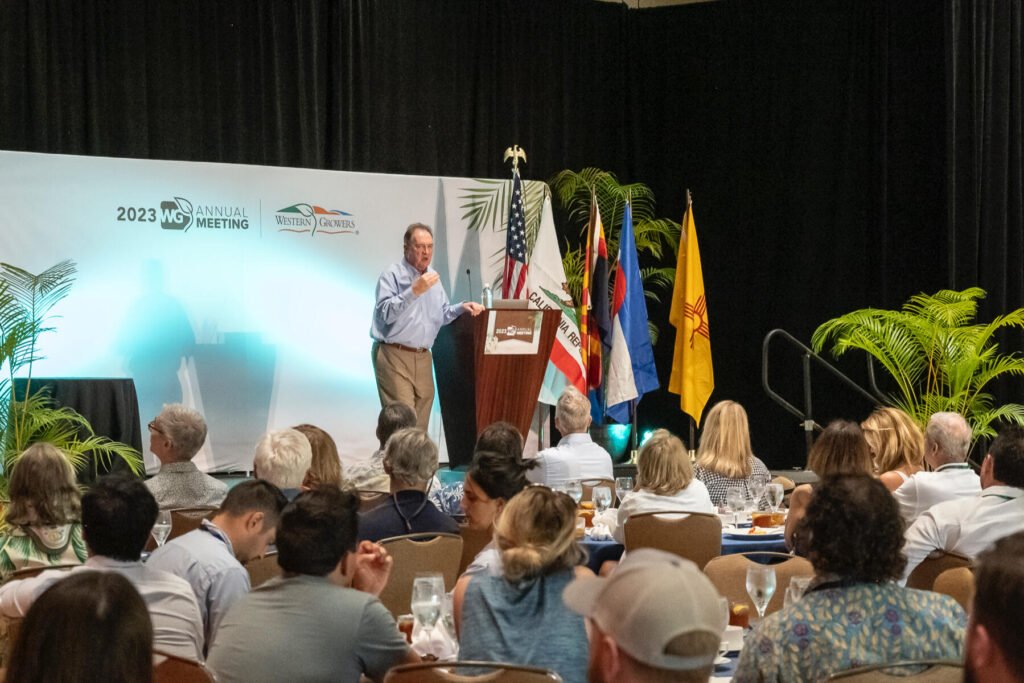
This was a comment made on stage yesterday by the outgoing Chairman of the Western Growers Association. He was making the point that in the face of a volatile industry – with challenges related to weather, climate, costs, labor shortages, and more – the typical farmer must be insanely optimistic at all times.
With that in mind, think about the honorable profession of farming — it’s been around almost since the beginning of time. And it’s a profession that has involved a lot of trial and error; failure and success; and a heck of a lot of innovation.
Often, during a keynote, I will tell the story that there are really two different types of farmers in the agricultural industry. And I make the point to the audience that their attitude towards innovation should be considered in the light of the attitudes carried by each type of farmer.
The first type of farmer is what we might call the ‘apathetic minority’, who share these attributes:
- they are not optimistic about the future
- they tend to seek the “same old advice” from the “same old sources”
- they have a high intolerance for risk
- they’re not convinced they can continue to make a comfortable living despite all the contrary evidence
- they’re skeptical of their potential since they feel they’ve seen too many ups and downs in the industry
Then there is the second group we might call the ‘future positive‘ type of farmer. They share these attributes :
- they’re quite optimistic about the future
- they’re very business-minded, using all the latest tools and ideas at their disposal
- they are very innovation-oriented, willing to approach everything in a new way with new ideas
- they are very collaborative for advice, seeking ideas from anyone and everyone
- they’re often focused on planning, profit, and growth, with clear objectives in mind
So here’s a good question: when it comes to you, or the organization that work for, what type of farmer are you?
Do you nurture your mind with an insane amount of optimism?
Daily Inspiration: Timing Tomorrow – “If you keep waiting around for ‘it’ to be ready you’ll never be ready when it’s actually ready!”
“If you keep waiting around for ‘it’ to be ready you’ll never be ready when it’s actually ready!” – Futurist Jim Carroll
Aloha from Kauai, Hawai! It was a long travel day but definitely worth it.

I’m here to speak today for the Chairman’s Luncheon for the Western Growers Association – the group that represents much of the fresh produce and fruit industry in California, Arizona, Colorado, and New Mexico. The topic? Farming in the era of artificial intelligence:
Don’t know much about artificial intelligence (AI) but wish you did? AI is already arguably the most disruptive technology in human history, but what will it mean for agriculture and the future of food production? During the Chair’s Luncheon, world-renowned futurist and AI expert Jim Carroll will deliver compelling insight into how AI is transforming our industry and what your company can do to stay ahead of this emerging megatrend.

What will I cover? How about this for a sample:
Whether it’s driverless tractors, weed-zapping robots, or data-transmitting crops, the future of farming is happening faster than you might think! We’re rapidly transitioning into a world of 24-hour farming, no longer restricted to farming only when the sun is up!
Much of this future will involve AI-based robotics, sophisticated farm machinery, deep data insight on pests, climate, irrigation and water, plant diseases, and more. Much of it will involve a continued acceleration of a trend we’ve been talking about in the industry for years – what we refer to as ‘precision agriculture.’
I talk about many of these trends over on my AI in Agriculture page – give it a look.
AI Megatrends – AI in Agriculture – Beyond ChatGPT: It’s Not Your Granddad’s Farm Anymore!
One of the trends I will spend quite a bit of time on will have to do with agricultural robots – there are many innovative ideas being rapidly developed – and yet are not anywhere close to being mainstream. There are a lot of small startups, and innovative companies pushing the edges of what is possible with advanced technologies; in other cases, they are being built by the innovation-minded farmer in his or her barn, hacking away at the future. In the research labs of mainstream agricultural equipment manufacturers, there is a frenetic pace of R&D.
They can do such things as pick fruit, examine the crop to identify diseases, spray pesticides, and much more. And yet, they aren’t yet quite mainstream or even close to being ready for prime time; their deployment is limited; their development is still underway, It’s not like you can go into the local store and buy an ag-robot. This means that many in the audience might be of the mindset that this is a trend and an opportunity that they do not yet need to concern themselves with – and that’s a dangerous place to be.
One of my favorite phases when it comes to the future is – ‘we tend to overestimate the rate of change that will occur on a two-year basis, and underestimate how much change will have occurred on a 10-year-basis.‘ At some point in time, AI-based ag robots will be common and in widespread use; today, they are not yet even close to being there. That doesn’t mean we can or should ignore the trend – it’s more important that we understand it, work with it, get involved with it, and understand what is happening – so that as it becomes mainstream, we’re ready to go.
Because if you keep waiting around for ‘it’ to be ready you’ll never be ready when it’s actually ready!
Keynote: Western Growers Association – “AI in Agriculture & Farming” – Kawai, Hawaii
This association represents the massive agricultural producers in California, Nevada and Arizona. Jim’s keynote took them into the current and future impact of AI in their industry on both a near and long-term basis – one that involves a world of virtualized 24-hour farms, weed-zapping robots, AI-accelerated plant genomics, AI-enabled disease identification and much more.



GET IN TOUCH
Jim's Facebook page
You'll find Jim's latest videos on Youtube
Mastodon. What's on Jim's mind? Check his feed!
LinkedIn - reach out to Jim for a professional connection!
Flickr! Get inspired! A massive archive of all of Jim's daily inspirational quotes!
Instagram - the home for Jim's motivational mind!