
The new Web site about my book is up; check out:
The design was done by Bill and Franke James of the James Gang; Franke did the cover art for the book. These two are truly creatively brilliant — check them out!
jc

The new Web site about my book is up; check out:
The design was done by Bill and Franke James of the James Gang; Franke did the cover art for the book. These two are truly creatively brilliant — check them out!
jc
“Believe it or not, manure can teach us a great deal about the future of business.” That’s what I learned about the future from manure, and it’s covered this week in my column in Profit.
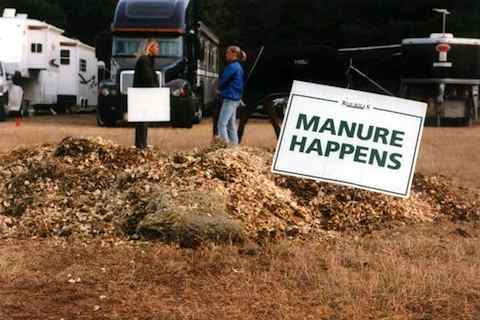 Here’s the article!
I saw the future in manure!
Believe it or not, manure can teach us a great deal about the future of business
Profit Magazine
December 2004
This past summer, I was invited to speak at a western agricultural company’s annual golf day. In attendance were several hundred farmers, their families and various folks from the local area, in a small town about 100 miles from the nearest city. It was about as rural as you could get.
I was asked to address “what comes next” in the world of agriculture, so I looked into the unique challenges facing agriculture today, as well as the trends that will impact the industry over the next five to twenty years.
While doing my research, I came across the phrase “manure management.” That was a new one! And the deeper I dug — so to speak — the more I came to realize that, believe it or not, we can learn a great deal about the future by looking at what is going on with manure. These are the lessons I learned from manure:
1. Accept that times are changing: We live in a time when change is taking place faster than ever, and is speeding up. The mere fact that there’s a profession of people known as “manure managers” shows we’re entering a world that will be far more complex. Recognizing that fact is step one to succeeding in the future.
2. Science is making waves : Manure managers exist because there’s a lot of innovation and R&D occurring with manure. For example, one of the biggest manure management problems involves what’s known as “pit crust.” As the name suggests, it’s the top layer of the manure in the pit, and it gets rather hard and crusty, leading to flies and rodents, not to mention enhanced smell problems.
Rapid evolution in biogenetics is helping to deal with the problem. Scientists determined that most of the pit crust comes from the outer shell of the corn that is fed to the animals, so they developed a specialized bio-enzyme that breaks down the shell during digestion, leading to a thinner crust. The result: fewer rodents and flies, less potential for disease and a big, positive environmental impact.
That’s but one example of how rapid scientific advance is causing change. Look into any industry, and you can see the emergence of all kinds of rapid innovation and new developments. Expect that trend to become more pronounced and even faster over time.
3. Hyper specialization will soon be standard : Given that there is so much new stuff going on, the typical farmer might not learn of the latest advances in manure management. That’s where the manure manager comes in — individuals who possess the specialized knowledge of what’s out there and what can be done with it. They are partners in the process, helping the farmers cope with the rapid change swirling around them.
A typical farmer can no longer be expected to know everything there is to know about farming today. They must call in outside expertise to help them deal with every type of complex issue, of which manure management is only one. And this is a trend true across the economy.
There is now so much new knowledge emerging that every profession and career is fragmenting into dozens of sub-specialties. No one person can be expected to master everything anymore.
4. A specialized partner can save you money : Manure managers are experts in providing farmers with the opportunity for revenue enhancement through the more intelligent application of manure on the fields. In one area in the U.S. Midwest, experts have been working with local farmers to undertake detailed soil and yield analysis to determine the best application rates for future plantings. The returns have been significant — one family farm saw a $19 increase in revenue yield per acre through such efforts. That might seem like a small number until you multiply it by 2,000 acres, for a net result of $38,000 — a big revenue improvement for a family farm operation.
That’s but one small example of how a specialized partner, dealing with specialized knowledge, can help you with your business. As the body of knowledge that surrounds us grows, there are all kinds of innovative, new and challenging ways to run the business better .
5. The future will be increasingly complex : Manure provides a useful signupst to a world that is going to involve a lot more change, specialization and complexity. Everything we know – the jobs in which we work, the professions in which we’ve been trained, the skills we possess, the marketplace in which we sell our products, the industry in which we work and the knowledge that we’re expected to master—will be extremely different tomorrow.
The fact that there exists in the world a group of people who are proud to be recognized as manure managers tells us a lot about the complexity of our future. Figuring out how to deal with such complexities will become the essence for innovative thinking, and from that, our future success.
“When Heinz came out with its “upside down,” ketchup bottle, Jim Carroll was amazed by the response. Not by the innovative product’s effect on sales, but in the peculiar way people reacted to the bottle. As many people opted to turn the white cap up instead of leaving it pointed down as intended. And Mr. Carroll says that move is symbolic of how many people in all walks of life resist change.”
I’ve got a couple of sessions in the next few days; this morning, for the Ontario government, focussing on e-gov trends; then two in New Brunswick looking at the future, trends and forward-thinking. Neat newspaper article here. (Adobe Acrobat)
We’ve had a new Website going up this week, and the Weblog is one of the more challenging parts. It’s getting there, but in the meantime, pardon the construction!
…. is up online and is here.
…is my publisher.



GET IN TOUCH
Jim's Facebook page
You'll find Jim's latest videos on Youtube
Mastodon. What's on Jim's mind? Check his feed!
LinkedIn - reach out to Jim for a professional connection!
Flickr! Get inspired! A massive archive of all of Jim's daily inspirational quotes!
Instagram - the home for Jim's motivational mind!