

The insurance industry is already tightly linked to AI – it’s used for risk management, market analysis, and predictive analytics. Yet the big change occurring in the industry is a shift to real-time underwriting based on real-time risk analysis – think about connected cars which provide discrete information on driver activity, or healthcare bioconnectivity which provides real-time insight into healthcare risk. Jim took the CEOs of the top reinsurance and insurance companies in North America on a tour of what happens as AI comes to accelerate this fundamental disruption.
Daily Inspiration: “Judge your success by what you actually do. Not just by what you plan to do!”
“Judge your success by what you actually do. Not just by what you plan to do!” – Futurist Jim Carroll
You know you’ve got a problem but you don’t fix it. You there are opportunities but you don’t chase them. You know there are solutions but you don’t solve them. You know there are creative ideas but you don’t create them.
You are dying from indecision. And let’s face it – indecision is a bad decision!
But here’s the thing – decisions are hard. Especially when you are not making them. This is why, when it comes to the future, it’s not the trend that matters – it’s what you do with it that counts.
So what do you end up doing instead? You wait it out, seeking clarity to guide you, certainty to drive you, and a lack of ambiguity to comfort you. But the world doesn’t work like that anymore, particularly when volatility and surprises have come our new normal.
So what should you do? Make a decision. Move forward. Get going. Start doing! Here are The 12 Behaviors of Decisive Leaders:
- develop the ability to make a decision despite the lack of clarity
- show more willingness to move forward
- be willing to take on risk
- stop focusing on the threat and become relentless on the opportunity
- don’t allow the detractors to slow the clarity of your conviction that its time to move forward
- work to get rid of institutionalized indecision
- implement more deadlines
- speed up your decision making
- break big decisions down into smaller decisions
- always move forward, not back
- pursue the right opportunities – not just the easy one
- above all, stop waiting for clarity
I know I’ve shared it before, but I’ll share it again. What holds back a lot of innovation in organizations is a culture of “aggressive indecision.”

What is it? It’s a form of organizational sclerosis that clogs up the ability of organizations to pursue the future. It’s based on an article I wrote twenty years ago – timeless leadership insight! – with some more valuable lessons that you might use to challenge yourself if you are suffering from this dreadful malady.
Paralyzed by indecision?
Just do it; Fear of the unknown has made doing nothing the new reality in business.
Here’s how to stop spinning your wheels
18 July 2003, The Globe and Mail
by Jim Carroll
You’ve been providing clients with a project quote every quarter — and when you decide to finally press them to close the deal, they are shocked to learn that you’ve been doing it for 2½ years.
You have a new initiative based on a key business trend that is still on the list of “things to deal with” — long after the trend has gone supernova and disappeared.
You finally decide to upgrade some of your significant business systems — only to learn that you’ve waited so long that the software you plan on purchasing is already out of date.
Sound familiar? It should. It’s the new reality in business: aggressive indecision.
Corporations have lost their sense of direction. In the nineties, people had a sense of purpose, and a desire to get things done. “Nobody knows where we’re going, but we’re making great time” could have been the catchphrase. Well, now no one knows where they are going, and they sure are taking their time getting there.
Quite simply, people have decided not to make decisions — and they like it. The result is an economy in which everyone seems to be stuck in a rut, unwilling and unable to move forward.
Why is this happening? In part, fear of the unknown. Executives are afraid to make decisions because the next unforeseen event might prove to have negative consequences. Combine this with the current focus on cost-cutting, a disastrous number of ill-advised decisions in the past decade during the investment bubble, and increasing corporate scrutiny as a result of ethics scandals, and you’ve got a general reluctance with many executives to do anything new.
The fact is, our confidence in the future has been shattered. Corporate nervousness has become the watchword, with the result that everyone is taking the easy way out: Deal with uncertainty by doing nothing.
What should you do to deal with this new reality?
First, look for the warning signs: a business mindset that is adverse to any type of risk; an absence of any new product or marketing initiatives; or an organization that is stuck in a rut, wheels spinning, and no one has decided even to call a tow truck.
Second, realize that aggressive indecision means that you’ll likely have to respond to external pressures faster than ever before. That’s because while people have learned that they can hold off until the very last minute, they are also learning that they can still get things right. This leads to a business cycle that involves extended periods of frustrated waiting, followed by a blur of activity as organizations rush about to respond to the customers’ demands for instant action.
Third, be prepared to change your corporate culture and work processes. You can’t get mad at your clients for waiting for 2½ years and then making a decision with a demand that you be there tomorrow. Don’t let it lead to an expectation gap — when your customer lives with aggressive indecision and you are still geared up to perform and deliver at the slow and steady pace that might have been appropriate in the past.
Finally, make some decisions. Remember what it used to be like when you had the courage to do something? Let’s call it the decision adrenaline rush. It’s good — and it can be addictive.
Want to test it? Find the one big decision that you’ve been deferring the longest, and decide one way or the other. Right now. Didn’t that feel good? Try it again — immediately. See? Isn’t that an amazing feeling?
You might not have made the right decision, and something could go wrong — but at least you’ve decided to start moving forward, rather than spinning your wheels in the mud. Battle aggressive indecision and you’ll find that you’ll gain back control over the future.
If your company is in the indecision funk, there is hope:
- Recognize the problem. Aggressive indecision can be an addictive vice, and like any other thing that isn’t good for you, the first step is recognizing the problem.
- Accept that uncertainty will continue to rule our economy. Making decisions in a vacuum has become one of the most needed corporate skills. Sure, things could go wrong as soon as you do, but that’s the way the world works today. The important thing is that you are again working to define the future before the focus on an uncertain future does you in.
- Accept the inevitability of change. Back in the nineties, people believed that we would see a lot of change in the business world. But now, with all that has gone wrong, it has become far too easy for people to convince themselves that they won’t be challenged by new business models, competitors, or innovation. That’s a dangerous attitude to carry around, and one that can also help to doom you to a state of inertia.
- Watch trends and react appropriately. Now is not the time to let your radar down. Fact is, while you might be suffering from active inaction, your competitors might not, with the result that you are almost guaranteeing yourself some sort of a surprise in the future.
- Redefine goals, establish priorities, and set targets. Companies mired in the mud of aggressive indecision are often directionless, drifting. They’ve lost sight of the need to constantly innovate and establish new directions, with the result that most staff don’t feel any compelling sense of urgency for change. Fix that in a hurry.
- Re-examine your business strategy. For the past several years, organizations have primarily focused on cost-cutting, and yet taking the knife to operations can only go so far. Restate where you plan to go in the next several years, and communicate that vision and direction to your staff.
If your clients or colleagues are suffering, you can:
- Share the risk. If it is the uncertainty that is killing many a business deal, see what you can do to minimize the fear.
- Be clear about the potential downside. If they aren’t making a decision, then why not be more open about any potential problems? If there are risks in the deal, be upfront about them.
- Clearly define the benefits. In an economy in which accountants rule the future, with every expenditure under the microscope, you’ve got to outline the benefits and return on investment clearly.
- Scare them into action. If they are stalling, then put into perspective how their peers, competition or others in a similar position are moving ahead. People hate to be left behind, and if you can provide information on how others are charging ahead it might spur some momentum.
- Be prepared to move on. Sadly, some people have become so bogged down with aggressive indecision that it might be time to cut their losses. If an existing client seems unlikely to do anything, then maybe you’d do better spending your time opening doors to new clients.
- Don’t give up. Continuing aggressive indecision within your client or customer base can drive you to distraction. A continuously negative message can dissuade you. In times like these, you must constantly battle the negative energy that aggressive indecision can place within you.
The natural human inclination, when faced with something that is uncomfortable, is to turn away from it — lingering uncertainty is the root cause of our aggressive indecision. But we can’t afford to do this any longer — our careers, our companies, and our future depend upon our ability to cope with a world of constant change. We’d better get used to it and take the time to learn the skills — and the attitude — that will help us to thrive in this era of uncertainty.
Daily Inspiration: “When everyone is thinking alike, do your own thinking!”
“When everyone is thinking alike, do your own thinking!” – Futurist Jim. Carroll
Being unique is the basis of all innovation – because if you are doing what everyone else is doing, you aren’t innovating.
You are copying.
With that in mind, chase your uniqueness; thrive on your differences; celebrate your oddities. I’ve never liked the word ‘conformity.’ To me, it reeks of the failure of sameness, an admission of defeat. You are giving up on your ideas and beliefs in order to achieve the approval of others. Why? What’s the point?
That type of thinking was confirmed to me while I was undertaking research for a keynote I’m giving to a senior group of insurance executives in Florida later this week; my detailed research hit upon these two gems.
First, the idea of ‘competition on the basis of being unique!’
Creativity may be at the root of new breakthroughs in insurance coverage, distribution and product development but innovation is the skill of taking new ideas and fashioning them into breakthrough products and services, said American International Group’s Chief Innovation and Strategic Relationship Officer Matthew Power.
“Creativity, in my view, involves the process of ideation and the conceptualization. Innovation involves the commercialization of an organization’s creativity,” Power said. “So I always tell my team that there’s no shortage of creativity within our organization, rather the challenge for the industry is harnessing that creativity in a way that allows it to be functionally and tactically commercialized into the marketplace.”
Matching or outrunning competitors is a traditional path to growth, but game-changing breakthroughs come only when organizations invent or create entire new products and categories of services, Power said. “A better approach to building true, sustainable competitive advantage is this notion of competing on the basis of being different from your competitors. Competition on the basis of being unique is really at the nexus of innovation and building tangible value for your customers over time.“
Creating a Breakthrough
1 February 2013, Best’s Review
Second, why being unique is the foundation of all innovation, and why understanding the future is the basis of that uniqueness:
Innovation “becomes a core earning stream,” another panelist said. It becomes the basis of how a company competes, said Matthew Power, president of Risk Specialists Cos. Inc. and executive vp of Lexington Insurance Co. in Boston. Mr. Power said some companies make the mistake of trying to compete on the basis of being the best in their field, which he called a “limited structure.”
Instead, he said being unique is the basis of innovation. This means understanding trends and anticipating how those trends will affect buyers, he said.
Innovation, execution go hand in hand
5 April 2010, Business Insurance
Music to my ears!
When it comes to that type of thinking about innovation, I’ve been dealing with a lot of organizations who have had some very interesting, innovative approaches to business strategy. Here’s a short list to think about as to how you stir up some innovation by messing with your business strategy – by being unique. Refusing to do what everyone else is doing, and doing your own thing!
- look out: don’t ask what you can do to run your business better — ask what you can due to run your customer, supplier, or partner’s business better!
- move beyond: most projects start out with one strategic goal in mind. Successful innovators realize partway into the project that myriad other new, unknown, and very cool opportunities are opening up — that they hadn’t even thought of before.
- watch everything: Keep your eyes open! Spot that one unique trend that might define a different pathway where you can stand out!
- turn the tables: a lot of industries are being Amaozoned and WalMartized and HomeDepotized, and have to meet certain operational expectations while facing intense competition. Refuse to play the game – invent a new game! Innovators go beyond standard industry practice and do cool things that let them regain more control over their relationship with customers. Don’t be commoditized – go bigger!
- go upside down: don’t think that you are the only one who can figure out how to innovate with your product or service – focus on customer-oriented innovation. If you look around, you’ll probably realize that they are already way ahead of you in reinventing, redefining, and repurposing what it is you sell them. Use THAT as a basis for innovation.
- be cool: smart people don’t want to work for companies that have no innovation oxygen. They’re looking for companies that are busting their markets, ramping up growth, and are willing to take a risk. Your brand isn’t just your product — it’s your attractability index! And here’s an even better secret: even existing staff want you to be cool. They’re seeing innovation all around them, and they want you doing it too, even if they grumble and groan about it.
- build your street-cred: your customers, suppliers, and partners live in a world in which everyone has instant insight, operational excellence, and staff who know what is going on. If you don’t, you lose your credibility, and you lose more than that. You’ve got to continue to invest to keep up with the ever-increasing minimum bar of expectations that’s out there.
- slice and dice: you’re a loser if you play in a commodity economy. Build the intelligence that lets you know where you can win by being premium, and tossing the rest of your customers overboard.
- routinely innovate: get away from spreadsheet-based compliance, and realize real business process transformation. View any emerging regulatory requirement as an innovation opportunity, and you’re golden!
- extend and embrace: make your insight your partner’s insight, and let your transactions be their transactions! While “portals” sounds so-90s, it’s still one of the leading-edge innovation strategies out there, and it has a big impact.
Above all, stop chasing harmony. Avoid groupthink. Kill committees. Stop seeking consensus. Banish buy-in. Forget concurrence. Give up on the goal of unanimity. These are the words, ideas, and cultures that kill uniqueness. Instead, celebrate your uniqueness, and use it as fuel for your creativity. The fact is, when everyone is running one way, run the other way! Because when everyone is thinking the same thing, you’ll always end up with the same thing!
Nature abhors complacency, despises routine, destroys hubris, punishes consistency, reorders routines, inhibits uniformity, and abandons mediocrity. Don’t be like everyone else. Be yourself!
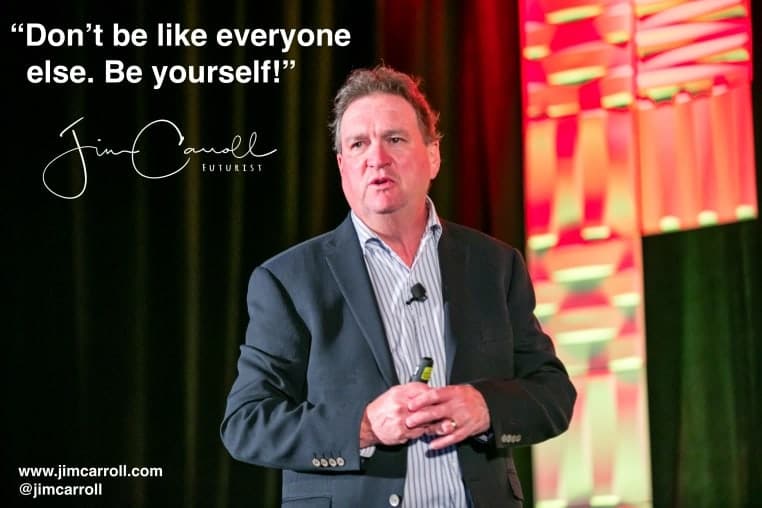
Be unique!
Daily Inspiration: “Never look back – the road is forward.”
“Never look back – the road is forward. If you spend too much time reflecting on what’s been done, you’re not spending enough time on what could be done.” – Futurist Jim Carroll
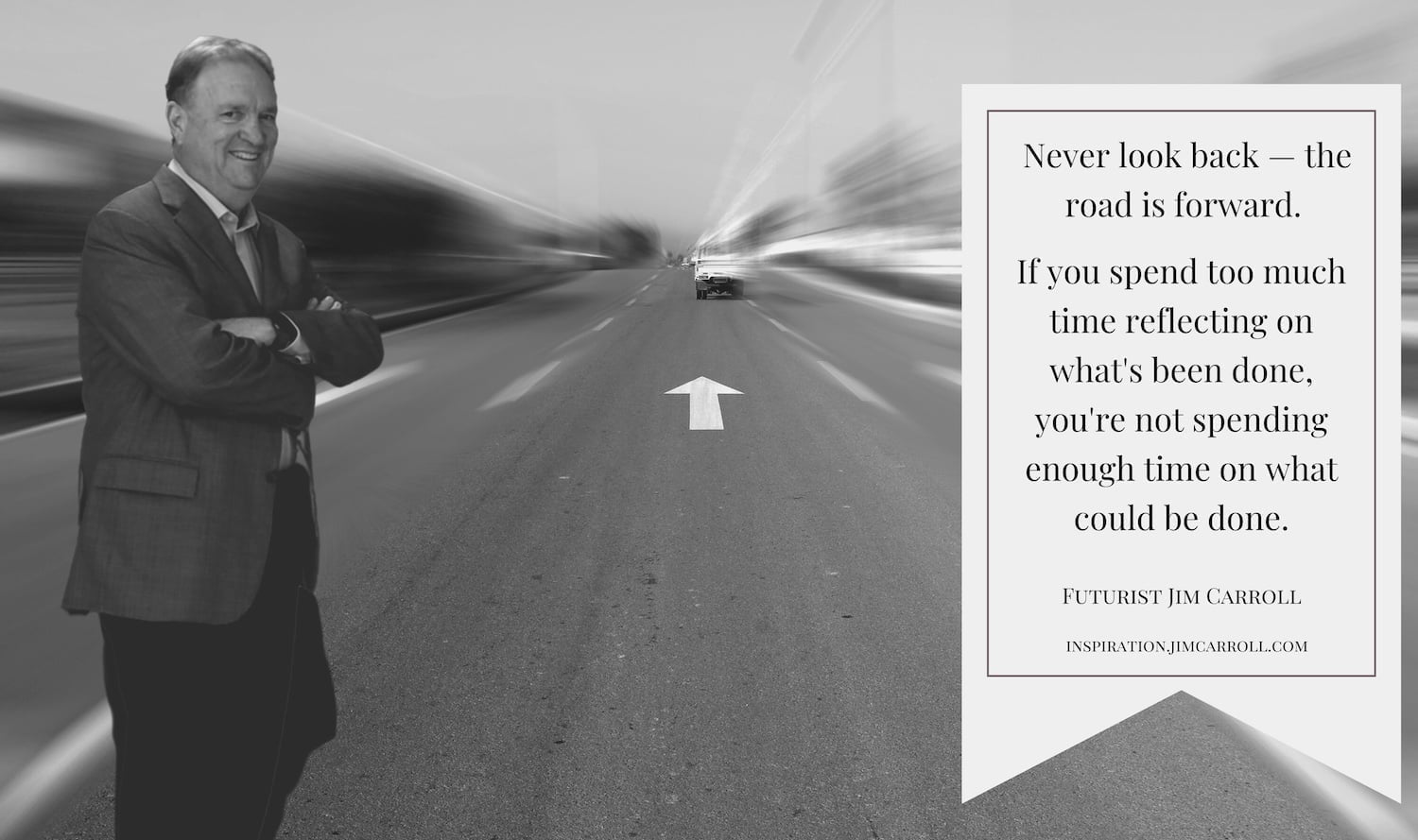
Far too many people arrive in the future without ever knowing how they got there. That’s because they’ve been too busy looking back! Part of the problem is that they are ‘forward-oriented’ : fully aware of and ready for the future.
Don’t take my word for it. Take a survey:
According to an extensive Korn Ferry study — capturing the sentiment of nearly 800 investors and including a detailed analysis of more than 150,000 leaders — corporate leadership is ill-prepared to meet the challenges of tomorrow.
As part of Korn Ferry’s comprehensive Self-Disruptive Leader* study, 795 investors were queried in a global survey.
The result: two thirds (67 percent) say that today’s private-sector leadership is “unfit” for the future.
Failing the Grade: Investors World-Wide Say Current Corporate Leadership is ‘Unfit’ for Future, a Major Korn Ferry Study Finds
12 March 2019, Business Wire
Oops.
Granted, it’s from 2019, and one might think things have changed a bit since then, but maybe not. The survey goes on to reveal that (obviously) the CEO is critical to overall success, but goes on to note that investors value the ability of a CEO to plan for the future, rather than their past success. Looking forward, not back.
This is concerning, given the importance of corporate leadership to investors: 78 percent insist the CEO is critically important when deciding in which companies to invest, and 83 percent cite an exceptional CEO as critical to an organization’s success in disruptive times.
Investors see the intense need for future-ready leaders, with two-thirds (66 percent) saying they value future vision and orientation over past performance. Sixty-nine percent say the need for transformation is going to make leadership more important to company performance within the next three years.
Failing the Grade: Investors World-Wide Say Current Corporate Leadership is ‘Unfit’ for Future, a Major Korn Ferry Study Finds
12 March 2019, Business Wire
How bad is it? Really bad.
As part of the global Self-Disruptive Leader study (and further validating investor sentiment), Korn Ferry delved into 150,000 leadership profiles worldwide. The results were even more staggering: The analysis revealed that, on average, only 15 percent of executives across the globe have what it takes be truly great leaders in the rapidly-changing business world.
Failing the Grade: Investors World-Wide Say Current Corporate Leadership is ‘Unfit’ for Future, a Major Korn Ferry Study Finds
12 March 2019, Business Wire
The study goes on to identify that the old command-and-control leadership style no longer cuts in a fast-moving world.
“For the last hundred years, leaders have been taught that control, consistency, and closure are the principles of business leadership. But dramatic changes to the global business environment mean that this is no longer sufficient–trust, purpose and energizing others are now central, ” says Dennis Baltzley, Korn Ferry’s global solution leader for leadership development and co-author of the new report, The Self-Disruptive Leader.
The study argues that today’s disruptive forces in technology, globalization, demographics and consumer behaviour are exposing the limitations of legacy leadership worldwide.
“As we accelerate further into the age of disruptive technology, competitor landscapes are evolving more quickly than ever before,” said Tu. “Self-Disruptive Leaders who can continually adapt to keep pace with the market are the key to success in today’s disruptive environment, but not all business leaders are ready for the challenge.”
That’s why I always emphasize the idea of establishing forward-oriented innovation culture — ensuring that we are on the cutting edge in terms of what might be impacting us tomorrow, so that we don’t sit back, Homer-Simpson-like, saying “d’oh, what happened?”
The reality that any CEO faces today is a rapidly changing landscape – and you need to know what comes next in order to turn it into an opportunity. Products go out of date faster, skills become more irrelevant faster, business models shift quicker, customer expectations accelerate at a greater pace, new competitors now emerge at blinding speed, and the scope and speed of required R&D keep increasing faster. Name just about any metric, and today’s CEO and senior executive have to deal with a greater number of challenging issues and need to do it at a pace that is nothing like it was yesterday. Speed demands that they be aware of it before it’s too late -m they need to know what’s next.
It will only get faster – that’s why the word agility and speed has dominated the corner suite for some time. And that’s why the ability to “See Disruptive Trends” is at the top of the list of what I provide my clients.
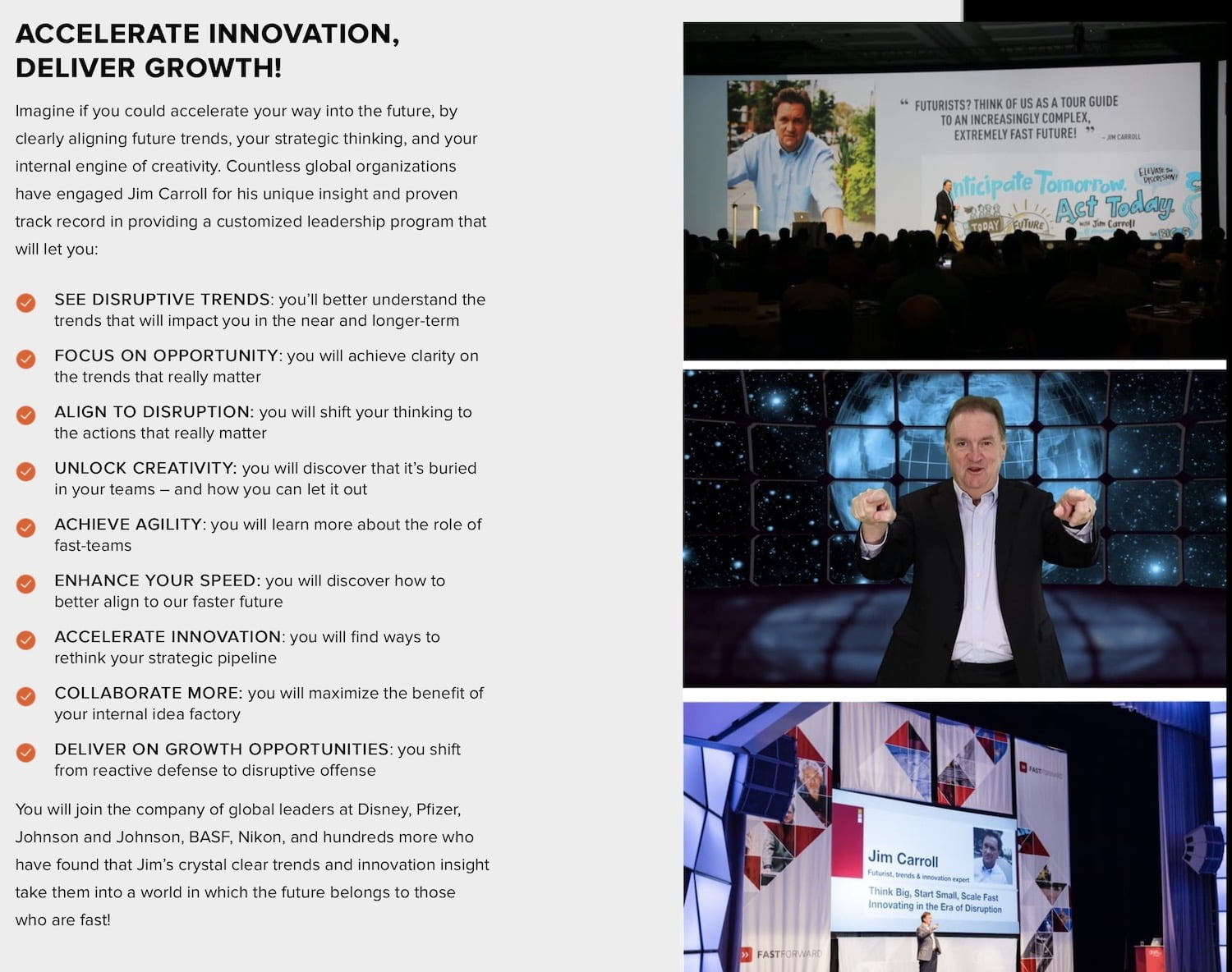
- SEE DISRUPTIVE TRENDS: you’ll better understand the trends that will impact you in the near and longer-term
- FOCUS ON OPPORTUNITY: you will achieve clarity on the trends that really matter
- ALIGN TO DISRUPTION: you will shift your thinking to the actions that really matter
- UNLOCK CREATIVITY: you will discover that it’s buried in your teams – and how you can let it out
- ACHIEVE AGILITY: you will learn more about the role of fast-teams
- ENHANCE YOUR SPEED: you will discover how to better align to our faster future
- ACCELERATE INNOVATION: you will find ways to rethink your strategic pipeline
- COLLABORATE MORE: you will maximize the benefit of your internal idea factory
- DELIVER ON GROWTH OPPORTUNITIES: you shift from reactive defense to disruptive offence
So what does this mean for you?
Remember – there are three types of people.
Those who watch the future happen.
Those who make the future happen.
And those who sit back after it has happened, failing to notice its sweeping impact, and say ‘what happened?’
The second group win – because they know what’s next, and what to do about it.
23 Trends for 2023 Recap: The Issues That Leadership Teams are Focused on Right Now!
Did you miss it?
My “23 Trends for 2023” series drew a lot of leadership attention.
It covers everything from the ‘return to work’ to AI, digital transformation to techno-skepticism, business models that are shifting to choosing not to take part in an economic downturn, crazy ideas mainstreaming to the end of oil, rapid product reinvention to the rise of the robots.
THESE are the trends my clients have been asking me about and are some of the critical issues unfolding RIGHT NOW.
Need to make it bigger? Click 23 Trends for 2023!
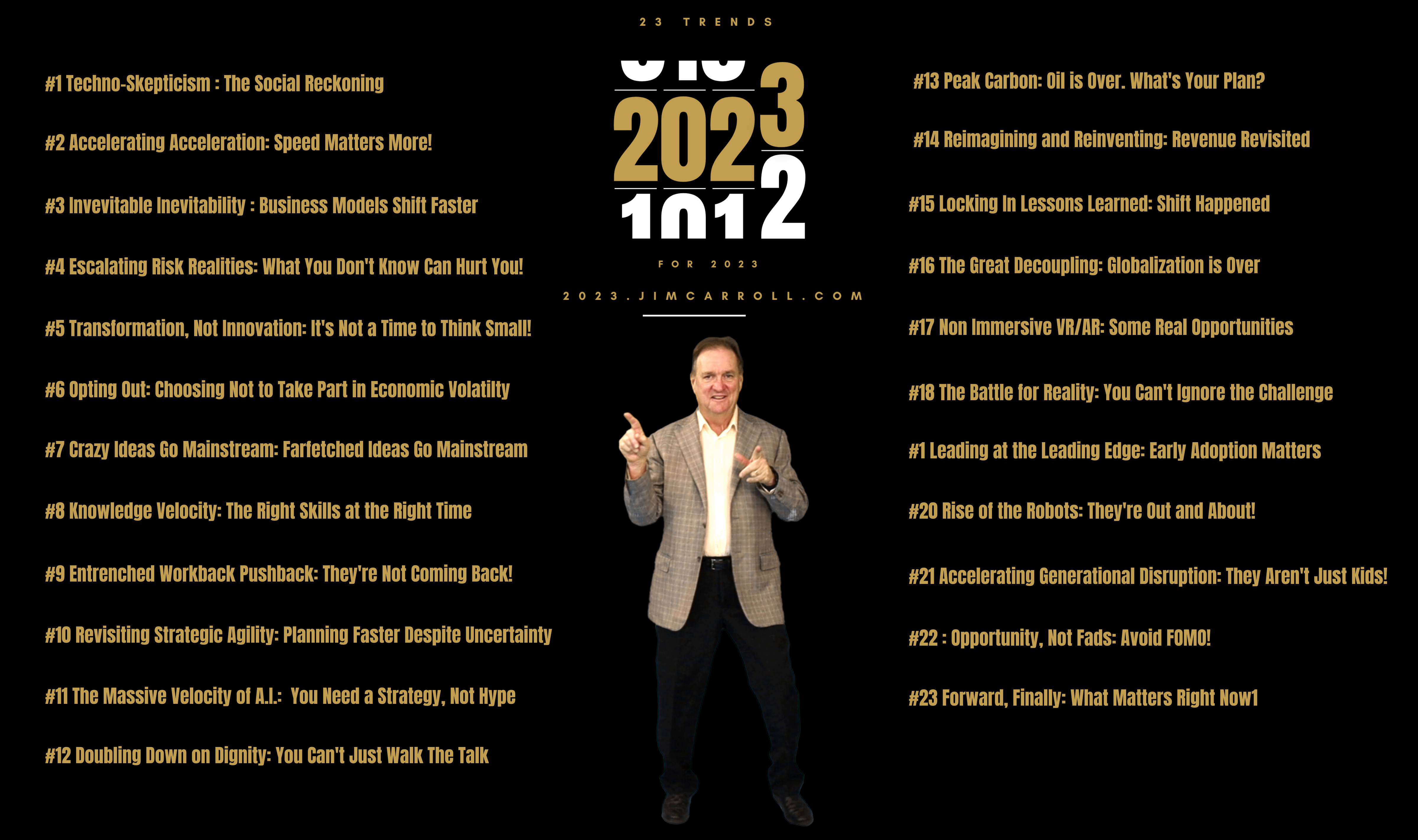
Start out by browsing the trends right here:
You can also get a good preview of the trends category here – > https://jimcarroll.com/category/2023/
Daily Inspiration: “If you are letting all this recession talk defer your plans for growth, you’re doing it all wrong!”
“If you are letting all this recession talk defer your plans for growth, you’re doing it all wrong!” – Futurist Jim Carroll
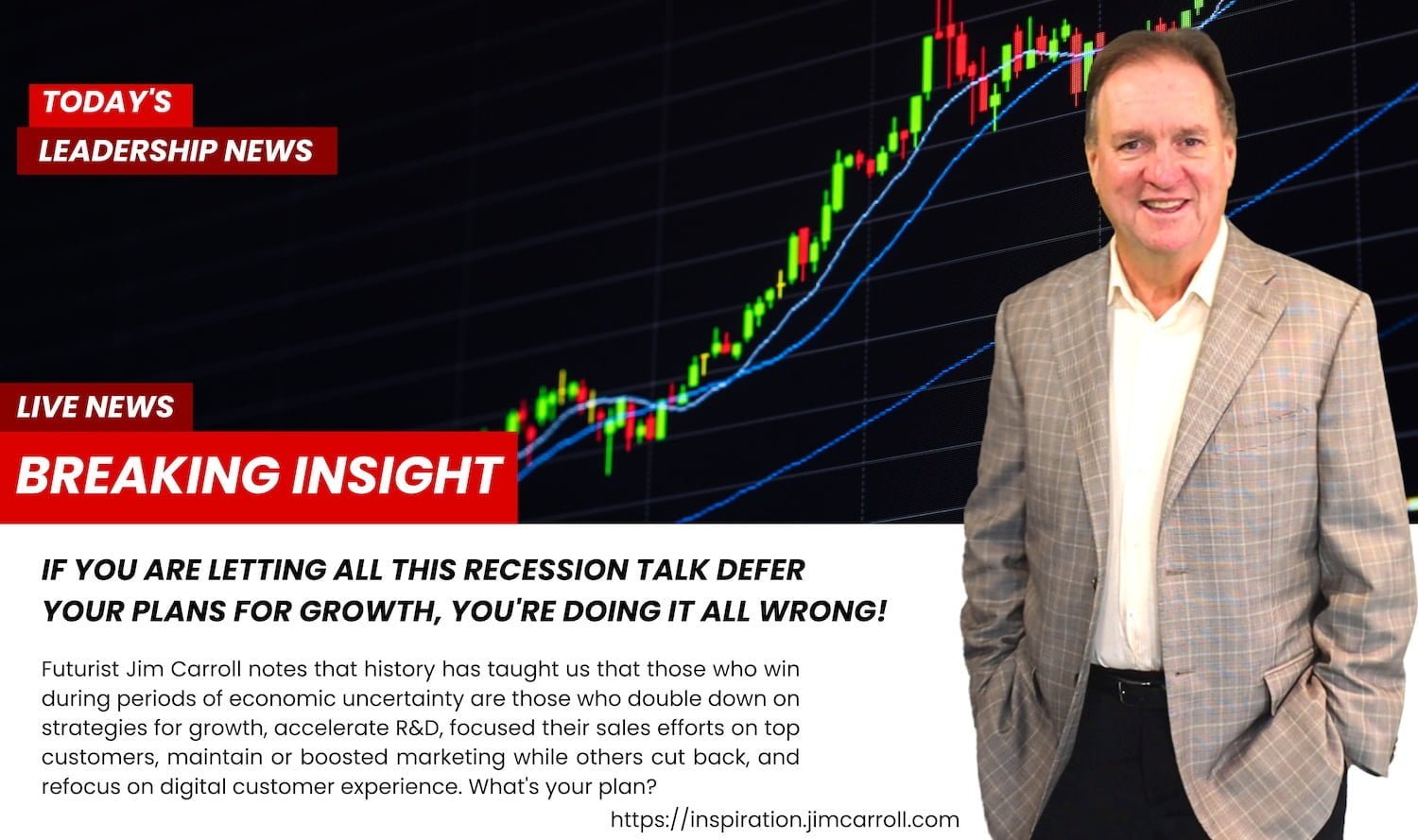
History has taught us that those who win during periods of economic uncertainty are those who double down on strategies for growth, accelerate R&D, focus their sales efforts on top customers, and maintain or boost marketing while others cut back, and refocus on digital customer experience.
Ya, I’m focused on that recession thing again! That’s because that’s where the growth in my speaking activities is!
It’s interesting but tragic watching all the tech company layoffs. Flush with cash, profitable, and not in terribly dire circumstances, they all seem to be lemmings following each other in a rush to cut staff. The round of layoffs seems rather mindless – if you dig beneath the announcements, you’ll see that is just a bit of a slash-and-burn exercise. In the meantime, their free cash flow last year?
Apple: $101.8 billion
Google: $67.0 billion
Microsoft: $60.7 billion
Facebook: $39.1 billion
Nvidia: $8.1 billion
Adobe: $6.9 billion
Salesforce: $5.5 billion
PayPal: $5.4 billion
Tesla: $5.0 billion
Airbnb: $2.2 billion
Zoom: $1.7 billion
Um, sure. They’re hurting badly! In the meantime, those who are being let go find themselves the casualties in what just seems to be a race to please the stock overlords on Wall Street.
The thing is, their erratic activities seem to be setting the tone for everyone else. “Tech companies are laying people off? That’s bad! Maybe I should do some layoffs too!” It fuels a belief that we are in dire economic straits, and that drastic action is needed. What this is doing is exposing the fraud behind the veneer of some ‘brilliant’ CEOs and senior executives – they really aren’t that smart, because they don’t know of the lessons of the past that have taught us about growth during uncertainty. Their ‘leadership’ skills are pretty marginal at best – it’s times like these that rip away the veneer of competence and the illusion of ability.
Anyone can cut costs. Real leaders grow their revenue. Those are the CEOs who get it.
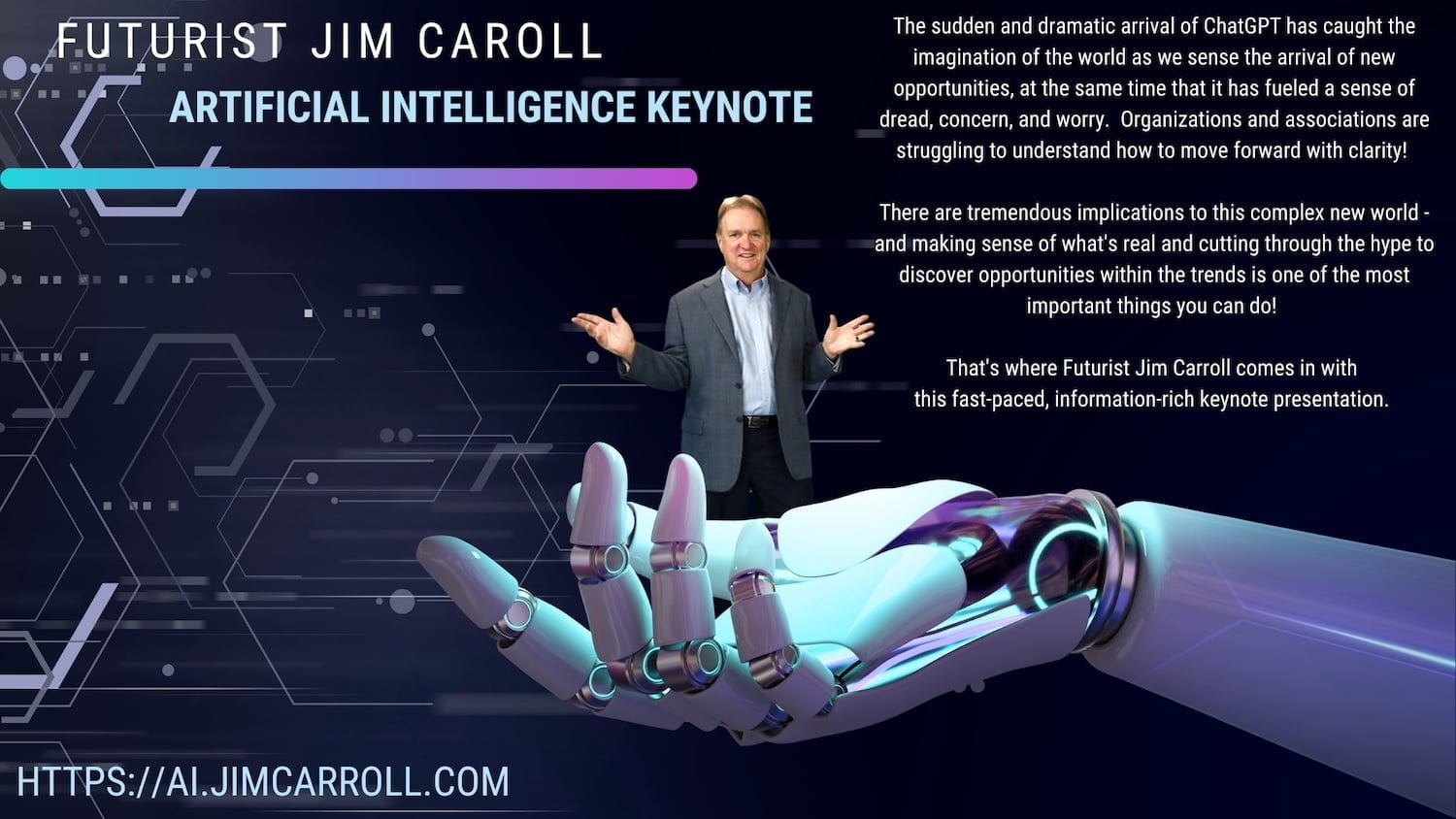
I was on a video call with the CEO of a client organization in the insurance industry yesterday. I’m with them next month; we spent some time with him and his team to walk through my potential discussion points. And I can tell you while he was excited with my content, he also became very excited when I spoke about my approach to the topic of A.I. That excitement continued when I spoke of the fact that I’m seeing many organizations ‘simply choose not to participate in any potential downturn,’ and that I could work this detailed insight into my keynote.
The A.I. topic is moving fast and drawing quite a bit of attention; I’ve been sending out this little bit of marketing collateral for those who inquire; details are at https://ai.jimcarroll.com
But avoiding the recession by choice? A topic that’s on fire!
I dug out a fascinating observation by professional services firm Grant Thornton on a survey they undertook to gauge the executive mindset on innovating despite uncertainty. More than 50% planned to double down on innovation in a downturn. A key observation?
“They don’t intend to just retrench and try to ride it out. Most are counting on continued investment in technology and innovation to push them through.”
That echoes my own findings. Last fall, I undertook a massive research effort involving a few thousand articles on how companies worldwide approached past periods of economic uncertainty and downward growth. The differences couldn’t be starker.
The ‘losers’ or those with marginal or negative growth had these commonalities:
- they saw post-downturn heavy cost-cutting
- scaled back of R&D
- quality talent was lost
- strayed out of their core business to try to find a path forward
- took a wait-and-see approach
The winners? Positive growth?
- played on the offensive but selectively
- accelerated their R&D spend
- focused sales efforts on top customers
- maintained or boosted marketing while others cut back
- focused on digital customer experience
Need a strategy for innovating for growth in uncertainty? It’s right there in those bullet points – and that’s what I’m concentrating on in my “Innovating for the Upturn” keynote.
Innovating For the Upturn: How to Accelerate Opportunity and Achieve Growth in an Era of Volatility
The opening observation in the keynote description?
Conventional wisdom would suggest we’d better hunker down, scale back, slow down, take it easy, be cautious, reduce spending, defer our actions, wait it out, take things slow, and put things on pause. But history tells us that doesn’t work – because those who choose to relentlessly focus on growth are those who win.
History teaches us everything we need to know right now. I’ll remind you of the simple fact that those who chose NOT to participate in the downturn – by doubling down on growth – saw significant returns, locking in gains of 13% CAGR in the years after the downturn compared to the ‘losers’ stalling at 1%. If you missed the post, it’s here – “Opting Out.”
Bottom line? It doesn’t take a lot of leadership skill to ‘slash and burn‘ – indeed, I believe it to be a sign of leadership weakness and failure.
It takes tremendous effort and is a powerful leadership skill, to grow through uncertainty. That’s real leadership success.
I’m pretty happy that it’s the CEOs who are focused on the latter who are discovering me – and my growth message – and bringing me into their events to talk to their team to help to set the tone.



GET IN TOUCH
Jim's Facebook page
You'll find Jim's latest videos on Youtube
Mastodon. What's on Jim's mind? Check his feed!
LinkedIn - reach out to Jim for a professional connection!
Flickr! Get inspired! A massive archive of all of Jim's daily inspirational quotes!
Instagram - the home for Jim's motivational mind!