
I added an AI Chatbot to my website using CommandBar. Here’s how I did it!


I added an AI Chatbot to my website using CommandBar. Here’s how I did it!
“Use the tools” – Futurist Jim Carroll

Try my AI!
My mindset has always been ‘You can’t talk about tomorrow if you aren’t doing tomorrow.’
With that in mind, if you head over to my website – jimcarroll.com – you’ll find a little button at the top right, “Ask AI.“ (It will hopefully soon read “Ask My AI” – I’ve sent this in as a product suggestion.)

That will give you a drop-down box that begins to lead you into the AI-based tool which will construct insight from over the 4,000 posts on my site, using ChatGPT.

You can ask questions of all the material I have written since 2002, conversing with my AI just as you might converse with ChatGPT. It’s the same technology. For example, if you ask “How does an organization become more innovative?“, it will give you a rather well-constructed response, based upon its having ingested the over 4,000 posts into a small little large-language-model, pumped out by the technology of ChatGPT.

I’ve built this into my site using CommandBar, a company long in the business of building effective customer support Website integrations, and which has recently integrated AI capabilities into its system.

When I am speaking to corporate and association groups about AI, I turn a part of my talk into the fact that in a nutshell, the way we need to approach it is an innovation story. And to me, innovation has always been about asking ourselves three questions. How might I be able to use new tools to help me to run my business better? Grow my business? Transform my business? Or, invent a new business. With that in mind, here’s a slide from the deck I used in my talk for 60 CEOs last week in Houston.

Right now, there are a LOT of opportunities to ‘run the business better‘ with the first batch of AI-based tools – such as using a service like CommandBar.
I was able to rather easily and effortlessly, with just a bit of poking around and pressing buttons – integrate an AI into my site. CommandBar has long supported the ‘integration’ of their help and product support navigation tools into existing technology marketing and customer support systems such as WordPress, ZenDesk, FreshDesk, and others. This means that if you are using any of these platforms in your organization, it’s slam-dunk easy to build an AI into your site – just like I have.

You do this by linking CommandBar to your data and then building out the manner by which visitors will ‘talk’ to the data. In my case, I simply constructed the screen that appears to visitors clicking on the AI on my site and linked it to my ChatGPT account. Voila – I’ve got an AI. It’s pretty effective.

A company like CommandBar, long in existence, already offered up multiple sophisticated customer support and customer acquisition systems – in addition to AI-powered Help, it offers product tours, onboarding, and survey technology.

For me, I can’t just talk with my clients about the opportunity of AI – I can only do so if I have the integrity that comes from actually deploying the tools. My integration of AI into my Website is just one of the many things I am doing to go down this path.
Innovation?
Use the tools. Deploy the technology. Chase the ideas. Do the steps!
Right now, there is a lot of ‘low hanging fruit’ that you can pick that is based on AI – and you can only taste the opportunity if you actually choose to do so!
“It’s at the very moment you think your future is guaranteed it becomes a certainty that it isn’t!” – Futurist Jim Carroll

When you speak about the future, you can’t just point to examples of leadership success as examples of the road to success – you need to outline the failures that you’ve seen which led to a pathway to failure. I’ve seen a lot of failures in my career within my client base – it’s always interesting to look back at a talk that I gave years ago and to take a look at what eventually happened with the organization.
I spent some time yesterday in my meeting with 60 CEOs in Houston, outlining the leadership attitudes and actions that can often hold back success – as good examples of the type of thinking to avoid.
First up – Nortel! Remember them – a big, iconic carrier in the telecommunications space! They imploded and filed for bankruptcy in 2009 after a spectacular stock runup during the dot.com years. It was at the very moment they were enjoying the massive sales driven by the early Internet era that they were making the fundamental mistakes that doomed their future.
What happened? Management complacency drove their collapse and looking back, it was evident in one of the sessions I did with them. (The organization booked me many, many times over the years, and was actually the sponsor of one of my radio shows in the 90s called “Ebiz with Jim Carroll.”) In 1994, I was invited to speak at the Nortel Open in Phoenix – at this moment in time, they were sponsoring this tournament on the PGA golf tour. Among other things, I was invited to talk about the future of telecommunication and the ‘telephone’ industry.
One of my key messages was that the technology of the Internet – IP, or Internet protocol – was set to become the backbone of the future telecommunication system and that they had better be prepared; it would play havoc with their existing lines of telecom hardware and software. The change was going to be fast, and dramatic, and might provide them with some extreme challenges in the future.
How was it received? Word got back to me that the CEO of the time, Jean Monty, flying back on the corporate jet to Toronto, was livid with my presentation. Who dared to invite this young upstart in, with such foolish ideas? Fun fact – IP became the backbone of the global telecom system, Nortel didn’t adapt and found the path to bankruptcy.
Next up – DaimlerChrysler. They invited me to speak at a strategic planning meeting in 2006 Germany; my job was to challenge a room of senior auto engineers to think about the disruptive future of the automotive industry. As you might have heard me outline here many times before, I essentially outlined what would become the future Tesla business model and the electric, technology-based vehicle of the future. They laughed at me. Today, Tesla owns the future of the auto industry as legacy companies continue to struggle to catch up.

Motorola? I spoke to them in 2006 – a meeting of their top 250 R&D engineers and leaders from around the world. I suggested that the future of the mobile phone industry was set for some upheaval. I shared that Apple was rumored to be coming out with a phone; that the future was to be found in ‘smartphone devices’ that went beyond simple mobile calling; and that someone was going to nail the idea of extending the functionality of the phone. The general consensus in the room was that they were having massive success selling the Razr mobile phone and that everyone would always want a Razr in the future. They had nothing to worry about!
I remember leaving Chicago, shaking my head in wonder at their attitude. What happened? They were pretty much pushed out of the mobile phone business within a matter of a few short years.
What goes wrong with these situations? (I have many more.) The sins of arrogance, hubris, complacency, future-oriented blindness. I wrote about all this in my post on leadership hubris sometime back.
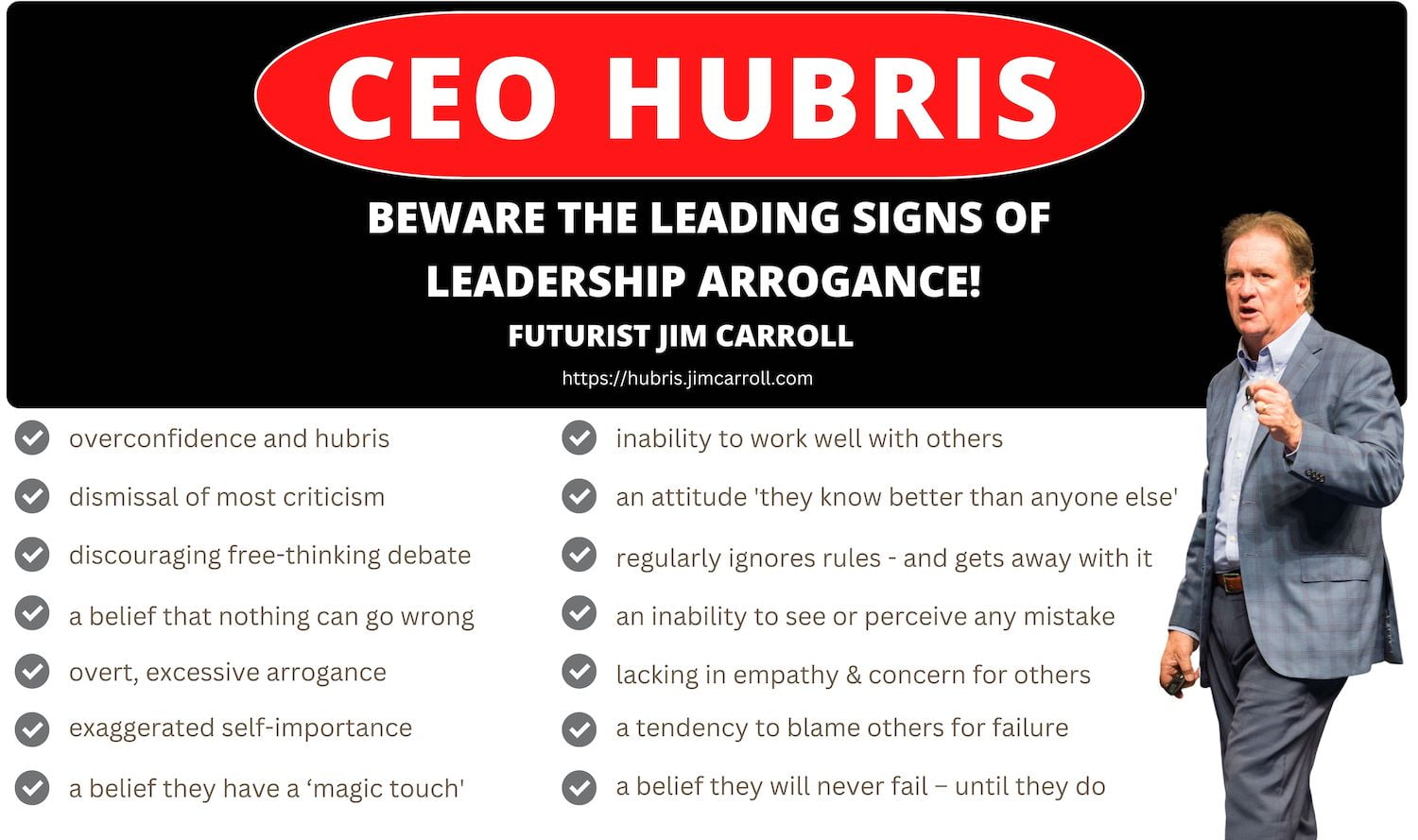
There are valuable lessons to learn from these examples – but it comes down to this: once you think your future is guaranteed, you’ve become so blinded by your success that you fail to see your potential failures!
And sadly, it happens over and over, all the time.
“Create your own giant leap!” – Futurist Jim Carroll
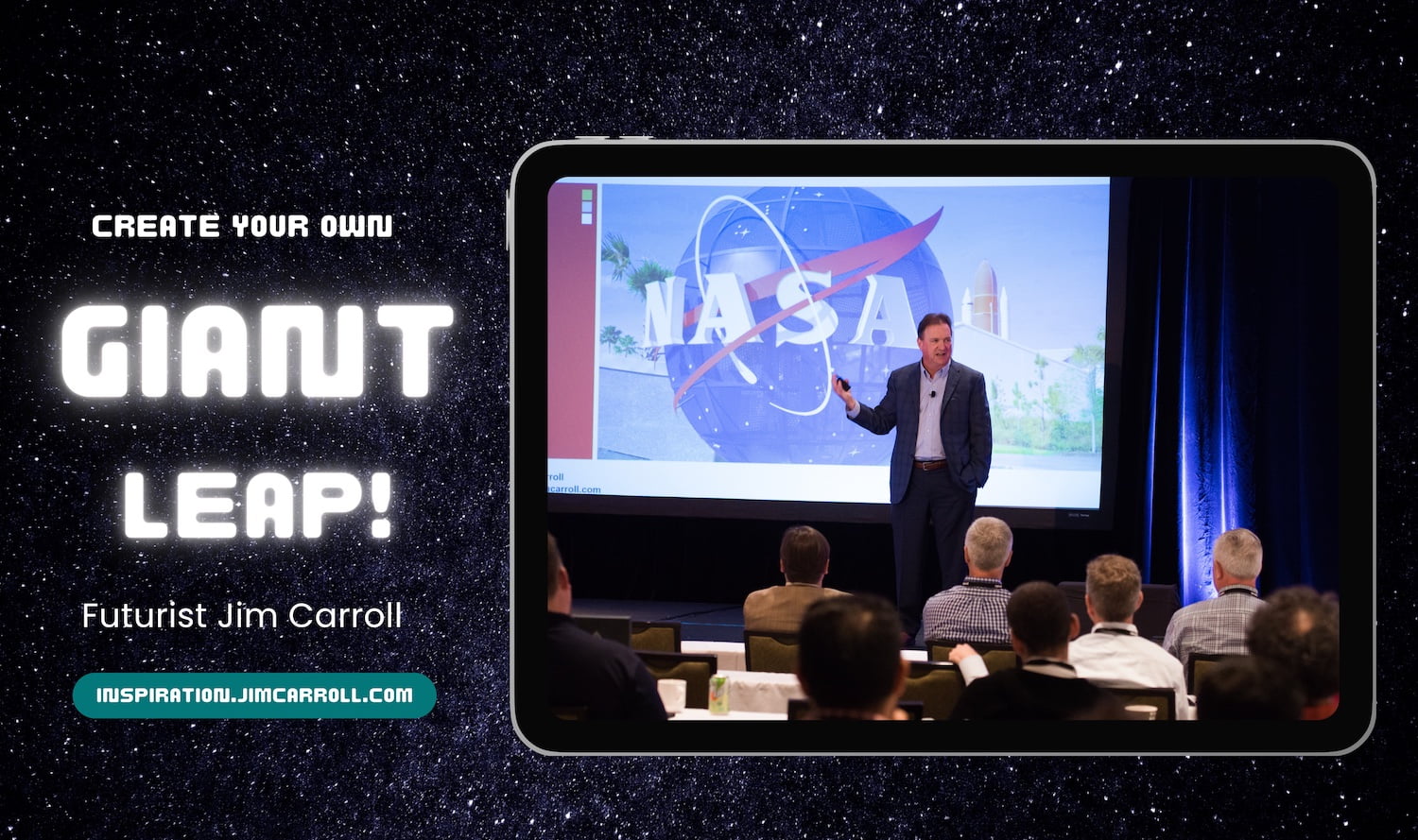
I’m a space nerd. Yesterday, I was space nerdering. As you can see, it was a hair-raising experience. (My wife came up with that one!)

It was a fun day – I mean, they even feature the storyline in grocery stores:

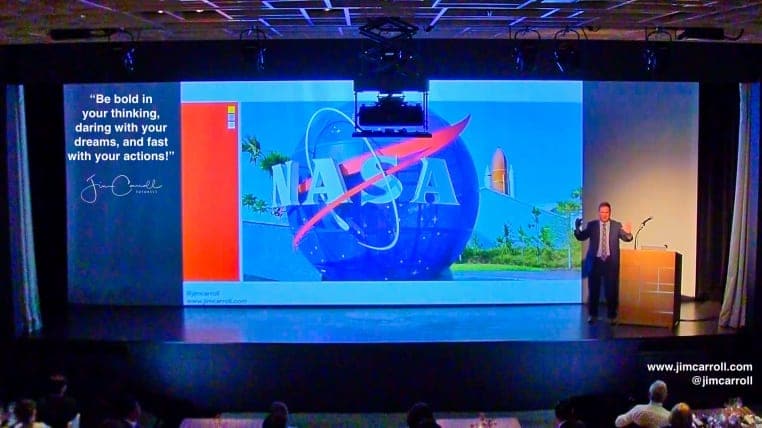
In any event, I’ve obviously found a lot of futuristic, innovation-themed insight with NASA and the space industry. And I’ve been shocked when I’ve been invited (twice) to speak to NASA – to a room full of astronauts, launch directors, and more. As I reported after the first one down in Houston:
What do you do when you are the worlds leading space organization, and things are in a bit of a funk? Funding cutbacks, the cancellation of missions and programs,
You engage a futurist to come in for a talk on the issue of ‘transformational leadership’ and what great leaders do to redefine their future in an era of significant transition.
And NASA found me, and I found myself in a room giving a dinner talk to a group that included astronauts, launch directors, (literally) rocket engineers and more.
One thing I did – in order to take them into the future,I took them back into their past to demonstrate to them all the other times that they faced similar situations, rose to the challenge, and accelerated to the future!
Read the blog post which summarized their reaction. One of the highlights of my 25 year speaking career!
There’s a video at the end of this post where I recreate the story of what I spoke about on stage – I did this from my virtual broadcast studio back in 2021.
I’ve also had the good fortune to speak at many events where famed astronauts or other heroes of the space age were also on the agenda, such as this one in Las Vegas. It sends shivers down my spine every time I have the chance to meet these folks as a part of the deal.

Even to share the ink on the agenda of an event with these heroes of the universe is an incredible honour for me.

And I’ve had some unique circumstances along the way – I’ve done three keynotes where Chris Hadfield is one of the other speakers. At this particular one, he left a bit of a dilemma on the stage where I would find myself immediately after this talk. The clip is short – give it a watch – I was thinking quickly!

In any event, I was inspired yesterday with a thought as to what each of us should do when it comes to aligning with the future. We were in the original Mission Control, watching the scene when Neil Armstrong first stepped onto the lunar surface and issued one of the most famous quotes of all time, and the inspiration came immediately to mind – because I am always thinking of the next day’s quote.
Create your own bold leap.
Why think small when you can pursue big dreams? Why do little things when you could be bigger in your goals? Why chase small ideas when there are small ones around?
As it happened, the book One Giant Leap was in my hotel room, and I started to re-read it. One of the opening paragraphs jumped out at me.
The leap to the moon in the 1960’s was an astonishing accomplishment. But why? What made it astonishing? We’ve lost track not just of the details;we’ve lost track of the plot itself. What exactly was the hard part?
The answer is simple: when president John Kennedy declared in 1961 that the United States would go to the moon, he was committing the nation to do something we couldn’t do. We didn’t have the tools, the equipment – we didn’t have the rockets or the launch pads, the space suits or the computers or the zero-gravity food – to go to the moon. And it isn’t just that we didn’t have what we would need; we didn’t even know what we would need. We didn’t have a list; no one in the world had a list. Indeed, our unpreparedness for the task goes a level deeper; we didn’t even know how to fly to the moon. We didn’t know what course to fly to get there from here. And, as the small example of lunar dirt shows, we didn’t know what we would find when we got there. Physicians worried that people wouldn’t be able to think in zero G.
Mathematicians worried that we wouldn’t be able to work out the math to rendezvous two spacecraft in orbit-to bring them together in space, docking them in flight both perfectly and safely. And that serious planetary scientist from Cornell worried that the lunar module would land on the moon and sink up to its landing struts in powdery lunar dirt, trapping the space travellers.
Commit yourself to trying to do something you think you can’t do! Create your own bold leap!
Food for thought!

We can’t be NASA, but we can find inspiration for our future by challenging ourselves to be bigger in our actions, words, mindsets, and goals.
Enterprise Bank, based in the Western US, has been running its virtual Enterprise University for 20 years! To kick off its 2023 series, it brought in Jim for a keynote that looked at the impact and opportunity of AI in a vast number of different industries, from retail to manufacturing, insurance, and finance, to healthcare and architecture.
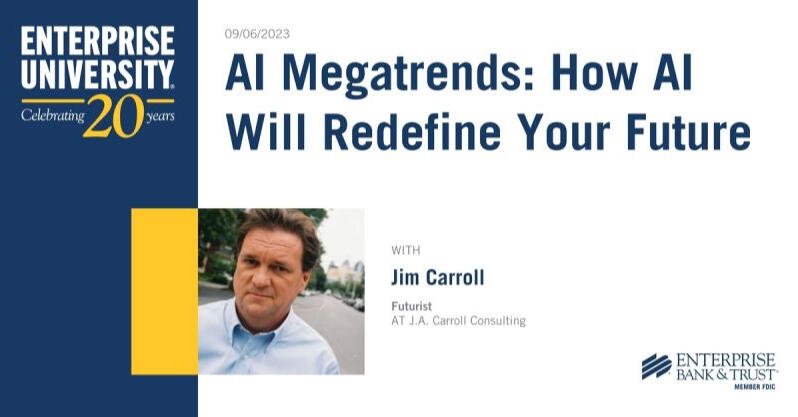
“Explaining AI today is just like explaining the internet in 1993” – Futurist Jim Carroll
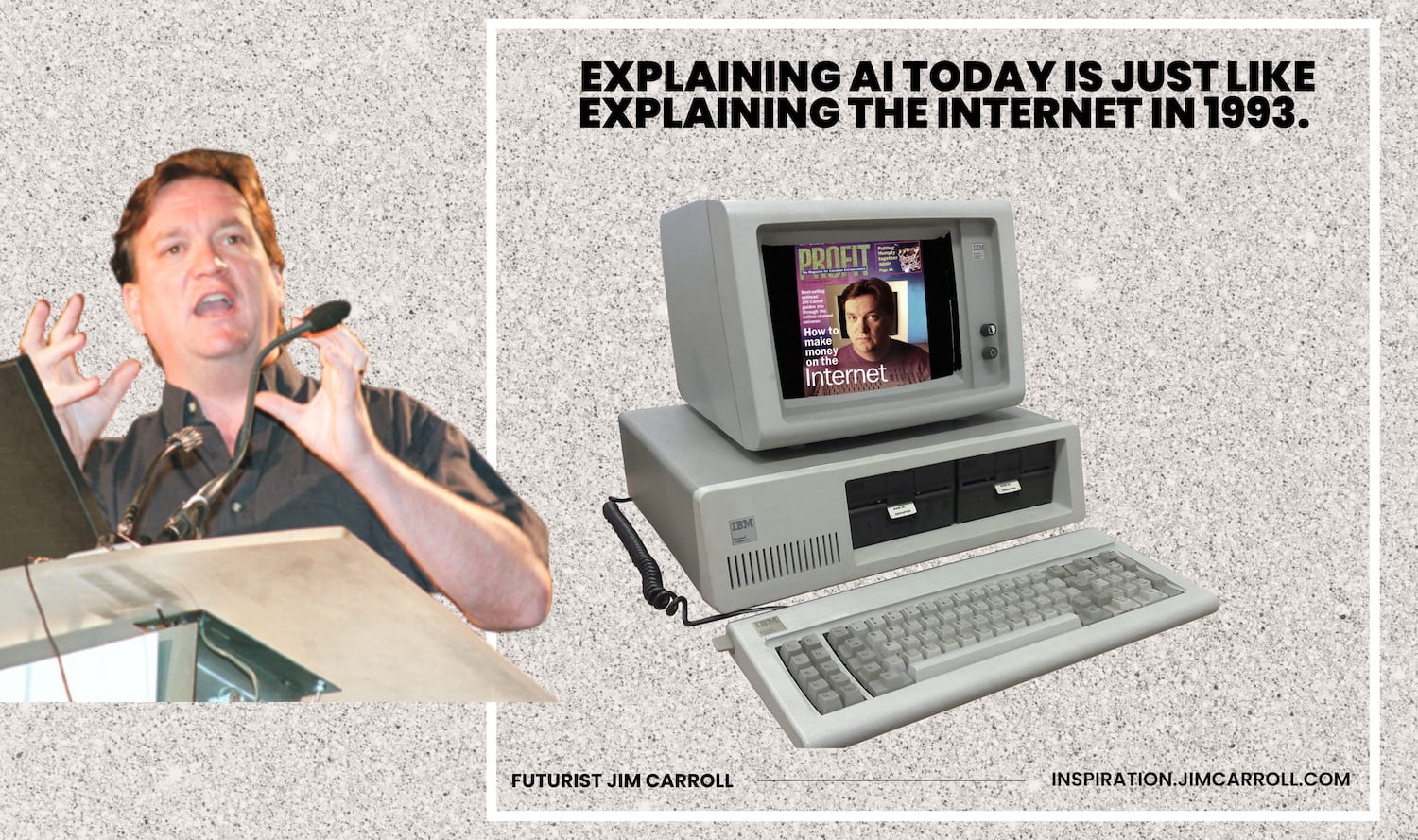
My 90s, as some of you know, were WILD. Writing and co-writing 34 books, hosting multiple national radio shows, writing columns regularly for newspapers and magazines, doing HUNDREDS of media interviews, including TV, print, and radio … and raising a young family with my wife at the same time. Wild.
With stuff like this – an interview in March 1994, one of literally hundreds I did over the years to come. I was out on book tours across Canada and often had 5 TV interviews back to back. Exhausting!

One of the books I co-wrote in 1995 – which followed a Profit magazine cover story profile shortly before which examined the strategic business opportunities of the Internet – went by the awful name of the Canadian Internet Advantage. It was a business strategy book, plain and simple – how could you use the Internet for strategic impact? It opened with this observation:
“….new software and imaginative services are making the Internet one of the most exciting places ever for doing business.”
The Internet – How it will change the way you do business
BusinessWeek, November 14, 1994Even before you bought this book, you have probably heard much about the wonders of the Internet, and how it will change the world around us.
While you hear a lot of talk about the Internet, you may still not be quite sure what it is or what it represents. You might be confused by the technology that surrounds it, or overwhelmed by the hype that seems to envelope it.
You might be intimidated by the computer technology that makes up the Internet. You want to understand it without listening to computer geeks speak of the wonders of high-speed broadband internetworking or the joys of multitasking. You might want to understand the Internet without getting lost in talk about bits and bytes and RAM and ROM and FTP and Telnet.
You might even be using the Internet already, on a day-to-day basis, but you want a better understanding of what it is really all about. Having ventured into the Internet, you can tell that something important is going on, but you are not quite sure what. You need a clearer picture of where all this stuff is headed.
You have an interest in the network known as the Internet — but to your frustration, no one has been able to explain the strategic potential of the Internet to you.
And so, you want to understand the business opportunities that can be found through use of the Internet. You want to know how it can be used in an educational or government setting. You want to understand its role in not-for-profit organizations. You want to know its impact on scientific research and health care services.
You need to understand the Internet as a strategy, not just as a technology.
Regardless of who you are and no matter what your objectives, it is clear that you need a good, hard and honest look at the opportunities that can be found in the network known as the Internet.
That’s what this book is all about.
* * * * * * *
The mere existence of such a trend is pause for some thought. How will business be affected? Education? Government? Science? Our own personal lives?
No one knows for sure what will happen, but one thing is for sure — the impact on our world, of a trend in which all computers globally become linked together, will be dramatic.
Substitute ‘AI’ for ‘Internet’ – and swap out ‘FTP and Telnet’ for ‘ChatGPT and LLM’s’ – and it says the same thing.
The book then went on to outline the fact that it would provide ‘strategic clarity’ around the Internet. Today, I’m using the same phrase – ‘strategic clarity’ – as I get booked by an increasing number of executives what is really going on out there.
In the Internet strategy book, we noted the necessity to cut through the hype.
For all the promise that the Internet shows, we need to keep in mind that we are still in the very early stages of a significant development.
This is particularly true when it comes to the use of the Internet for strategic purposes. There has been a lot of talk of late about the significant ‘competitive advantage’ that organizations can obtain by utilizing the Internet.
Like any new technology, we need to be realistic in our expectations of what the Internet can deliver. We need an understanding of its promise without the hype.
In this book, we will provide you with an overview of the Internet without that hype. We will help you understand the role of the Internet in business, education, government and the not-for-profit sector, without getting you lost in the technology. We will put into perspective some of the key activities that your organization can begin to explore in order to understand where the Internet might bring you some benefit.
We’ll talk about the Internet in simple, human terms, and not in technical terms.
I’m thinking about these issues today – and a lot recently, actually – as I head down to Houston to meet with the CEOs of 60 major software companies to talk about the strategic business role of AI. I find myself in the same mindset – there is something massive playing out here, but there is going to be some time for it to all unfold. Meanwhile, some companies are rushing into it blind, chasing a technology without a strategy; the hype machine is in full force; and a lot of foolish mistakes are being made.
Meanwhile, those who think strategically and recognize this is a fast-moving long-term game are the ones who will win.
Back in 1993? We led the same idea with the buzzkill.
The Internet is for the Long Term
As a first step, we’ll be quite frank with you on the benefits of the Internet.
If you get involved with the Internet, you need to recognize that it is a system that can take some time to deliver results.
The Internet won’t dramatically affect your business overnight — the Internet is not a place to ‘get rich quick.’ You won’t instantly become a ‘knowledge expert’, able to access the whole of human knowledge merely by pressing a key — it will take some time to learn how to navigate its massive information sources. Using the Internet for a week or a month won’t dramatically change your skill set such that you are more likely to find a job or opportunity — the Internet will change your skills in more subtle ways.
The Internet promises a lot, but in approaching it, you need to be real in your expectations.
Substitute AI for Internet in that paragraph, and here we find ourselves today. I will be sharing the same type of message in Houston, with this closing slide:
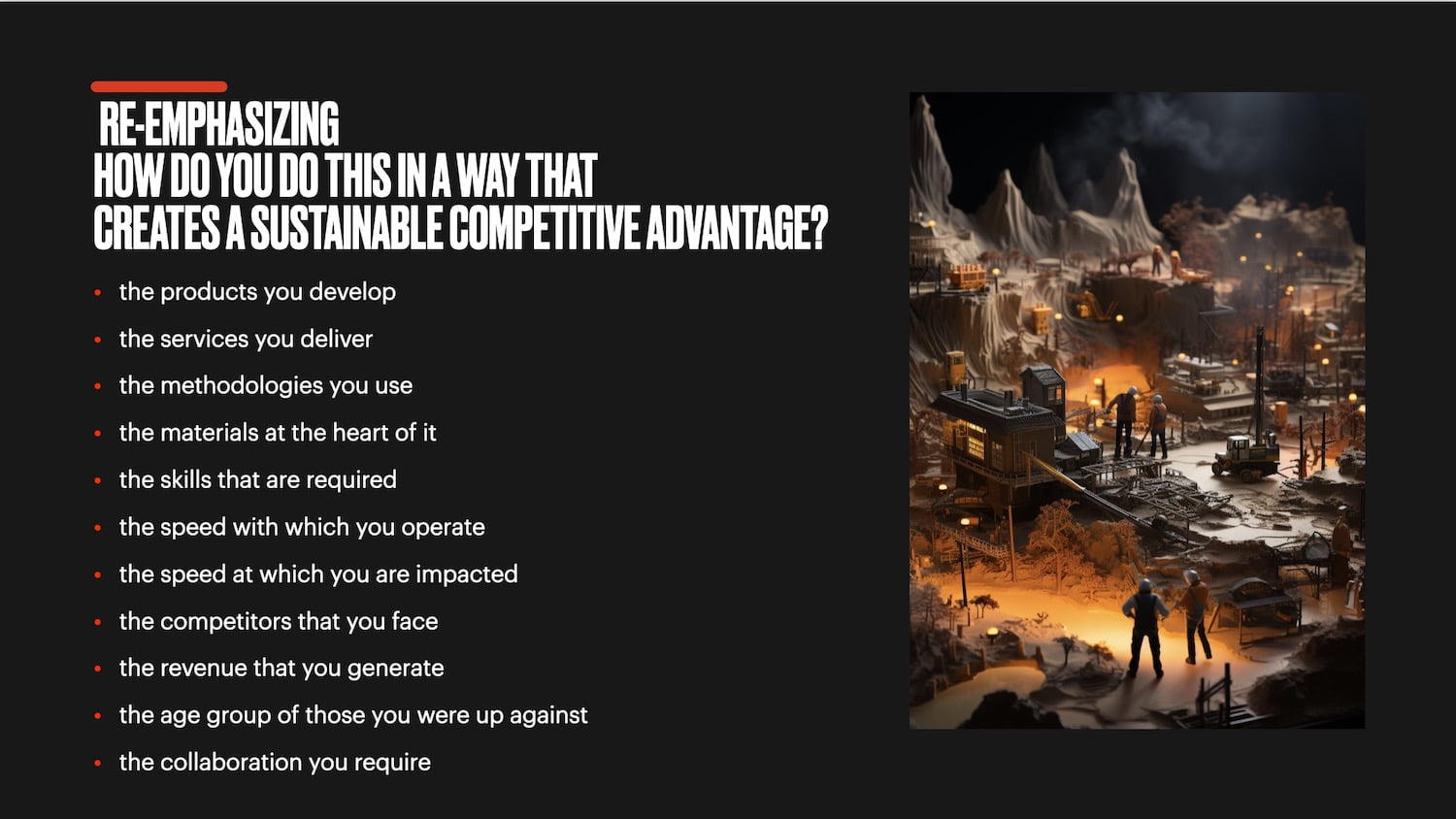
AI – how do you take advantage of it in a way that creates a sustainable competitive advantage? The bottom line is this – AI is going to change:
But it’s not going to do this overnight, and you need to be strategic in your thinking.
It’s 1993 all over again.
It’s fascinating.



GET IN TOUCH
Jim's Facebook page
You'll find Jim's latest videos on Youtube
Mastodon. What's on Jim's mind? Check his feed!
LinkedIn - reach out to Jim for a professional connection!
Flickr! Get inspired! A massive archive of all of Jim's daily inspirational quotes!
Instagram - the home for Jim's motivational mind!