“Every day, it is more obvious that the future isn’t just a fiction – it’s reality!” – Futurist Jim Carroll

by JimCarroll
“Every day, it is more obvious that the future isn’t just a fiction – it’s reality!” – Futurist Jim Carroll

by JimCarroll
“What made you successful in the last 10 years will not make you successful in the next 10. Given that, what are you going to change in your thinking and your strategy to adjust to this harsh reality?” – Futurist Jim Carroll
10 Signs that You are Failing at Innovation, and What You Should Do About It!
For close to 25 years, I have been relentlessly studying what makes organizations successful at dealing with the future and innovation. I know why some fail, while others succeed.
In those who fail, there are some common traits :
Innovative companies act differently. In these organizations
The fact is, every organization should be able to develop innovation as a core virtue — if they aren’t, they certainly won’t survive the rapid rate of change that envelopes us today.
by JimCarroll
“The function of a futurist? To help you understand where you want to go – and what you need to do to get there successfully!” – Futurist Jim Carroll

by JimCarroll
“The world needs more people with a new type of degree that I call the Masters in Business Imagination!” – Jim Carroll
Masters in Business Imagination – The Only Degree You’ll Ever Need!
Each day, I post a motivational quote from a stage to my Instagram feed. Follow me and get inspired!
This morning, I suggested that we need more people with a new degree I’ve proposed, that I call the Masters in Business Imagination!
I’ve been proposing this for quite some time, and in fact, back in 2004, wrote the MBI Manifesto. You can read it here, or access the PDF ] [icon name=”file-pdf-o” class=”” unprefixed_class=””]
I’ve done several keynotes specifically on the MBI theme; indeed, Fairmont/Raffles Hotel International had me in for a senior leadership meeting, to encourage their team to think differently about the future. How did it go?
“Thank you for coming to Whistler and speaking to our leadership team. Wow! What a session – we’ve seen a lot of motivational speakers, but you really managed to capture the reality of what we need to innovate in the context of some pretty dramatic trends and change. Outstanding!“
Need a unique keynote? Read on!
Keynote: The Masters in Business Imagination: Motivational Guidance for the Era of Fast!
In an era of dramatic and relentless change, people and organizations are scrambling to align themselves for a new, topsy-turvy world. Jim Carroll comes to the rescue with his keynote, The Masters in Business Imagination which will inspire your team to adopt relentless creativity and innovation as core virtues. Once you ‘graduate’ from his MBI class, you’ll possess the skills common to this critical degree of the 21st century economy, by linking your initiatives to a carefully calibrated curriculum of change-oriented thinking.
MBI’s see things differently – they don’t look at things like most people. MBI’s spur creativity in other people – they inspire others to develop similar levels of imaginative thinking. They focus on opportunity – not threat and realize that action, not inaction, is the driving force for the future. They refuse to accept the status quo and are prepared to eliminate habit. MBI’s bring big ideas to life – and paint pictures of where the organization is going to go, rather than focusing on where it has been in the past. They learn and unlearn, forgoing the dangerous assumption that what they know today will carry them into tomorrow. Most important of all, they refuse to say the word CAN’T. They know that barriers, perceived or otherwise, are simply temporary roadblocks that they can get around with fresh insight, imaginative analysis, and creative thinking!
Fire up your enthusiasm, energy and innovation spirit with a unique motivational keynote by futurist Jim Carroll, as he inspires your team to align themselves to the only degree they will need for the future – The Masters in Business Imagination!
by JimCarroll
Last week, I was in Palm Springs, California, with a session for a board of directors on what’s really going on with the acceleration towards self-driving cars and trucks.
To prepare, I used my secret weapon, and actually grabbed close to 850 articles from the last two months on things going on in this fast moving sector, and read through them all. Whoah! Lots happening and fast! ( That’s typical of the preparation I put into many of my leadership meetings and keynotes.)
One article in the bunch, though, really captured my attention: “Penguins could keep your self driving car safe“. The article was published in January over at the Daily Mail. [icon name=”external-link” class=”” unprefixed_class=””]
The essence of the research reported upon in the article is this: “penguins hunt in groups and synchronize their dives to catch fish.” Studying how they do so could provide invaluable insight into the evolution of self-driving cars. Much of the article focused on how that type of behaviour could help to avoid the future hacking of cars, but I think that there is much more going on than that…..
Self-driving cars will be connected by telemetry, LIDAR and other technologies, and will operate in a pack mentality to coordinate their efforts. This permits the emergence of ‘pelotons’ — connected ‘trains’ of vehicles in communication with each other, and in communication with intelligent, connnected smart highway technology. (Did you know that Amazon has some patents with respect to the latter?) We are already seeing trials in which groups of 6, 8 or 10 trucks travel together, separated by just a few feet, travelling in a coordinated group at 60mph. Pack-activity.
Penguins are great in travelling in packs, so why not learn how they do it, and engineer that into autonomous vehicle technology…. and so studying how nature does this will provide deep insight into what to do this with cars and trucks.
If you think this through, the result? The Intel-Mobileye $15 billion deal is just the tip of the iceberg, so to speak, for what is to come in terms of access to skills and R&D in automotive.
You can expect Silicon Valley and car companies to be seeking out and hiring a lot of penguin-researchers, and other specialists in the study of animal behaviour. It’s called biomimicry, and its an approach that has been used for quite some time to engineer unique solutions to complex problems.
The thinking is that there are opportunities that can come from emulating the time-proven methodologies and strategies as seen in nature. Examples abound, as noted in the Daily Mail article:
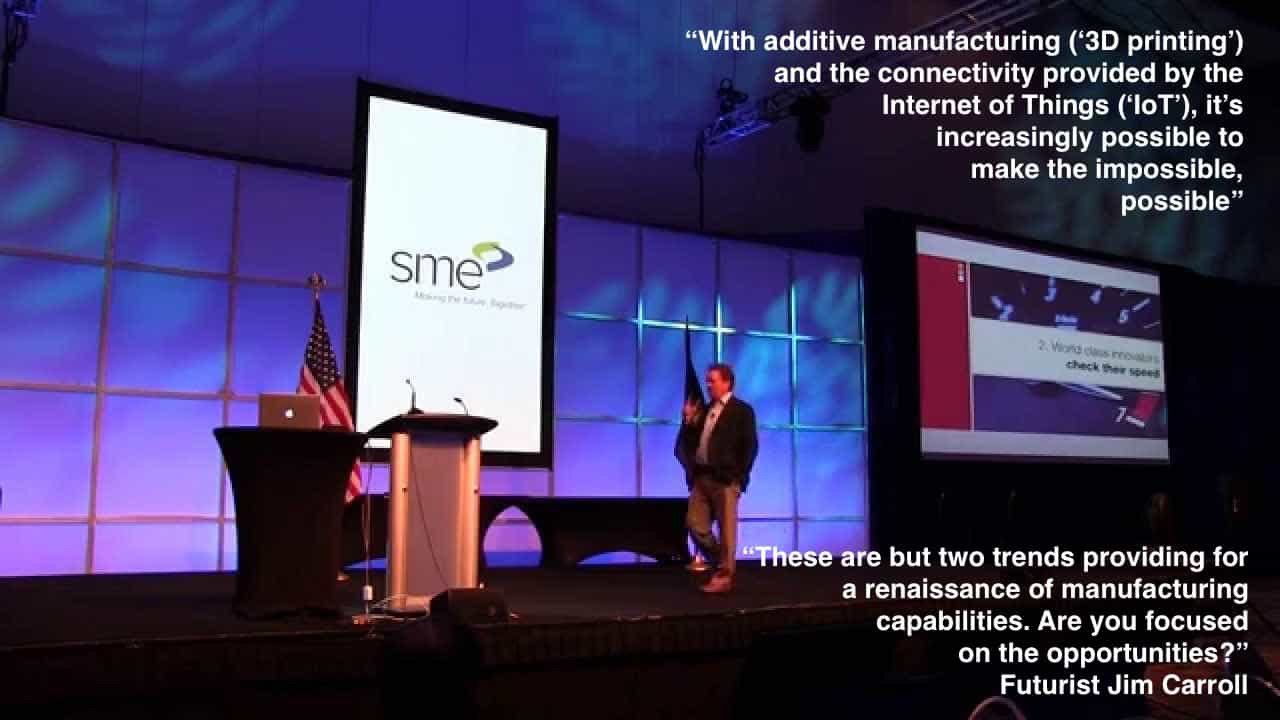
It goes beyond animals : I’ve been keynoting quite a few manufacturing conferences, and have spoken about the acceleration of 3D printing, or additive manufacturing. Here’s something cool : Airbus is evolving its approach to 3D printing by study botany, with the thinking that if it can mimic the structural strength of plants, it can print interior structures that are lighter and stronger. Important for airplanes!
In other words, the future doesn’t just belong to those who are fast. It belongs to those who understand the importance of penguins!
by JimCarroll

The folks at Postal and Parcel Technology Magazine approached me some months back to write an article about the future of mail in the era of technology, and particularly, e-mail.
I suggested to them that rather than looking forward, why not look to the past for valuable lessons?
Such as, how organizations seem to always react in a negative way to new technologies, new ideas and innovation?
What better way to do so than by writing about the fact that I was almost fired in 1989 (yup, 28 years ago) because of a cover story that I was featured in about electronic mail. And the fact that some folks who had a vested interest in paper mail read the article, didn’t like it, and complained. Kind of loudly. Because they didn’t like change….
The folks at Postal and Parcel loved the idea – and so we ran an article, below.
So what happened in 1989? I wasn’t fired. I ended up quitting the firm some months later, after 10 years, because the senior leadership team couldn’t comprehend my indications that something ‘big’ was happening.
For a few years, I made a lot of money actually consulting to companies on technology. Then I wrote some books (34, actually) about the Internet, and sold about 2 million books. That got me on the speaker circuit. I started speaking about the future. Companies took notice of what I was saying. More and more people and companies noticed, and I soon found myself providing guidance on the future to some fascinating organizations. One day, I found myself in front of some astronauts and astrophysicists at NASA, speaking to them about the future of space, the space industry, and the realities of innovation!
The article — click the image for a full version. Or access the PDF : [icon name=”file-pdf-o” class=”” unprefixed_class=””]. Read it below!
Fright Club
Jim Carroll Explains Why Organizations Should Never Fear Change
Postal and Parcel Technology International, March 2017
In October 1989 I was almost fired from a job with a global professional services firm because of email! Not because of anything I had sent or received, but because I appeared in an office automation magazine extolling the benefits of using electronic mail over regular paper mail.
Why did this get me in trouble? The firm I was with had a contract with a large national postal services organization, and it seems the CEO took exception to someone internal promoting the virtues of a whacky new form of communication that could replace paper mail. After some explaining that I had no nefarious intent, cooler heads prevailed and I kept my job, although I later decided it was developments like email that really interested me, so I became a global futurist and expert on innovation, and today count Disney, NASA and Johnson & Johnson among my clients.
Email is an example of something that forever changed the way we communicate, but as my story shows, there are people who don’t like new technology and the change it represents. But it also makes the point that you have to move beyond that type of thinking if you are to survive.
Over the years, I have spent time with a tremendous number of organizations and have seen some business models decimated by technology – just as others turn the same ideas into an opportunity. Ideally you want to be in the latter camp, but how?
First of all, accept that in the future you won’t even recognize the industry you are operating in. That’s because the rate of business model change is accelerating in every single industry. In 10 years’ time your business model will look nothing like it does today, with a huge disruption most likely to stem from a younger generation with a better grasp of the latest technologies.
Now, the technology they use will probably seem unrelated or irrelevant to your area of business at first, and you may discount it, but the truth will be that if you don’t embrace it, your operation won’t survive. Examples of this type of disruption are occurring right now.
Battling against a culture of innovation can set you upward this. form of organizational sclerosis. It will clog up your ability to pursue new ideas. How do you recognize if you have a problem? There are a few recognizable signs For example, do you laugh at new ideas? Is your organization more focused on process than success/ Is the company culture very much, “Well, this is how we do it because we’ve always done it this way?”
Innovative companies are different. Ideas flow freely throughout the organization, and success and failure are championed. There are many leaders who encourage innovative thinking, rather than magaers who run a bureacracracy, and a number of creative champions who thrive on thinking about how to do things differently. These companies recognize that innovation is also about how to run, grow and transform the business.
The fact is, every organization should be able to develop innovation as a core virtue – if it isn’t, it certainly won’t survive the rapid rate of change that envelopes us today.
I am a big believer that the world of communications and logistics – as found in the postal industry – has a fascinating and marvellous future in this new, fast-paced, virtual/physical economy that is being created. But to do that, you must have an open mind and a willingness to embrace the future.
In other words, don’t fire the messenger. Ask yourself, “What is the messenger really trying to tell us?

Each workday morning, a short bit of inspirational insight from Jim. No clutter, no muss, no fuss. Archives are at https://inspiration.jimcarroll.com


GET IN TOUCH
Jim's Facebook page
You'll find Jim's latest videos on Youtube
Mastodon. What's on Jim's mind? Check his feed!
LinkedIn - reach out to Jim for a professional connection!
Flickr! Get inspired! A massive archive of all of Jim's daily inspirational quotes!
Instagram - the home for Jim's motivational mind!