Legacy no longer matters – it’s what you do next that counts!
Here’s why!

by JimCarroll
Legacy no longer matters – it’s what you do next that counts!
Here’s why!

by JimCarroll
“Those who don’t like a trend don’t just oppose the trend, they now deny the reality of the trend itself” – Futurist Jim Carroll

I’ve done a LOT of economic development-oriented keynotes over the years – for government agencies, regional associations, economic development organizations,s, and companies, on the trends that will define the next wave of opportunity. These talks usually revolve around such issues as advanced manufacturing, workforce skills issues, disruptive business models, the acceleration of technology, and similar issues – all trends that are resulting in new jobs, new companies, and new opportunities.
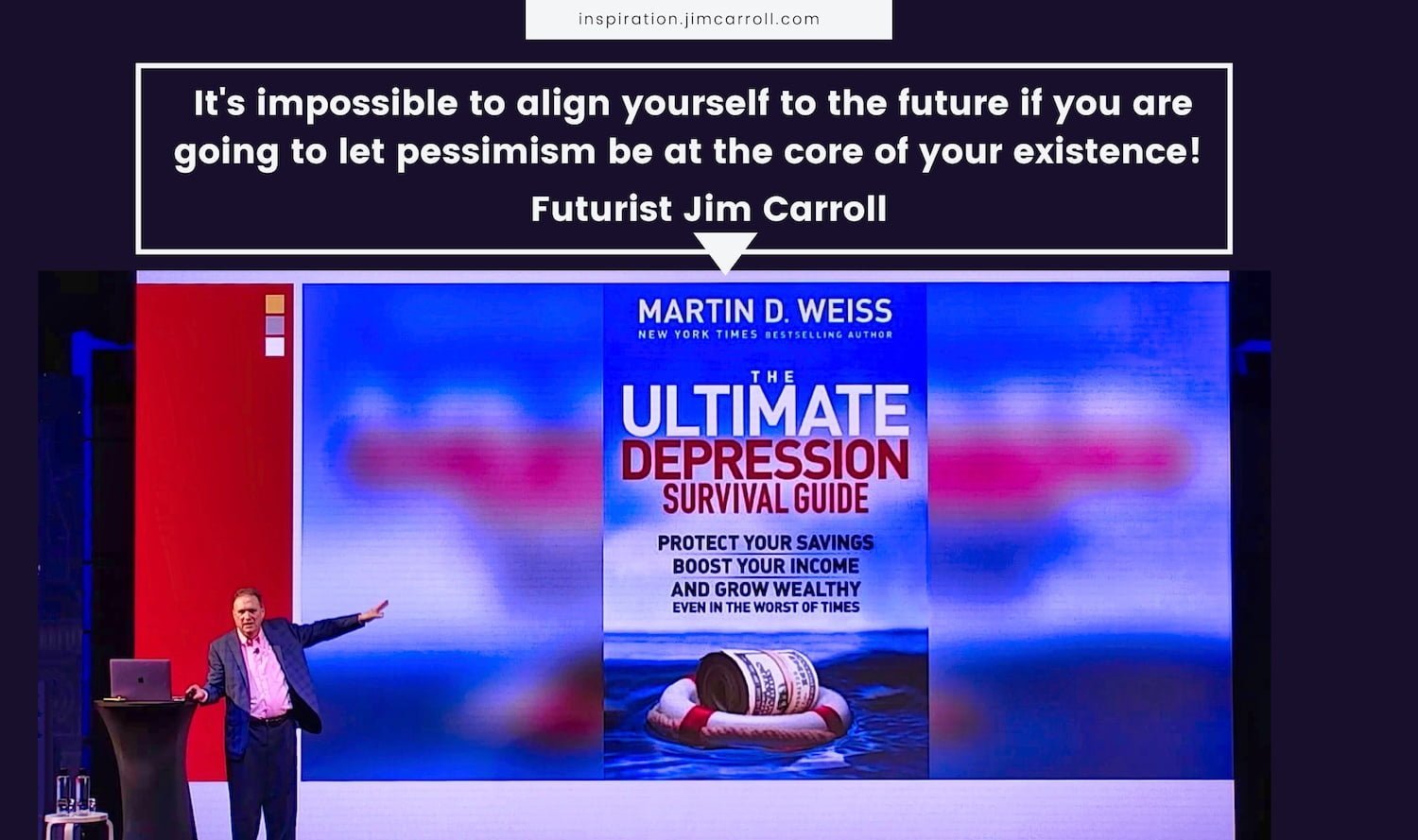
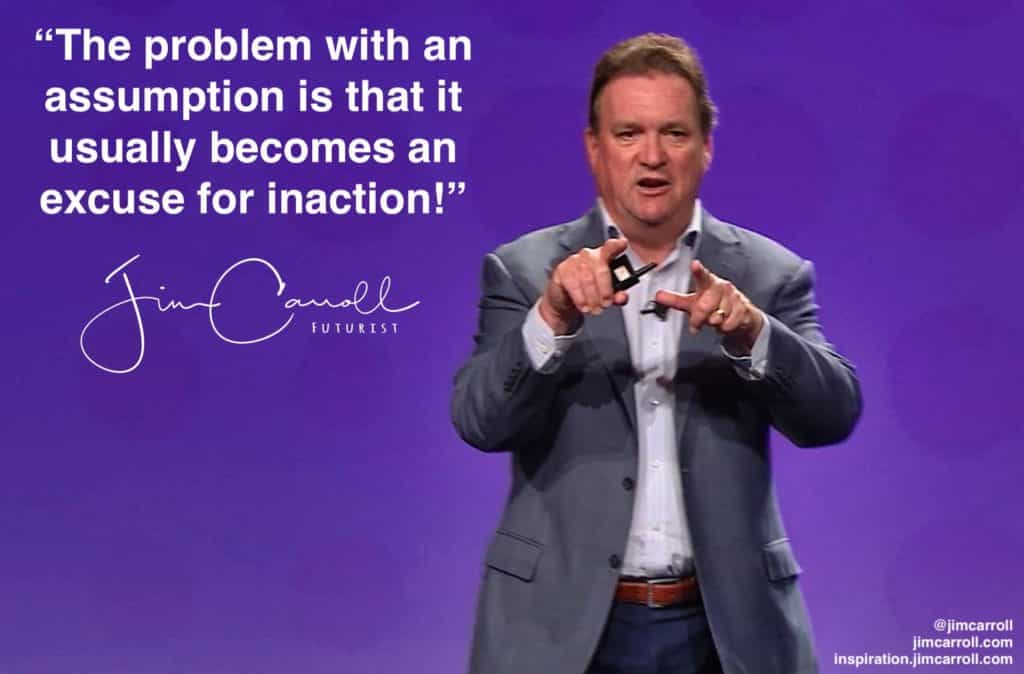
This has included events such as the Nevada Economic Development Association; business relocation groups such as CoreNet, the Industrial Asset Management Council (who represent the Fortune 1000 companies making major factory investment decisions), and many others. All of these talks have examined what it takes to accelerate a region into the future – aligning to trends, building an environment and infrastructure supportive of economic growth, and more. The particular photo used in today’s quote is from the IAMC event in Richmond, Virginia – the third time in two decades they’ve asked me to open their event.
But things have changed. There is no doubt that in the last few years, many regions have been doing everything they can to turn themselves away from opportunity, putting in place barriers, rolling back the future, or denying the reality of trends. I’m always fascinated – and shocked at the stupidity really – when I see politicians attacking wind energy ‘because the lights might go out,’ and who fail to understand the role of battery technology in the next-generation grid. This type of sheer stupidity will do nothing to attract new energy jobs to such a region – leading companies in this new era in which oil and carbon are over will choose other regions in which to make their investment.
Political populism does not create jobs – it destroys them. And with that in mind, here’s the second version of today’s quote: “Those who attack the future, try to roll back the future, or stack the odds against the future, will be taken aback by the lack of opportunity in the future!”

I try to avoid politics in these posts, but we are seeing this trend everywhere – attacks on teachers, education materials, and classrooms, with plans for veterans to take on the role of educators; the reversal of long-standing constitutional rights with an attack on reproductive health and marriage; dismissal of the science and opportunity of wind energy and other forms of renewable technology in the face of a deepening energy crisis; the denial of the acceleration of climate damage.
Here’s the thing – an anti-future agenda can only go so far before the companies and groups who make economic development decisions are going to choose to invest elsewhere. I’ll just leave this observation here:
As a global company headquartered in Indianapolis for more than 145 years, we work hard to retain and attract thousands of people who are important drivers of our state’s economy. Given this new law, we will be forced to plan for more employment growth outside our home state,” the company said in a statement obtained by Fox News Digital on Sunday. Fox News, August 2022
I’ve tried to describe this on stage by explaining it in the context of the time the Jetsons met the Flinstones. This is our world right now.

Of course, one time, I was really wound up on stage. Fair warning – if you are a big fan of a guy who likes to abscond with nuclear secrets, you probably don’t want to watch this clip. But I would also suspect that you are probably not a fan of mine in any event, since those are the folks who really don’t seem to like the future anyways!

What happens when a region turns its back on the future? Florida will have difficulty attracting teachers in the future; Indiana and other regions will not become a chosen destination for new doctors and nurses starting their professional careers, and other similar trends unfold. This does not happen all at once – economic decline happens slowly and then, all at once.
With that in mind, here’s what I think will happen:
It’s pretty clear that the trend we will see in the future is that future denialism carries a price.
I spoke about this issue in this recent manufacturing podcast – and it was interesting, that this particular issue REALLY drew the attention of the two fellows interviewing me.

The reality, sometimes, hurts.
by JimCarroll
“Visionaries chase vague opportunities in the face of massive uncertainty in order to find an unknown, elusive future reality!” – Futurist Jim Carroll

I was about to send out my post when I decided to go in a different direction – and so here was the first cut!
“Experiential capital: Do things that have a vague objective, an unknown potential for success, and an uncertain payback!” – Futurist Jim Carroll

Why should you pursue uncertainty, chase vague opportunities and try and find an elusive reality? Because it might be one of the most important leadership strategies that you pursue as we go into the era of acceleration! It will help to ensure you develop the required yet unknown and undeveloped skills that you need for an uncertain future. It will enhance your balance sheet with real 21st-century capital – learn more – – about what I’ve come to call experiential capital!
What I’ve learned from watching my global client base is that those who succeed are willing to take on projects, not to win – but to learn. They are constantly working on projects that might have an uncertain return and unknown payback – but which will provide their in-depth experience and insight into some key aspects of the disruptive change that will impact them going forward. It’s by understanding change that opportunity is defined, and that’s what experiential capital happens to be – and in the future, it will be one of the most important assets you can possess.
Watch this compilation video where I’m busy on stage describing the concept of experiential capital: it gets right to the point.

In the 20th century, financial capital was the resource of choice. That doesn’t cut it anymore. Today, it’s all about skills, experience, creativity, and more. Do you have what it takes? Read my post: “Understanding 21st Century Capital: Why It’s Not Just Financial Capital Anymore!”
In my book Ready, Set, Done: How to Innovate When Faster is the New Fast, I made this observation:
“Innovation comes from risk, and risk comes from experience. The most important asset today isn’t found on your balance sheet – it is found in the accumulated wisdom from the many risks that you’ve taken. The more experiential capital you have, the more you’ll succeed.”
I can’t emphasize enough how important investment this can be – here’s a variety of previous blog posts you can explore to understand the concept in further depth.
How do you go about doing it? Play more!

Put frivolous play into your daily routine!
by JimCarroll
“Everything you know is instantly, suddenly obsolete!” – Futurist Jim Carroll

Let’s consider skills and knowledge.
I purchased one of the very first internet-enabled thermostats almost two decades ago, long before they became mainstream as Nest or ecobee devices. I always took great delight in telling the story on stage when my HVAC contractor came into our house for the installation, looked at it, and said “Wow, this is kind of complicated. I can do the wiring that goes into the air conditioner and the furnace, but this Ethernet stuff, this computer stuff, I have no idea what to do with it.”
And I said, “That’s okay. My 12-year-old will do the Ethernet wiring,” and he did.
Think about what has happened here. That HVAC contractor, all of a sudden – the knowledge that he or she needs to know to do his or her job has forever changed! The industry has become so complex, with so much new knowledge with new devices, new technologies, new concepts, and new forms of home installation to support (wind, solar, local microgrids, batteries) that simply knowing how to install a two-pair wire into a thermostat is no longer enough.
I tell the story on stage here:

The reality is that we are in a world of faster knowledge obsolescence and the rapid emergence of new knowledge. Everything you know today will be replaced by something new tomorrow.
This type of reality is occurring in every industry. A truck today contains more technology than a typical Cessna airplane. The volume of knowledge for any healthcare worker is now doubling every 78 days. The typical machinist almost needs to be able to do trigonometry in their heads, according to one robotics manufacturer. An auto mechanic today is essentially a hi-tech computer repair technician. We are in a world in which the knowledge that is required in any industry is changing at a furious pace – Mercedes-Benz is investing a billion dollars to get insight and capabilities into battery science, battery technology, electric vehicle tech, and self-driving concepts.
How do we respond to a world in which everything is going out of date faster than ever before, being supplanted and enhanced by new knowledge?
At a personal level, make sure you are learning for a living. If you aren’t learning, you aren’t living.
And at a corporate level, expand your knowledge assets. We are in a world in which organizations and industries are establishing external ecosystems to help them put in place the knowledge and skills and capabilities to take themselves into a faster future. This includes the use of tools to access small pools of niche knowledge, external knowledge partnerships, and “complexity partnerships.”
Everything you know is becoming obsolete – and so replenish your knowledge faster.
by JimCarroll
It’s going to be a spectacular fall with a number of fascinating events!
I’ll be kicking it off in Des Moines, Iowa, with a keynote that focuses on two key issues – inovating in uncertainty, and the future of construction!
Rethinking Housing in the Era of Volatility – It’s a Great Time to Double Down on Innovation!
In an era of economic volatility, it’s more important than ever to focus on the future in order to achieve the core mandate of assisting the less fortunate in society. When it comes to housing, it’s also important to align opportunities for shelter with new opportunities that exist. That’s where the message of Futurist Jim Carroll comes in with a two-track message.
The economy? Here’s a key reality that Jim has shared with his global clients through the recession of ’01 and ’08 – only 10% of organizations become breakthrough performers during a recession – but that is because they decided to double down on their innovation efforts despite uncertainty. That’s a powerful lesson for all of us – because the other 90%, driven by aggressive indecision, become the marginal performers, the failures, the innovation laggards. That’s why it is important for the housing sector in Iowa to double down on the future despite economic volatility – and to focus on the trends that will drive future growth.
Growth? Opportunities? In the housing and construction sector, we are seeing fascinating new trends with methodologies, materials, robotics, energy efficiency and so much more. The concept of 3D printing housing components has gone from science fiction fantasy to practical potential reality in just a matter of years; the emergence of new construction materials continues to offer up opportunities for cost efficiencies and savings in the overall budget; automated masons and bricklaying concepts are already being pursued, moving from theory to reality faster than we might think. And energy? Oil is over, solar and wind dominate the future, and local neighborhood microgrids drive opportunity. Consider this fact – we are already seeing the emergence of window technology that is not just a window – but a solar energy generator at the same time! When it comes to construction, the future is nothing but an opportunity!
Join us in a keynote on a voyage with Futurist Jim Carroll as he helps us understand what comes next, and what to do about it!
by JimCarroll
“If you aren’t thinking big enough then you aren’t thinking at all!” – Futurist Jim Carroll

Are you thinking BIG enough?
That’s the challenge I often raise on stage – and in this case, on the Bridge of the Enterprise from Star Trek. Built at the Center for the Performing Arts in Las Vegas. Leonard Nimoy – Spock – was on stage just before me at this event in 2009. My job at this event in front of thousands was to help them to think BIG – to realize that their world was changing, and that if they didn’t change with it, it might not work out too well!

Here’s the thing – with so much transformative change underway, this is no time to think “small.” This is the time in which you need to be thinking “big.”
How “small” is your world? Do you have a narrow view of opportunity? Do you think in small, incremental steps? Do you focus on small ideas? Do you drive yourself forward with tiny initiatives? Do you hold yourself back through incredibly narrow goals? Do you measure your success each and every day through a series of small, incremental wins? This is not necessarily a bad thing – any type of initiative is a great initiative – but are you missing out by limiting your thinking and actions?
The reality is that right now, thinking BIG in terms of opportunity and the future will be crucial to your future success. Every single industry is in the midst of massive change – a world of 24-hour farming, precision medicine, manufacturing based on mass customization, the acceleration of renewables and battery technology, and insurance based upon real-time data analytics. Most industries will be barely recognizable in the future – the only remaining issues in getting there are relentless volatility and the timing of trends.
What does it mean for your future? In the old days, companies had “industries” that they worked within, “markets” that they sold into, “products and services” they sold, and “business models” that they based decisions upon. Every single one of those items in quotes is changing, This means that the assumptions that drive decisions are out of date, flawed and broken. All this is happening with an overall belief that the world will continue to move relatively slowly.
Every single assumption that you might have about your future could be wrong. Challenge those assumptions, think about the rapidity of future trends, and innovate — and you’ll find the growth opportunities that seem to elude so many others.
Think about this NOW!
Think BIG!
Each workday morning, a short bit of inspirational insight from Jim. No clutter, no muss, no fuss. Archives are at https://inspiration.jimcarroll.com


GET IN TOUCH
Jim's Facebook page
You'll find Jim's latest videos on Youtube
Mastodon. What's on Jim's mind? Check his feed!
LinkedIn - reach out to Jim for a professional connection!
Flickr! Get inspired! A massive archive of all of Jim's daily inspirational quotes!
Instagram - the home for Jim's motivational mind!