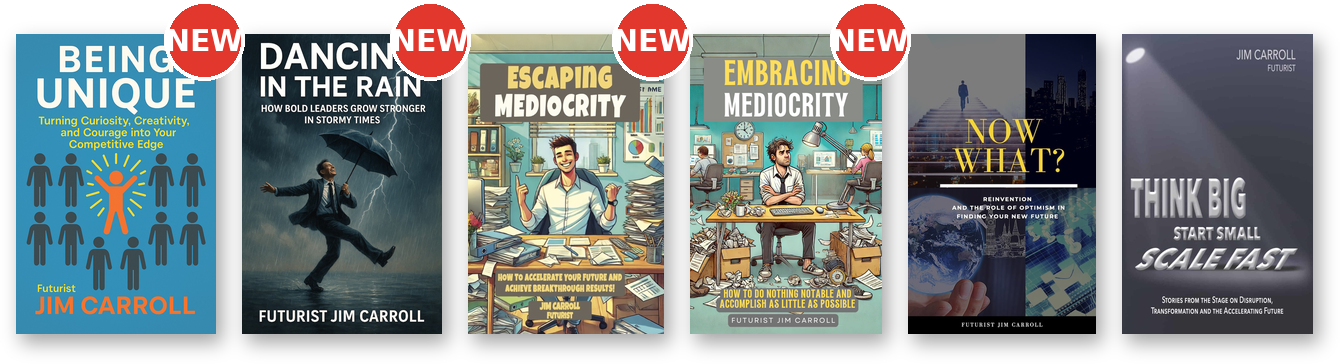
So many folks are asking for short summaries of my keynote topic that I’ve decided to pull together a PDF summary.
You can grab it here.


So many folks are asking for short summaries of my keynote topic that I’ve decided to pull together a PDF summary.
You can grab it here.
“Pursue ideas. Chase dreams. Be bold. Enjoy the ride!” – Futurist Jim Carroll
I’m on stage early this morning, so I don’t have a lot of time to write this post. As a result, I thought I would just come up with a list of 2-word phrases that can inspire, challenge, motivate, and encourage you.
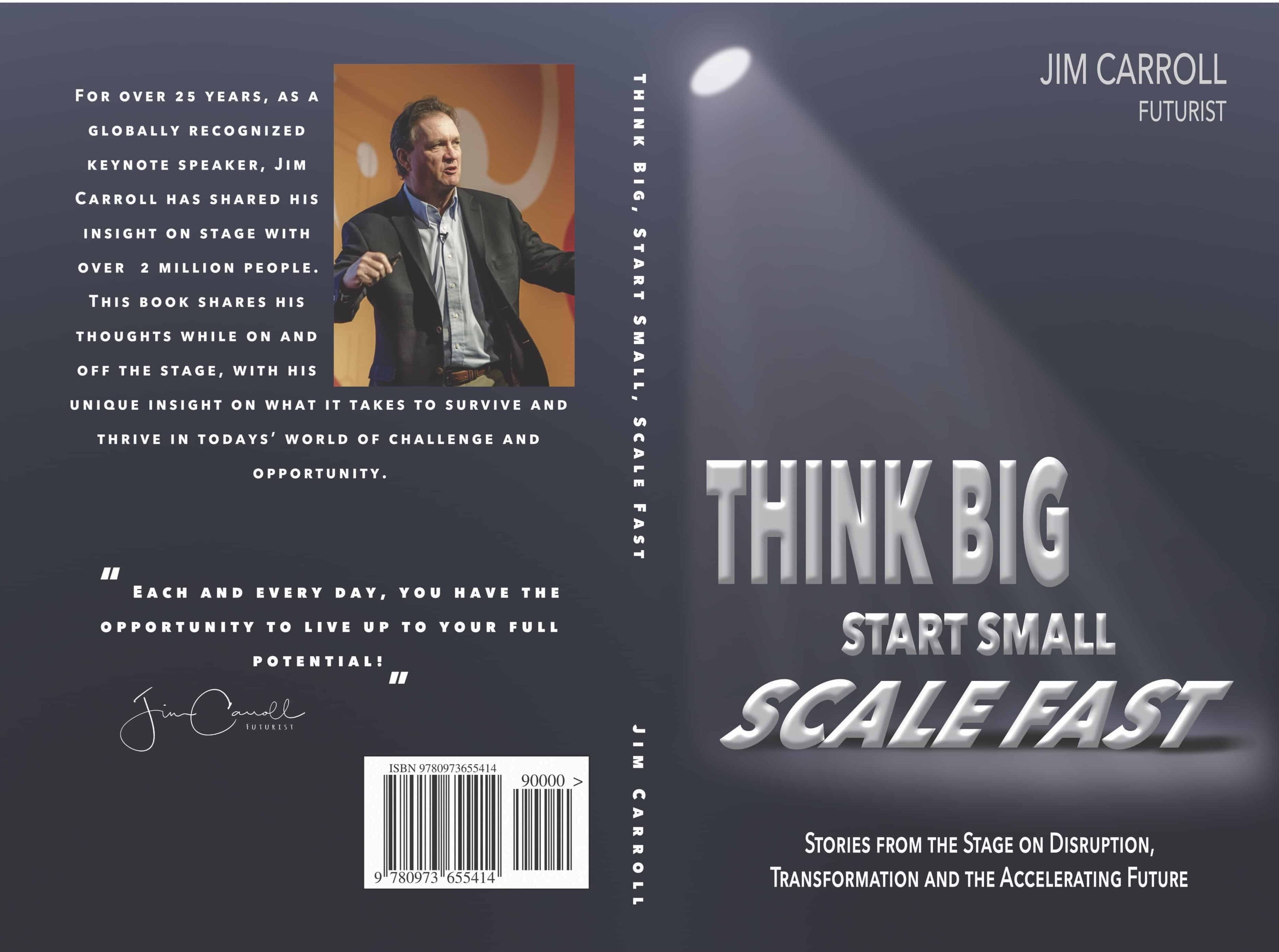
I’ve always liked short, sharp shocks of insight (a tribute to Pink Floyd there!) since I find that it can help us to think big and be bold about the future. I guess I’ve done this for a long time; I even used the three phrases that start this list in the title of one of my books!
I’ve always also liked the idea of lists that have a type of ‘number branding,’ and so how about 101?
With that in mind, here goes!
I’m not sure if there is duplication, but it is a fun list!
“How do you identify a truly great idea? As soon as someone says ‘That’s the dumbest thing I’ve ever heard!'” – Futurist Jim Carroll
Every great idea was once the dumbest thing you ever heard!
I’ve said many times in the past, and I repeated it again during the Q&A portion of a virtual talk I gave the other day:
Q. “What early indicators should we look out for that would give us an indication that a once unproven technology, what is a big, bold idea that you referred to, is about to become widely adopted.”
A. “My answer to that would be when a lot of people are saying “That’s the dumbest thing I ever heard.”

I spent a little bit of time looking into the genesis of this idea, using my online research database tool. Lo and behold, I dub out this article from 2003 when I first began to use the phrase in the media. It’s a great article – and is evocative of a time when I was once again reinventing, shifting from focusing just on technology to the opportunities for disruptive, transformative thinking and innovation.
Despite years of cost-cutting, many organizations continue to operate with an alarmingly high-cost base, with scads of inefficient business processes built into the bureaucracy.
We reinvent the wheel over and over, unable to share ideas and information throughout the organization. We see valuable information walk out the door every time an employee leaves. We infuriate our customers through our inability to provide rapid, effective, intelligent customer support.
Why? Because we refuse to be innovative. We’ve got to get away from the past, and continue to reinvent ourselves for the future, through the application of all kinds of wildly innovative ideas as to how we work on a day-to-day basis.
Innovation implies courage, among other things. So how do you and your organization get into an innovative frame of mind?
Recognize that you’ve got to instill a sense of courage, a willingness to explore new things. The fact is, the current business climate certainly doesn’t encourage the emergence of any corporate innovation heroes. Indeed, it would seem that few of us have any gumption to try to do anything different, particularly given the carnage that emerged after the gung-ho nineties. Lots of new ideas there — and look what happened to all the folks who were on the leading edge! Who would dare try anything new?
Recognize that opportunity abounds for innovative approaches to our day-to-day routine. For example, given the vast range of sophisticated new technologies, there is no shortage of opportunities to continue to be innovative in the way that we utilize and share information within our organization. Have you taken a look at the hot new Internet technology known as Weblogs? They’re causing a lot of rethinking within the Internet community as to how to share information and there are plenty of opportunities there for sharing internal corporate knowledge.
Revisit opportunities to streamline business processes. What about that paper form that gets sent around the company, to be initialed and signed in duplicate and triplicate? There are plenty of inefficient business processes that surround us that could use a tune-up, with resulting efficiencies and cost savings. There are lots of innovative HR professionals who are busy putting in place sophisticated HR self-service employee portals which significantly streamline processes involving benefits management and other functions. Why aren’t you?
Constantly take a look at how you might provide more effective customer support. Innovative organizations continue to explore and implement sophisticated self-service solutions that help a call center rejig its approach to providing support during peak periods. Customers keep changing and are increasing their expectations as to the type of support you provide, so you’d better make sure that you are innovative in your response.
Take a look at your partners — suppliers and business associates. Are there unique ways that you might be able to partner with them to reduce costs, or simply make these inter-organization relationships work better?
All of these issues, and more, have little to do with the development of new products, yet are equally important in becoming an innovative organization.
Of course, you won’t succeed at all if you have a corporate culture that stops innovation dead in its tracks. If your executives are fond of statements such as “that’s the dumbest thing I ever heard,” “that’s not my problem,” “you can’t fix that” and “it won’t work,” then you’ve got a lot of work to do to develop a culture that supports innovative processes.
Smooth the wheels of innovation
28 November 2003, The Globe and Mail
To be a futurist is to be someone who is laughed at a lot. Mostly because people refuse to believe the accuracy of what we are telling them.
But, they stop laughing eventually.
LOL.
“Strategic clarity: It’s the compass that will guide you through the uncertainty of tomorrow.” – Futurist Jim Carroll
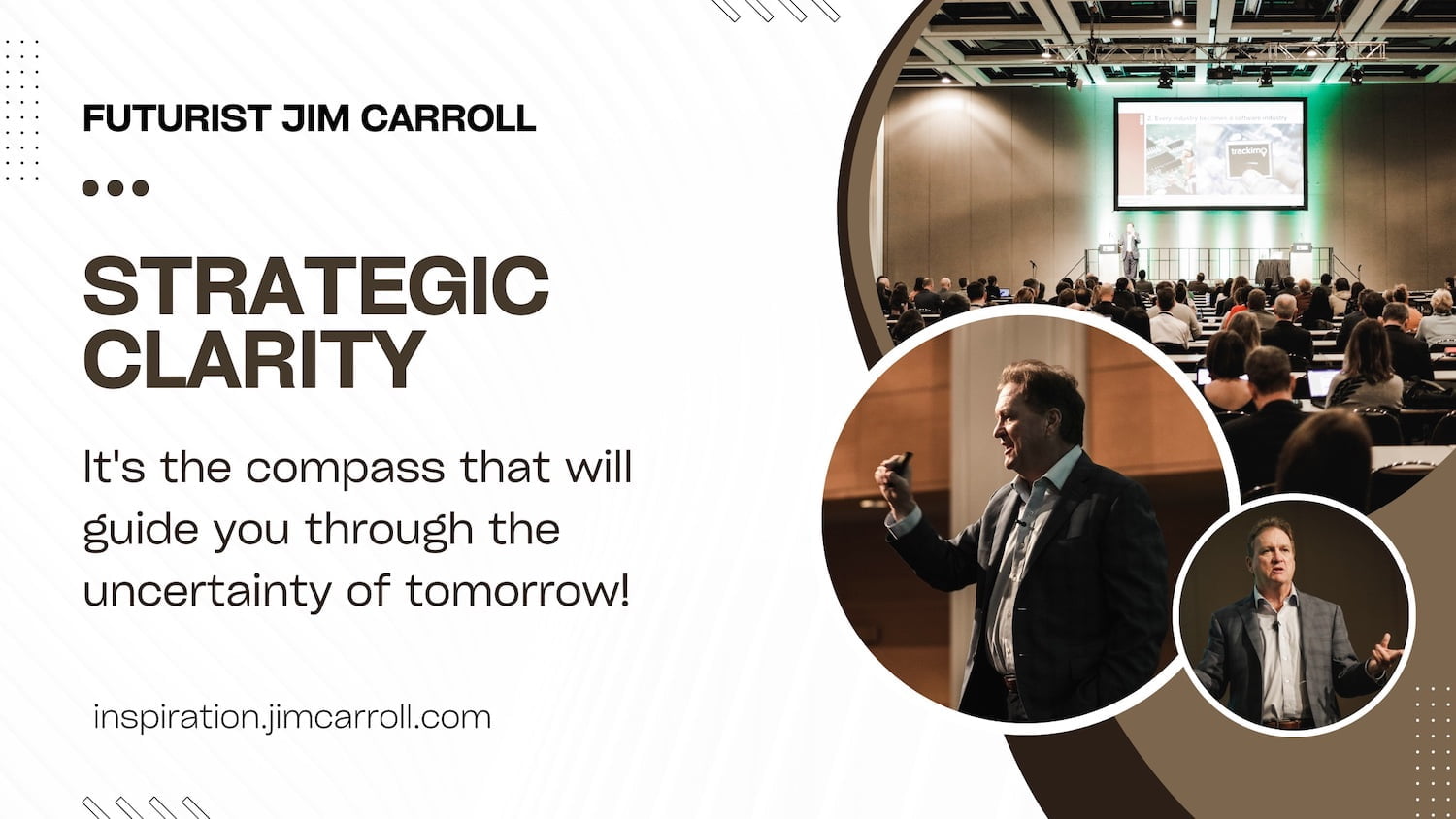
Let me share with you an email I blasted out yesterday to the 400+ agents at the 40-plus speaker’s bureaus around the world who at one time or another have booked me into events, and who continue to put me out to their clients.
Yesterday, my hunch that executives want insight into the STRATEGY of AI, not the TECHNOLOGY, proved that I was pretty prescient.
Because yesterday, I fielded 12 inquiries for keynotes on AI – and insight on strategic clarity around AI.
12 inquiries. Think about that.
Organizations in the UK, Hong Kong, the US, Germany, and Japan.
It might be that only one or two turns into something, but all of them indicated that they were looking for executive-level insight.
Not the tech.
Strategic clarity.
AI. It’s about strategic clarity.
And it’s all right here:
https://jimcarroll.ai
I’ve never seen anything unfold at such speed!
And I’m eager to help you understand the opportunity. Give me a call and let’s Zoom if you want to understand what these potential clients are saying.
I included in the email a header that emphasizes the point:

Last year, I figured that AI was going to be THE forthcoming topic that would dominate the corporate and association agenda and that DEI (diversity, equity, and inclusion) was beginning to run to the end of its run. Every year seems to have a ‘theme,’ a ‘hot topic,’ and an in-demand focus. AI was going to be it.
On this point, I proved to be absolutely, 100% correct in my prediction.
I guess I’m pretty good at this trend stuff.
Why did I come to this conclusion? Last summer, as the text-to-image generating technologies MidJourney and Stable Diffusion were exploding onto the scene, I knew something was up. And then, in the fall, while I was in the UK keynoting a major conference, ChatGPT appeared – and to say that I had tingles on the back of my neck was a bit of an understatement.
I decided that I was going to double down on the AI topic because my sense was it was going to be THE future-oriented topic that would dominate association conference platforms for a time – and that leadership teams of corporate organizations would be screaming for real insight about it. Strategic insight. Leadership insight. Strategic clarity.
I also knew that there were already many AI-focused speakers and experts out there – the speaker’s bureaus who will often book me also represent some of the leading A.I. researchers, academics, tech executives, and many others. But having been on the speaking circuit for so long, I also knew that many of them would take a technological approach to the issue – here’s how large-language models work here’s why they are happening so fast, here’s what you can expect to happen in the future. Lots of deep insight, lots of tech, lots of fascinating stuff – but very little strategy.
I also knew – and it’s the nature of the industry I work in. that there would be a flood of speakers with a generic AI keynote. Here’s our future, here’s what’s going on, here’s how you can use ChatGPT for personal productivity, and here are some cool new AI toys. Lots of powerful motivational insight – but very little insight that speaks to the deep disruptive impact on a particular industry, heavily researched and extremely detail focused. It’s not the type of thing a CEO wants when he or she is bringing their team together to figure out how AI is going to change their industry, company and future.
In other words, I was very aware that all of this would do little to satisfy the demands of executives for insight into the deep, substantive, strategic issues that would be emerging with faster-moving AI technologies. It’s not about the technology, it’s about the strategy – that’s what I kept reminding myself. I knew this from everything I’ve been doing for 30 years as a speaker – when the Internet exploded onto the scene, I quickly gained a reputation as the guy who could outline, from a business strategy and transformation perspective, what it really meant. The same thing happened with e-commerce, social media, and other major trends along the way.
And I also knew I was a natural to slide into this role with AI. I’ve already been covering it on stage for quite some time – speaking about the acceleration of robotics and AI in the construction and manufacturing sector; the movement towards predictive analytic-based real-time insurance underwriting; the arrival of highly intelligent, connected medical devices with embedded AI connectivity. I was already there.
And so I began to double down, writing, researching, enhancing my background – and above all, investing in the jimcarroll.ai domain name and building out a Web site that would carry my message to the world
Today?
It’s beginning to pay off. In buckets – because executives worldwide are demanding the strategic clarity that is required to help them through the complex fog of uncertainty that AI is bringing them tomorrow – today.
Here’s what we know about the future of infrastructure.
An event I did yesterday on the topic – the entire 30-minute video.

You’ll notice by watching, of course, that for this event, I had my friend Briana interview me throughout. She’s another version of the AI-generated avatar that I am increasingly integrating into my work. It’s all a part of the idea that you can’t talk about a trend – in this case, AI – without working with as many different aspects of the trend as you can. I’ll be taking her on stage with me at an in-person event next week in Quebec City.
“It’s only a stranded asset if you decide to leave it stranded!” – Futurist Jim Carroll
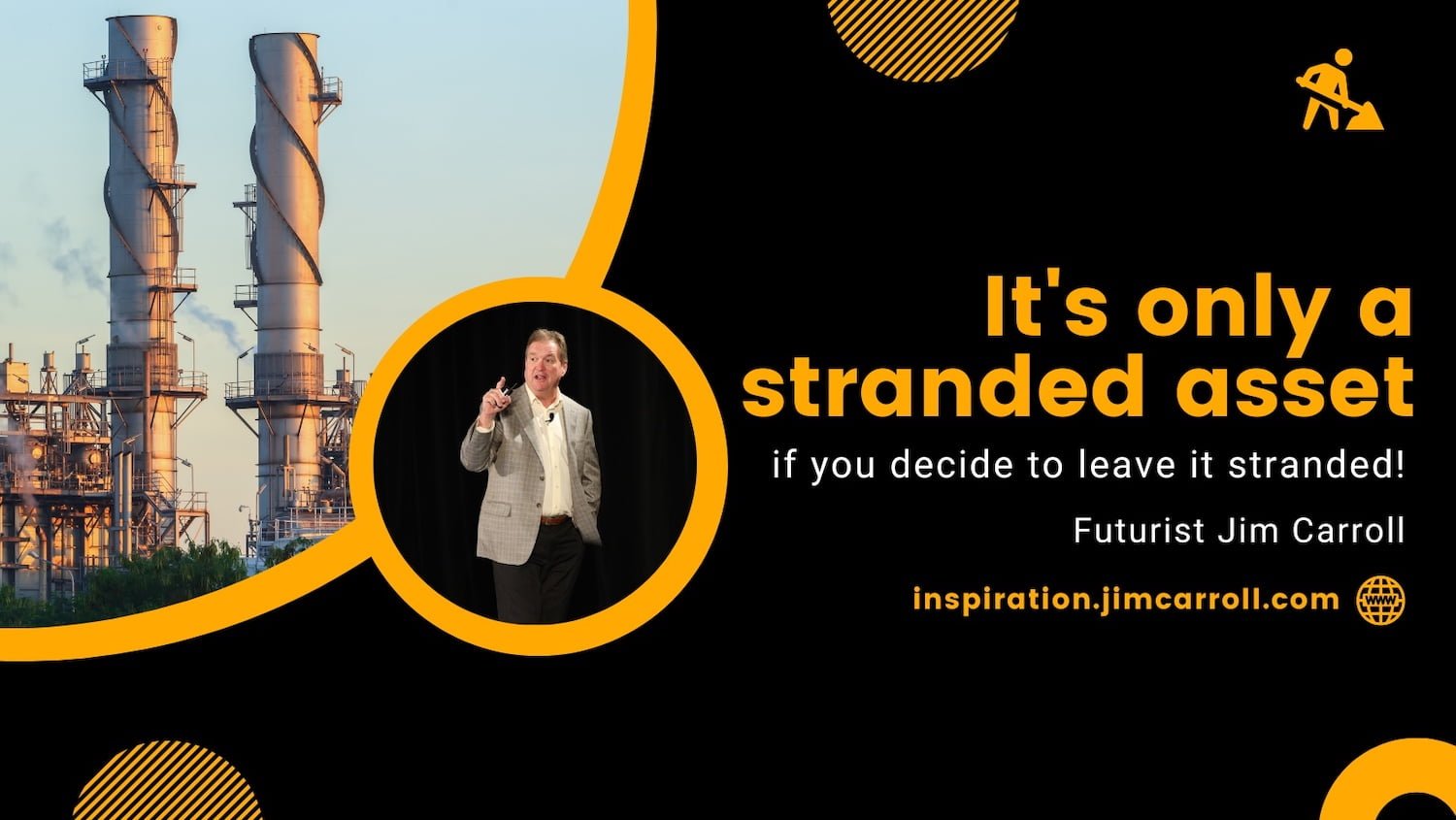
I did a virtual talk for a global investment firm yesterday on the ‘future of infrastructure.’
It was actually within their annual general meeting, which is always a structured, formal affair that involves many specific legal issues and detailed requirements. But the team there wanted to shake things up a little with a view to the future, and so found me through one of my agents in the UK.
My talk took a look at the future of several major sectors of ‘infrastructure’ investment, including energy, telecom, construction, and healthcare. In that context, I pointed out several things, with a few examples including the fact that:
The entire 30-minute video is here; you might find it interesting.
In the planning calls around the event, the client did want to make sure that I made a reference to the idea of ‘stranded assets,’ i.e. those investments that are rendered old, irrelevant, out of date, obsolete, or from the olden days as a result of accelerating trends. This might include such things as natural gas and nuclear plants., which play a smaller role in our renewables-based distributed energy future. It might also involve the old business models and ideas that support old business concepts – such as a world of big, centralized energy distribution networks which become somewhat irrelevant in a future world of distributed, connected intelligent energy microgrids.
And that’s where the idea for today’s phrase came about – because these old stranded assets can always find new life if they are subjected to new forms of thinking!
Assets become ‘stranded’ or old and out of date only if decisions are not made to make them relevant going forward. This means accepting that business models have changed, new technologies have emerged, or new ideas are dominating – and doing what is necessary to realign those old assets to ensure that they somehow have a role in this new future. The best example is with energy utilities, where essentially, those old stranded assets evolve into a new role – one in which the energy utility simply becomes ‘insurance’ for the new renewables-based future.
Read the post The Future of Energy Utilities: Simply, They’re Insurance Companies Now, for more.
The Future of Energy Utilities: Simply, They’re Insurance Companies Now.
Here’s a clip that puts it into perspective:

I spoke about the issue of stranded assets near the end of my keynote, noting that I am seeing increasing signs that senior executives in these industries are coming to recognize reality – and are doing what is necessary to accept and align with that reality, thereby pursuing the ‘de-strandification’ of stranded assets! (I made up that word!)

Over the years, I’ve seen many leaders fight the future and try and prevent the future – but an inevitability, the future wins. If you don’t accept that, any stranded asset will remain forever stranded.
You’ll notice by watching, of course, that for this event, I had my friend Briana interview me throughout. She’s another version of the AI-generated avatar that I am increasingly integrating into my work. It’s all a part of the idea that you can’t talk about a trend – in this case, AI – without working with as many different aspects of the trend as you can. I’ll be taking her on stage with me at an in-person event next week in Quebec City.



GET IN TOUCH
Jim's Facebook page
You'll find Jim's latest videos on Youtube
Mastodon. What's on Jim's mind? Check his feed!
LinkedIn - reach out to Jim for a professional connection!
Flickr! Get inspired! A massive archive of all of Jim's daily inspirational quotes!
Instagram - the home for Jim's motivational mind!