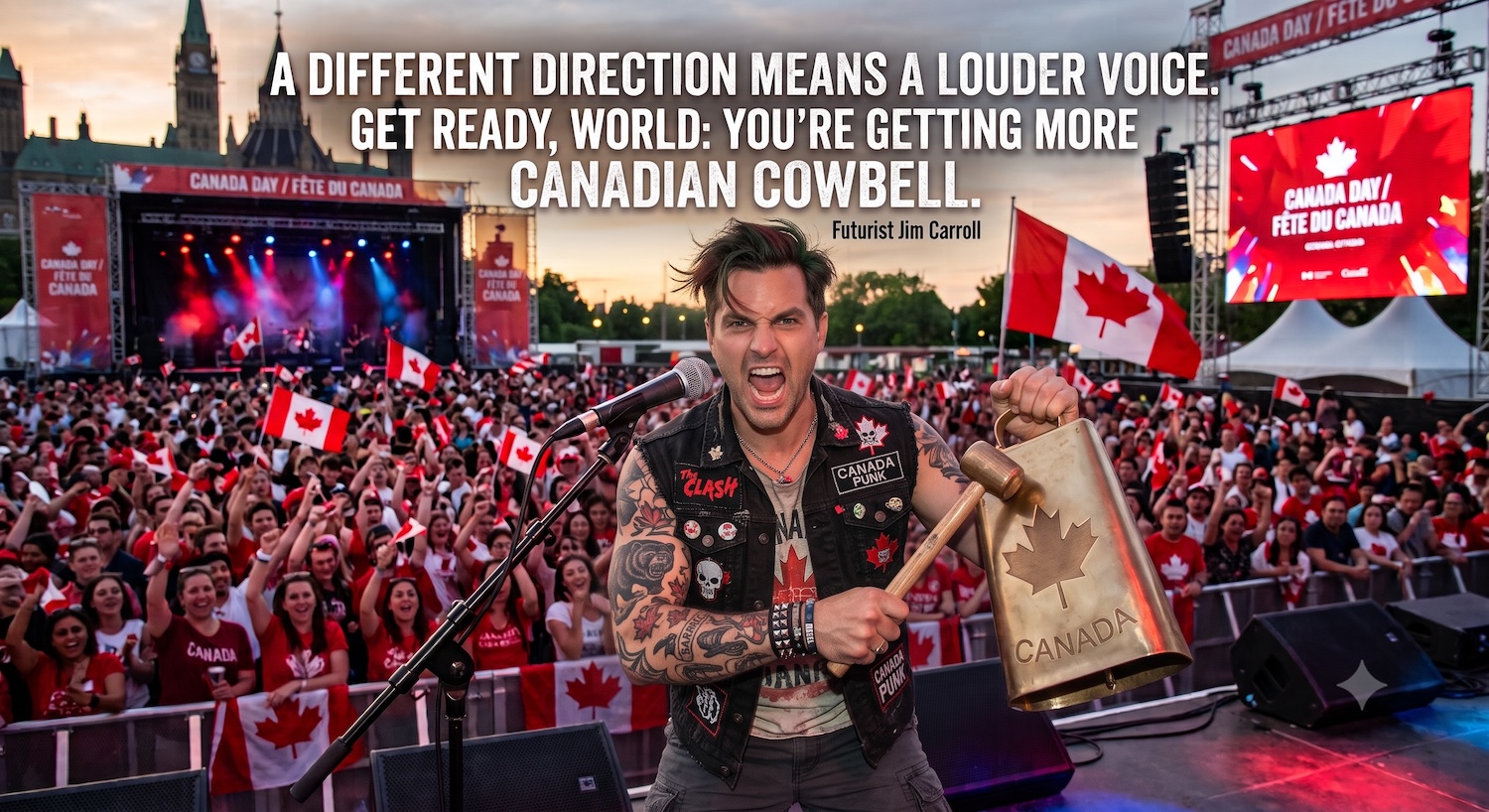
"A different direction means a louder voice. Get ready, world: you're getting more Canadian cowbell." - Futurist Jim Carroll
Happy Canada Day!
July 1 marks the 159th birthday of what most global surveys rank one of the best places in the world to live.
I concur.
So what's the basis for todays' quote? Word is that the USMCA - the most successful trading agreement in history - won't be renewed today, marking a 10 year countdown to its termination. That's a long time in geopolitics - and it's a near certainty that those opposed to it probably won't be around to see what happens. The inevitability of biology always has its way. And personally, I believe that the inevitability of time will put it on a path to some soft of renewal.
That said, we're not your granddads Canada anymore, and friendships, once destroyed, take a long time to come back.
With all that, for the last few years, one thing has been clear - Canada has had a massive choice to make: do we wait around for our southern neighbour, once a staunch ally, to dictate our terms, or do we finally take control of our own economic destiny?
It's pretty certain it's the latter - and with that, it's pretty clear that the rest of the world is about to see a lot more cowbell as Canada gets more aggressively involved on the world stage. Cowbell? The greatest SNL skit of all time!
Prime Minister Mark Carney made it crystal clear recently that we are charting a fundamentally different path forward, noting that "hope isn't a plan, and nostalgia isn't a strategy." Instead of looking backward at old, volatile relationships, the focus has shifted fiercely to what we can control. That involves building a resilient, self-reliant nation that aggressively expands its global trade reach on our own terms - and which does not rely on a neighbour to the south.
This new direction makes me look back at a deeply personal blast from the past. Seventeen years ago, in May 2009, I published a satirical press release on my blog titled "Canada announces end of economic relationship with the US, & a bold new strategy to 2020." At the time, I wrote it tongue-in-cheek to point out the cyclical friction across our border. I even temporarily took it down because it felt too provocative.
I WROTE THIS IN 2009. It looks spot on today.
The fact is, as I look at the global landscape today, what started as pure satire reads like a blueprint. From building independent trade corridors to taking full charge of our resource and agricultural sovereignty, the goals we joked about in 2009 are fast becoming the exact roadmap we need today.
Sometimes, satire just isn't funny anymore because it becomes all too real.
Happy Canada Day. Let's make some noise. Here is what I wrote back then...
A "blast from the past from 2009
"Canada announces end of economic relationship with the US, & a bold new strategy to 2020"'
Futurist Jim Carroll, May 2009
So I was on the phone today with the CEO of a major global organization headquartered in Canada. I'll be opening a leadership meeting for the company in early 2013, and this was a call to begin planning for the structure of my talk.
During the call, comments by Prime Minister Stephen Harper of Canada about the US economic relationship came up. This is a country that is seeing its share of challenges due to fast-paced challenges in its "special relationship" with the US.
I mentioned to the CEO that as far back as 2009, I was already predicting that Canada would likely have challenges in selling its oil in the future into the US market. And many other challenges! And that it would have to re-orient its economy further away from the US and take on much more of a global view!
This was evident to me back then -- and look where things are today. What are serious people and politicians and everyday folk in Canada suddenly talking about that no one took seriously just a year ago?“...a Pacific energy pipeline....” “.... aligning more natural resources and commodities with long-term Asian contracts....” “...... a serious free trade relationship with Europe that goes beyond NAFTA.”
With that in mind, I just dug out an old post I wrote way back in 2009 that was written as a bit of a joke at the time -- surmising that Canada would see many reasons to reorient its global economy in the future. It's a press release written very much tongue-in-cheek. It was briefly posted to my blog. (I removed it after a short time since I thought that many people might find it offensive. But back then, it was covered in Bourque.org and a few other breaking Canadian news blogs....)
I now find it remarkably prescient, though some of it is still very clearly written for fun. For example, the border wall!
Canada announces end of economic relationship with US, & a bold new strategy for 2020
Ottawa, May 14, 2009
- Energy & Oil: Canada will invest in a massive infrastructure project that will allow it to deliver the bulk of its significant energy/oil resources to Asia, Europe, and Africa within 5-7 years. The infrastructure project will consist of several significant pipeline projects that will direct Canadian oil, natural gas, and other energy sources to east and west coast ports, as well as shipping and marine infrastructure, that will provide for an "ocean railway of energy" destined to the AEA countries." Today, Canada is the largest supplier of energy to the United States. By 2020, Canada aims to provide almost no energy to the US," noted Canada at the news conference. "We wish them well in their efforts to solve their energy crisis. We do not intend to help them any further."
- Food & agriculture: Global food production must double to meet world population growth, and Canadian grain, beef, pork, and other producers will work to achieve an AEA target market of 90% by 2020. "Quite simply, the rest of the world beyond the US needs a stable, reliable food supplier, and Canada intends to become the leading global brand in that regard."
- Resources: Canada will seek investment from major Asian and mid-East sovereign wealth funds in an ambitious effort to re-orient the target markets for at least 80% of Canadian mineral commodities to AEA nations by 2015."Quite simply, Canada has the natural resources -- iron, nickel, copper, uranium, and just every other type of metal -- that the newly industrialized world in Asia needs. As we witness a continued decline in US economic power, particularly in the manufacturing sector, we must ensure that we pursue growth opportunities elsewhere in the world. As China re-industrializes with the economic recovery, we intend to be their partner of choice."
- Manufacturing: Since the advent of the US-Canada free-trade agreement in 1994, Canada has shared in one of the modern world's greatest economic successes -- the highly integrated Canadian-US manufacturing network supply chain. However, with the collapse of the US manufacturing sector, as well as the continuous suffocation of the border flow of goods, Canada must re-orient itself to the new realities of the 21st century."A nation does not move forward suffering from the ongoing implementation of economic choke points," noted Canada. "We will re-align ourselves to economies that believe the way forward is through intelligent, smart-border policies that encourage the free flow of goods and people; not a nation that has a border policy that is driven by politics. We will immediately provide strong incentives for Canadian manufacturers to re-focus on Canadian markets, as well as the establishment of significant new markets in AEA countries. There are over 2 billion people in these markets and 280 million in the US. "Our future lies outside of North America, and we will align our manufacturing sector to this reality."
- Immigration-based knowledge factories: Canada is the envy of other nations throughout the world for its open, welcoming culture towards new immigrants. It plans to build on this reputation by establishing itself as the world's dominant source for high-level, specialized knowledge expertise in almost every single professional field." We believe that we are entering the second era of off-shoring," noted Canada, "with the next wave going far beyond customer support call centers. Nations around the world will need access to high-level talent in the fields of medicine and health care, scientific research, agricultural and architectural skills, and legal and professional services -- and will seek to access that knowledge through the global communications networks that will dominate the economy of the 21st century" said Canada. "We will welcome global knowledge experts in every field of human endeavour to relocate to Canada, enjoy all the attributes that our nation has to offer and provide their skills to a massive offshore group of clients in AEA nations. In doing so, we will establish Canada as the global hub for the knowledge economy of the 21st century. Quite simply, Brand Canada will become the most widely recognized phase when it comes to the need for access to knowledge."
- Immediate border construction: Finally, Canada announced that it would immediately begin construction of a border that would prevent unauthorized entry into Canada by US citizens. "We will immediately begin planning construction of a 4,500-mile physical border along our common frontier with the US," noted Canada. "We increasingly view the US health care system to be in peril -- within a decade, some US states will be devoting more than 60% of their GDP to health care. Many US citizens will plan to flee to Canada to take advantage of our world-class universal health care system. We must prevent this mass migration of Americans into Canada, and believe that significantly enhanced border structures are the only means of doing so."