I've been covering the link between future trends and innovation strategies for 30+ years. I went back through my blog posts, stretching to 2002, to dig out the nuggets of innovation insight I've discovered along the way. This series revisits those stories, tests what still holds up, and turns them into practical lessons for what comes next.
One thing I've learned from working with organizations around the world is that culture reveals itself most clearly in what happens immediately after someone raises a new idea. The reaction in that moment tells you far more than the innovation language in the annual report.
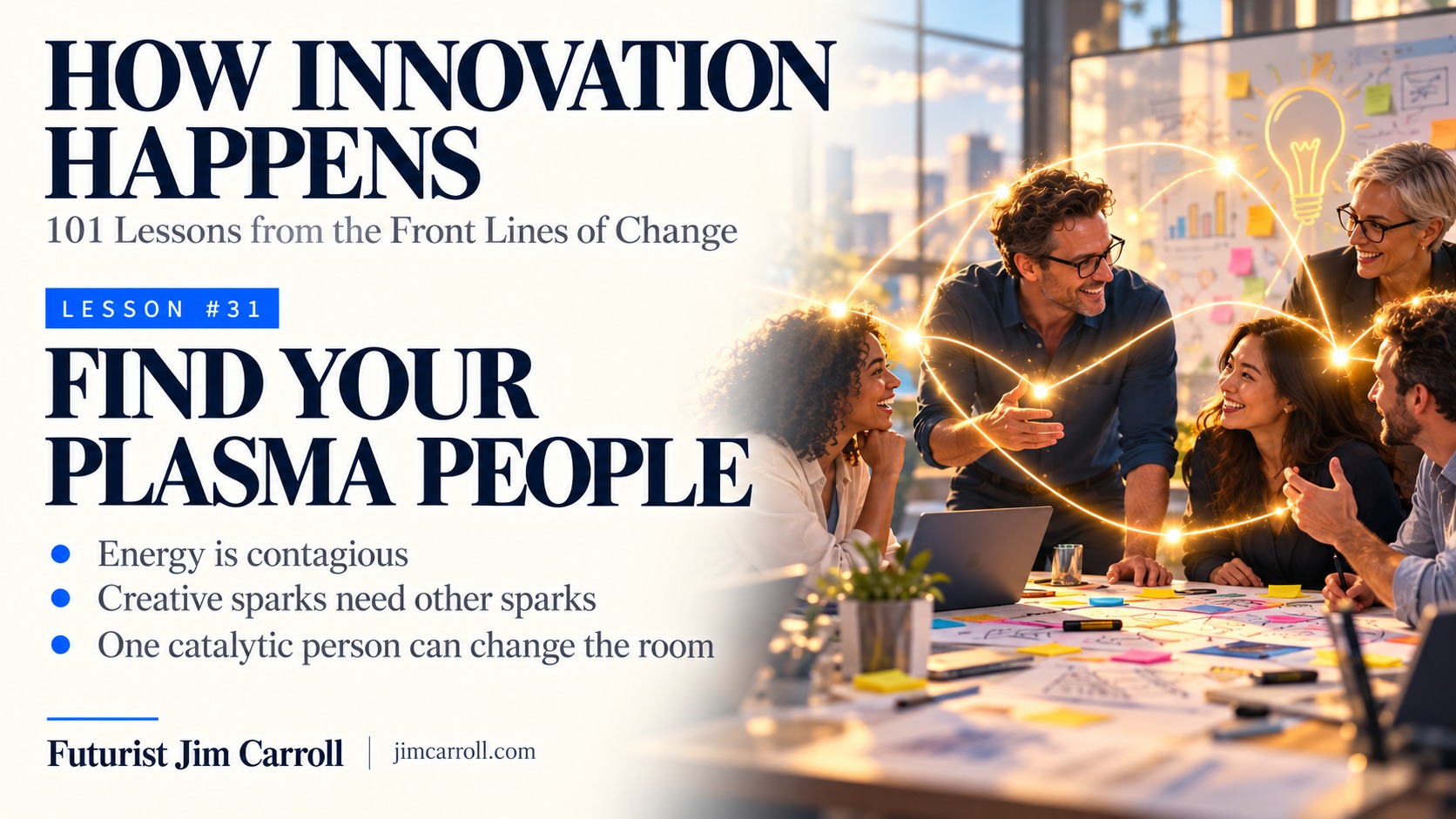
Years ago I used "cardboard people and plasma people" as a shorthand for a generational and cultural divide.
Cardboard is static. Plasma is dynamic. In organizations, some people are comfortable with fixed processes and established channels. Others instinctively expect interaction, speed, customization and constant change.
You need both operational discipline and adaptive energy. But if every important decision is controlled by people whose mental model is static, your organization will struggle with a fluid future.
Plasma people are not defined by age. They are defined by how naturally they adapt.
This is where culture either reinforces the future or quietly kills it. If you want to change the pattern, start with these three moves.
Action Items:
- Identify the people who instinctively experiment with new tools and methods.
- Give them a role in redesigning old processes.
- Pair operational experts with adaptive thinkers instead of forcing one group to dominate.
Explore the full How Innovation Happens series.
Real-World Examples
These researched examples show the lesson at work in the real world.
Oticon: The hearing-aid company that made expertise mobile
Danish hearing-aid maker Oticon was under pressure in the late 1980s. Competition was intensifying, and a conventional hierarchy made it difficult to respond to technological change. Managing director Lars Kolind wanted more than a new product plan. He wanted to change who could start work, move between assignments and bring unfamiliar knowledge into a project.
In 1991 the company introduced what became known as its 'spaghetti organization.' Traditional departments and fixed job boundaries gave way to flatter structures and project teams assembled around opportunities. A Copenhagen Business School account describes a dramatic headquarters move, new open working space and an internal market in which employees could participate across organizational lines.
The redesign helped energize Oticon's innovation, and business-school cases document substantial early improvements. But the deeper research also provides a useful warning: the model later became fragmented, and the company returned to more formal coordination as technologies and its scale changed. Fluidity was valuable; unbounded fluidity introduced new problems of its own.
The enduring lesson is about identifying people who can reorganize themselves when the work changes. Plasma people are not simply younger, louder or more enthusiastic. They are comfortable recombining expertise rather than treating a box on an organization chart as the limit of their contribution.
Why it matters: Find colleagues who can cross roles and recombine capabilities, while giving them the coordination needed to deliver.
Sources:
U.S. Navy Task Force 59: Give adaptive teams a real operating mission
Militaries are frequently portrayed as rigid hierarchies, particularly where expensive ships, established doctrine and complex approval chains are involved. Yet unmanned vessels and artificial intelligence were evolving faster than traditional acquisition and fleet-integration cycles could comfortably absorb. The U.S. Navy faced a question familiar to every large organization: how do you turn promising technology into operational learning quickly?
In September 2021, the Navy's Fifth Fleet established Task Force 59 in Bahrain. Its stated mission was to integrate unmanned systems and artificial intelligence into maritime operations, with an emphasis on improving awareness of activity at sea. Rather than treating experimentation only as a distant laboratory exercise, the Navy created a task force within an operational command.
The initial announcement stressed working with international partners and existing maritime forces. That mattered because new systems do not become useful simply by being invented. They need people who can connect the technology, the users, the field conditions and the organizational rules. The Navy was explicitly creating an environment for that kind of integration.
This is a story about an adaptive operating model, not about machines replacing sailors. Leaders made room for people who could test, connect and revise emerging capabilities alongside the institution's experienced operators. The real question is whether your own organization gives its most adaptable people a serious mission or merely calls them enthusiastic troublemakers.
Why it matters: Put adaptive talent in charge of real operational experiments, not just demonstrations at innovation events.
Sources: