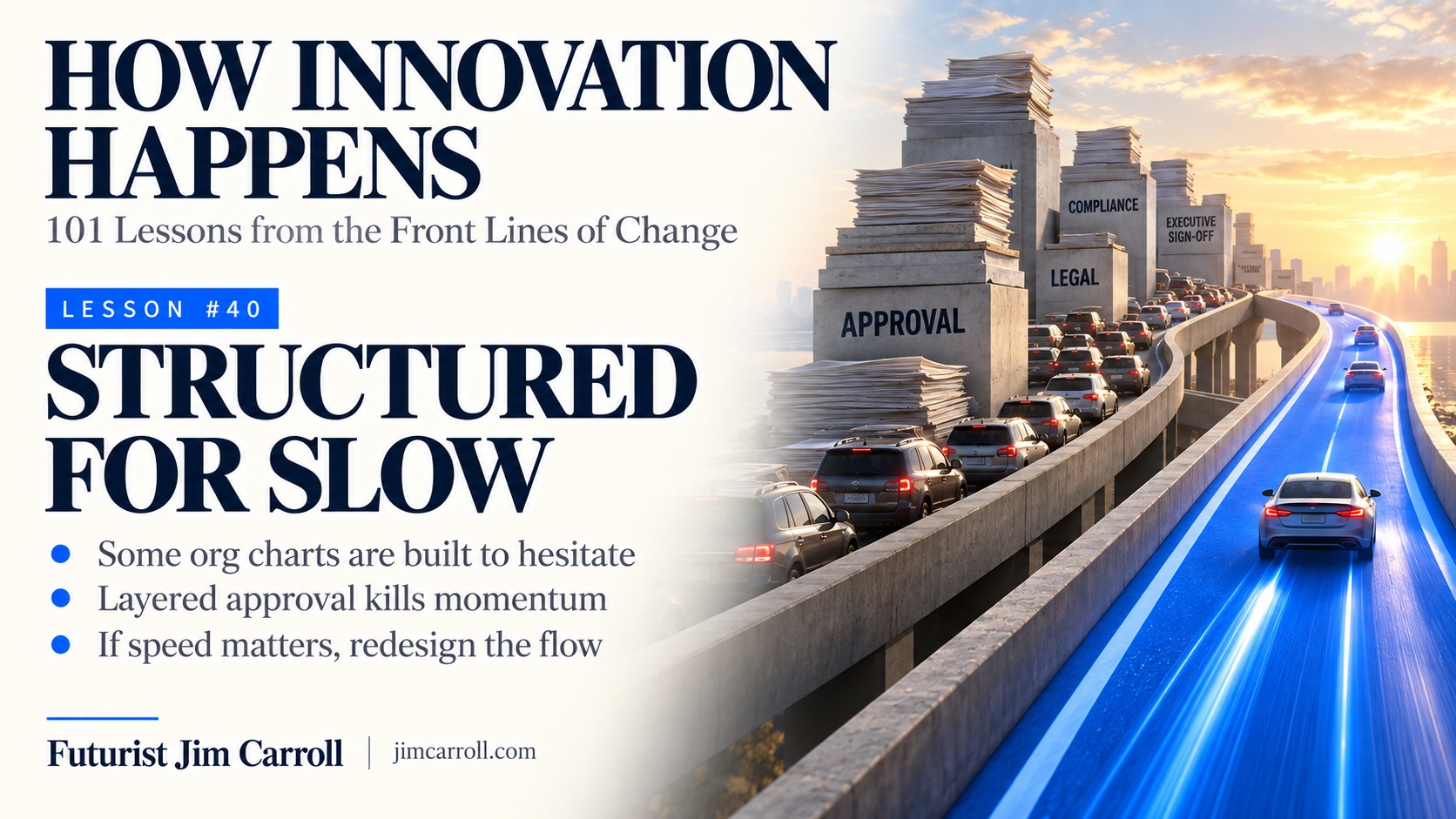
I've been covering the link between future trends and innovation strategies for 30+ years. I went back through my blog posts, stretching to 2002, to dig out the nuggets of innovation insight I've discovered along the way. This series revisits those stories, tests what still holds up, and turns them into practical lessons for what comes next.
"You're structured for slow in the era of fast."
One thing I've learned from working with organizations around the world is that culture reveals itself most clearly in what happens immediately after someone raises a new idea. The reaction in that moment tells you far more than the innovation language in the annual report.
Many organizations know they need to move faster but have designed almost every internal mechanism to produce delay.
Budget cycles are annual. Hiring takes months. Technology approvals take quarters. Decisions climb layer after layer. Collaboration is trapped in functions.
That is a structural problem, not a motivational one. Telling people to "be agile" while leaving the machinery unchanged simply creates frustration.
Speed has to be designed into the organization.
This is where culture either reinforces the future or quietly kills it. If you want to change the pattern, start with these three moves.
Action Items:
- Measure the time required for five common decisions.
- Identify which delays come from structure rather than complexity.
- Give lower levels clear authority to make more decisions without escalation.
Explore the full How Innovation Happens series.
Real-World Examples
These researched examples show the lesson at work in the real world.
RECOVERY: A clinical trial structured for speed without abandoning evidence
In March 2020, doctors treating patients with COVID-19 urgently needed to know which therapies worked. Conventional drug studies often require separate protocols, repeated reviews and lengthy recruitment. Running a collection of disconnected small trials risked producing uncertainty while hospital wards filled. Researchers at Oxford and across Britain's National Health Service made a different organizational choice.
The RECOVERY trial used a single, simplified platform to evaluate multiple treatments against usual care. The first protocol was drafted on March 10, approved on March 17, and its first patient enrolled on March 19. The combination of national research infrastructure, uncomplicated data collection and adaptable treatment arms allowed the study to recruit patients across many hospitals almost immediately.
On June 16, investigators announced evidence that dexamethasone reduced mortality among severely ill patients requiring respiratory support. The trial also ruled out benefits from some widely discussed treatments in its hospitalized study population. The result mattered not only because of the drug, which was inexpensive, but because a large, controlled experiment delivered an actionable answer during the first wave.
The research team did not overcome slowness through motivational speeches. It removed avoidable complexity from trial design while retaining randomization and oversight. In a system with serious consequences, faster learning came from redesigning the work itself, not from relaxing the requirement for trustworthy evidence.
Why it matters: Speed is an organizational design decision: simplify the route to reliable evidence without eliminating essential safeguards.
Sources:
San Francisco: Make the street safer before the concrete is permanent
A dangerous street can wait years for reconstruction because the usual capital-project process involves detailed engineering, budgets, public consultation, procurement and construction. San Francisco faced a particular version of this problem as it pursued its Vision Zero traffic-safety goals. The city needed safer routes now, not only after a generation of large infrastructure projects.
In June 2019, the San Francisco Municipal Transportation Agency adopted a Quick-Build program for streets in its high-injury network. The program authorized adjustments using materials such as paint, posts and parking changes that were reversible or could be refined. Crucially, it also allowed more iterative field testing and shortened the outreach and project-approval process.
By December 2019, the agency was reporting multiple quick-build projects completed or under construction, including protected bikeways on parts of 5th Street and Indiana Street. Temporary or adjustable materials were not an assertion that every design was correct; they provided a way to put safety interventions into real use and modify them with observed results.
The institutional insight is easy to miss: the agency changed what counted as an acceptable first implementation. Instead of treating a perfect final streetscape as the only legitimate output, it created a safer, faster intermediate step. Whether any particular street achieves its long-run goals still requires measurement, but the delay-producing structure itself was challenged.
Why it matters: When a full redesign takes years, create a safe, reversible path to test improvements in the real world.
Sources: