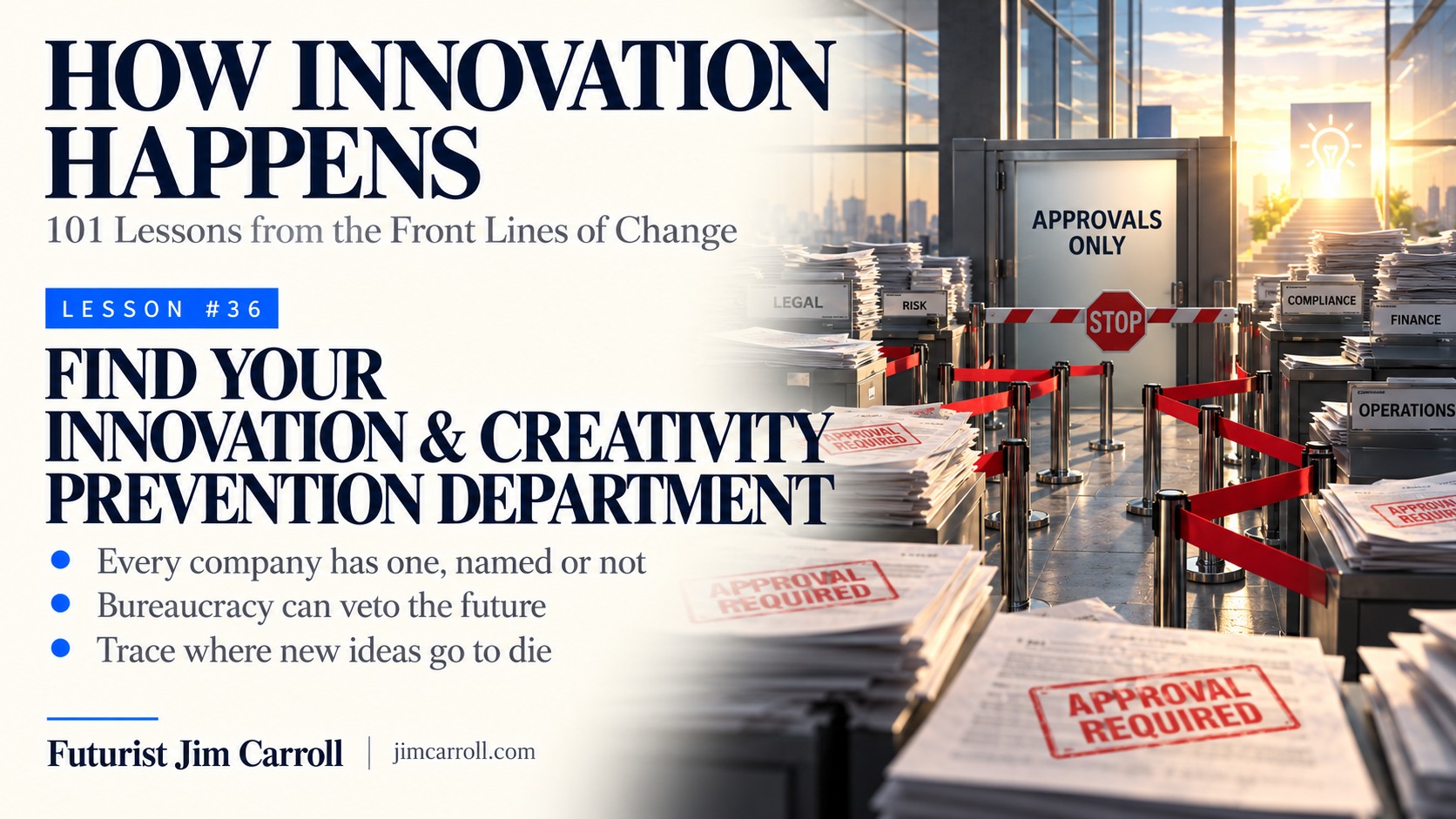
I've been covering the link between future trends and innovation strategies for 30+ years. I went back through my blog posts, stretching to 2002, to dig out the nuggets of innovation insight I've discovered along the way. This series revisits those stories, tests what still holds up, and turns them into practical lessons for what comes next.
"Your challenge is probably within your Innovation & Creativity Prevention Department!"
One thing I've learned from working with organizations around the world is that culture reveals itself most clearly in what happens immediately after someone raises a new idea. The reaction in that moment tells you far more than the innovation language in the annual report.
Every organization has one, even if it does not appear on the org chart.
It may be a process, a committee, a manager, a policy or simply a culture that makes unusual people exhaust themselves getting permission. Its function is always the same: protect the familiar from the inconvenience of the new.
The dangerous part is that prevention departments often believe they are protecting quality, consistency or risk management. Sometimes they are. Sometimes they are protecting inertia.
This is where culture either reinforces the future or quietly kills it. If you want to change the pattern, start with these three moves.
Action Items:
- Ask employees where good ideas go to die.
- Map every approval required to test a small idea.
- Remove one approval that adds delay without adding real protection.
Explore the full How Innovation Happens series.
Real-World Examples
These researched examples show the lesson at work in the real world.
Healthcare.gov: A troubled launch exposes the cost of fragmented ownership
The U.S. federal health-insurance marketplace was supposed to make it easier for people to compare coverage and enroll. When Healthcare.gov launched on 1 October 2013, visitors instead faced errors, unavailable functions and poor performance. The failure was visible to millions, but many of the underlying causes were buried inside contracting arrangements, coordination problems and assumptions about who would integrate the whole system.
A U.S. Government Accountability Office investigation found ineffective contract planning and oversight, including a launch without verification that the system met performance requirements. The responsible agency had identified serious contractor problems but took limited corrective action as the deadline approached. Complexity was not just a technical issue; it was reinforced by the way responsibilities and approvals had been organized.
A subsequent emergency repair effort brought technologists and federal teams together to stabilize the website. The episode helped strengthen the case for the U.S. Digital Service and other practices aimed at putting cross-functional technical expertise closer to public-service delivery. The story should not be simplified into a claim that all contractors or government controls are bad. Proper procurement, privacy and security remain essential.
What failed was the relationship between controls and outcomes. A system can contain enormous amounts of documented oversight while still lacking timely ownership of the user experience. The true Innovation Prevention Department may be the structure that makes everyone responsible for a part and no one capable of fixing the whole.
Why it matters: Audit not just how many controls exist, but whether anyone has authority to resolve cross-functional failure.
Sources:
Project Orbis: Cancer-drug regulators decide to review together
Cancer-drug trials increasingly recruit patients in many countries, but companies have traditionally navigated separate regulatory submissions and review schedules. A promising medicine could therefore reach patients in one country significantly earlier than in another. Some delay is necessary for careful evaluation; other delay is a consequence of organizations working in isolation.
In May 2019, the U.S. Food and Drug Administration launched Project Orbis with regulatory partners, initially including Health Canada and Australia's Therapeutic Goods Administration. Rather than waiting for one agency's process to finish before another began its work, regulators created a framework for concurrent submission and collaborative review of selected oncology applications.
Each national regulator retained independent authority over approval and labeling. The FDA's 2020 annual report recorded 60 marketing applications involving 16 distinct projects during the program's first year, leading to 38 approvals counted across participating authorities. The numbers refer to regulatory actions in different markets, not 38 distinct cancer drugs. The program subsequently expanded to other partners.
The unexpected innovation was not a new laboratory discovery. It was a change to the process that stands between evidence and patients. Regulators did not abandon standards; they questioned whether separate sequences of work were the only safe way to administer them. Sometimes the prevention department can be improved by connecting the people who already understand the rules.
Why it matters: Remove avoidable sequencing and coordination delays without compromising the substantive safeguards that matter.
Sources: