Autonomous electrification.
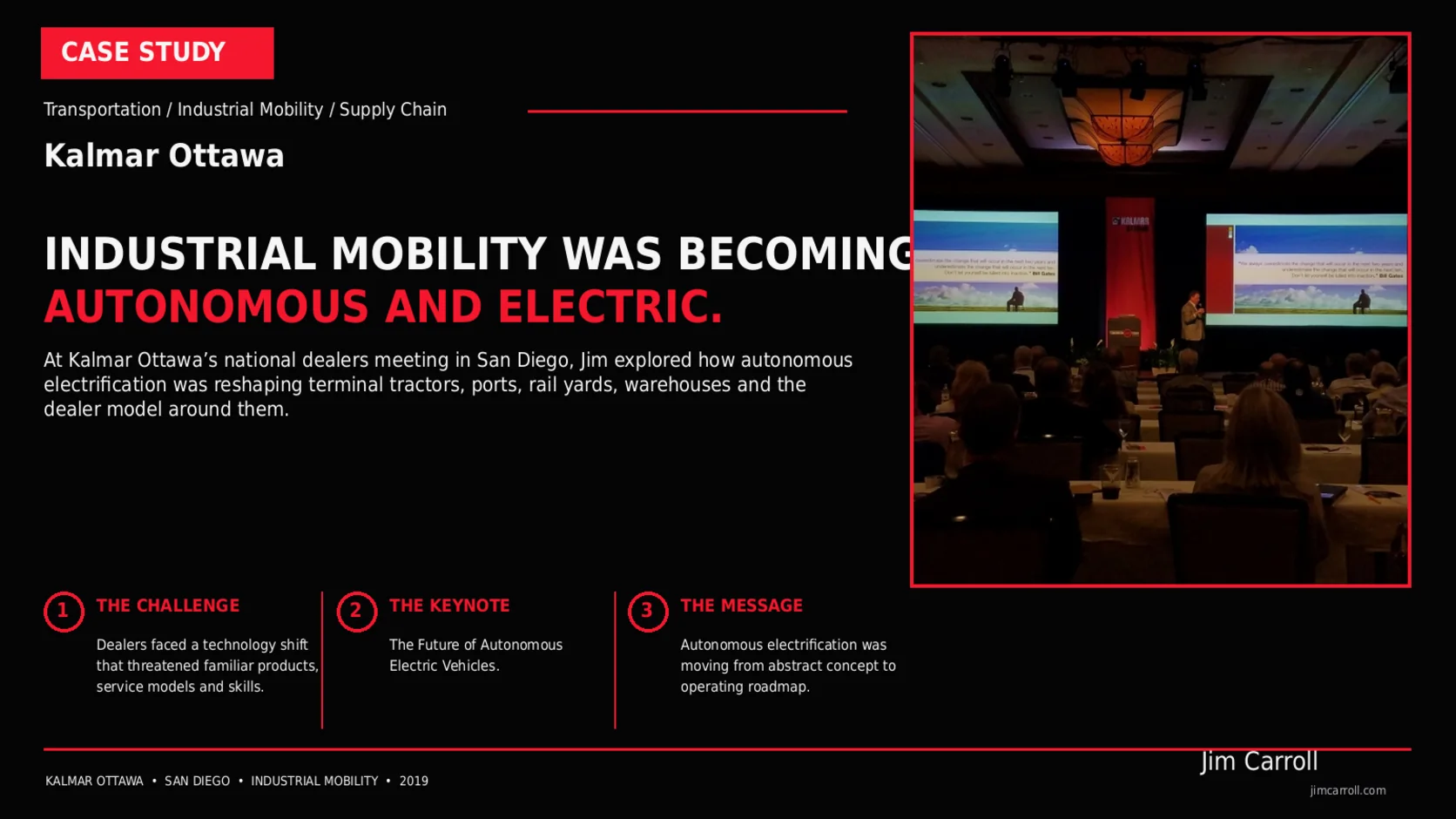
That was the phrase at the center of my keynote for Kalmar Ottawa at its national dealers meeting in San Diego.
Kalmar Ottawa manufactures the specialized terminal tractors and container-handling vehicles used in ports, rail yards and warehouses — equipment that sits inside the critical infrastructure of the global supply chain.
And that equipment was entering a period of major transition.
Electric propulsion was advancing.
Autonomous technologies were moving steadily from research into practical industrial environments.
The software, sensors and intelligence surrounding vehicles were becoming as important as the mechanical platform itself.
And companies throughout transportation were confronting the reality that the future would look very different from the fleet they had traditionally sold and serviced.
That was the reason I was brought in.
The organization wanted its dealer network to understand the trends driving the transition toward an increasingly electric and autonomous vehicle fleet.
The challenge was not simply technological.
It was psychological.
People often resist a future that threatens what they know.
Dealers have expertise built around existing technologies, established service models and familiar customer relationships.
When the technology changes, some see opportunity.
Others see disruption.
My message was that the trend would move forward regardless.
The choice was whether to align with it early or react to it later.
Six themes framed the discussion:
- Autonomous Electrification
The convergence of electric propulsion and autonomous operation was becoming a defining force in industrial transportation.
- Electric Fleets
The transition away from conventional power systems would reshape vehicle economics, maintenance requirements and infrastructure.
- Autonomous Operation
Ports, rail yards and warehouses offered practical environments in which automation could steadily expand.
- Global Supply-Chain Transformation
The vehicles themselves were part of a much larger logistics system undergoing rapid technological change.
- Dealer Model Transition
As the fleet changed, dealers would need to develop new expertise, new service capabilities and new ways of creating value.
- Mindset and Adaptation
The biggest barrier to a new technology is often not the technology itself, but the willingness of people to leave the comfort of the old model.
The keynote connected to one of the stories I often use on stage: the Jetsons meeting the Flintstones.
It is a useful metaphor because many industries live in both worlds at once.
The existing world continues to operate.
The new world develops alongside it.
Eventually the balance shifts.
Transportation was already moving through that process.
Self-driving cars, autonomous vehicles and electric propulsion were becoming increasingly difficult to dismiss as distant concepts.
In industrial environments — where routes can be controlled, operating conditions are defined and the economic case for automation can be clearer — the transition could move particularly quickly.
For the dealer network, that raised a practical strategic question:
Do you defend what you have always sold, or prepare for what your customers will need next?
The answer matters.
A technology transition changes more than the product.
It changes the skills required to support it.
It changes maintenance.
It changes infrastructure.
It changes customer expectations.
And it changes the value a dealer needs to provide.
That was the message in San Diego.
The future was not simply an electric version of the existing vehicle.
It was the beginning of an entirely different industrial mobility platform.
Autonomous electrification was no longer an abstract concept. It was becoming the roadmap.