I've been covering the link between future trends and innovation strategies for 30+ years. I went back through my blog posts, stretching to 2002, to dig out the nuggets of innovation insight I've discovered along the way. This series revisits those stories, tests what still holds up, and turns them into practical lessons for what comes next.
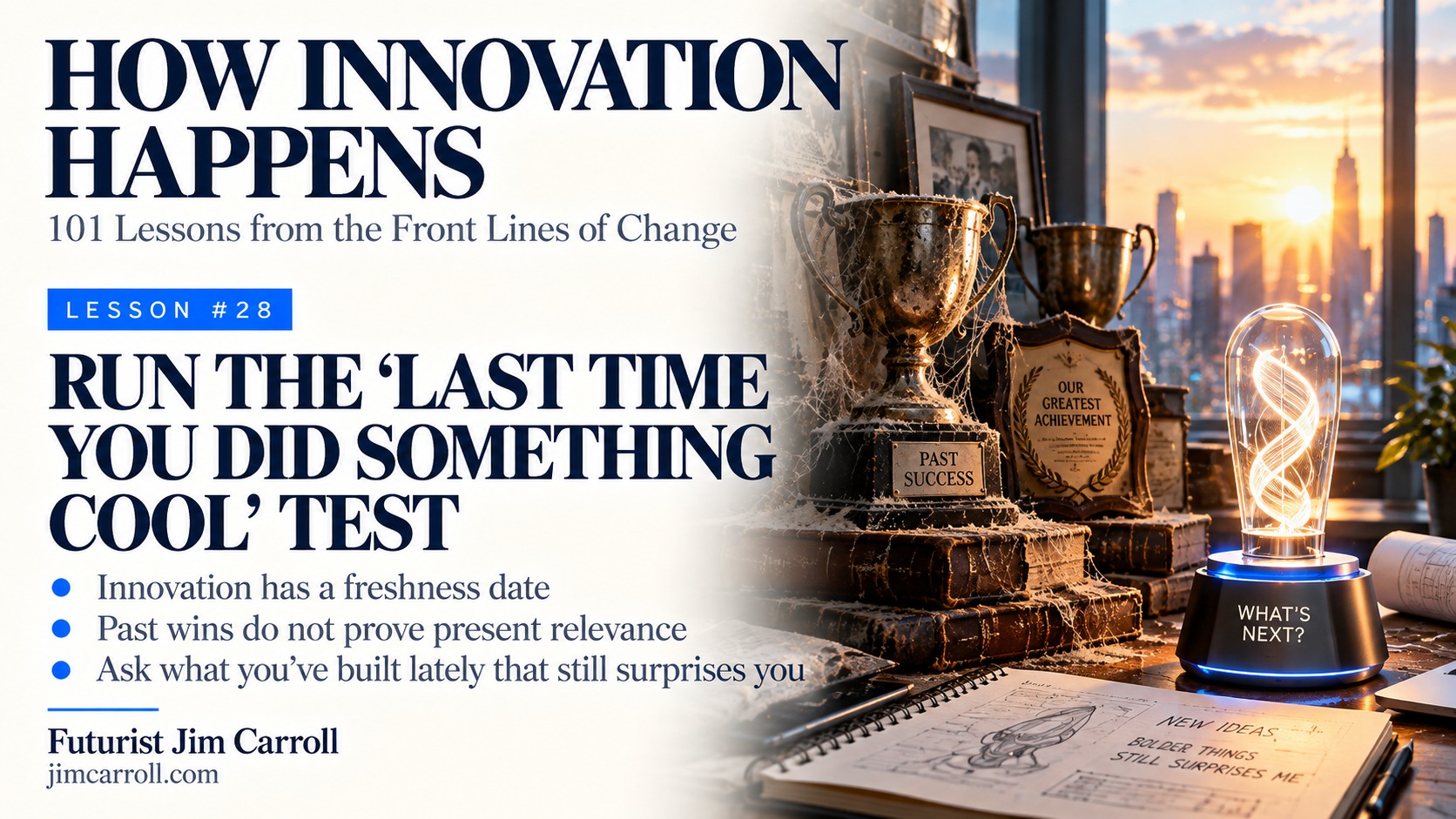
"If you can't remember the last time you did something really cool, you have a bigger innovation problem than you think."
I've come back to this idea repeatedly in my work because the mindset behind innovation usually changes before the results do. What people notice, question, challenge, and act on determines how ready they are for what comes next.
Innovation should leave evidence.
If months or years pass without a project that made people excited, nervous, curious or proud, your innovation problem may not be a lack of ideas. It may be that routine has swallowed every available bit of energy.
"Cool" is not a strategy metric, but it is a useful cultural diagnostic. It tells you whether people are still stretching themselves.
So what does that mean in practice? It means challenging the assumption, habit, or hesitation that is keeping you anchored to the present. Here are three places to start.
Action Items:
- Ask everyone on your team to name the last thing they worked on that felt genuinely new.
- If the answers are old, investigate why.
- Put one ambitious project on the calendar that people will still talk about a year from now.
Explore the full How Innovation Happens series.
Real-World Examples
These researched examples show the lesson at work in the real world.
Fayetteville Free Library: A public library makes room for making
A public library is traditionally a place to borrow books, consult information and find a quiet place to read. By 2011, that familiar identity could also be a constraint. If libraries existed to help communities learn, why should learning be restricted to consuming information rather than creating physical things?
The Fayetteville Free Library in New York established a permanent makerspace, its Fab Lab, in 2011. The American Library Association describes it as the first permanent makerspace in a U.S. public library. The concept invited patrons to explore equipment, practical projects and skills that did not fit the inherited image of a lending library.
The experiment was more than a novelty gadget in a corner. It challenged what counted as library service and expanded the institution's relationship with people who wanted to build, tinker and collaborate. It also helped provide a visible model for other libraries exploring maker programs and lending kits.
This is a useful 'last time you did something cool' test. The value is not that every institution needs a 3D printer. It is that the library made a tangible change people could experience, one that would have been difficult to imagine from its traditional operating checklist alone.
Why it matters: A genuinely exciting experiment can reveal a larger mission that routine work has hidden.
Sources:
Times Square: A handful of chairs tests an entirely different street
For decades, Times Square was a knot of traffic, pedestrians, theaters and business activity. The normal response to congestion was to tweak signals and improve vehicle movement. Closing parts of Broadway to cars seemed like an extraordinarily visible gamble in one of New York City's most heavily visited intersections.
In 2009, New York City launched its Green Light for Midtown pilot, creating pedestrian space in Times and Herald Squares. Rather than wait for a costly permanent reconstruction, the city initially used temporary treatments, movable chairs, planters and paint. It then measured the effects on traffic and safety before committing to longer-term changes.
The city's own project announcements document the trial and the later move toward permanent public space. Former transportation commissioner Janette Sadik-Khan later described the early setup as traffic cones and beach chairs, a small physical test of a proposition that had once seemed politically and operationally difficult.
One of the most useful signals of innovative energy is that an organization can point to a visible experiment and say, 'We actually tried that.' The chairs were not the strategy. They made a different urban future real enough for people to experience and evaluate.
Why it matters: A bold idea becomes easier to judge when people can inhabit a small working version of it.
Sources:
---