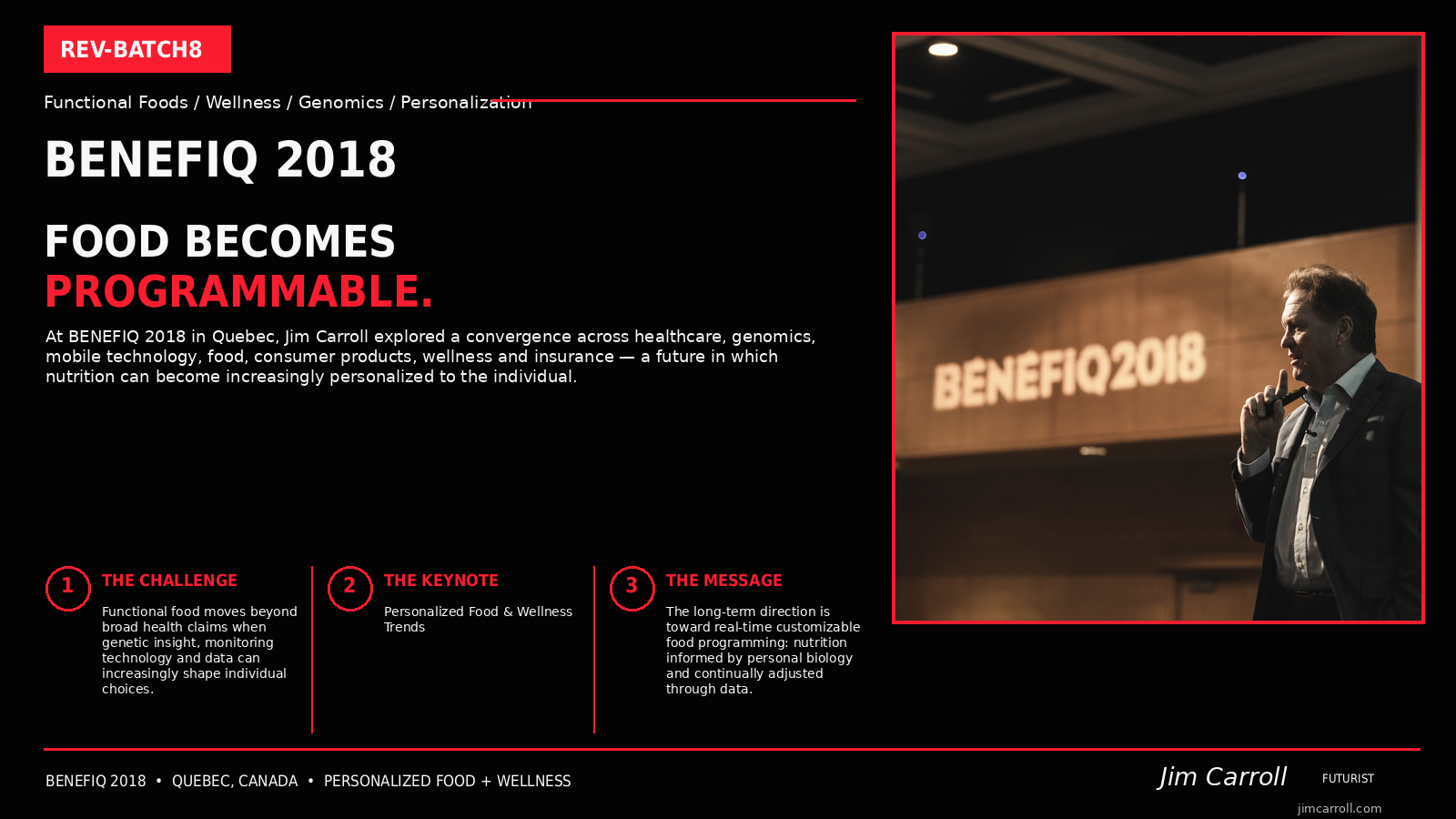
Food industry leaders gathered at BENEFIQ 2018 in Quebec were operating in a moment of profound convergence. Genomics was moving from laboratory curiosity to actionable consumer insight. Connected devices were making personal health data continuous and granular. A generation of consumers was beginning to expect nutrition not as a mass-market product but as something shaped by their biology, habits, and goals.
The room was grappling with how fast the science was moving and how slowly the industry had adapted. Personalization was already the direction of travel — but the tools to deliver it at scale, from genomic profiling to AI-driven recommendation engines, were arriving faster than most organizations had planned for. What would it mean when every food product had to compete not just on taste and price, but on what it did for a specific individual's health profile?
Jim's keynote, "Food Became Programmable," argued that the convergence of biology, data, and food was creating an entirely new competitive landscape — one where the winners would be those who understood that mass-market nutrition was giving way to personal programming. The question for everyone in the room was not whether this transformation would happen, but how fast they were moving toward it.
- Genomics. Genetic insight was moving from research settings to consumer applications, creating a new information layer that linked individual biology directly to nutrition choices, health response, and long-term outcomes.
- Wearable Monitoring. Connected devices were making continuous personal health and wellness data accessible at scale, turning abstract health goals into real-time feedback loops that could inform eating and supplementation decisions.
- Functional Foods. Food was increasingly positioned with an explicit health, performance, or wellness purpose — moving from broad benefit claims toward evidence-backed outcomes targeted at specific populations and biological profiles.
- Personalization. Mass-market nutrition was fragmenting as genomic, behavioral, and monitoring data began enabling recommendations designed for the individual rather than the average consumer — the same disruption that had already reshaped media, retail, and financial services.
- Wellness Ecosystem. The boundaries between food, healthcare, technology, insurance, and consumer products were collapsing around a shared focus on prevention, longevity, and individual performance — creating both competitive threat and partnership opportunity for food companies.
- Real-Time Adjustment. Data was making it possible to refine nutrition choices continuously — not just at the point of purchase but across time, as conditions, goals, and biomarkers changed — fundamentally altering the product development and marketing model.
The BENEFIQ audience left with a question that wouldn't go away: when food becomes programmable, what exactly is the food industry selling? The answer Jim argued for — data-informed biology outcomes, not products — required a fundamental rethinking of what competitive advantage meant in a sector where every ingredient would eventually carry an information layer.