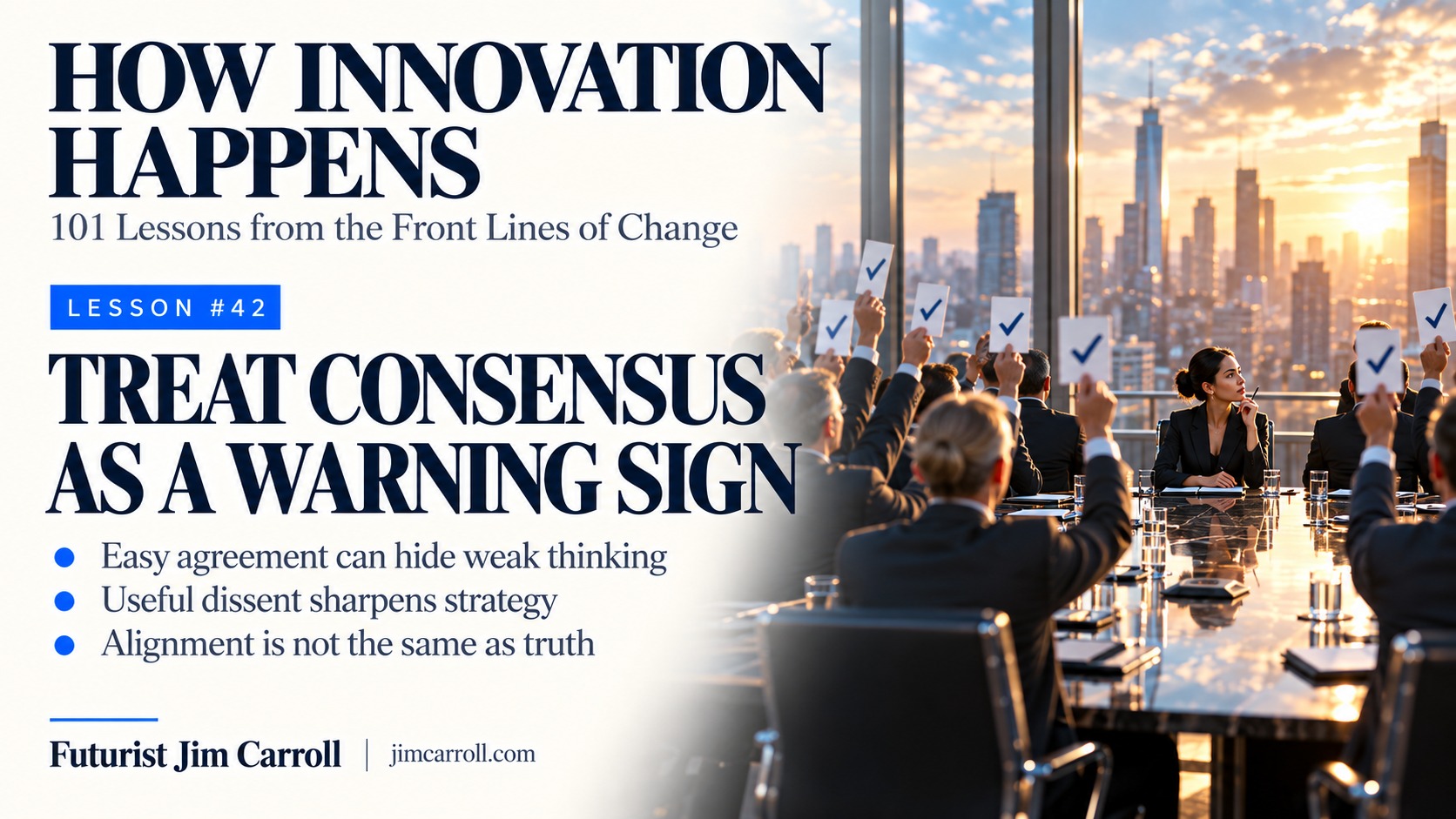
I've been covering the link between future trends and innovation strategies for 30+ years. I went back through my blog posts, stretching to 2002, to dig out the nuggets of innovation insight I've discovered along the way. This series revisits those stories, tests what still holds up, and turns them into practical lessons for what comes next.
"When everyone is working together to stay the course, you've got a bigger problem than you think."
One thing I've learned from working with organizations around the world is that culture reveals itself most clearly in what happens immediately after someone raises a new idea. The reaction in that moment tells you far more than the innovation language in the annual report.
Consensus feels like alignment. Sometimes it is. Sometimes it is collective avoidance.
If everyone agrees that the existing strategy is fine despite major external change, you may not have a strong culture. You may have a culture that has stopped challenging itself.
Useful disagreement is a strategic asset. It exposes assumptions while there is still time to change them.
This is where culture either reinforces the future or quietly kills it. If you want to change the pattern, start with these three moves.
Action Items:
- Assign a devil's advocate to major strategy decisions.
- Ask what evidence would cause the group to reverse its position.
- Track whether dissenting views disappear as they move up the hierarchy.
Explore the full How Innovation Happens series.
Real-World Examples
These researched examples show the lesson at work in the real world.
RBS: An acquisition without a board member willing to say stop
In 2007, Royal Bank of Scotland joined a consortium bidding for ABN AMRO during an increasingly unstable credit market. The acquisition was enormous, the available due diligence was limited, and the consequences for capital and liquidity were serious. Yet the decision moved forward through a board that appeared broadly aligned with the proposed deal.
After RBS required a government rescue, Britain's Financial Services Authority investigated its failure. Its detailed board report found inadequate challenge around the ABN AMRO acquisition. Interviewees told investigators that no board member proposed not proceeding. One former board member described an element of 'group-think,' and the report criticized the absence of penetrating analysis of the risk across the whole bank.
The investigation also noted that investment-bank advisers were remunerated largely through success fees and that the board knew the constraints on due diligence. These facts did not prove that everyone privately expected a collapse. They showed that an exceptionally consequential transaction had proceeded without the skepticism, independent incentives and challenge its risks demanded.
Consensus can be genuine. But when a major choice demands enormous commitment and nobody is prepared to examine the case against it, agreement becomes a warning sign. The value of a dissenting director is not that they automatically know better. It is that they force the assumptions behind a fashionable strategy into the open while an organization can still change course.
Why it matters: Before a high-stakes decision, insist on an independently argued case for doing nothing, doing less or stopping.
Sources: Financial Services Authority, RBS failure report · UK Parliament Treasury Committee, FSA investigation of RBS
The New York Times: A newsroom questions its own comfortable rituals
The New York Times had excellent journalism and a recognizable print brand in 2014. Those were real strengths, but they could also make the newsroom's inherited routines seem beyond debate. Mobile news consumption, audience development and digital competition were changing rapidly while publishing schedules and newsroom prestige remained organized around the printed paper.
An internal Innovation Report, produced by a team inside the Times and later leaked publicly, took direct aim at the gap. It described a newsroom whose stories were routinely filed late, whose mobile products reflected print sections and whose teams devoted less attention to distribution and audience development than they did to page design. The report advocated questioning the gravitational pull of Page One.
This was not evidence that journalists had stopped doing strong work or that management was uniformly opposed to digital change. It was evidence that an organization could agree in principle that digital mattered while its daily operating decisions kept reinforcing older assumptions. Subsequent strategy reports more openly articulated the need for a digital business capable of supporting the newsroom.
The counterintuitive leadership act was to challenge a source of pride before it became wholly untenable. A company does not need a crisis to identify its own sacred routines. It needs an internal process that makes criticism of successful practices legitimate, particularly when the success of those practices gives their defenders extraordinary influence.
Why it matters: Treat repeated agreement around a legacy strength as a prompt to examine the habits and incentives that surround it.
Sources: The New York Times, internal 2014 Innovation Report · Nieman Journalism Lab, later digital strategy and the 2014 report
Read this lesson, with linked sources for every example, on innovation.how.