I've been covering the link between future trends and innovation strategies for 30+ years. I went back through my blog posts, stretching to 2002, to dig out the nuggets of innovation insight I've discovered along the way. This series revisits those stories, tests what still holds up, and turns them into practical lessons for what comes next.
One thing I've learned from working with organizations around the world is that culture reveals itself most clearly in what happens immediately after someone raises a new idea. The reaction in that moment tells you far more than the innovation language in the annual report.
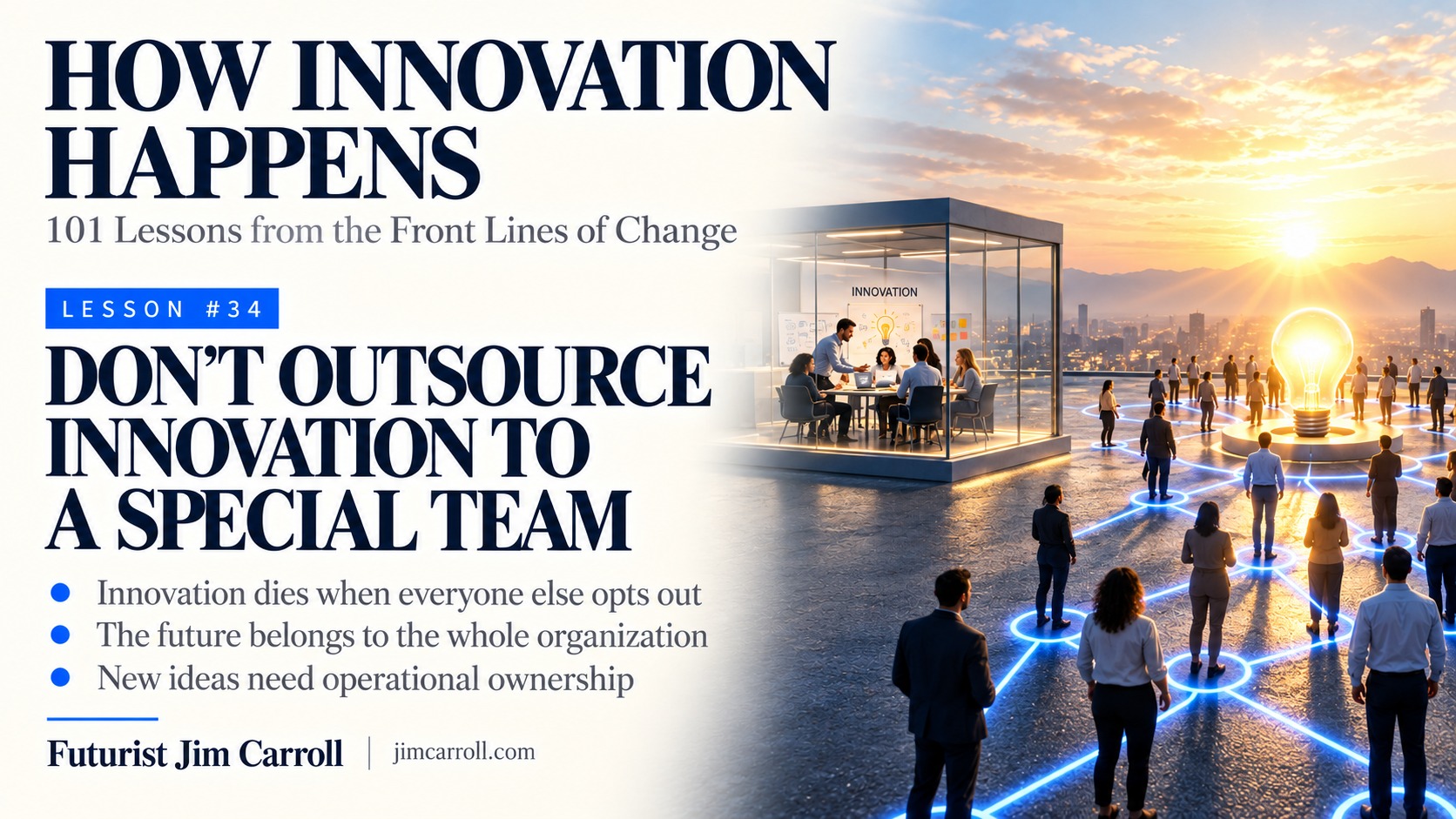
One of the fastest ways to weaken innovation is to declare that it belongs to the "innovation team."
That sounds progressive. In practice, it tells everyone else that innovation is somebody else's job.
Real innovation happens in customer service, finance, operations, sales, HR, technology and the front line. It includes running the business better, growing it and transforming it. A central team can coordinate and accelerate, but it cannot carry the responsibility alone.
Innovation should be a verb embedded in every role.
This is where culture either reinforces the future or quietly kills it. If you want to change the pattern, start with these three moves.
Action Items:
- Add an innovation responsibility to every function, not just R&D.
- Ask each team how it can run, grow and transform the business.
- Judge the central innovation team by how much capability it spreads, not how much it owns.
Explore the full How Innovation Happens series.
Real-World Examples
These researched examples show the lesson at work in the real world.
U.S. Veterans Health Administration: Frontline ideas travel across a national system
A healthcare system with hospitals and clinics across an entire country has an enormous reservoir of practical experience. The difficulty is that a solution discovered at one location can remain invisible elsewhere. A centralized innovation office may generate impressive presentations, yet miss everyday improvements that nurses, pharmacists, physicians and administrative teams create during the work itself.
The U.S. Veterans Health Administration established its Diffusion of Excellence program in 2015, with a process that identifies promising practices developed on the frontline and supports their adaptation by other facilities. Its materials describe providing training, tools and autonomy to innovators while making a curated marketplace of practices available across the national system.
The model does not pretend every local idea is ready for universal rollout. Promising practices need evidence, implementation support and adaptation for different conditions. The organization's playbook and marketplace are mechanisms for finding what works locally and helping others make it work responsibly. The published program history documents the approach rather than promising that every idea succeeds.
The surprising feature is what the central team is designed to do. It does not claim ownership of every new idea. It acts as a connector, making it easier for dispersed employees to surface, test and share what they learn. Innovation remains in the operational system rather than being trapped in a specialized department.
Why it matters: A central innovation group should amplify and spread frontline discovery rather than monopolize it.
Sources:
Virginia Mason: Every employee gets the authority to stop an unsafe procedure
At Virginia Mason Medical Center in Seattle, patient safety was once largely interpreted through professional status and traditional reporting lines. In a hospital, that can create a dangerous silence: a nurse or support worker may see a problem without feeling authorized to interrupt the person in charge. The organization decided that operational improvement could not remain the exclusive job of executives and specialists.
Beginning in 2002, Virginia Mason adapted aspects of the Toyota Production System to healthcare and created its Patient Safety Alert process. Any employee who encounters a situation likely to harm a patient can report the issue immediately and stop the relevant activity while it is addressed. Leaders committed to responding, investigating and protecting the people who raise alarms.
A peer-reviewed account records 6,112 alerts received through December 2006, including reports from nurses, managers, physicians and nonclinical workers. Virginia Mason has also documented a 2005 incident in which a nurse challenged a physician's unsafe conduct, then reported retaliation. Leadership supported the nurse rather than treating the doctor's seniority as a reason to dismiss her concern.
The case is about more than safety reporting. It redistributes responsibility for improvement to those closest to the work. Instead of telling every employee that innovation is somebody else's job, Virginia Mason built a mechanism in which anyone could interrupt the system when evidence demanded a better approach.
Why it matters: Give people closest to the work a practical way to challenge the process—and defend them when they use it.
Sources: