
I’ve been covering the link between future trends and innovation strategies for 30+ years. I went back through my blog posts, stretching to 2002, to dig out the nuggets of innovation insight I’ve discovered along the way. This series revisits those stories, tests what still holds up, and turns them into practical lessons for what comes next.
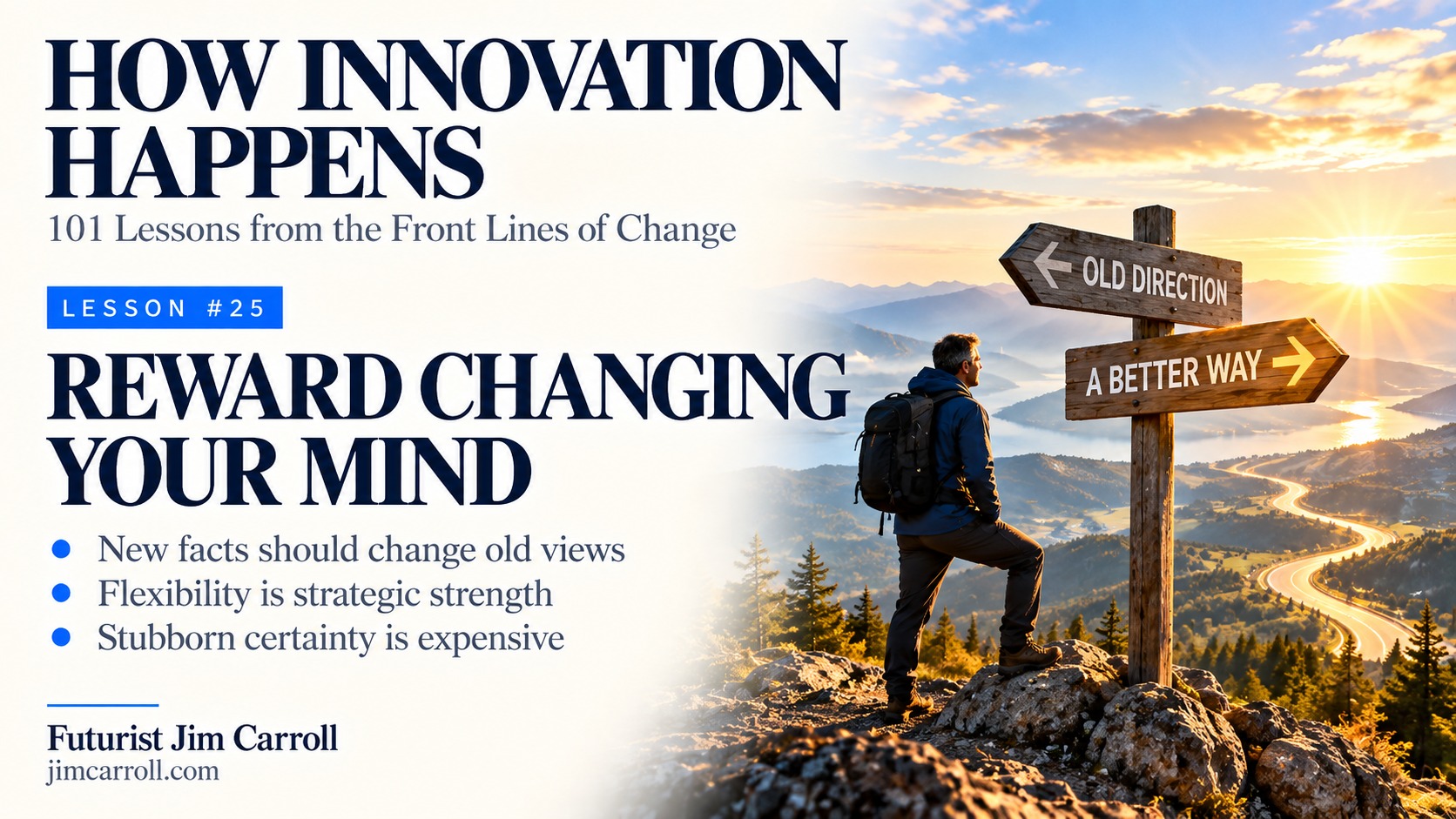
“It takes more courage to change your mind than to live with the consequences of being stubborn.”
I’ve come back to this idea repeatedly in my work because the mindset behind innovation usually changes before the results do. What people notice, question, challenge, and act on determines how ready they are for what comes next.
Organizations often say they value learning, then punish the most visible evidence of learning: changing your mind.
A leader who revises a position can be accused of inconsistency. A team that stops a project can be labelled a failure. So people defend old decisions long after the evidence has changed.
That is not conviction. It is sunk-cost theatre.
Innovation requires the freedom to say, “We believed this six months ago. We know more now.”
So what does that mean in practice? It means challenging the assumption, habit, or hesitation that is keeping you anchored to the present. Here are three places to start.
Action Items:
- Publicly acknowledge one decision you changed because the evidence changed.
- Reward teams that stop weak projects early.
- Ask in reviews, “What have we learned that should cause us to change our mind?”
Explore the full How Innovation Happens series.
Real-World Examples
These researched examples show the lesson at work in the real world.
Ford: Walking away from an electric SUV after the economics changed
Large vehicle-development programs create powerful pressure to continue. Engineers have spent years on the design, suppliers have prepared capacity, leaders have announced the plan, and canceling feels like admitting defeat. That makes an expensive product program a particularly hard place for an organization to say that new evidence has changed its mind.
Ford had planned a three-row electric SUV, but reported lower-than-expected electric-vehicle adoption and near-term pricing pressure. In 2024 it canceled the program. Its SEC filing recorded $1.2 billion in expenses related to the cancellation and estimated approximately $700 million in further costs or cash outflows, most expected in the first half of 2025.
The decision did not demonstrate that electrification was a mistake. It demonstrated that a particular product plan and its economics no longer looked like the right answer. Ford continued pursuing electrification while revising its timing and investments. That distinction is essential: a changed tactic need not mean abandoning the long-term direction.
The leadership question is whether a company rewards those who surface inconvenient demand and cost information before the launch, or expects them to defend the public plan. Stopping an expensive project can look inconsistent. Continuing a weak one merely to avoid embarrassment may be far worse.
Why it matters: Make it safe to revise a plan when the evidence changes, particularly after money and reputation are committed.
Sources:
CERN’s faster-than-light neutrinos: Changing a conclusion in public
In 2011, the OPERA experiment reported an extraordinary measurement: neutrinos traveling from CERN to Italy appeared to arrive slightly sooner than light would have. Because that would challenge a central assumption of modern physics, the researchers did not simply declare the laws of nature overturned. They exposed the anomaly to outside scrutiny.
Other experiments checked the finding while OPERA investigated its timing system. A faulty component in the fiber-optic timing chain ultimately helped explain the anomaly. By June 2012, CERN reported that four experiments had results consistent with neutrinos respecting the speed of light.
In scientific work, changing a conclusion after discovering an instrument problem is not a public-relations trick. It is a normal, necessary response to evidence. The value of the episode lies partly in how visible that process became: a spectacular claim, rigorous challenges, competing measurements and a revised answer.
Business leaders often say they want evidence-driven decisions, but treat changed positions as signs of weakness. This case suggests a better standard. What matters is not whether the first interpretation survives. It is whether the process can identify error before the organization commits itself permanently to a false belief.
Why it matters: An organization demonstrates intellectual strength when it can explain exactly why it changed its mind.
Sources:
—



GET IN TOUCH
Jim's Facebook page
You'll find Jim's latest videos on Youtube
Mastodon. What's on Jim's mind? Check his feed!
LinkedIn - reach out to Jim for a professional connection!
Flickr! Get inspired! A massive archive of all of Jim's daily inspirational quotes!
Instagram - the home for Jim's motivational mind!