Your size is no excuse for being slow.
There's a rather fascinating contradiction at the heart of many large organizations.
They have extraordinary knowledge, talented people, sophisticated systems, extensive resources and decades of experience. They have everything they need to innovate.

Speaking to leaders at MacKay CEO Forums. The challenge for established organizations is turning knowledge and resources into action.
Except, sometimes, the ability to move.
I've been exploring this dilemma in my keynotes for decades, including a leadership session for DuPont, where the challenge was particularly interesting: how does an organization with an extraordinary history of scientific discovery and innovation operate with the urgency of a startup?
It was a question worth asking then. And as we head into 2027, it's becoming even more important.
Because the future doesn't care how big you are. It cares how quickly you can respond.
Why do big organizations struggle to move quickly?
When I spoke to DuPont's leadership team, one of my central themes was that innovation couldn't simply remain an activity within research and development. It had to become an organization-wide expectation, influencing leadership, decision-making, organizational culture and the ability to turn scientific breakthroughs into commercial opportunities.
The original challenge was straightforward: large organizations possess scale, expertise and infrastructure. Startups possess urgency. Successful organizations increasingly need both.
That's a theme I've explored in countless other leadership sessions and in books such as Ready, Set, Done: How to Innovate When Faster Is the New Fast and Think Big, Start Small, Scale Fast.
And here's what I've learned.
Organizations rarely become slow because their people lack ideas. They become slow because their processes, assumptions and structures make it difficult to act on those ideas.
A proposal moves from committee to committee. A promising experiment becomes a six-month planning exercise. A decision waits for the next budget cycle. Eventually, someone schedules another meeting to discuss why nothing is happening.
I've often described this as organizational inertia: the tendency to protect the systems that made an organization successful, even when those systems are beginning to limit its future.
And there's an uncomfortable possibility hiding inside all this.
Your organization might not have an innovation problem. It might have a permission problem.
What does startup speed actually mean?
It doesn't mean abandoning quality, bypassing regulations or taking reckless risks. A major manufacturer, healthcare organization, utility or financial institution can't simply ignore the responsibilities that come with its business.
Nor does it mean telling exhausted employees to work harder and faster.
Startup speed is about reducing the time between recognizing an opportunity and learning something useful about it.
Can you investigate a new idea without establishing an enormous project? Can a team test a reasonable hypothesis without spending months securing approval? Can you learn from a customer, supplier or research partner before committing significant resources?
Think about the industrial organizations I've worked with over the years.
At Chemours, I explored how advances in materials science were creating new opportunities across established industries. At Schneider Electric, the discussion involved connected operations, data and the transformation of industrial processes.
Different technologies, different business challenges, but an important common question: how does an established organization develop the capacity to respond while the world around it keeps changing?
The answer isn't necessarily a bigger innovation budget.
Sometimes it's removing the obstacles that prevent people from acting on what they already know.

On stage at the Chemours Plunkett Awards, exploring innovation and the changing industrial future.
Why does startup speed matter in 2027?
Because the time available to respond to emerging opportunities keeps shrinking.
Artificial intelligence is accelerating experimentation and some forms of product development. New digital tools make it easier to explore ideas without building everything from scratch. Research, knowledge and expertise increasingly flow across organizational boundaries.
But the same technologies that make experimentation faster also create new pressures on established organizations.
A smaller competitor might be able to test an idea before your leadership team has finished debating whether it's worth investigating.
Of course, not every emerging technology is ready for commercial deployment. Many never will be. And in an environment of rising costs, scarce talent, uncertain markets and limited capital, leaders are right to be careful.
But caution doesn't have to mean inactivity.
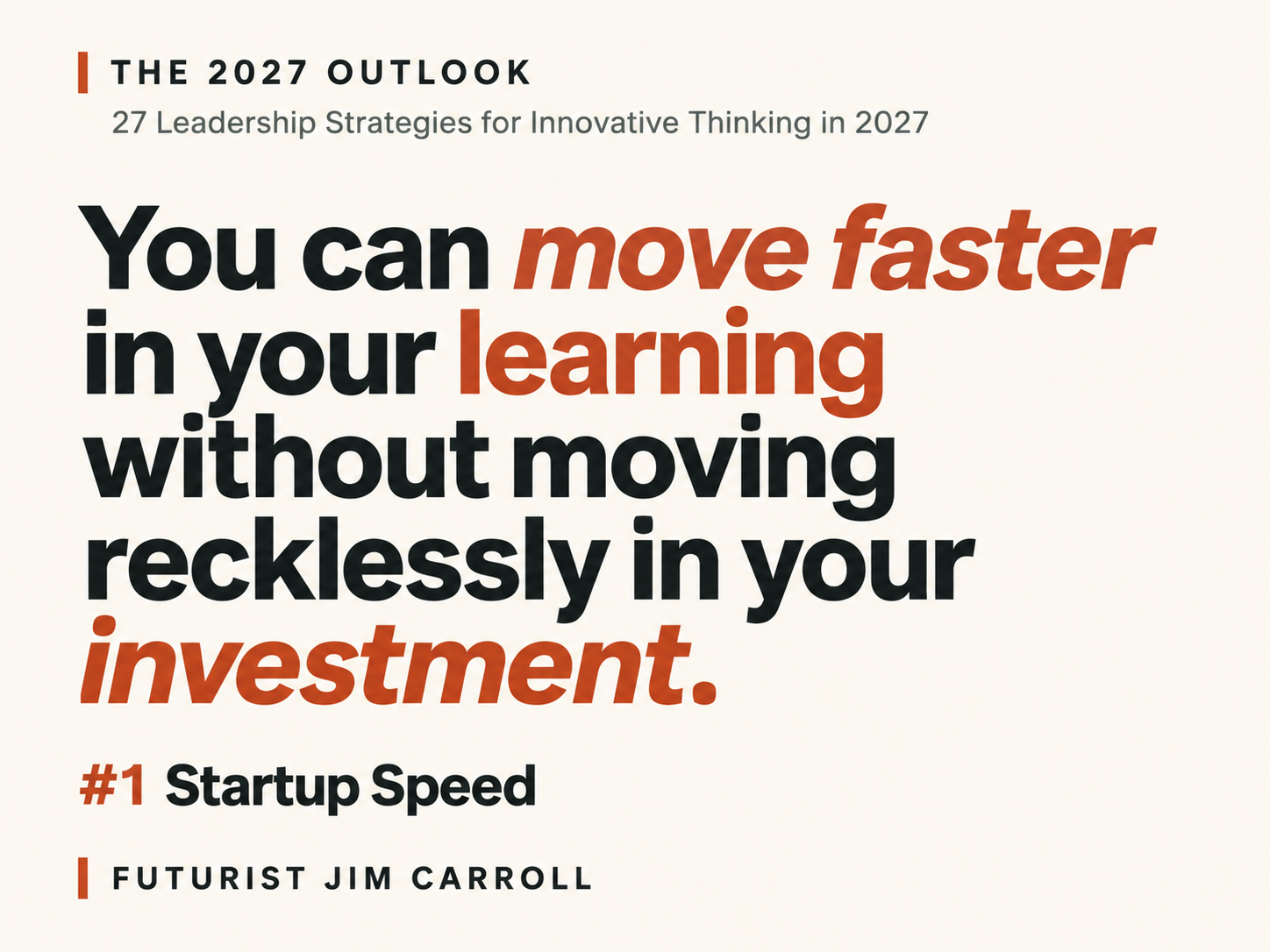
You can move faster in your learning without moving recklessly in your investment.
That's the distinction I believe matters most for leadership in 2027.
What should you do now — and into 2027?
I've long encouraged organizations to Think Big, Start Small, Scale Fast. The idea is particularly relevant when leaders need to improve their ability to respond but can't afford a massive transformation initiative.
Here are five practical ways to begin.
1. Measure how long it takes to get an idea moving.
Choose a recently proposed improvement that matters to your customers or operations. How many days passed between identifying the opportunity and receiving permission to test it? How many approvals were involved? Where did the idea get stuck?
You can't improve organizational speed if you don't know where time is being lost.
2. Find one decision that doesn't need so many approvals.
Identify a low-risk decision that routinely travels through multiple management levels. Could a qualified team make that decision within clearly defined financial, safety and operational limits?
Don't remove necessary oversight. Remove unnecessary waiting.
3. Give a small team permission to learn.
Choose a business problem and give a few people a modest budget, a short timeframe and a clear objective. Ask them to test an approach, speak to customers or suppliers, investigate an emerging tool and return with evidence.
The result doesn't have to be a successful new product. It needs to be useful knowledge that supports a better decision.
4. Look outside your organization for ideas that are already moving.
Find the startups, researchers, technology developers and industry innovators working on your most pressing challenges. Talk to them. Attend demonstrations. Join their professional communities.
You might discover that someone else has already solved a problem you've spent months discussing internally.
5. Measure the time from learning to action.
At your next leadership meeting, don't simply ask how many innovation projects are underway. Ask which assumptions were tested, what was learned, what decision followed and how long that decision took.
An innovation initiative that produces another presentation isn't necessarily progress. One that helps you make a better decision might be.
How do you know you're becoming faster?
Here's a simple test.
Take one worthwhile idea and compare what happens to it now with what happened to a similar idea previously.
Did it take fewer days to authorize an experiment? Could the team obtain feedback sooner? Were unnecessary approval stages eliminated? Did you decide to proceed—or stop—with better evidence?
That's real progress.
And if the experiment reveals that an idea isn't viable, you've still gained something valuable: you discovered that before committing significant resources.
Speed isn't about doing everything quickly. It's about learning quickly enough to know what deserves your attention, and acting decisively when the evidence supports it.
The leadership lesson for 2027
I've watched organizations spend extraordinary amounts of time discussing innovation while struggling to change the way they actually work.
And I've watched the world continue to move while those discussions take place.
That's why the challenge I explored at DuPont remains so relevant. The advantages of size, experience and resources are enormous, but they become much less valuable when an organization can't respond to new opportunities.
You don't need to turn your organization into a startup.
You need to bring some startup urgency into the way it learns, decides and acts.
Because in 2027, your greatest competitive disadvantage might not be the ideas you lack. It might be the time you lose trying to act on the ideas you already have.
It's what happens to your industry. And what you do next.
— Futurist Jim Carroll