I've been covering the link between future trends and innovation strategies for 30+ years. I went back through my blog posts, stretching to 2002, to dig out the nuggets of innovation insight I've discovered along the way. This series revisits those stories, tests what still holds up, and turns them into practical lessons for what comes next.
I've come back to this idea repeatedly in my work because the mindset behind innovation usually changes before the results do. What people notice, question, challenge, and act on determines how ready they are for what comes next.
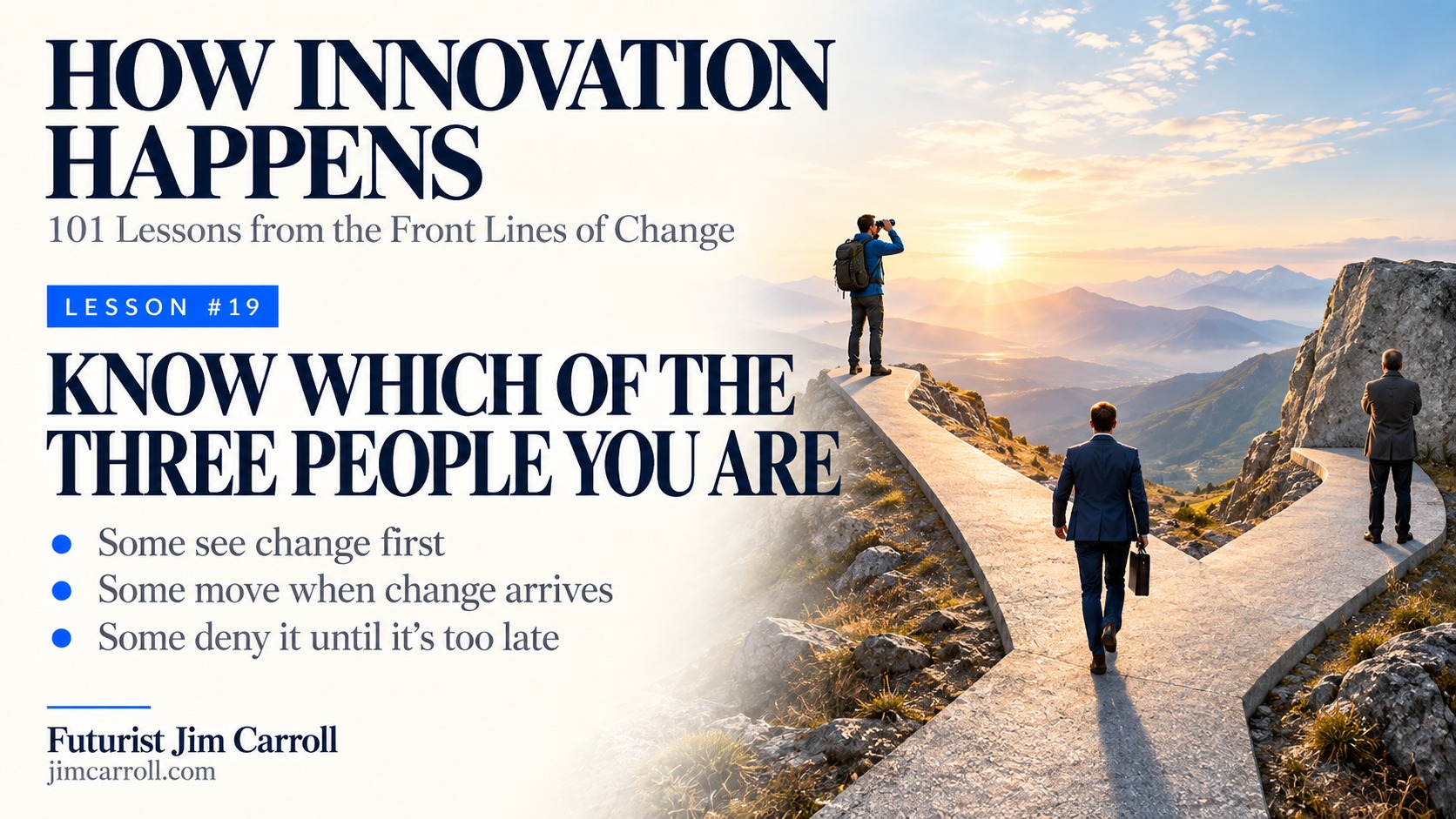
In periods of disruption, I often see three kinds of people.
There are those who see change early and act. There are those who notice change only once it becomes obvious and then scramble to catch up. And there are those who eventually look around and say, in effect, "Whoa, what happened?"
The difference is rarely intelligence. It is attention, curiosity and willingness to challenge assumptions.
Your organization contains all three types. The danger is allowing the third group to control the pace of the first.
So what does that mean in practice? It means challenging the assumption, habit, or hesitation that is keeping you anchored to the present. Here are three places to start.
Action Items:
- Ask your team which category best describes your organization today.
- Identify who consistently spots change early and give them more voice.
- Track one trend now so you do not have to explain later how it surprised you.
Explore the full How Innovation Happens series.
Real-World Examples
These researched examples show the lesson at work in the real world.
Svalbard Seed Vault: Preparing for a disaster before anyone knew its name
In February 2008, a global seed vault opened inside a mountain on Norway's Svalbard archipelago. It was built to safeguard backup samples from seed banks around the world against events that might be far away, unlikely or impossible to predict: war, infrastructure failure, environmental disruption and loss of crop genetic diversity.
It was easy to describe such a project as excessively cautious while everyday food systems appeared to function. The need became concrete when war in Syria made the International Center for Agricultural Research in the Dry Areas' genebank near Aleppo inaccessible. ICARDA had placed duplicates of its collections in Svalbard.
Beginning in 2015, it withdrew seeds to reconstruct research collections in Lebanon and Morocco and later returned regenerated samples to the vault. Crop Trust and scientific accounts document the recovery. The seed vault was not a forecast of a particular war; it was a deliberate choice to prepare for classes of disruption before their precise form was known.
Nor did the vault replace the expertise and effort needed to regrow the collection. It preserved an option that would otherwise have been lost. This is what it looks like when someone understands that the future will eventually test today's assumptions.
Why it matters: The people who recognize a future vulnerability early may appear unnecessarily cautious right up to the moment when their preparation becomes indispensable.
Sources:
Bosch eBike Systems: Seeing an electric mobility market before it was obvious
Around 2009, engineers at Bosch saw that advances in small motors, electronics and battery energy density were making a different kind of bicycle possible. Electrically assisted bikes existed, but the market for integrated, high-quality drive systems had not yet reached the scale now familiar in European cities.
Bosch developed eBike Systems as an internal start-up, drawing on capabilities from power tools, sensors, control technology and automotive engineering. In a retrospective interview published by Bosch, engineers described early prototypes and how, by the middle of 2009, they had developed demonstration systems for fourteen bicycle-industry customers.
At the Eurobike trade fair in 2010, about fifty preproduction bikes carried Bosch drives; serial production followed in 2011. The decision was not a vague declaration that mobility would someday be electrified. Bosch created a distinct team, tested technology with actual bicycle makers and chose a role as a supplier of integrated systems.
In later years the business expanded across categories and geographic markets. It is an example of an organization positioning itself before a transition was universally accepted rather than waiting for a large, obvious market to assign it a place.
Why it matters: Recognizing a trend early matters only if you convert that recognition into a capability, customer relationships and practical experiments before the market becomes crowded.
Sources: