I've been covering the link between future trends and innovation strategies for 30+ years. I went back through my blog posts, stretching to 2002, to dig out the nuggets of innovation insight I've discovered along the way. This series revisits those stories, tests what still holds up, and turns them into practical lessons for what comes next.
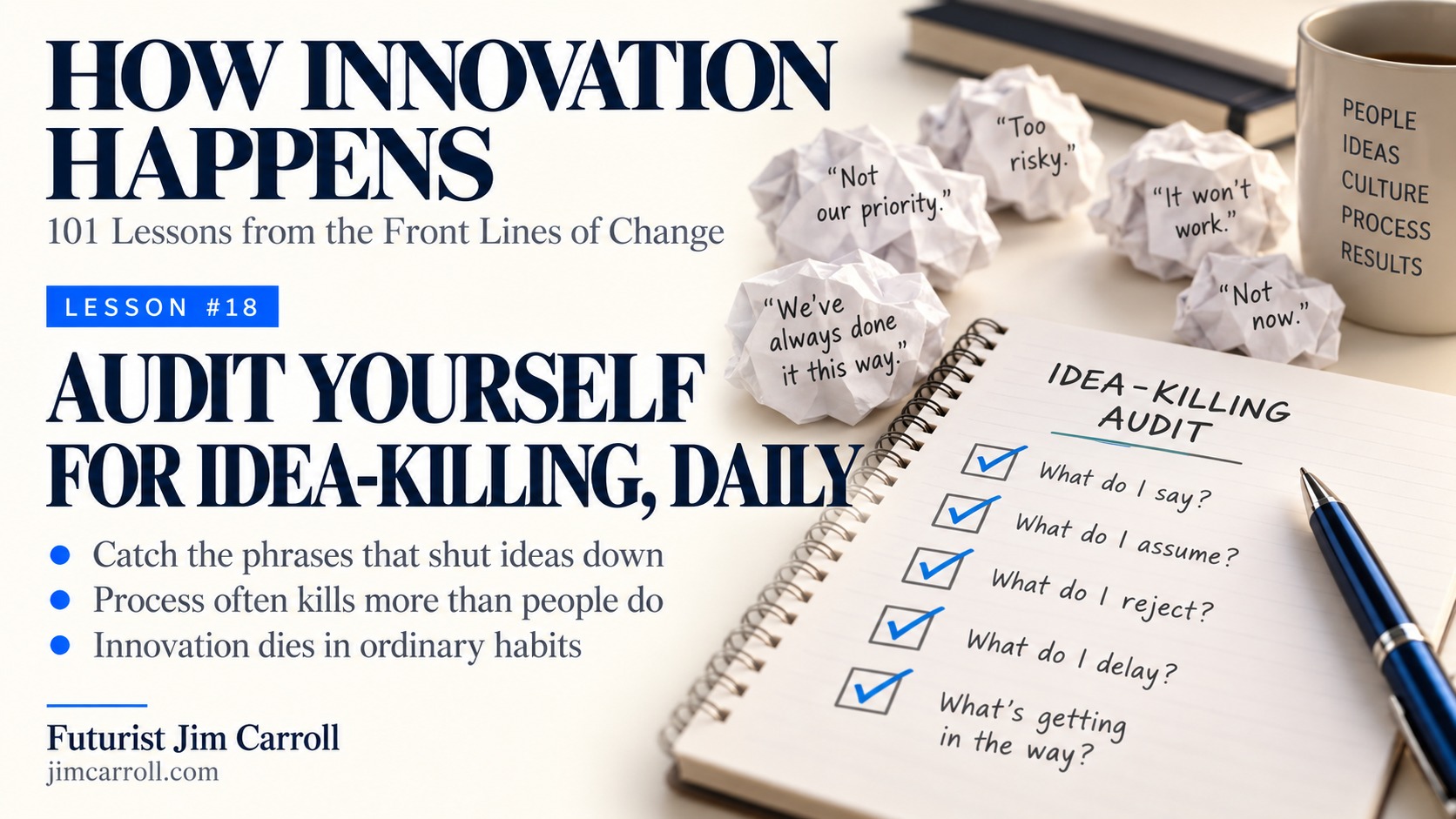
"What am I going to do today to kill new ideas?"
I've come back to this idea repeatedly in my work because the mindset behind innovation usually changes before the results do. What people notice, question, challenge, and act on determines how ready they are for what comes next.
It is an intentionally uncomfortable question because idea-killing is usually accidental.
Leaders do it when they interrupt too quickly, demand a business case too early, make a joke at the wrong moment, or ask for certainty before exploration has even begun. Over time, teams learn the pattern. They stop bringing half-formed ideas because they know what will happen to them.
That is how a leader can sincerely ask for innovation while training everyone around them not to innovate.
The most important innovation audit may be the one you run on your own behaviour.
So what does that mean in practice? It means challenging the assumption, habit, or hesitation that is keeping you anchored to the present. Here are three places to start.
Action Items:
- Notice your first reaction the next time someone brings you an unfinished idea.
- Replace "why won't this work?" with "what would have to be true?"
- Ask your team what you do that makes them less likely to suggest something new.
Explore the full How Innovation Happens series.
Real-World Examples
These researched examples show the lesson at work in the real world.
Adobe Kickbox: Giving people seed money before permission
A company can say it welcomes employee innovation while making even the smallest experiment depend on a chain of managerial approvals. Adobe approached that contradiction directly with its Kickbox program, introduced internally in 2013. Employees who completed a brief workshop received a red box containing a guided experimentation process and a prepaid card worth $1,000 to test an idea.
Mark Randall, the program's creator, described participants as the chief executives of their own early-stage projects. They could spend a small, controlled amount of company money to explore customer needs, test assumptions and gather evidence before asking for larger support.
Adobe reported that more than a thousand employees had participated by 2014. The program did not eliminate oversight for higher-risk work or guarantee that every idea deserved a product launch; it simply moved the first inexpensive act of learning ahead of the conventional approval bottleneck.
A later account by Adobe's legal team described how legal safeguards were designed to permit rapid experiments without ignoring privacy and intellectual property concerns. That is a particularly useful distinction: the organization did not need to abolish guardrails. It had to stop treating every $1,000 experiment like a multimillion-dollar commitment.
Why it matters: Audit the first five minutes of an idea's life. If approval costs more than the experiment, your process is designed to kill learning.
Sources:
W. L. Gore: Dabble time leads from heart implants to guitar strings
At materials company W. L. Gore, an engineer working on medical implants explored a problem that had little to do with the product line he was paid to develop: how to make guitar strings that retained their tone longer. The company had a culture of experimentation and what was described as dabble time, with roughly ten percent of employees' time expected to go to new ideas or initiatives.
Dave Myers's experimentation with polymer coatings ultimately helped produce Elixir guitar strings, a commercially significant move into a different category. Deloitte documented the connection in a case study of Gore's organizational model. This example is not about granting everyone unlimited freedom or pretending innovation has no financial discipline.
Gore's privately held structure and long-term investment approach gave promising ideas more room than a tightly scheduled, quarterly performance process might allow. The striking point is the distance between the engineer's assigned field and the eventual product.
A conventional manager could easily have asked why a medical-device engineer was spending time thinking about music. The innovation emerged in the space where a talented employee could follow an unexpected possibility far enough to learn whether it was real.
Why it matters: An organization should question how often it demands that early ideas justify themselves against the job description and budget category of the person who noticed them.
Sources: